A female patient presents with diffuse alopecia. She suffered from typhoid fever 4 months back. What is the most probable diagnosis?
What is the condition characterized by the sudden onset of hair turning white overnight?
Hirsutism can be caused by all of the following, EXCEPT:
Lichen planus is associated with which of the following nail findings?
Cicatricial alopecia is seen in all of the following conditions EXCEPT?
The telogen phase of hair growth typically lasts for how long?
Which of the following statements is NOT true regarding the hair cycle?
The time period that elapses between physical or emotional stress and hair loss is approximately:
Which of the following causes scarring type of alopecia?
Coarse pitting of nails is seen in?
Explanation: ### Explanation **Correct Answer: B. Telogen Effluvium** **Why it is correct:** Telogen effluvium (TE) is a form of non-scarring, diffuse hair loss that occurs when a physiological or emotional stressor prematurely pushes a large number of growing (anagen) hairs into the resting (telogen) phase. * **The Latency Period:** A classic clinical feature of TE is that hair shedding typically occurs **2 to 4 months after the inciting event**. * **The Trigger:** Common triggers include high-grade fever (e.g., Typhoid, Malaria), major surgery, pregnancy (post-partum), and severe nutritional deficiencies. In this case, the history of typhoid fever 4 months prior is the definitive diagnostic clue. **Why incorrect options are wrong:** * **Androgenetic alopecia:** This is a patterned, progressive thinning (vertex and frontal scalp) rather than sudden diffuse shedding, and it is driven by genetics and androgens, not acute systemic illness. * **Anagen effluvium:** This involves the shedding of hairs in the growth phase, usually occurring **1 to 2 weeks** after a trigger. It is most commonly associated with chemotherapy or radiation, not febrile illnesses. * **Alopecia areata:** This typically presents as well-demarcated, **circumscribed patches** of hair loss with "exclamation mark hairs," rather than diffuse thinning across the entire scalp. **NEET-PG High-Yield Pearls:** * **Hair Cycle:** Normal scalp has ~85-90% anagen hairs and ~10-15% telogen hairs. In TE, the telogen count exceeds 20-25%. * **Diagnosis:** TE is often diagnosed via a **Hair Pull Test** (positive if >10% of hairs are pulled) or a trichogram showing increased telogen bulbs (club hairs). * **Prognosis:** Acute TE is self-limiting; hair density usually returns to normal within 6-9 months once the trigger is removed.
Explanation: **Explanation:** The phenomenon of hair turning white "overnight" (historically termed *Canities subita*) is a classic clinical presentation of **Alopecia areata**. **Why Alopecia Areata is correct:** Alopecia areata is an autoimmune condition where T-cells attack the hair follicles. It has a specific predilection for **pigmented (black/brown) hairs**. In a diffuse variant of the disease, an acute autoimmune strike causes the sudden shedding of all pigmented hairs, leaving only the pre-existing grey or white hairs behind. This creates the dramatic clinical illusion that the patient’s hair turned white overnight. **Why the other options are incorrect:** * **Vitiligo:** This is a primary demyelinating disorder of the skin. While it can cause localized white hair (**Poliosis**), it is a gradual process and does not involve sudden hair loss. * **Anagen effluvium:** This refers to massive hair shedding (usually due to chemotherapy). It affects all hairs regardless of color and does not specifically result in a "white hair" appearance. * **Albinism:** This is a congenital genetic disorder characterized by a global lack of melanin from birth; it is not an acquired or sudden condition. **High-Yield NEET-PG Pearls:** * **Pathognomonic Sign:** "Exclamation mark" hairs (short, broken hairs thicker at the top than the base) seen at the periphery of patches. * **Nail Changes:** Fine "geometric pitting" is the most common nail finding in Alopecia areata. * **Histology:** Characterized by a **"Swarm of Bees"** appearance (peribulbar lymphocytic infiltrate). * **Treatment:** Intralesional corticosteroids (Triamcinolone) are the first-line treatment for localized patches.
Explanation: **Explanation:** **Hirsutism** is defined as the presence of terminal hair in females in a male-pattern distribution (androgen-dependent areas). The correct answer is **Spironolactone** because it is a treatment for hirsutism, not a cause. 1. **Why Spironolactone is correct:** Spironolactone is a potassium-sparing diuretic that acts as a potent **androgen receptor antagonist** and a weak inhibitor of androgen synthesis (inhibiting 17α-hydroxylase). Because it blocks the action of dihydrotestosterone (DHT) on hair follicles, it is a first-line pharmacological treatment for hirsutism. 2. **Why other options are incorrect:** * **Steroidogenic enzyme defects:** Conditions like **Congenital Adrenal Hyperplasia (CAH)**, specifically 21-hydroxylase deficiency, lead to an accumulation of androgen precursors, causing virilization and hirsutism. * **Minoxidil:** This is a potent vasodilator. While it is used to treat alopecia, its systemic absorption or topical use can cause **hypertrichosis** (generalized excessive hair growth), which is often clinically grouped with hirsutism in exams, though technically distinct. * **Acromegaly:** Excess Growth Hormone (GH) and IGF-1 stimulate hair follicles both directly and by increasing local androgen sensitivity, leading to hirsutism. **High-Yield Clinical Pearls for NEET-PG:** * **Ferriman-Gallwey Score:** Used to quantify hirsutism; a score of **≥8** is generally considered diagnostic. * **Hirsutism vs. Hypertrichosis:** Hirsutism is androgen-dependent (face, chest, back); Hypertrichosis is androgen-independent (generalized, often drug-induced by Phenytoin, Cyclosporine, or Minoxidil). * **Most common cause:** Polycystic Ovary Syndrome (PCOS) is the most common cause of hirsutism. * **Rapid onset:** Sudden, severe hirsutism with virilization suggests an **androgen-secreting tumor** (adrenal or ovarian).
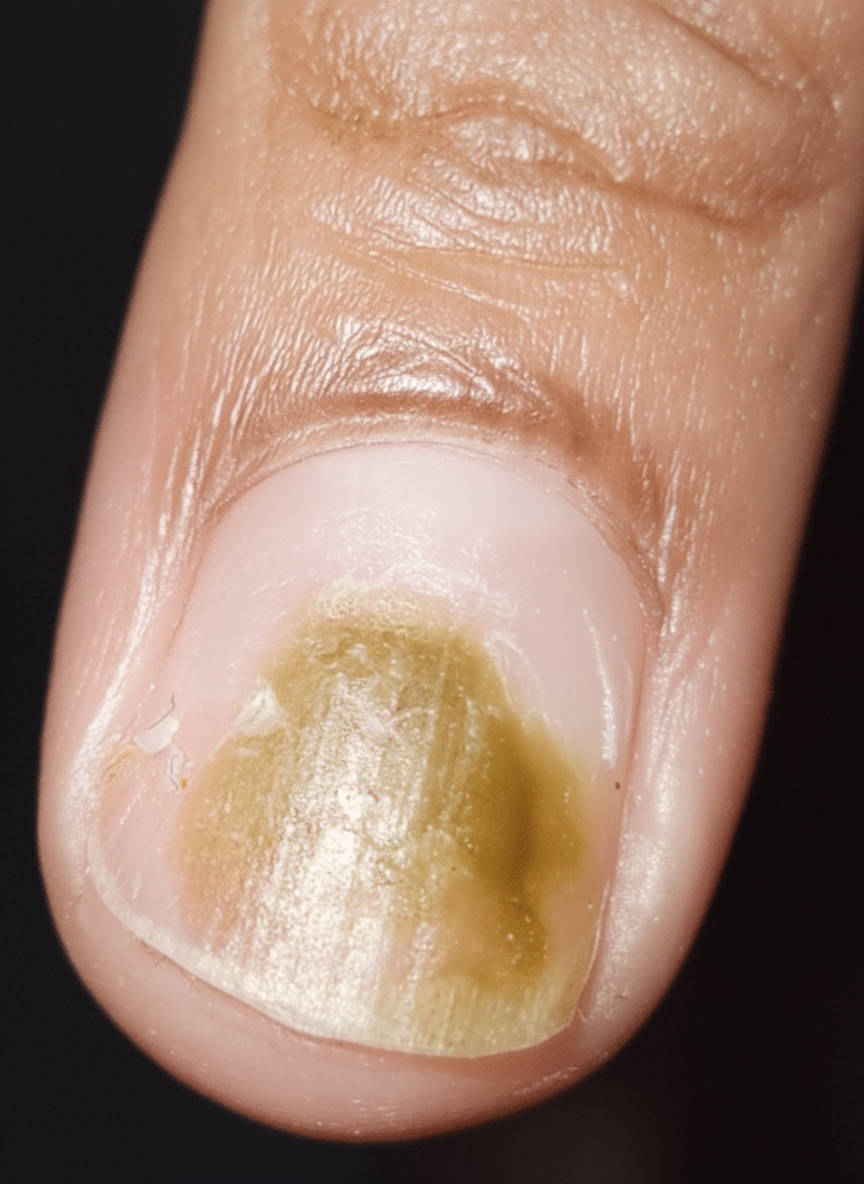
Explanation: **Explanation:** **Lichen Planus (LP)** is a chronic inflammatory condition that affects the skin, mucous membranes, hair, and nails. Nail involvement occurs in approximately 10% of cases. **Why Nail Pterygium is Correct:** The hallmark of nail Lichen Planus is the destruction of the nail matrix. When the proximal nail fold fuses with the nail bed due to scarring and inflammation of the matrix, it forms a V-shaped extension of skin over the nail plate known as **Pterygium (Dorsal Pterygium)**. This is a classic, high-yield sign of LP. Other common findings include longitudinal ridging, thinning of the nail plate, and "onychorrhexis" (brittle nails). **Analysis of Incorrect Options:** * **A. Koilonychia:** This refers to spoon-shaped nails, most commonly associated with **Iron Deficiency Anemia**, Plummer-Vinson syndrome, or Raynaud’s disease. * **B. Tinea versicolor:** This is a superficial fungal infection of the skin caused by *Malassezia furfur*. It does not typically involve the nails (nail fungal infections are termed Onychomycosis). * **C. Psoriasis:** While psoriasis also causes nail changes, its classic findings include **pitting** (deep and irregular), oil spots (salmon patches), subungual hyperkeratosis, and distal onycholysis. **High-Yield Clinical Pearls for NEET-PG:** * **Dorsal Pterygium** = Lichen Planus; **Ventral Pterygium** (Hyponychium attached to the nail plate) = Scleroderma or SLE. * **Twenty-nail dystrophy (Trachyonychia):** Can be a manifestation of LP, Psoriasis, or Alopecia Areata, where all 20 nails appear "sandpaper-like." * **Wickham Striae:** Reticulate white lines seen in oral or cutaneous LP. * **Civatte bodies:** Histopathological finding in LP representing apoptotic keratinocytes.
Explanation: **Explanation:** The core concept in this question is the distinction between **Cicatricial (Scarring)** and **Non-cicatricial (Non-scarring)** alopecia. Cicatricial alopecia involves permanent destruction of the hair follicle and its replacement by fibrous tissue, leading to irreversible hair loss and loss of follicular ostia. **Why Tinea Capitis is the correct answer:** Tinea capitis is a fungal infection of the scalp caused by dermatophytes. It is typically a **non-cicatricial** alopecia because the fungus usually invades the hair shaft or the keratinized layer of the follicle without destroying the stem cells in the bulge area. However, a severe inflammatory variant called **Kerion** can occasionally lead to scarring, but in the context of standard NEET-PG questions, Tinea capitis is classified as non-scarring. **Analysis of Incorrect Options:** * **Lichen Planus (Lichen Planopilaris):** This is a classic cause of primary cicatricial alopecia. It involves a lymphocytic inflammation that targets the follicular bulge, leading to permanent scarring. * **Discoid Lupus Erythematosus (DLE):** DLE is one of the most common causes of scarring alopecia. It presents with well-demarcated erythematous plaques, follicular plugging, and eventual atrophy. * **Scleroderma:** Specifically localized scleroderma (Morphea) or "En coup de sabre," causes linear scarring alopecia due to the excessive deposition of collagen which obliterates the hair follicles. **High-Yield Clinical Pearls for NEET-PG:** * **Non-Scarring Alopecia Mnemonic:** "TAP" (Tinea capitis, Alopecia areata, Psoriasis/Pityriasis capitis) and Telogen effluvium. * **Scarring Alopecia Mnemonic:** "LSD" (Lichen planopilaris, Scleroderma, DLE) and Pseudopelade of Brocq. * **Clinical Sign:** The absence of **follicular ostia** (pores) is the hallmark of cicatricial alopecia on physical examination.
Explanation: The hair growth cycle consists of three distinct phases: **Anagen** (growth), **Catagen** (involution), and **Telogen** (resting). **Explanation of the Correct Answer:** The **Telogen phase** is the resting stage of the hair follicle. In a healthy scalp, approximately 10–15% of hairs are in this phase at any given time. The duration of the telogen phase is consistently cited as approximately **3 months or 100 days**. At the end of this period, the "club hair" is shed, and a new anagen hair begins to grow in its place. **Analysis of Incorrect Options:** * **A (1 day):** No phase of the hair cycle is this brief. * **B (10 days):** This is the approximate duration of the **Catagen phase** (the brief transitional phase where the follicle shrinks and hair growth stops). * **D (1000 days):** This represents the approximate duration of the **Anagen phase** (ranging from 2 to 6 years, or roughly 1000+ days). **NEET-PG High-Yield Clinical Pearls:** * **The "Rule of 3s":** A simple mnemonic to remember the durations is: * Anagen: 3 years (1000 days) * Catagen: 3 weeks (21 days, though often simplified to 10–14 days) * Telogen: 3 months (100 days) * **Telogen Effluvium:** This is a common cause of diffuse hair loss triggered by stress, pregnancy, or illness. It occurs when a physiological stressor pushes a large percentage of hairs prematurely into the telogen phase, leading to noticeable shedding roughly **3 months after the inciting event**. * **Normal Shedding:** Losing 50–100 hairs per day is considered physiological.
Explanation: **Explanation:** The hair cycle consists of three main phases: **Anagen** (growth), **Catagen** (involution), and **Telogen** (resting). Understanding the physiological distribution of these phases is crucial for diagnosing hair loss disorders. **1. Why Option B is the Correct Answer (The False Statement):** In a healthy human scalp, approximately **85% to 90%** of hair follicles are in the **Anagen phase** at any given time. Stating that only 40% are in Anagen is incorrect. If Anagen percentages drop significantly (e.g., to 40%), it would indicate severe pathological hair loss, such as Anagen Effluvium or advanced Telogen Effluvium. **2. Analysis of Other Options:** * **Option A:** The **Telogen phase** typically lasts for about **3 months (100 days)**. During this time, the hair remains in the follicle until it is pushed out by a new anagen hair. This is why a stressful event often leads to hair shedding (Telogen Effluvium) exactly 3 months later. * **Option C:** The **Catagen phase** is indeed an **involutionary period**. It is the shortest phase (lasting 2–3 weeks) where the hair follicle shrivels, the lower part is destroyed, and the hair bulb becomes "club-shaped." * **Option D:** **Telogen** is correctly defined as the **resting phase** that occurs after catagen and before the follicle re-enters the anagen phase to start a new cycle. **NEET-PG High-Yield Clinical Pearls:** * **Anagen:** Lasts 2–6 years. Determines the maximum length of hair. * **Telogen Effluvium:** A shift of anagen hairs into telogen, leading to diffuse shedding (usually >20% follicles in telogen). * **Exogen:** A newly described fourth phase representing the active shedding of the hair shaft. * **Normal Hair Loss:** Shedding 50–100 hairs per day is considered physiological.
Explanation: ### Explanation The question describes the characteristic timeline of **Telogen Effluvium (TE)**, a common form of non-scarring alopecia. **1. Why 3 Months is Correct:** The underlying medical concept is the **human hair cycle**. Under normal conditions, approximately 90% of scalp hair is in the Anagen (growth) phase and 10% is in the Telogen (resting) phase. When a significant physiological or emotional stressor occurs (e.g., high-grade fever like Typhoid, major surgery, childbirth, or severe psychological trauma), it triggers a large proportion of Anagen hairs to prematurely enter the Telogen phase. The Telogen phase typically lasts for **about 100 days (3 months)**. During this period, the hair remains in the follicle but is no longer growing. Once the new Anagen hair begins to grow underneath, it pushes the old Telogen hair out, resulting in the sudden, diffuse shedding observed by the patient. Therefore, the lag time between the inciting event and the hair loss is approximately 3 months. **2. Why Other Options are Incorrect:** * **21 days / 30 days:** These periods are too short. While the Catagen (transition) phase lasts about 2–3 weeks, the subsequent Telogen phase must be completed before the hair is shed. * **6 months:** This is generally the timeline for **Chronic Telogen Effluvium** or the point where hair regrowth becomes noticeable, rather than the initial onset of shedding. **3. NEET-PG High-Yield Pearls:** * **Pull Test:** Positive in TE (extracting >6 hairs or >10% of hairs pulled). * **Hair Morphology:** TE shows "Club hairs" (bulbar, non-pigmented roots). * **Anagen Effluvium:** Occurs much faster (1–2 weeks) after chemotherapy because it affects actively dividing cells. * **Prognosis:** Acute TE is self-limiting; hair density usually returns to normal within 6–12 months after the stressor is removed.
Explanation: ### Explanation Alopecia is broadly classified into **Non-scarring (Non-cicatricial)** and **Scarring (Cicatricial)** types. The fundamental difference lies in the preservation of the hair follicle; in scarring alopecia, the follicle is destroyed and replaced by fibrous tissue, leading to permanent hair loss. **Why Option C is Correct:** While most cases of **Tinea capitis** (fungal infection of the scalp) are non-scarring (e.g., Grey patch or Black dot types), the inflammatory variant known as **Kerion** (a painful, boggy mass) and **Favus** (caused by *T. schoenleinii*) lead to intense inflammation. This inflammatory process destroys the hair follicles, resulting in permanent **scarring alopecia**. **Analysis of Incorrect Options:** * **A. Androgenic Alopecia:** This is a non-scarring alopecia characterized by follicular miniaturization under the influence of Dihydrotestosterone (DHT). The follicles remain viable for a long time. * **B. Alopecia Areata:** An autoimmune condition where T-cells attack the hair bulb. It is non-scarring because the stem cells in the bulge are spared, allowing for potential hair regrowth. * **C. Traction Alopecia:** Initially, this is a non-scarring alopecia caused by chronic tension on the hair. However, it only becomes scarring in very advanced, chronic stages; in the context of standard classification for exams, it is grouped under non-scarring. **High-Yield Clinical Pearls for NEET-PG:** * **Primary Scarring Alopecia Examples:** Lichen Planopilaris (LPP), Discoid Lupus Erythematosus (DLE), Pseudopelade of Brocq, and Folliculitis Decalvans. * **Key Sign of Scarring:** Absence of follicular ostia (the scalp looks smooth and shiny). * **Exclamation Mark Hairs:** Pathognomonic for Alopecia Areata. * **Wood’s Lamp:** Useful in Tinea capitis (e.g., *M. canis* shows bright green fluorescence).
Explanation: **Explanation:** **1. Why Psoriatic Arthritis is Correct:** Nail pitting is a classic sign of psoriasis, occurring in approximately 50% of patients with skin involvement and up to 80% of those with **psoriatic arthritis**. Pitting results from focal areas of parakeratosis (retained nuclei in the stratum corneum) within the **proximal nail matrix**. As the nail grows out, these parakeratotic cells shed, leaving behind depressions. In psoriasis, these pits are typically **deep, large (coarse), and irregularly distributed**, distinguishing them from the shallow, geometric pits seen in other conditions. **2. Why the Other Options are Incorrect:** * **Dermatitis Herpetiformis:** This is an autoimmune blistering disease associated with celiac disease. It primarily affects the skin (extensor surfaces) and does not typically present with nail pitting. * **Bullous Pemphigoid:** This is a subepidermal blistering disorder. While it can occasionally cause nail dystrophy due to periungual blistering, pitting is not a characteristic feature. * **Pemphigus Vulgaris:** This is an intraepidermal blistering disease. Nail involvement (like onychomadesis or paronychia) can occur in severe cases, but coarse pitting is not a diagnostic hallmark. **3. Clinical Pearls for NEET-PG:** * **Pitting Patterns:** * **Psoriasis:** Deep, coarse, and irregular pits. * **Alopecia Areata:** Fine, shallow, and "geometric" (grid-like) pits. * **Eczema:** Irregular, wavy pits. * **Other Nail Signs in Psoriasis:** Oil spots (salmon patches), onycholysis, subungual hyperkeratosis, and splinter hemorrhages. * **High-Yield Association:** Nail involvement in psoriasis is a strong clinical predictor for the future development of psoriatic arthritis.
Hair Growth Cycle and Anatomy
Practice Questions
Alopecia Areata
Practice Questions
Androgenetic Alopecia
Practice Questions
Telogen Effluvium
Practice Questions
Scarring Alopecias
Practice Questions
Hair Shaft Abnormalities
Practice Questions
Hirsutism and Hypertrichosis
Practice Questions
Nail Anatomy and Growth
Practice Questions
Nail Infections
Practice Questions
Nail Psoriasis and Other Inflammatory Nail Disorders
Practice Questions
Nail Tumors
Practice Questions
Management of Hair and Nail Disorders
Practice Questions
Get full access to all questions, explanations, and performance tracking.
Start For Free