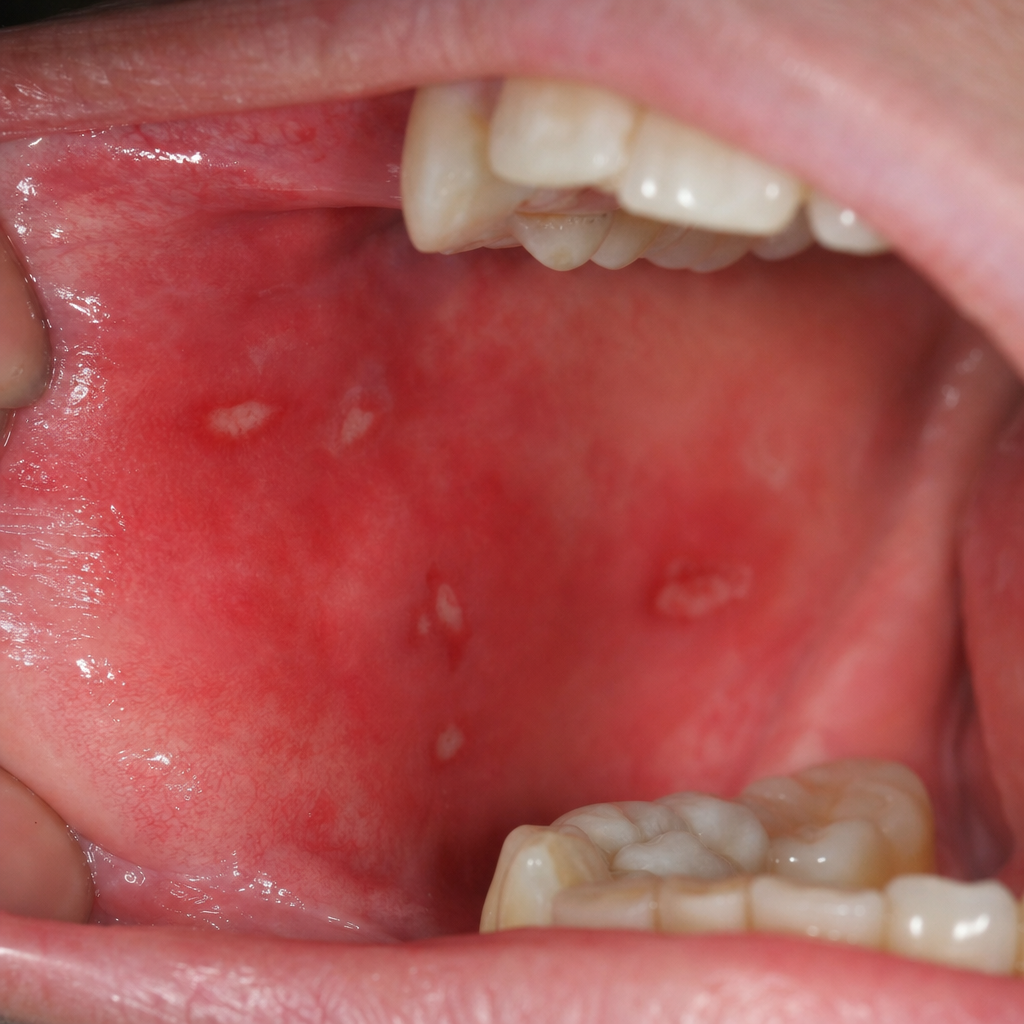
Non-cicatricial alopecia can be present in which skin disease?
Nail deformities commonly seen in lichen planus include all of the following EXCEPT:
A 30-year-old female developed diffuse hair loss 3 months after the delivery of her first child. What is the probable diagnosis?
Which of the following is NOT a cause of cicatricial alopecia?
Pseudopelade is best described as:
Which of the following conditions is associated with scarring alopecia?
What is the approximate rate of growth of beard hair?
Thimble pitting of nails is seen in which of the following conditions?
All of the following are causes of cicatrizing alopecia except?
Nail's involvement is NOT a feature of which of the following conditions?
Explanation: **Explanation:** Alopecia is broadly classified into two categories: **Cicatricial (Scarring)** and **Non-cicatricial (Non-scarring)**. The fundamental difference lies in the preservation of the hair follicle; in non-cicatricial alopecia, there is no clinical evidence of inflammation, scarring, or atrophy, and the follicular ostia remain visible, meaning the hair has the potential to regrow. **Why Alopecia Areata is Correct:** Alopecia areata is a classic example of **non-cicatricial alopecia**. It is an autoimmune condition where T-cells attack the hair bulb (anagen phase), leading to sudden, well-demarcated patches of hair loss. Since the hair follicles are not destroyed or replaced by fibrous tissue, the condition is reversible. **Analysis of Incorrect Options:** * **Scleroderma (Morphea):** This is a connective tissue disorder characterized by fibrosis and collagen deposition. When it affects the scalp (e.g., *En coup de sabre*), it destroys the hair follicles, leading to **cicatricial alopecia**. * **Lichen Planus (Lichen Planopilaris):** This is a primary lymphocytic inflammatory disorder that targets the follicular bulge. It results in permanent destruction of the follicle and is a leading cause of **cicatricial alopecia**. * **Syphilis:** While secondary syphilis can cause "moth-eaten" alopecia (which is non-cicatricial), the question asks for the most definitive association. However, in the context of standard NEET-PG patterns, Lichen Planus and Scleroderma are classic "scarring" examples, whereas Alopecia Areata is the prototype for "non-scarring." *(Note: Syphilis can be non-cicatricial, but Alopecia Areata is the most characteristic answer provided).* **High-Yield Clinical Pearls for NEET-PG:** * **Non-Cicatricial Examples:** Alopecia areata, Telogen effluvium, Anagen effluvium, Trichotillomania, and Male/Female pattern hair loss. * **Cicatricial Examples:** DLE (Discoid Lupus Erythematosus), Lichen planopilaris, Pseudopelade of Brocq, and Kerion (Tinea capitis). * **Pathognomonic Sign:** "Exclamation mark hairs" are seen at the margins of active patches in Alopecia areata.
Explanation: **Explanation:** Lichen Planus (LP) is an inflammatory condition that affects the skin, mucous membranes, and nails. Nail involvement occurs in approximately 10% of cases and is primarily due to inflammation of the **nail matrix**. **Why Beau’s lines is the correct answer:** **Beau’s lines** are transverse depressions across the nail plate caused by a *temporary* systemic insult (e.g., high fever, chemotherapy, or severe illness) that briefly halts nail growth. While LP causes permanent or chronic damage to the matrix, it typically manifests as longitudinal (vertical) changes rather than temporary transverse arrests. **Analysis of incorrect options:** * **Pterygium (Dorsal):** This is the **hallmark** of nail Lichen Planus. It occurs when the proximal nail fold fuses with the nail bed due to scarring and destruction of the matrix, resulting in a V-shaped extension of skin over the nail. * **Longitudinal grooves:** These are very common in LP. Chronic inflammation of the matrix leads to thinning of the nail plate, resulting in vertical ridges, grooves, and "roughness" (trachyonychia). * **Onycholysis:** While less specific than pterygium, the inflammatory process in LP can involve the nail bed, leading to the separation of the nail plate from the bed. **NEET-PG High-Yield Pearls:** * **Twenty-nail dystrophy (Trachyonychia):** When all 20 nails are involved with a "sandpaper" appearance; LP is a major cause. * **Pterygium formation:** Dorsal pterygium is seen in **Lichen Planus**, whereas ventral pterygium (hyponychium sticking to the plate) is seen in **Scleroderma** or **SLE**. * **Management:** Intralesional or systemic steroids are required urgently to prevent permanent scarring and **Anonychia** (complete loss of the nail).
Explanation: **Explanation:** The correct diagnosis is **Telogen Effluvium (TE)**. This is a form of non-scarring, diffuse hair loss that occurs when a significant number of hair follicles are prematurely pushed into the telogen (resting) phase due to a systemic stressor. **Why Telogen Effluvium is correct:** During pregnancy, high levels of estrogen prolong the **anagen (growth) phase**, leading to thicker hair. Following delivery, the sudden drop in estrogen levels triggers a synchronized shift of these follicles into the telogen phase. Hair shedding typically begins **2 to 4 months after the inciting event** (postpartum, high fever, major surgery, or severe stress), matching the timeline in this clinical scenario. **Analysis of Incorrect Options:** * **Androgenic Alopecia:** Characterized by patterned hair loss (widening of the central part in females) due to follicular miniaturization, rather than sudden diffuse shedding. * **Endocrinal Alopecia:** While hormonal imbalances (like hypothyroidism) cause hair loss, the specific postpartum timing makes TE the most classic and likely diagnosis. * **Systemic Lupus Erythematosus (SLE):** SLE can cause "lupus hair" (thin, friable frontal hair) or scarring alopecia, but it is usually accompanied by systemic symptoms (rash, joint pain) and is not specifically triggered by childbirth. **High-Yield Clinical Pearls for NEET-PG:** * **The "Hair Pull Test":** Positive in TE (usually >6 hairs extracted). * **Trichoscopy:** Shows decreased hair density without significant variation in hair shaft diameter (unlike androgenic alopecia). * **Prognosis:** TE is self-limiting; hair density usually returns to normal within 6–12 months. * **Common Triggers:** "4 Ms"—Metabolic (Iron deficiency), Medical (Post-febrile), Mental stress, and Maternity.
Explanation: **Explanation:** Alopecia is broadly classified into two categories: **Cicatricial (Scarring)** and **Non-Cicatricial (Non-scarring)**. The fundamental difference lies in the fate of the hair follicle; in cicatricial alopecia, the follicle is permanently destroyed and replaced by fibrous tissue, leading to irreversible hair loss. **Why Androgenetic Alopecia is the correct answer:** Androgenetic alopecia (Option D) is the most common cause of **non-cicatricial** alopecia. It is characterized by follicular miniaturization driven by dihydrotestosterone (DHT), where terminal hairs transform into vellus-like hairs. Crucially, the follicular ostia (openings) remain intact, and there is no clinical or histological evidence of scarring or inflammation. **Analysis of Incorrect Options (Cicatricial Causes):** * **Lichen Planopilaris (Lichen Planus):** A primary lymphocytic cicatricial alopecia. It typically presents with "perifollicular scaling" and "perifollicular erythema." * **Discoid Lupus Erythematosus (DLE):** A common cause of primary scarring alopecia. It presents with well-demarcated erythematous plaques, atrophy, and "follicular plugging." * **Pseudopelade of Brocq:** An idiopathic, end-stage scarring alopecia characterized by small, flesh-colored patches that look like "footprints in the snow." **High-Yield NEET-PG Pearls:** * **Clinical Sign:** The absence of follicular ostia (smooth, shiny scalp) is the hallmark of cicatricial alopecia. * **Other Non-Cicatricial causes:** Alopecia areata, Telogen effluvium, Trichotillomania, and Syphilitic alopecia. * **Other Cicatricial causes:** Folliculitis decalvans, Frontal fibrosing alopecia, and Keratosis follicularis spinulosa decalvans. * **Diagnostic Tool:** Trichoscopy is essential to differentiate between the two; look for "yellow dots" in non-scarring and "white dots/loss of ostia" in scarring types.
Explanation: **Explanation:** **Pseudopelade of Brocq** is a rare, idiopathic, chronic inflammatory condition that leads to **Cicatricial (Scarring) Alopecia**. The underlying medical concept involves the destruction of the hair follicle bulge (where stem cells reside) and its replacement by fibrous tissue, leading to permanent hair loss. Clinically, it presents as small, smooth, flesh-colored or "ivory-white" patches of hair loss with no visible inflammation, often described as **"footprints in the snow."** **Analysis of Options:** * **Option A (Alopecia steatoides):** This is an archaic term for hair loss associated with severe seborrheic dermatitis (oily scales). It is non-scarring. * **Option B (Alopecia mucinosa):** This is a condition characterized by mucin deposition in the hair follicles. While it can lead to scarring in later stages, it is primarily a follicular mucinosis and not synonymous with Pseudopelade. * **Option C (Traction alopecia):** This is a form of hair loss caused by chronic pulling or tension on the hair shafts (e.g., tight hairstyles). It is initially non-scarring, though it can become permanent over time. **High-Yield Clinical Pearls for NEET-PG:** * **Diagnosis of Exclusion:** Pseudopelade of Brocq is often considered the end-stage of various inflammatory scalp conditions (like Lichen Planopilaris or DLE) where specific diagnostic features have disappeared. * **Clinical Sign:** Absence of follicular orifices (ostia) is the hallmark of cicatricial alopecia. * **Pull Test:** Usually negative at the margins, as the process is slowly progressive. * **Histopathology:** Shows "naked" hair shafts in the dermis with a lack of sebaceous glands.
Explanation: **Explanation:** Alopecia is broadly classified into **Non-scarring** (reversible, preserved follicular openings) and **Scarring/Cicatricial** (permanent, loss of follicular openings with fibrosis). **Lichen Planopilaris (LPP)**, a follicular variant of **Lichen Planus**, is a classic cause of primary scarring alopecia. It involves a lymphocytic inflammatory infiltrate that attacks the hair follicle bulge (where stem cells reside). This leads to the destruction of the follicle and its replacement by fibrous tissue, resulting in permanent hair loss and a "shiny," smooth scalp surface. **Analysis of Incorrect Options:** * **Alopecia Areata (A):** An autoimmune, non-scarring alopecia characterized by "exclamation mark" hairs and a "swarm of bees" peribulbar lymphocytic infiltrate. * **Tinea Capitis (B):** A fungal infection that typically causes non-scarring alopecia. However, if it progresses to a **Kerion** (inflammatory mass), it can result in secondary scarring. In its standard form, it is classified as non-scarring. * **Androgenic Alopecia (C):** The most common form of non-scarring hair loss, driven by dihydrotestosterone (DHT) causing follicular miniaturization rather than destruction. **High-Yield Clinical Pearls for NEET-PG:** * **Scarring Alopecia Mnemonic (L-D-C):** **L**ichen Planopilaris, **D**iscoid Lupus Erythematosus (DLE), and **C**entral Centrifugal Cicatricial Alopecia (CCCA). * **LPP Clinical Sign:** Perifollicular scaling and erythema at the active border. * **DLE vs. LPP:** DLE often shows prominent "plugging" of follicular orifices and telangiectasia, whereas LPP shows a smoother, "porcelain" scarring. * **Pseudopelade of Brocq:** The end-stage "footprints in the snow" appearance of various scarring alopecias.
Explanation: The growth rate of human hair varies significantly depending on the anatomical site, age, and hormonal influences. **Explanation of the Correct Answer:** The correct answer is **0.4 mm/day (Option B)**. On average, beard hair grows at a rate of approximately **0.38 to 0.44 mm per day**. This is slightly faster than scalp hair, which typically grows at a rate of 0.33 to 0.35 mm/day (roughly 1 cm per month). The growth of beard hair is highly androgen-dependent; dihydrotestosterone (DHT) stimulates the follicles in the beard area to transition from vellus to terminal hair and increases their metabolic activity during the anagen (growth) phase. **Analysis of Incorrect Options:** * **Option A (0.2 mm/day):** This is too slow for facial hair. This rate is more characteristic of **fingernails** (which grow ~0.1 mm/day) or very slow-growing body hair. * **Option C (0.6 mm/day):** This value overestimates the average physiological growth rate. While individual variations exist, 0.6 mm/day is significantly higher than the documented mean for terminal beard hair. * **Option D (1 mm/day):** This is an extreme outlier. No human hair follicle consistently produces hair at this speed under normal physiological conditions. **High-Yield Clinical Pearls for NEET-PG:** * **Scalp Hair Growth:** ~0.35 mm/day (1 cm/month). * **Nail Growth:** Fingernails grow at ~3 mm/month (0.1 mm/day), while toenails grow at 1/3 to 1/2 that rate (1 mm/month). * **Anagen Phase:** The beard has a shorter anagen phase compared to the scalp, which is why beard hair does not grow as long as scalp hair. * **Telogen Effluvium:** A common exam topic where a physiological stressor shifts a large percentage of hairs from the anagen to the telogen (resting) phase, leading to diffuse shedding.
Explanation: **Explanation:** **Thimble pitting** refers to the presence of multiple, deep, and irregularly spaced pits on the nail plate, resembling the surface of a tailor’s thimble. **1. Why Psoriasis is correct:** Pitting is the most common nail finding in psoriasis. It occurs due to **parakeratosis of the proximal nail matrix**. As the nail grows out, these clusters of parakeratotic cells are shed from the nail plate surface, leaving behind characteristic depressions or "pits." In psoriasis, these pits are typically deep, large, and randomly distributed. **2. Analysis of Incorrect Options:** * **Alopecia areata:** While pitting *can* occur here, it is typically **shallow, fine, and arranged in a regular, geometric (grid-like) pattern**, unlike the deep, irregular thimble pitting of psoriasis. * **Lichen planus:** The hallmark nail finding is **pterygium formation** (v-shaped scarring of the proximal nail fold onto the bed) and longitudinal ridging. It leads to nail thinning and atrophy, not discrete thimble pitting. * **Pemphigus:** Nail involvement is rare and usually manifests as paronychia or onychomadesis (nail shedding) due to acantholysis, but not classic pitting. **3. Clinical Pearls for NEET-PG:** * **Oil drop sign (Salmon patch):** Pathognomonic for nail psoriasis (due to exocytosis of leukocytes under the nail plate). * **Distal Onycholysis:** Separation of the nail plate from the bed, often with a yellowish margin. * **Nail Psoriasis & Arthritis:** Nail involvement is a strong clinical predictor for **Psoriatic Arthritis**, particularly involving the Distal Interphalangeal (DIP) joints. * **Twenty-nail dystrophy (Trachyonychia):** Rough, sandpaper-like nails seen in Alopecia areata, Lichen planus, or Psoriasis.
Explanation: **Explanation:** The core concept in this question is the distinction between **Cicatrizing (Scarring)** and **Non-cicatrizing (Non-scarring)** alopecia. **Why Alopecia Areata is the correct answer:** Alopecia areata is a classic example of **non-cicatrizing alopecia**. It is an autoimmune condition where T-cells attack the hair bulb, causing the hair to enter the telogen (resting) phase prematurely. Crucially, the hair follicles are preserved and not destroyed by fibrosis. Therefore, the potential for hair regrowth remains, and there is no clinical scarring or loss of follicular ostia. **Analysis of Incorrect Options (Causes of Cicatrizing Alopecia):** Cicatrizing alopecia involves permanent destruction of the hair follicle, which is replaced by fibrous tissue (scarring). * **Lichen Planopilaris (Lichen Planus):** This is a primary lymphocytic cicatrizing alopecia. It presents with follicular plugging and "perifollicular scaling," leading to permanent hair loss. * **Discoid Lupus Erythematosus (DLE):** A common cause of primary scarring alopecia. It presents with erythematous plaques, follicular plugging, and eventual central atrophy/scarring. * **Lupus Vulgaris:** This is a chronic progressive form of cutaneous tuberculosis. It causes deep tissue destruction and secondary intention healing, which results in extensive scarring (secondary cicatrizing alopecia). **NEET-PG High-Yield Pearls:** * **Pathognomonic sign of Alopecia Areata:** "Exclamation mark" hairs (short broken hairs, broader at the top than the base). * **Histology of Alopecia Areata:** Characterized by a "Swarm of Bees" appearance (peribulbar lymphocytic infiltrate). * **Classification:** * *Primary Cicatrizing:* Lichen planopilaris, DLE, Pseudopelade of Brocq, Folliculitis decalvans. * *Non-Cicatrizing:* Alopecia areata, Telogen effluvium, Androgenetic alopecia, Trichotillomania.
Explanation: **Explanation:** The correct answer is **Discoid Lupus Erythematosus (DLE)**. While DLE is a chronic cutaneous form of Lupus that primarily affects sun-exposed areas (scalp, face, and ears) leading to scarring alopecia, it **characteristically spares the nails**. In contrast, Systemic Lupus Erythematosus (SLE) frequently involves the nails (showing periungual telangiectasia or splinter hemorrhages), but pure DLE does not. **Analysis of other options:** * **Psoriasis:** Nail involvement is extremely common (up to 50% of patients). High-yield features include **pitting** (most common), **onycholysis**, **oil spots** (salmon patches), and subungual hyperkeratosis. * **Lichen Planus (LP):** Nail LP occurs in 10% of cases. The hallmark is the **Pterygium formation** (V-shaped extension of the proximal nail fold onto the nail bed), which leads to permanent scarring and nail destruction. Other features include longitudinal ridging and "angel wing" deformity. * **Dermatomyositis:** This condition presents with pathognomonic nail fold changes, specifically **Gottron’s papules** over the knuckles and **periungual telangiectasia** (Keining’s sign) with ragged cuticles. **NEET-PG High-Yield Pearls:** * **Pterygium:** Seen in Lichen Planus (dorsal) and Peripheral Vascular Disease (ventral). * **Geometric Pitting:** Characteristic of Alopecia Areata (regularly spaced pits). * **Oil Spot Sign:** Pathognomonic for Psoriasis. * **Twenty-nail dystrophy (Trachyonychia):** Can be an isolated finding or associated with Alopecia Areata, Psoriasis, or Lichen Planus.
Hair Growth Cycle and Anatomy
Practice Questions
Alopecia Areata
Practice Questions
Androgenetic Alopecia
Practice Questions
Telogen Effluvium
Practice Questions
Scarring Alopecias
Practice Questions
Hair Shaft Abnormalities
Practice Questions
Hirsutism and Hypertrichosis
Practice Questions
Nail Anatomy and Growth
Practice Questions
Nail Infections
Practice Questions
Nail Psoriasis and Other Inflammatory Nail Disorders
Practice Questions
Nail Tumors
Practice Questions
Management of Hair and Nail Disorders
Practice Questions
Get full access to all questions, explanations, and performance tracking.
Start For Free