A male presents with alopecia and exclamation mark hairs. Diagnosis?
A 30-year-old woman presents with non-scarring patchy hair loss on her scalp. What is the most likely diagnosis?
What is the definition of Alopecia universalis?
Preferred concentration of minoxidil for female androgenetic alopecia is?
Nail pitting is most commonly associated with which of the following conditions?
What type of condition is alopecia areata?
Which of the following can cause both cicatricial as well as non-cicatricial alopecia?
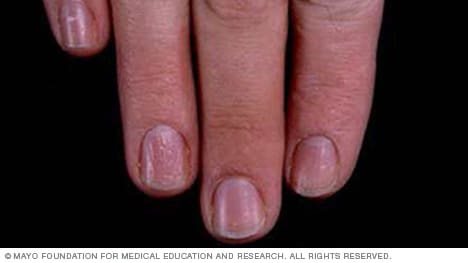
Which of the following nail findings is seen in the condition shown below?
What does the anagen phase of hair growth indicate?
Which of the following causes non-cicatricial alopecia?
Explanation: ***Alopecia areata*** - The presence of **exclamation mark hairs** (hairs that are narrower closer to the scalp and wider at the distal end) is a classic dermatoscopic finding specifically associated with **alopecia areata**. - **Alopecia areata** is an autoimmune condition characterized by patchy hair loss and often presents with these peculiar hair shaft abnormalities. *Telogen effluvium* - This condition involves diffuse thinning of hair, often triggered by stress, illness, or hormonal changes, but does not typically present with **exclamation mark hairs**. - It is characterized by an increased shedding of **telogen (resting phase)** hairs, with no specific hair shaft abnormalities like exclamation marks. *Androgenic alopecia* - This is the most common type of hair loss, characterized by a patterned balding (receding hairline, thinning crown), due to the effect of androgens on genetically susceptible hair follicles. - While it causes hair miniaturization, it does not involve the formation of **exclamation mark hairs**. *Tinea capitis* - This is a **fungal infection** of the scalp that typically causes scaly patches, broken hairs, and sometimes inflammation or painful lesions, often with associated **lymphadenopathy**. - The distinctive **exclamation mark hairs** are not a feature of **tinea capitis**; instead, broken-off hairs or "black dots" may be observed.
Explanation: ***Alopecia areata*** - This condition is characterized by **non-scarring, patchy hair loss**, often described as circular or oval, which fits the description of the patient. - It is an **autoimmune disorder** where the immune system attacks hair follicles, leading to their sudden loss without leaving a scar. - Classic presentation includes **smooth, hairless patches** with "exclamation mark hairs" at the periphery. *Androgenetic alopecia* - This is typical **pattern hair loss**, often presenting as a receding hairline and thinning crown in men, and diffuse thinning over the scalp in women. - It is characterized by progressive miniaturization of hair follicles, leading to finer, shorter hairs, rather than sudden patches. - The hair loss is **gradual and follows a predictable pattern**, not discrete circular patches. *Tinea capitis* - This is a **fungal infection** of the scalp, which typically causes **non-scarring alopecia** with scaling, erythema, and broken hairs. - While it can cause patchy hair loss, the presence of **scaling, inflammation, black dots (broken hairs), and sometimes pustules** would be expected, which are not mentioned in the patient's presentation. - Severe forms (kerion) may lead to scarring if left untreated, but most cases are non-scarring. *Trichotillomania* - This is a **hair-pulling disorder** where individuals compulsively pull out their own hair, resulting in patches of varying hair lengths and often broken hairs. - The patches are typically **irregularly shaped** with hairs of different lengths, and a history of hair pulling or psychological stressors would be evident, which is not stated in the scenario.
Explanation: **Correct: Loss of all hair on the body** - **Alopecia universalis** is the most severe form of **alopecia areata**, characterized by complete hair loss across the entire body, including scalp hair, eyebrows, eyelashes, and body hair. - This condition is believed to be an **autoimmune disorder** where the immune system mistakenly attacks hair follicles. *Incorrect: Loss of scalp hair* - This definition partially describes **alopecia totalis** (loss of all scalp hair), which is a less extensive form than alopecia universalis. - It does not account for the loss of hair in other body regions, which is a key feature of alopecia universalis. *Incorrect: Loss of hair at the scalp margin* - This description is characteristic of **alopecia marginalis** or **frontal fibrosing alopecia**, which typically affects the hairline, particularly in the frontal and temporal regions. - This is a localized form of hair loss and does not involve hair loss across the entire body. *Incorrect: Male pattern hair loss* - Refers to **androgenetic alopecia**, a common type of hair loss primarily affecting men, characterized by a receding hairline and thinning at the crown. - This is a progressive, patterned hair loss influenced by genetics and hormones, distinct from the widespread autoimmune-mediated loss seen in alopecia universalis.
Explanation: ***2%*** - Minoxidil 2% solution is the **preferred initial concentration** for female androgenetic alopecia due to its efficacy and better tolerability profile compared to higher concentrations. - While 5% minoxidil can be more effective, it carries a higher risk of **hypertrichosis (unwanted hair growth)**, which is a significant concern for female patients. *5%* - While 5% minoxidil is more effective for male pattern baldness, its use in women is associated with a **higher incidence of hypertrichosis**, particularly on the face. - It is typically considered an alternative for women who do not respond to 2% minoxidil and are willing to accept the increased risk of side effects. *8%* - Concentrations of minoxidil above 5% are generally **not recommended** for female androgenetic alopecia due to a significantly increased risk of side effects, including severe hypertrichosis and scalp irritation. - The additional benefit in terms of hair regrowth with such high concentrations is often outweighed by the **adverse effects**. *10%* - Minoxidil 10% is rarely used for female androgenetic alopecia and is typically reserved for **severe cases in men** who have not responded to lower concentrations. - Its use in women would lead to unacceptably high rates of **adverse events**, especially hypertrichosis.
Explanation: ***Psoriasis*** - **Nail pitting** is a classic finding in **psoriasis**, present in up to 50% of patients with cutaneous disease and 80-90% of those with psoriatic arthritis. - Other nail changes include **onycholysis**, **subungual hyperkeratosis**, and **oil drop sign**. *Paronychia* - This condition involves **inflammation of the skin surrounding the nail**, often due to infection (bacterial or fungal). - It does not typically cause **nail pitting**, but rather redness, swelling, and pain around the nail fold. *Ectodermal dysplasia* - A group of genetic disorders affecting the development of **ectodermal structures**, including skin, hair, teeth, and nails. - Nail abnormalities can occur, such as **onychodysplasia** or hypoplastic nails, but **pitting** is not a characteristic feature. *Alopecia areata* - An **autoimmune condition** causing patchy hair loss, which can also affect nails in 10-66% of cases. - Nail pitting can occur, often with a **geometric pattern**, along with **trachyonychia** (rough, sandpaper-like nails) or longitudinal ridging. - However, **psoriasis remains the most characteristic** condition associated with nail pitting and is more commonly encountered in clinical practice with nail involvement.
Explanation: ***Autoimmune disorder*** - **Alopecia areata** is characterized by the immune system mistakenly attacking healthy **hair follicles**, leading to non-scarring hair loss. - This immune response targets specific structures within the hair follicle, interrupting the normal hair growth cycle. *Allergic disorder* - Allergic disorders involve an exaggerated immune response to harmless substances (**allergens**), often mediated by IgE antibodies, which is not the primary mechanism in alopecia areata. - Clinical manifestations typically include hives, eczema, or respiratory symptoms, rather than targeted hair follicle destruction. *Anaphylactic disorder* - Anaphylaxis is a severe, life-threatening allergic reaction that involves a sudden systemic release of mediators, causing widespread symptoms like bronchospasm and hypotension. - This acute, systemic reaction is distinct from the chronic, localized immune attack on hair follicles seen in alopecia areata. *Bacterial infection* - Bacterial infections are caused by microorganisms and are typically treated with antibiotics, often presenting with signs of inflammation like pus, redness, and fever. - **Alopecia areata** is not caused by bacteria and does not respond to antibiotic treatment, as its etiology is rooted in immune dysfunction.
Explanation: ***SLE*** - **Systemic Lupus Erythematosus (SLE)** can cause both **non-scarring alopecia (diffuse thinning)** due to immune complex deposition around hair follicles, and **scarring alopecia (discoid lupus erythematosus of the scalp)**. - The scarring form, discoid lupus, can lead to permanent hair loss and **cicatrix formation**, whereas non-scarring forms are often reversible. *Telogen effluvium (temporary hair loss)* - **Telogen effluvium** is a form of **non-scarring alopecia** characterized by excessive shedding of telogen hair, typically triggered by stress, illness, or medication. - It does not involve damage to the hair follicle stem cells and is highly reversible, thus **no cicatricial changes occur**. *Hypothyroidism (hormonal imbalance)* - **Hypothyroidism** typically causes **diffuse, non-scarring hair loss** (telogen effluvium) due to the metabolic slowdown affecting the hair growth cycle. - It does not directly cause destruction of hair follicles leading to **scarring or cicatricial alopecia**. *Alopecia areata (non-scarring alopecia)* - **Alopecia areata** is an autoimmune condition causing **patchy, non-scarring hair loss**, characterized by lymphocytes attacking active hair follicles. - The hair follicles remain intact, allowing for potential regrowth, and it **does not lead to scarring**.
Explanation: **Nail Pitting** - The image clearly displays multiple **small depressions or pits** on the surface of the toenails, which is characteristic of nail pitting. - Nail pitting is a common finding in **psoriasis**, where the nails often show these distinctive indentations due to abnormal keratinization in the nail matrix. - This is the most prominent and diagnostic feature visible in the image. *Nail Pterygium* - Nail pterygium involves the forward growth of the proximal nail fold (the cuticle) attaching to the nail plate, or the distal growth of the hyponychium attaching to the nail plate. - This condition is often associated with **lichen planus**, trauma, or connective tissue diseases, and is not visible in the provided image. *Nail Pigmentation* - Nail pigmentation refers to discoloration of the nail plate, which can range from brown, black, blue, or green. - Causes include melanin deposition (e.g., in moles, melanoma), medications, or fungal infections, none of which are primarily depicted in the image. *Nail Ridges* - Nail ridges (longitudinal or transverse) are lines or grooves on the nail surface. - Longitudinal ridges are common with aging, while transverse ridges **(Beau's lines)** indicate a temporary cessation of nail growth due to illness or trauma. - While some mild longitudinal ridging might be present, the most prominent and diagnostic feature in the image is the presence of **pits**, not just ridges.
Explanation: **Correct: The phase of active growth of hair.** - The **anagen phase** is the active growth period for hair follicles, during which cells in the hair matrix rapidly divide and differentiate, leading to hair elongation. - This phase determines the **length of the hair**, lasting anywhere from 2 to 7 years in the scalp. *Incorrect: The phase of transition between growth and rest.* - This description corresponds to the **catagen phase**, a short transitional period following anagen. - During the **catagen phase**, the hair follicle shrinks, and hair growth ceases as the hair detaches from the dermal papilla. *Incorrect: The phase of hair resting.* - This refers to the **telogen phase**, which is the resting stage of the hair cycle. - In the **telogen phase**, hair follicles are inactive, and hairs are retained in the follicle but are not actively growing; they are eventually shed. *Incorrect: The phase of hair degeneration.* - This term is most accurately associated with the **catagen phase**, where the hair follicle undergoes controlled apoptosis and structural changes signaling the end of growth. - While **telogen** can be considered a resting or dormant phase, "degeneration" explicitly describes the cellular and structural breakdown characteristic of catagen.
Explanation: ***All of the options*** - **Tinea capitis**, **SLE** (Systemic Lupus Erythematosus), and **Alopecia areata** all can cause **non-cicatricial alopecia**. - **Non-cicatricial alopecia** refers to hair loss where the hair follicle is not permanently destroyed, and hair regrowth is possible, leaving no scarring. *Tinea capitis* - This is a **fungal infection** of the scalp that causes hair shafts to break, leading to patches of hair loss. - While it can lead to inflammation, it typically does not cause permanent destruction of the hair follicle unless severe and untreated, thus being predominantly **non-cicatricial**. *SLE* - Hair loss in **SLE** can occur due to various mechanisms, including diffuse thinning, patchy alopecia, or the characteristic "**lupus hair**" (fragile hairs around the hairline). - This type of hair loss is usually **non-scarring** and reversible, although discoid lupus erythematosus often causes scarring alopecia. *Alopecia areata* - This is an **autoimmune condition** characterized by patchy, sudden hair loss on the scalp or other body parts. - The hair follicles are attacked by the immune system but are not destroyed, making the condition largely **non-cicatricial** and potentially reversible.
Hair Growth Cycle and Anatomy
Practice Questions
Alopecia Areata
Practice Questions
Androgenetic Alopecia
Practice Questions
Telogen Effluvium
Practice Questions
Scarring Alopecias
Practice Questions
Hair Shaft Abnormalities
Practice Questions
Hirsutism and Hypertrichosis
Practice Questions
Nail Anatomy and Growth
Practice Questions
Nail Infections
Practice Questions
Nail Psoriasis and Other Inflammatory Nail Disorders
Practice Questions
Nail Tumors
Practice Questions
Management of Hair and Nail Disorders
Practice Questions
Get full access to all questions, explanations, and performance tracking.
Start For Free