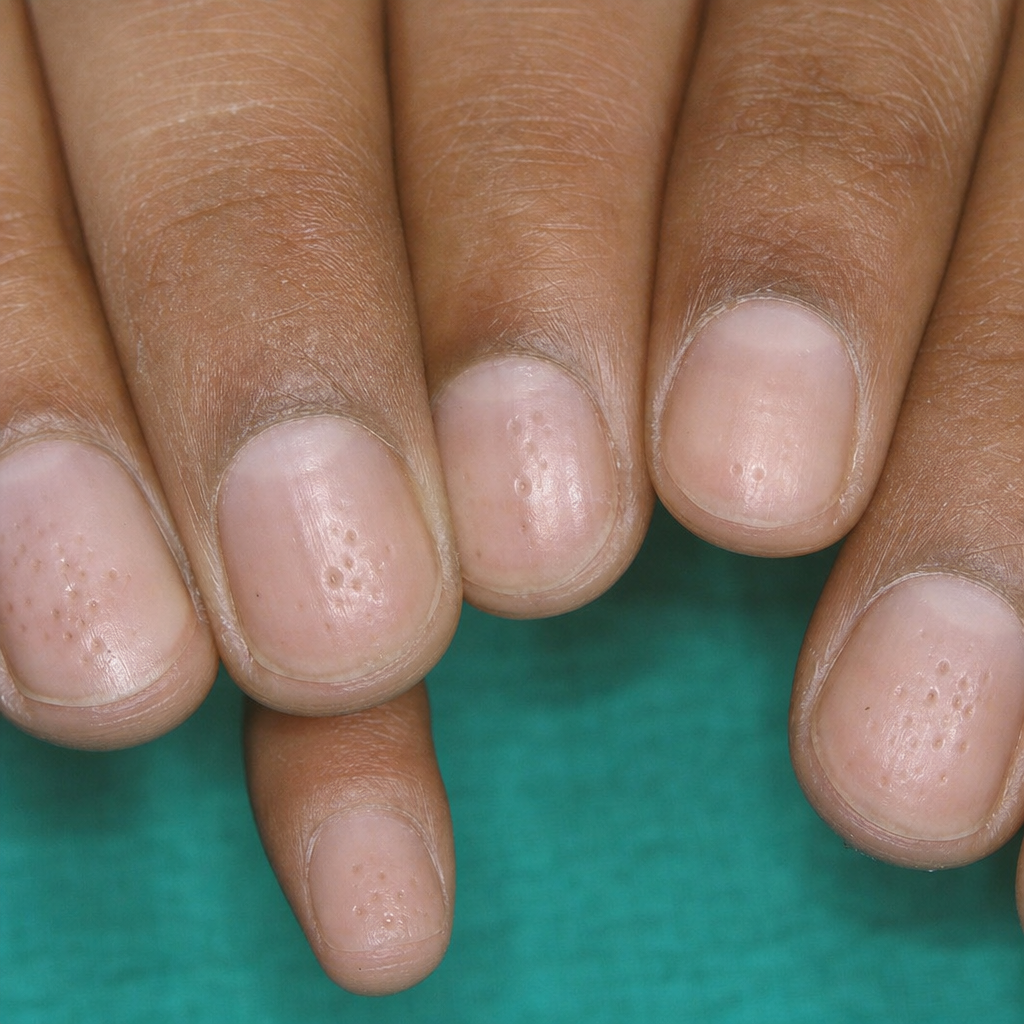
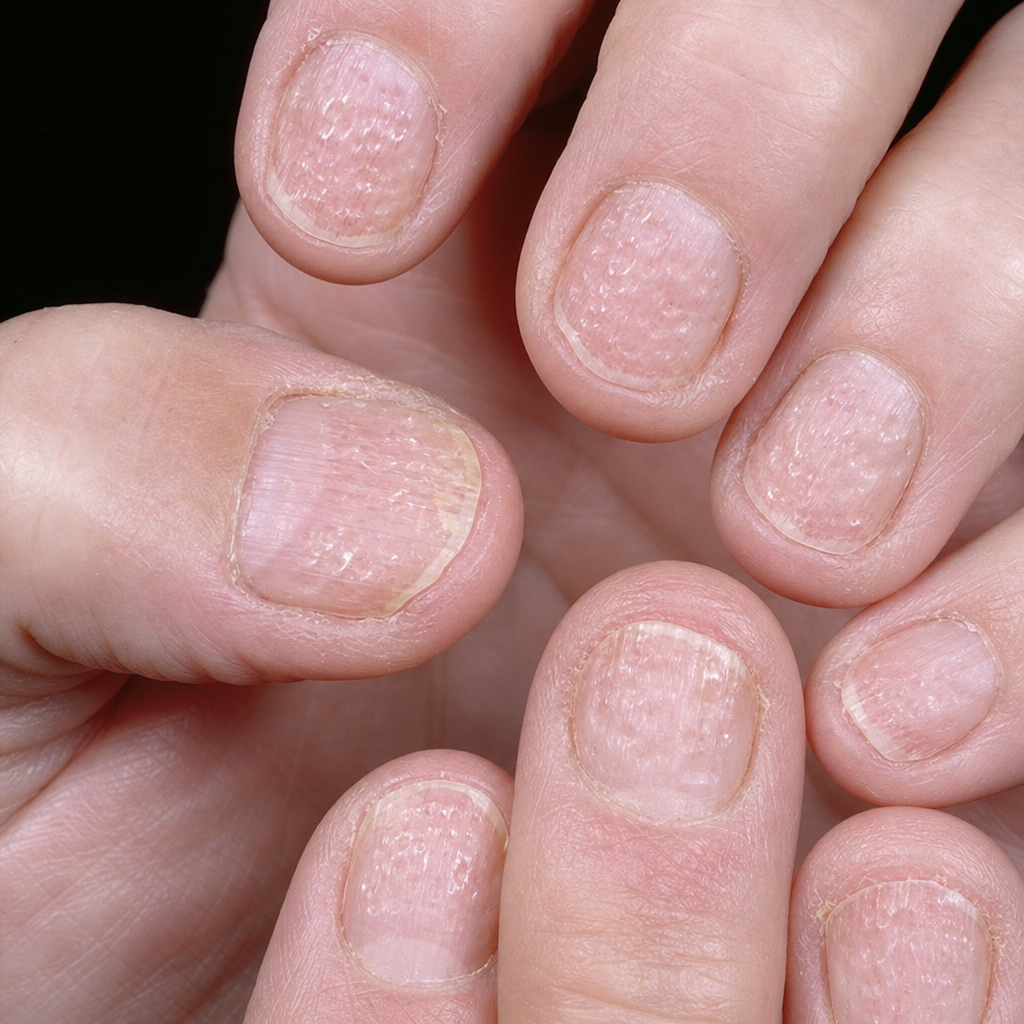
All are true about psoriasis except:
Pitting of nails is seen in:
Which of the following conditions is characterized by specific nail changes such as pitting, onycholysis, and oil spots?
All are true about lichen planus EXCEPT:
Pterygium of nail is seen in?
A patient presents with focal alopecia areata. All of the following are associations of alopecia areata except:
Which of the following conditions does NOT cause nail pitting?
Which of the following statements is incorrect regarding nail changes in various conditions?
Keratoderma blennorrhagica is seen in?
A 25-year-old presents with silvery scales on elbows and knees. Likely diagnosis?
Explanation: ***Very pruritic*** - While psoriasis can be itchy, it is generally not characterized as "very pruritic" compared to other dermatological conditions like **eczema** or **scabies**. - **Pruritus** in psoriasis tends to be mild to moderate, and it is not a defining characteristic that differentiates it from other skin disorders. *Parakeratosis & acanthosis* - **Parakeratosis** (retention of nuclei in the stratum corneum) and **acanthosis** (epidermal hyperplasia) are classic histopathological hallmarks of psoriasis. - These features reflect the rapid epidermal turnover characteristic of the condition. *Pitting of nails* - **Nail pitting**, onycholysis, and subungual hyperkeratosis are common and characteristic manifestations of psoriasis, affecting up to 50% of patients. - These nail changes are highly indicative of **psoriatic involvement**. *Joint involvement in 5–10%* - **Psoriatic arthritis**, involving inflammation of the joints, affects approximately 5-30% of individuals with psoriasis. - This statistic makes joint involvement a significant comorbidity of psoriasis.
Explanation: ***Psoriasis and Alopecia areata*** - **Nail pitting** is a very common and characteristic finding in **psoriasis**, resulting from defective keratinization of the nail matrix. - While less common, nail pitting can also occur in **alopecia areata**, typically due to inflammation affecting the nail matrix. *Psoriasis only* - While **psoriasis** is a primary cause of nail pitting, stating it as "only" is incorrect as other conditions also present with this sign. - This option incorrectly limits the differential diagnosis for nail pitting. *Psoriasis and Lichen planus* - **Psoriasis** does cause nail pitting, but **lichen planus** typically causes **longitudinal ridging**, splitting, subungual hyperkeratosis, and sometimes pterygium formation, rather than classic pitting. - This option includes a condition that usually manifests with different nail changes. *Alopecia areata and Eczema* - **Alopecia areata** can cause nail pitting, but **eczema** of the hands or fingers more commonly leads to **nail plate dystrophy**, discoloration, ridging, or thickening, rather than distinct pitting. - While eczema can affect nails, pitting is not its characteristic nail manifestation.
Explanation: ***Psoriasis*** - **Psoriasis** characteristically causes several specific nail changes, including **pitting**, **onycholysis** (separation of the nail plate from the nail bed), and **oil spots** (yellow-brown discoloration resembling an oil drop under the nail). - These nail manifestations are often indicative of underlying psoriatic disease, even in the absence of extensive skin lesions. *Lichen planus* - **Lichen planus** can affect the nails, causing longitudinal ridging, thinning, and sometimes pterygium formation, but typically not pitting, onycholysis, or oil spots. - In severe cases, it can lead to permanent nail loss or scarring. *Darier disease* - **Darier disease** (keratosis follicularis) is characterized by specific nail findings such as longitudinal red and white streaks, V-shaped notching at the distal nail edge, and subungual hyperkeratosis. - It does not present with the classic triad of pitting, onycholysis, and oil spots. *Onychomycosis* - **Onychomycosis** is a fungal infection of the nail that typically causes thickening, discoloration (yellow, brown, white), and crumbling of the nail plate. - While it can cause onycholysis, it does not typically produce pitting or oil spots, which are more specific to psoriasis.
Explanation: ***Spares oral mucosa*** - This statement is incorrect because **lichen planus frequently involves the oral mucosa**, presenting as white reticular lesions, erosions, or plaques. - Oral involvement is common and can be the only manifestation of lichen planus. *Wickham's striae present* - **Wickham's striae** are characteristic **white, lacy reticular patterns** seen on the surface of lichen planus lesions, especially on the oral mucosa and cutaneous papules. - Their presence is a classic diagnostic feature of lichen planus. *Violaceous flat papules* - Cutaneous lesions of lichen planus are typically described as **pruritic, polygonal, planar (flat-topped), purple (violaceous) papules and plaques**. - This classic description helps in the clinical diagnosis of the condition. *Koebner phenomenon positive* - The **Koebner phenomenon**, or isomorphic response, refers to the development of new skin lesions in areas of trauma or injury. - This phenomenon is often observed in lichen planus, where scratching or irritation can precipitate new lesions along the lines of trauma.
Explanation: ***Lichen planus*** - **Pterygium of the nail** refers to the forward growth of the proximal nail fold over the nail plate, often seen as a V-shaped scarring, which is a characteristic feature of severe **nail lichen planus**. - Other nail changes in lichen planus can include **longitudinal ridging**, thinning, splitting, and anonychia. *Pemphigoid* - Bullous pemphigoid typically affects the **skin with tense blisters** and rarely involves the nails significantly. - Nail changes are uncommon but if present, are usually non-specific, such as **subungual hematomas** or **onycholysis**, not pterygium. *Psoriasis* - Nail psoriasis presents with characteristic features like **pitting**, **onycholysis**, **oil-drop spots**, and **subungual hyperkeratosis**. - While significant nail dystrophy can occur, true pterygium formation from the proximal nail fold is **not a typical finding** in psoriasis. *Pemphigus* - Pemphigus is an autoimmune blistering disorder characterized by **flaccid blisters** and erosions, primarily affecting the skin and mucous membranes. - **Nail involvement is rare** and usually secondary to periungual blistering, leading to non-specific changes like paronychia or onychomadesis, not pterygium.
Explanation: ***Geographic tongue*** - **Geographic tongue** (benign migratory glossitis) is a benign inflammatory condition of the tongue and is generally not associated with alopecia areata. - While its exact cause is unknown, it's typically linked to genetic factors or sensitivities rather than autoimmune hair loss. *Atopy* - **Atopy**, including conditions like **eczema**, **asthma**, and **allergic rhinitis**, is a well-established association with alopecia areata, suggesting a shared immune dysregulation. - Patients with alopecia areata often have a higher prevalence of **atopic diathesis**. *Exclamatory mark* - The presence of **exclamatory mark hairs** (short, broken hairs that are narrower near the scalp) is a **pathognomonic sign** of active alopecia areata. - These hairs indicate ongoing inflammation and destruction of the hair follicles. *Nail pitting* - **Nail pitting**, characterized by small depressions in the nail plate, is a common finding in patients with alopecia areata, reflecting an immune-mediated attack on the **nail matrix**. - Other nail changes, such as **trachyonychia** (roughened nails), can also occur.
Explanation: ***Pityriasis Rosea*** - This condition primarily affects the **skin**, causing a distinctive rash of oval, pinkish-red patches, often preceded by a **herald patch**. - It characteristically spares the **nails**, meaning nail pitting is not a feature of pityriasis rosea. - Nail changes are not associated with this self-limiting dermatosis. *Lichen planus* - **Nail lichen planus** can cause various nail changes, including **pitting**, longitudinal ridging, pterygium formation, and thinning of the nail plate. - It is an inflammatory condition affecting the skin, hair, nails, and mucous membranes. - Nail involvement occurs in approximately 10% of patients with cutaneous lichen planus. *Psoriasis* - **Nail psoriasis** is common, affecting up to 50% of patients with psoriasis, and **pitting is the most characteristic nail finding**. - Pitting appears as small punctate depressions on the nail surface due to defects in the proximal nail matrix. - Other nail changes include onycholysis (oil drop sign), subungual hyperkeratosis, and salmon patches. *Fungal infection* - **Onychomycosis** (fungal nail infection) typically causes **thickening, discoloration, onycholysis, and crumbling** of the nail. - **True nail pitting is NOT a characteristic feature** of fungal infections, as pitting results from defects in the proximal nail matrix, not fungal invasion. - Fungal infections affect the nail plate and bed differently, causing destruction rather than the punctate depressions seen in pitting.
Explanation: ***Koilonychia is associated with Vitamin B12 deficiency.*** - **Koilonychia**, or "spoon nails," is primarily associated with **iron deficiency anemia**, not Vitamin B12 deficiency. - In Koilonychia, the nails become **thin, brittle**, and concave in shape. *Onycholysis is seen in Psoriasis.* - **Onycholysis** refers to the separation of the nail plate from the nail bed, which is a common nail finding in **psoriasis**. - Other nail changes in psoriasis include **pitting**, oil spots, and subungual hyperkeratosis. *Mees lines are indicative of Arsenic poisoning.* - **Mees lines** are transverse white lines or bands that appear across the nail plate, characteristic of severe illness or poisoning. - They are classically associated with **arsenic poisoning**, but can also be seen in other conditions like thallium poisoning or kidney failure. *Pterygium of nails is associated with Lichen Planus.* - **Pterygium unguis** involves the forward growth of the proximal nail fold (cuticle) onto the nail plate, leading to fusion. - It is a prominent and often distinguishing feature of **lichen planus** affecting the nails, which can lead to permanent nail deformity or loss.
Explanation: ***Reactive arthritis*** - **Keratoderma blennorrhagica** is a classic mucocutaneous manifestation of reactive arthritis, presenting as hyperkeratotic lesions on the palms and soles. - Reactive arthritis is also associated with a preceding infection, asymmetric oligoarthritis, enthesitis, and often **HLA-B27 positivity**. *Rheumatoid arthritis* - This condition is characterized by chronic symmetrical polyarthritis, primarily affecting small joints, and is associated with **rheumatoid factor (RF)** and **anti-CCP antibodies**. - Skin manifestations in rheumatoid arthritis are typically rheumatoid nodules, vasculitis, or neutrophilic dermatoses, not keratoderma blennorrhagica. *Psoriatic arthritis* - While it can involve skin lesions (psoriasis), these are typically well-demarcated erythematous plaques with silvery scales, distinct from **keratoderma blennorrhagica**. - Psoriatic arthritis often presents with dactylitis, enthesitis, and nail pitting, but keratoderma blennorrhagica is not a typical feature. *Ankylosing spondylitis* - This is a chronic inflammatory disease primarily affecting the axial skeleton, leading to **sacroiliitis** and spondylitis. - Skin manifestations like keratoderma blennorrhagica are not associated with ankylosing spondylitis.
Explanation: ***Psoriasis*** - **Silvery scales** on **extensor surfaces** like elbows and knees are classic presentations of plaque psoriasis. - This chronic inflammatory skin condition is characterized by **accelerated epidermal turnover**. *Atopic dermatitis* - Typically presents as **eczematous lesions** characterized by **red, itchy, and often oozing or crusted patches**, mainly on flexural surfaces in adults. - It is strongly associated with a history of **allergies, asthma, or hay fever**. *Pityriasis rosea* - Usually starts with a **herald patch** followed by smaller, oval, pinkish-orange macules and patches with fine scales in a **Christmas tree pattern** on the trunk. - It is distinguished from psoriasis by its distribution and appearance of scales. *Lichen planus* - Characterized by **pruritic, purple, polygonal, planar papules and plaques** (the "6 P's") often with fine, white lacy streaks called **Wickham's striae**, typically affecting flexor surfaces, wrists, and oral mucosa. - It does not present with silvery scales on extensor surfaces.
Get full access to all questions, explanations, and performance tracking.
Start For Free