Which of the following are treatment options for acne vulgaris?
Most common side effect of retinoids is
Which of the following is the platinum-based chemotherapeutic agent used as first-line treatment for ovarian carcinoma?
Microabrasion using modified Croll technique utilizes:
A 35 years old female presented with acne. She was treated for her acne but after the treatment, she developed pigmentation. Which drug is responsible for hyperpigmentation?
A girl about to marry has comedonal acne. Drug to treat such a case is:
What is the most appropriate topical treatment for external genital warts in pregnancy?
Which of the following is not true about hydroquinone?
Potato nose is seen in ?
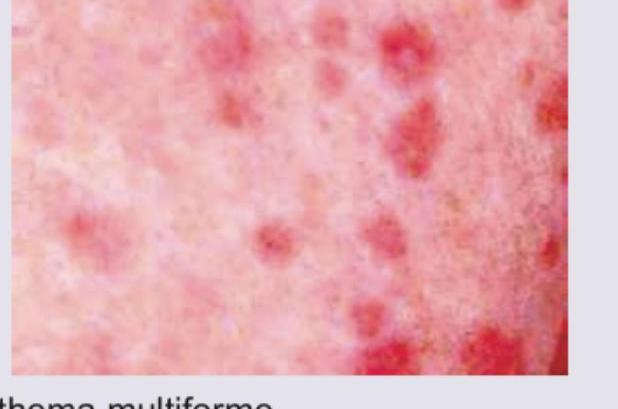
Identify the lesion: (Recent NEET Pattern 2016-17)
Explanation: ***All of the options*** - All listed options (Isotretinoin, Topical erythromycin, and Oral Minocycline) are well-established and commonly used **treatment options for acne vulgaris**, depending on the severity and type of acne. - The choice of treatment often follows a stepped approach, starting with topical agents for mild to moderate acne and progressing to oral medications like antibiotics or isotretinoin for more severe or resistant cases. *Isotretinoin* - **Isotretinoin** is a powerful oral retinoid primarily used for **severe, recalcitrant nodular acne** that has not responded to other treatments. - It works by reducing sebum production, follicular hyperkeratinization, inflammation, and the growth of *P. acnes*. *Topical erythromycin* - **Topical erythromycin** is an **antibiotic** used to treat mild to moderate inflammatory acne by reducing the growth of *Cutibacterium acnes* (formerly *Propionibacterium acnes*) and decreasing inflammation. - It is often combined with other topical agents like benzoyl peroxide to minimize the development of **antibiotic resistance**. *Oral Minocycline* - **Oral minocycline** is a **tetracycline antibiotic** used for moderate to severe inflammatory acne. - It reduces bacterial populations on the skin and exhibits **anti-inflammatory properties**, making it effective for widespread or deeper lesions.
Explanation: ***Mucocutaneous dryness*** - This is the **most common side effect** of retinoids, particularly oral isotretinoin, occurring in nearly all patients - Manifests as **cheilitis** (dry, cracked lips), **xerosis** (dry skin), **dry nasal mucosa**, and **conjunctival dryness** - Direct result of decreased sebaceous gland activity and altered epithelial differentiation - Managed with **emollients and lip balm** *Headache* - Can occur with retinoid use, but less common than mucocutaneous effects - **Severe headaches** with visual changes may indicate **pseudotumor cerebri** (benign intracranial hypertension), a rare but serious complication requiring immediate discontinuation *Diarrhoea* - **Gastrointestinal side effects** are uncommon with systemic retinoids - Not a characteristic adverse effect of this drug class *Photosensitivity* - While retinoids can increase susceptibility to **sunburn**, this is not the most common side effect - Patients should be advised to use **sunscreen** and avoid excessive sun exposure - Less universal than mucocutaneous dryness
Explanation: ***Cisplatin*** - **Cisplatin** is a platinum-based chemotherapy drug that forms **DNA cross-links**, inhibiting DNA synthesis and leading to the death of rapidly dividing cells, making it highly effective against **ovarian carcinoma**. - It is a cornerstone of chemotherapy regimens for ovarian cancer, often used in combination with other agents such as paclitaxel. *Methotrexate* - **Methotrexate** is an **antimetabolite** that inhibits dihydrofolate reductase, thereby interfering with DNA synthesis. - While it is used in various cancers like leukemia, lymphoma, and some solid tumors (e.g., breast cancer, gestational trophoblastic disease), it is **not a primary recommended drug for ovarian carcinoma**. *Cyclophosphamide* - **Cyclophosphamide** is an **alkylating agent** that causes DNA damage, leading to cell death. - It is used in many cancers, including lymphoma, breast cancer, and some leukemias, but it is **not a first-line or primary agent for ovarian carcinoma** in contemporary treatment guidelines. *Dacarbazine* - **Dacarbazine** is an **alkylating agent** primarily used in the treatment of **malignant melanoma** and Hodgkin lymphoma. - It is **not indicated for the treatment of ovarian carcinoma**.
Explanation: ***18% Citric acid*** - The modified Croll technique for **microabrasion** specifically utilizes an 18% solution of **citric acid**. - This technique is effective for removing superficial enamel discolorations and opacities by gently abrading the affected surface. *5% HF* - **Hydrofluoric acid (HF)** is a highly corrosive acid primarily used by **dental technicians** for etching ceramic restorations, not for in-office microabrasion on natural teeth. - Due to its extreme toxicity and potential for severe tissue damage, HF is generally not used intraorally for enamel procedures. *37% Phosphoric Acid* - **37% phosphoric acid** is routinely used in dentistry as an **etchant** to prepare enamel and dentin surfaces for bonding procedures, creating a microporous surface for resin penetration. - Its mechanism is to demineralize the tooth surface to enhance adhesion, not to mechanically abrade or remove superficial stains in the same manner as microabrasion. *10% HCl* - While hydrochloric acid (HCl) was historically used in earlier microabrasion techniques, the **modified Croll technique** specifically moved to **citric acid** due to its gentler nature and reduced potential for adverse effects on tooth structure compared to stronger acids. - Stronger concentrations of HCl can be more aggressive and carry a higher risk of excessive enamel removal or chemical burns if not carefully controlled.
Explanation: ***Minocycline*** - **Minocycline** is known to cause different types of hyperpigmentation, including blue-grey discoloration of the skin, scars, mucosa, eyes, and teeth, especially with long-term use. - This pigmentation can be due to the accumulation of **iron oxide** and **minocycline degradation products** in tissues. *Doxycycline (a tetracycline antibiotic)* - While doxycycline is a tetracycline, it is **less commonly associated with significant hyperpigmentation** compared to minocycline. - It can cause photosensitivity, which might lead to hyperpigmentation in sun-exposed areas, but direct drug-induced blue-grey discoloration is rare. *Tetracycline (a tetracycline antibiotic)* - **Tetracycline** can cause tooth discoloration, especially in children, and photosensitivity, but direct drug-induced skin hyperpigmentation as described is **less common** than with minocycline. - Other side effects like gastrointestinal upset are more prominent. *Erythromycin (a macrolide antibiotic)* - **Erythromycin** is a macrolide antibiotic and is **not typically associated with significant skin hyperpigmentation** as a side effect. - Common side effects include gastrointestinal disturbances like nausea, vomiting, and diarrhea.
Explanation: ***Retinoids*** - **Topical retinoids** (e.g., tretinoin, adapalene) are the cornerstone of comedonal acne treatment as they normalize follicular keratinization, preventing the formation of microcomedones and promoting their expulsion. - They work by **reducing hyperkeratinization** and the adhesion of epidermal cells within the follicle, which directly targets the underlying pathology of comedonal acne. *Topical antibiotic* - Topical antibiotics (e.g., clindamycin, erythromycin) primarily target the **bacterial component** of acne, specifically *Cutibacterium acnes*, and have anti-inflammatory effects. - They are less effective for purely **comedonal acne**, which lacks significant inflammatory lesions or bacterial overgrowth as the primary issue. *Estrogen* - Estrogen, often combined with progestin in **oral contraceptives**, can treat acne by reducing androgen levels and thus decreasing sebum production. - This is typically used for **hormonal acne** with inflammatory lesions, and it is not the first-line treatment for purely comedonal acne. *Benzoyl peroxide* - **Benzoyl peroxide** is an antimicrobial agent and has comedolytic properties, meaning it helps to shed dead skin cells and prevent clogged pores. - While it has some benefit, it is often more effective for **inflammatory acne** due to its antimicrobial action and is secondary to retinoids for primary comedonal treatment.
Explanation: ***Trichloroacetic acid (TCA)*** - **TCA** is a caustic agent that **chemically ablates** warts and is considered safe for use in **pregnancy** as it is not systemically absorbed. - It works by **denaturing proteins** and causing necrosis of the wart tissue, leading to its destruction. *5-Fluorouracil cream* - **5-Fluorouracil** is an **antineoplastic agent** that inhibits cell proliferation and DNA synthesis. - It is **contraindicated in pregnancy** due to potential **teratogenic effects** on the fetus. *Imiquimod cream* - **Imiquimod** is an **immune response modifier** that stimulates interferon and cytokine production. - It is **not recommended in pregnancy** due to **insufficient safety data** regarding its systemic absorption and potential effects on fetal development. *Podophyllin resin* - **Podophyllin** is a **cytotoxic agent** that inhibits cell division and causes tissue necrosis. - It is **contraindicated in pregnancy** due to significant **systemic absorption** and high risk of **fetal toxicity and teratogenicity**.
Explanation: ***It should not be used for melasma or chloasma of pregnancy*** - This statement is **NOT TRUE** - hydroquinone is actually a **first-line treatment for melasma** including chloasma (melasma of pregnancy) - Hydroquinone 2-4% is one of the **most effective topical agents** for treating melasma and is widely recommended in dermatological guidelines - While hydroquinone use during **active pregnancy** is approached with caution (FDA Category C), it is definitely indicated for treating melasma/chloasma **after pregnancy** and for general melasma in non-pregnant patients - The condition (melasma/chloasma) is appropriately treated with hydroquinone; only the **timing during pregnancy** requires consideration *Response is incomplete and pigmentation may recur* - This is a **TRUE statement** about hydroquinone therapy - Treatment response is often **incomplete** with partial lightening of hyperpigmentation - **Recurrence is common** after discontinuation, especially with continued sun exposure or hormonal triggers - Maintenance therapy is often needed to sustain results *It inhibits tyrosinase* - This is a **TRUE statement** - hydroquinone's primary mechanism of action - Acts as a **competitive inhibitor of tyrosinase**, the rate-limiting enzyme in melanin synthesis - This inhibition reduces melanin production in melanocytes, leading to depigmentation *It requires prescription strength concentrations above 2%* - This is a **TRUE statement** in most countries including India and the USA - Hydroquinone concentrations **≤2%** are available over-the-counter (OTC) - Concentrations **>2% (typically 3-4%)** require a prescription - Higher concentrations provide greater efficacy but also increased risk of side effects like ochronosis
Explanation: ***Acne rosacea*** - **Potato nose**, also known as **rhinophyma**, is a severe manifestation of **acne rosacea**, characterized by thickened, red, and bumpy skin on the nose. - This condition results from **hyperplasia of sebaceous glands** and connective tissue in the nose, leading to its characteristic bulbous appearance. *Acne vulgaris* - This common skin condition is characterized by **comedones**, **papules**, **pustules**, and sometimes cysts, primarily on the face, chest, and back. - It does **not typically cause rhinophyma** or significant thickening of nasal skin. *Rhinosporoidosis* - This is a **chronic granulomatous fungal infection** affecting mucous membranes, particularly the nose. - While it can cause nasal polyps and masses, it does **not result in the sebaceous gland hyperplasia** and thickened skin characteristic of rhinophyma. *Lupus vulgaris* - Lupus vulgaris is a chronic and progressive form of **cutaneous tuberculosis**, often affecting the face. - It presents with **reddish-brown plaques** and nodules that can ulcerate and scar but does **not lead to the specific nasal hypertrophy** seen in rhinophyma.
Explanation: ***Erythema multiforme*** - The image displays characteristic **targetoid lesions** with multiple concentric rings of color (erythema, edema, pallor), typical of **erythema multiforme**. - These lesions often appear suddenly, symmetrically, and commonly on the extremities, often triggered by infections (e.g., **herpes simplex virus**) or medications. *Gianotti-Crosti syndrome* - Characterized by **monomorphic, flesh-colored to erythematous papules** and papulovesicles, often on the cheeks, buttocks, and extensor surfaces of the limbs. - This condition is typically observed in **children** after viral infections and does not usually present with target lesions. *Pityriasis rosea* - Starts with a single **"herald patch,"** followed by smaller, oval, pinkish-red patches with fine scales, often arranged in a **"Christmas tree pattern"** on the trunk. - The morphology of the lesions in the image, specifically the targetoid appearance, is not consistent with pityriasis rosea. *Acne rosacea* - Marked by **facial erythema**, papules, pustules, and telangiectasias, primarily affecting the central face. - It does not present with the widespread, distinct target lesions seen in the image.
Get full access to all questions, explanations, and performance tracking.
Start For Free