For how long before pregnancy should isotretinoin be stopped?
Corticosteroids are contraindicated in all of the following conditions except:
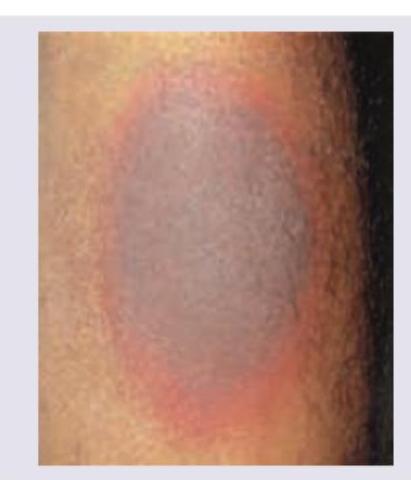
A patient presents to the dermatology clinic reporting recurrent skin lesions as seen on the image. He describes that these lesions emerge within hours each time he takes NSAIDs. What is the most likely diagnosis?
Which of the following are recognized side effects of topical corticosteroid use? a. Hypertrichosis b. Acneiform eruptions c. Skin atrophy d. Blue pigmentation of the skin
A 30-year-old woman with multiple episodes of GTCS was prescribed phenytoin by district hospital physician. After 7 days she presents with a single skin lesion on her arm as shown below. Which of the following will predispose to the condition shown here? (Recent NEET Pattern 2016-17)
A 40-year-old man with severe hidradenitis suppurativa on adalimumab develops new pustules and nodules despite compliance. Current weight is 120 kg. Most appropriate next step is:
Which of the following statements about biologics in psoriasis is FALSE?
Match the systemic medications with their most characteristic cutaneous adverse effects: 1. Hydroxyurea a. Acral erythema 2. Capecitabine b. Leg ulcers 3. EGFR inhibitors c. Acneiform eruption
A 50-year-old woman presents with a well-defined erythematous patch on her leg following the administration of an antibiotic. What is the most likely diagnosis?
Which is the first generation topical retinoid?
Explanation: **Explanation** **1. Why 3 months is the correct answer:** Isotretinoin is a highly effective systemic retinoid used for severe nodulocystic acne. However, it is a potent **teratogen** (FDA Pregnancy Category X), causing characteristic malformations known as "Retinoic Acid Embryopathy." While the elimination half-life of isotretinoin is relatively short (approximately 10–20 hours), guidelines recommend a safety margin to ensure complete clearance from the body and stabilization of endogenous retinoid levels. In India and many international guidelines, a **1-month** washout period is the absolute minimum; however, for the purpose of competitive exams like NEET-PG, **3 months** is frequently cited as the safest clinical window to ensure zero risk of teratogenicity before conception. **2. Why the other options are incorrect:** * **3 days / 2 weeks:** These durations are far too short. The drug and its metabolites (like 4-oxo-isotretinoin) would still be present in the plasma, posing a high risk of spontaneous abortion and severe birth defects (craniofacial, cardiac, and CNS anomalies). * **3 years:** This is the washout period required for **Acitretin** (used in psoriasis). Acitretin can undergo reverse esterification to etretinate in the presence of alcohol, which is stored in adipose tissue for years. Isotretinoin does not have this long-term storage profile. **3. High-Yield Clinical Pearls for NEET-PG:** * **Contraception:** The "Pledge" program requires two forms of contraception starting 1 month before, during, and 1 month after therapy. * **Monitoring:** Baseline and monthly monitoring of Liver Function Tests (LFTs) and Lipid profile (especially Triglycerides) is mandatory. * **Side Effects:** The most common side effect is **Cheilitis** (dryness of lips). It can also cause pseudotumor cerebri if combined with Tetracyclines. * **Acitretin vs. Isotretinoin:** Always distinguish the washout periods: **1 month/3 months** for Isotretinoin vs. **3 years** for Acitretin.
Explanation: **Explanation:** The core concept in this question is the distinction between **autoimmune** and **infectious** skin diseases. Corticosteroids are potent immunosuppressants; while they are the mainstay of treatment for autoimmune conditions, they are generally contraindicated in active viral, bacterial, or fungal infections as they impair the body's ability to contain the pathogen. **Why Pemphigus is Correct:** Pemphigus (including Pemphigus Vulgaris and Pemphigus Foliaceus) is a group of life-threatening **autoimmune blistering diseases** caused by IgG antibodies against desmogleins. Systemic corticosteroids are the **first-line treatment** and are considered "life-saving" in these conditions. They work by suppressing the production of autoantibodies and reducing the inflammatory response that leads to acantholysis (loss of cell-to-cell adhesion). **Why the other options are Incorrect:** * **Herpes Zoster, Varicella, and Herpes Simplex:** These are all viral infections caused by the Herpesviridae family (VZV and HSV). Administering corticosteroids in the presence of an active, untreated viral infection can lead to **dissemination**, delayed healing, and increased risk of secondary bacterial infections due to local or systemic immunosuppression. While steroids are occasionally used in specific complications (like post-herpetic neuralgia or Ramsay Hunt syndrome), they are contraindicated as a primary or monotherapy during the active infectious phase. **NEET-PG High-Yield Pearls:** * **Pemphigus Vulgaris:** Characterized by "row of tombstones" appearance on histology and a positive Nikolsky sign. * **Steroid Sparing Agents:** In Pemphigus, Azathioprine or Mycophenolate Mofetil are often added to reduce long-term steroid side effects. * **Absolute Contraindications for Topical Steroids:** Untreated bacterial (e.g., Impetigo), viral (e.g., Herpes), or fungal (e.g., Tinea) infections, and Rosacea (can cause steroid-induced rosacea).
Explanation: ***Fixed drug eruptions*** - This is the classic presentation of a fixed drug eruption (FDE), characterized by the recurrent appearance of one or more well-demarcated, erythematous to violaceous patches or plaques in the **exact same location** each time the causative drug (in this case, **NSAIDs**) is administered. - The lesions typically appear within hours of drug exposure and resolve over days to weeks, often leaving behind a slate-gray or brown **post-inflammatory hyperpigmentation**. *Erythema multiforme* - This condition is characterized by distinctive **targetoid lesions** (iris lesions), which have at least three concentric zones of color change. The lesion in the image is a uniform plaque, not a target lesion. - While drugs can be a cause, erythema multiforme is most commonly triggered by infections, particularly the **Herpes Simplex Virus (HSV)**. *Drug Induced Pigmentation* - This refers to a discoloration of the skin caused by drugs, but it typically lacks the acute inflammatory features (erythema, edema) seen in an FDE. It is a more chronic and insidious process. - It is commonly associated with drugs like **minocycline**, **amiodarone**, or antimalarials and presents as diffuse or patterned hyperpigmentation, not as a recurrent inflammatory plaque. *Herpes* - Herpes virus infections classically present as grouped **vesicles** (small blisters) on an erythematous base, which then evolve into pustules and crusted erosions. The image shows a plaque, not vesicles. - Recurrence is common with herpes, but it is not triggered by medication ingestion; rather, it's often precipitated by stress, illness, or immunosuppression.
Explanation: ***a, b, c*** - This option correctly includes three well-established local adverse effects of topical corticosteroids: **Hypertrichosis** (increased hair growth), **Acneiform eruptions** (steroid acne), and crucial connective tissue damage leading to **Skin atrophy**. - Other recognized local side effects include telangiectasias, striae, hypopigmentation, purpura, and delayed wound healing. *a, b, d* - This option incorrectly includes 'd. Blue pigmentation of the skin'; topical steroids primarily cause **hypopigmentation** due to melanocyte suppression, not true blue discoloration. - Blue pigmentation (e.g., slate-grey or blue-black) is typically associated with drugs like **Minocycline** or conditions like **Ochronosis** (Alkaptonuria). *a, c, d* - This option incorrectly lists 'd. Blue pigmentation of the skin' (as explained above) and simultaneously omits 'b. **Acneiform eruptions**', which is a very common side effect, especially with high-potency steroids applied to the face. - **Steroid acne** results from follicular occlusion and changes in the sebaceous unit, presenting as monomorphic papules and pustules. *b, c, d* - This option incorrectly includes 'd. Blue pigmentation of the skin' while omitting 'a. **Hypertrichosis**', an effect common due to the stimulation of hair follicles by circulating corticosteroid metabolites. - The development of **hypertrichosis** is concentration-dependent and especially noticeable in women using potent topical steroids on the face.
Explanation: ***HLA-B*1502*** - The image shows a **severe cutaneous adverse reaction (SCAR)** to phenytoin, likely representing early **Stevens-Johnson Syndrome (SJS)** or a maculopapular eruption that may progress to SJS/TEN. - The **HLA-B*1502** allele is strongly associated with an increased risk of **phenytoin-induced SJS/TEN** in patients of **Asian descent** (particularly Han Chinese, Thai, and South Asian populations). - This genetic marker has been identified as a major predisposing factor for aromatic antiepileptic drug-induced severe cutaneous reactions, including those from **phenytoin, carbamazepine, and oxcarbazepine**. - Screening for HLA-B*1502 is recommended before initiating these drugs in high-risk populations. *HLA-B*5801* - The **HLA-B*5801** allele is strongly associated with **allopurinol-induced severe cutaneous adverse reactions**, including SJS and TEN. - It is also associated with carbamazepine-induced SJS/TEN in some populations (particularly Japanese and Europeans). - However, this patient was prescribed **phenytoin, not allopurinol**, and HLA-B*5801 is not the primary genetic marker for phenytoin-induced reactions. *HLA-DQ2, DR3, DR4* - **HLA-DQ2 and DR3/DR4** are genetic markers primarily associated with **celiac disease** and autoimmune disorders like **Type 1 Diabetes Mellitus**. - These HLA alleles are not associated with drug-induced severe cutaneous adverse reactions or phenytoin hypersensitivity. *HLA-DR4* - **HLA-DR4** is associated with autoimmune diseases, most notably **rheumatoid arthritis**, **Type 1 Diabetes**, and **pemphigus vulgaris**. - There is no established association between HLA-DR4 and phenytoin-induced severe cutaneous adverse reactions or SJS/TEN.
Explanation: ***Increase adalimumab frequency*** - For patients on **adalimumab** with an inadequate response, increasing the frequency of administration (e.g., weekly instead of every other week) is a common and effective strategy, especially in highly symptomatic patients. - Given the patient's **high weight (120 kg)**, there's a possibility of suboptimal drug levels, and increasing the frequency can help achieve therapeutic concentrations and improve disease control. *Add intralesional steroids* - **Intralesional steroids** are useful for treating individual, inflamed **hidradenitis suppurativa (HS)** lesions, particularly for acute pain and inflammation. - They are not appropriate for managing widespread, severe disease progression or breakthrough symptoms despite systemic therapy, as they do not address the underlying systemic inflammation. *Switch to another TNF inhibitor* - While switching biologics is an option for non-responders, it is typically considered after optimizing the existing therapy, such as increasing the **frequency** or **dosage** of the current drug, especially when dealing with a potential suboptimal drug level due to high body weight. - In this case, there's still room to intensify the current **adalimumab** regimen before considering a full class switch. *Add oral antibiotics* - **Oral antibiotics** are often used in **hidradenitis suppurativa (HS)** for their anti-inflammatory and immunomodulatory properties and to treat secondary infections. - However, they are generally not the primary solution for breakthrough disease in a patient already on a TNF inhibitor like **adalimumab**, especially when the main issue might be insufficient systemic disease control from the biologic.
Explanation: ***IL-23 inhibitors require most frequent dosing*** - **IL-23 inhibitors** generally have some of the **least frequent dosing schedules** among biologics for psoriasis, often administered every 8-12 weeks after an initial loading phase. - This statement is false because their less frequent dosing contributes to better patient adherence and convenience. *TNF inhibitors increase risk of TB reactivation* - **TNF inhibitors** (e.g., infliximab, adalimumab) modulate the immune system by blocking tumor necrosis factor-alpha, which is crucial for granuloma formation to contain **tuberculosis**. - This mechanism significantly **increases the risk of reactivation of latent TB**, making TB screening essential before and during treatment. *All require baseline TB screening* - Due to the immunosuppressive nature and mechanisms of action of most biologics in psoriasis, **screening for latent or active tuberculosis (TB)** is a mandatory baseline requirement for all classes. - This precaution helps prevent the reactivation of TB, which can be life-threatening in immunocompromised patients. *IL-17 inhibitors may exacerbate IBD* - **IL-17 inhibitors** (e.g., secukinumab, ixekizumab) act by blocking interleukin-17, a cytokine involved in both psoriasis and the pathogenesis of **inflammatory bowel disease (IBD)**. - While generally effective for psoriasis, there have been reports of new-onset or exacerbation of IBD in some patients treated with IL-17 inhibitors, making this a relevant clinical consideration.
Explanation: ***1-b, 2-a, 3-c*** - **Hydroxyurea** is well-known to cause **leg ulcers**, particularly in patients with myeloproliferative disorders. These ulcers are often chronic and difficult to heal. - **Capecitabine** is a prodrug of 5-fluorouracil and characteristically causes **acral erythema**, also known as hand-foot syndrome, presenting as redness, swelling, and pain on the palms and soles. - **EGFR inhibitors** frequently lead to an **acneiform eruption**, often described as a papulopustular rash resembling acne, which can involve the face, scalp, and trunk. *1-a, 2-b, 3-c* - This option incorrectly associates Hydroxyurea with acral erythema; **acral erythema (hand-foot syndrome)** is a classic side effect of **capecitabine**, not hydroxyurea. - It also incorrectly associates capecitabine with leg ulcers; **leg ulcers** are a known adverse effect of **hydroxyurea**, not capecitabine. *1-c, 2-a, 3-b* - This option incorrectly links Hydroxyurea with acneiform eruption; **acneiform eruption** is characteristic of **EGFR inhibitors**. - It also incorrectly attributes leg ulcers to EGFR inhibitors; **leg ulcers** are a common side effect of **hydroxyurea**. *1-b, 2-c, 3-a* - This option incorrectly attributes acneiform eruption to capecitabine; **acneiform eruption** is specifically linked to **EGFR inhibitors**. - It also incorrectly associates EGFR inhibitors with acral erythema; **acral erythema** is a characteristic side effect of **capecitabine**.
Explanation: ***Fixed drug eruption*** - This condition presents as a **solitary, well-demarcated erythematous patch** that recurs at the **same cutaneous site** upon re-exposure to an offending drug. - The history of antibiotic administration followed by a localized patch is highly characteristic of a **fixed drug eruption**. *Contact dermatitis* - This typically results from direct skin exposure to an allergen or irritant, causing an **itchy rash** that is usually not well-demarcated and may include vesicles or bullae. - It would not typically be related to systemic drug administration and does not recur at the same site with repeated systemic exposure. *Psoriasis* - Characterized by **silvery scales** on well-demarcated **erythematous plaques**, often on extensor surfaces like elbows and knees. - It is a chronic inflammatory condition and does not typically present as a single, acute lesion in response to medication. *Tinea corporis* - This is a **fungal infection** of the skin, presenting as a **ring-shaped lesion** with central clearing and raised, scaly borders. - It is not caused by drug administration and has specific morphological features (e.g., scaling, annular pattern) that differentiate it from the described lesion.
Explanation: ***Retinoic acid (tretinoin)*** - **Tretinoin** is the **first generation topical retinoid** and is a naturally occurring derivative of **vitamin A**. - It is widely used for **acne vulgaris** and **photoaging** due to its potent effects on cellular differentiation and proliferation. *Adapalene* - **Adapalene** is a **third-generation topical retinoid** known for its selective action on **retinoic acid receptors (RARs)**. - It causes less irritation compared to tretinoin while maintaining significant efficacy in **acne treatment**. *Tazarotene* - **Tazarotene** is another **third-generation topical retinoid**, known as a **prodrug** that is converted to its active form, **tazarotenic acid**. - It is particularly effective for **psoriasis** and **acne**, demonstrating potent anti-inflammatory effects. *Acitretin* - **Acitretin** is a **second-generation oral retinoid** primarily used for severe **psoriasis**. - It is not a topical retinoid and has a systemic mechanism of action, with significant potential for **teratogenicity**.
Topical Corticosteroids
Practice Questions
Topical Antibiotics
Practice Questions
Topical Antifungals
Practice Questions
Topical Antivirals
Practice Questions
Topical Retinoids
Practice Questions
Systemic Retinoids
Practice Questions
Immunosuppressive Agents
Practice Questions
Antihistamines in Dermatology
Practice Questions
Biological Agents in Dermatology
Practice Questions
Dermatological Vehicles and Delivery Systems
Practice Questions
Phototherapeutic Agents
Practice Questions
Adverse Cutaneous Drug Reactions
Practice Questions
Get full access to all questions, explanations, and performance tracking.
Start For Free