Chemical peeling is indicated in all of the following except
What is the best method to treat a large port-wine stain?
Which of the following is a true statement regarding the human eye?
Type of laser used for capsulotomy is:
A child presents with grouped vesicles on the lips. What is the bedside investigation that you would like to do?
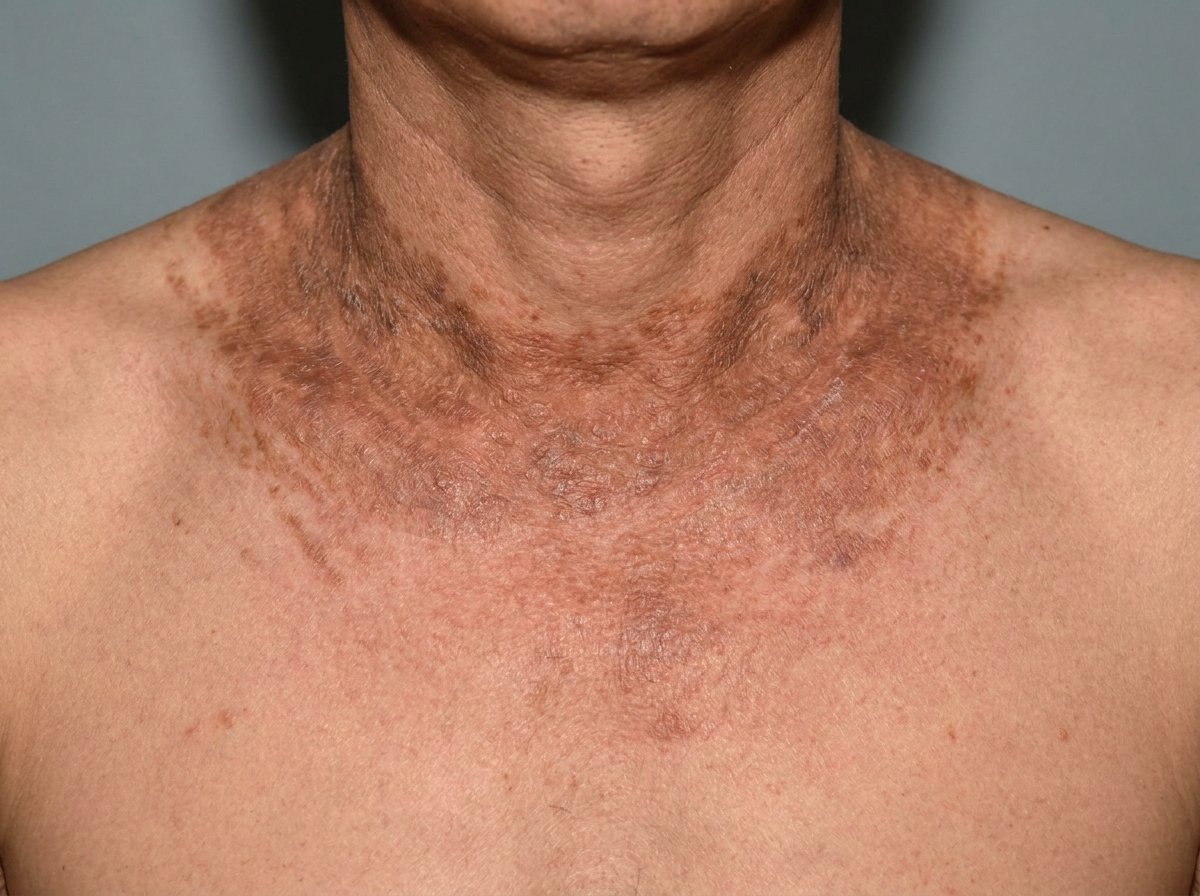
Dermatological manifestation of which of the following diseases?
An 8-year-old girl has extreme photosensitivity since birth. She has recently been diagnosed with skin cancer. What is the diagnosis?
A 6-year-old child born to consanguinity has pallor and intolerance to sunlight. His urine was exposed to Wood's light. Probable diagnosis is:
A 40 year old man presented with a flat 1x1cm scaly, itchy black mole on the front of thigh. Examination did not reveal any inguinal lymphodenopathy. The best course of management would be:
Which of the following events does NOT occur in rods in response to light
Explanation: ***Lichen planus*** - Chemical peels are generally **contraindicated** in active inflammatory conditions like **lichen planus**, as they can worsen the inflammation or trigger a Koebner phenomenon. - While chemical peels can address post-inflammatory hyperpigmentation, they should not be used during the active phase of lichen planus due to the risk of exacerbation. *Melasma* - **Melasma** is a common indication for chemical peels, particularly superficial and medium-depth peels, to reduce hyperpigmentation. - Peels containing agents like **glycolic acid**, salicylic acid, or trichloroacetic acid are often used to lighten melanin deposits. *Acne vulgaris* - Chemical peels are effective in treating **acne vulgaris** by exfoliating the skin, reducing comedones, and improving overall skin texture. - **Salicylic acid peels** are particularly useful due to their lipophilic nature, allowing them to penetrate and clean pores. *Photoaging* - **Photoaging**, characterized by fine lines, wrinkles, and dyspigmentation from sun exposure, is a primary indication for chemical peels. - Peels can promote **collagen remodeling** and help achieve a more even skin tone and smoother texture.
Explanation: ***Pulsed dye laser*** - The **pulsed dye laser (PDL)** is considered the **gold standard** for treating port-wine stains due to its specific targeting of hemoglobin in the dilated capillaries without damaging surrounding tissue. - This treatment involves multiple sessions to progressively lighten the stain and prevent complications such as **nodularity** and **tissue hypertrophy**. *Radiotherapy* - **Radiotherapy** is generally not recommended for port-wine stains due to its potential for **scarring**, **pigment changes**, and risk of **malignancy**. - It is an aggressive treatment typically reserved for **cancerous conditions** or severe proliferative vascular lesions not amenable to other treatments. *Tattooing* - **Tattooing** involves injecting skin-colored pigments into the lesion to camouflage it, but it does not treat the underlying vascular abnormality. - This method can result in an **artificial appearance**, **uneven coverage**, and potential for **allergic reactions** or infections. *Excision with skin grafting* - **Surgical excision** of a large port-wine stain would result in a **significant scar** and require **skin grafting**, which carries risks of graft failure, poor aesthetic outcome, and color mismatch. - This method is generally reserved for very small, localized lesions or those with significant **nodular hypertrophy** that cannot be effectively managed by laser therapy.
Explanation: ***Normal eye medium will permit wavelength of 400- 700 nm*** - The **normal human eye** can perceive light in the **visible spectrum**, which ranges approximately from **400 nm (violet)** to **700 nm (red)**. - This range of wavelengths is efficiently transmitted through the ocular media (cornea, aqueous humor, lens, vitreous humor) to reach the retina. *Lens will not reflect light* - The human **lens** does **reflect some light**, contributing to phenomena like **glare** and internal reflections, especially if there are opacities like cataracts. - While its primary function is to transmit and refract light, it is not perfectly non-reflective. *Even after cataract surgery UV rays are not penetrated* - Modern **intraocular lenses (IOLs)** implanted during **cataract surgery** are designed to **block UV light (UVA and UVB)** to protect the retina. - However, the natural lens also blocks UV light, and before the development of UV-blocking IOLs, patients sometimes experienced increased retinal exposure to UV post-surgery. *Cornea cut off wavelength upto 400 nm* - The **cornea** primarily absorbs and blocks **UVB (280-315 nm)** and **UVC (100-280 nm)** radiation, protecting the anterior segment structures and retina from harmful short-wavelength light. - It does **not cut off wavelengths up to 400 nm**; it primarily transmits wavelengths longer than approximately 300-310 nm into the eye.
Explanation: ***Nd:YAG*** - The **Nd:YAG (Neodymium-doped Yttrium Aluminum Garnet) laser** is the gold standard for performing posterior capsulotomy after cataract surgery due to its **photodisruptive** action. - Its **nanosecond pulses** create plasma and shock waves that effectively cut the opaque posterior capsule with minimal collateral tissue damage. *Argon* - **Argon lasers** are primarily used for **photocoagulation**, such as in treating diabetic retinopathy or retinal tears, due to their ability to create thermal burns. - They are not suitable for capsulotomy as their thermal effect would cause excessive damage and scarring to the surrounding ocular tissues. *Ruby* - The **Ruby laser** was one of the earliest lasers developed but is largely **obsolete** in modern ophthalmology. - It operates at a wavelength not ideal for precise tissue cutting or photodisruption required for capsulotomy. *CO2* - **CO2 lasers** are primarily used in surgery for **tissue ablation** and cutting due to their high absorption by water, leading to surface vaporization. - They are not used for capsulotomy because their wavelength would be heavily absorbed by the ocular media, causing significant damage to the cornea and lens.
Explanation: ***Tzanck smear*** - A **Tzanck smear** is a rapid bedside test that can identify **multinucleated giant cells**, which are seen in herpes simplex virus infections. - The presence of **grouped vesicles on the lips** is highly suggestive of **herpes labialis** (HSV-1), which is primarily a **clinical diagnosis**. - Among the options provided, Tzanck smear is the only relevant bedside investigation, though it has **limited sensitivity and specificity** and **cannot distinguish between HSV and VZV**. - In modern practice, **PCR or direct immunofluorescence** are preferred when laboratory confirmation is needed, but Tzanck smear remains a low-cost option in resource-limited settings. *Wood's lamp* - A Wood's lamp uses **ultraviolet light** to detect certain fungal or bacterial infections by revealing characteristic fluorescence. - It is useful for conditions like **tinea capitis** (green fluorescence) and **erythrasma** (coral-red fluorescence), but has no role in diagnosing viral vesicular lesions. *Slit skin smear* - A **slit skin smear** is used to detect **acid-fast bacilli** in the diagnosis of **leprosy**. - It is not indicated for vesicular lesions and is irrelevant to herpes simplex infection. *KOH* - A **KOH (potassium hydroxide) mount** is used to diagnose **fungal infections** by dissolving keratinocytes and revealing fungal hyphae or spores. - It has no utility in diagnosing viral infections such as herpes simplex.
Explanation: ***Pellagra*** - The image shows a classic "butterfly" rash on the face, specifically a photosensitive dermatitis, which is a hallmark of **pellagra**. - Pellagra is caused by a deficiency of **niacin (vitamin B3)**, characterized by the "3 D's": **dermatitis**, **diarrhea**, and **dementia**. *Photo dermatitis* - While pellagra often presents with photosensitive dermatitis, "photo dermatitis" is a general term for **skin inflammation caused by light exposure** and not a specific disease itself. - It could be caused by various factors, including medication, immune reactions, or other underlying conditions, but the pattern seen here is highly suggestive of pellagra. *Acrodermatitis enteropathica* - This condition is a **hereditary zinc deficiency** that typically presents with a periorificial and acral dermatitis. - The skin lesions are typically **vesicular-pustular or eczematous** and do not usually have the distinct butterfly pattern of photosensitive dermatitis seen in the image. *Vitamin B deficiency* - While pellagra is a vitamin B **(niacin, B3)** deficiency, this option is too broad. - Other vitamin B deficiencies, such as **riboflavin (B2)** or **pyridoxine (B6)** deficiency, have different dermatological manifestations like angular cheilitis, glossitis, or seborrheic dermatitis, but not the characteristic facial rash seen here.
Explanation: ***Xeroderma Pigmentosum*** - This condition is characterized by an extreme sensitivity to **ultraviolet (UV) light** from birth due to defects in **DNA repair mechanisms**, leading to severe sunburns, pigmentary changes (freckles, hypopigmented macules), and a high risk of developing **skin cancers** at a young age. - The history of extreme photosensitivity since birth and the diagnosis of skin cancer in an 8-year-old girl is highly indicative of Xeroderma Pigmentosum. *Bloom syndrome* - Bloom syndrome is an inherited disorder characterized by **stunted growth**, a **photosensitive facial rash (telangiectatic erythema)**, and a predisposition to **various cancers**, including leukemia and lymphomas. - While photosensitivity and cancer risk are present, the extreme skin damage and early onset of specific skin cancers (as opposed to leukemias/lymphomas often seen in Bloom) make Xeroderma Pigmentosum a more fitting diagnosis. *Griscelli syndrome* - Griscelli syndrome is a rare autosomal recessive disorder characterized by **partial albinism**, immunodeficiency, and neurological impairment. - While it involves pigmentary abnormalities, it does not typically present with the extreme photosensitivity or the very early skin cancer development described in the patient. *Chediak Higashi syndrome* - Chediak-Higashi syndrome is an autosomal recessive disorder characterized by **partial albinism**, recurrent pyogenic infections, and neurological abnormalities, due to defective lysosomal trafficking. - This syndrome is not primarily associated with extreme photosensitivity leading to early skin cancers but rather with immunodeficiency and neurological issues.
Explanation: ***Gunther disease*** - The combination of **pallor**, **intolerance to sunlight** (photosensitivity), **consanguinity**, and particularly the **red fluorescence of urine under Wood's light** (due to increased uroporphyrins and coproporphyrins) is highly characteristic of **congenital erythropoietic porphyria (CEP)**, also known as Gunther disease. - This is an **autosomal recessive** disorder of heme synthesis, leading to accumulation of porphyrin precursors. Affected individuals often have **erythrodontia** (reddish-brown discoloration of teeth), severe **anemia**, and **hemolysis**, alongside marked photosensitivity. *SLE* - **Systemic lupus erythematosus (SLE)** can cause **photosensitivity** and **pallor (due to anemia)**, but it is an autoimmune disease, not an inborn error of metabolism. - It does not typically present with red fluorescent urine under Wood's light, which is a specific finding for porphyrias. *Xeroderma pigmentosum* - This is a rare **autosomal recessive** genetic disorder characterized by extreme **photosensitivity** and a high risk of skin cancers due to a defect in DNA repair mechanisms. - While it causes severe photosensitivity, it does not involve abnormalities in porphyrin metabolism or lead to red fluorescent urine. *Bloom syndrome* - **Bloom syndrome** is a rare **autosomal recessive** genetic disorder characterized by **photosensitivity**, **short stature**, a **distinctive facial appearance**, and an increased risk of cancer. - It does not involve porphyrin metabolism or result in red fluorescent urine under Wood's light.
Explanation: ***Excision biopsy*** - A **flat, scaly, itchy, black mole** is highly suspicious for **melanoma**, and an excision biopsy provides the most accurate histopathological diagnosis and depth assessment. - This procedure removes the entire lesion with a narrow margin of normal-appearing skin, allowing for comprehensive evaluation of its nature and determining further management. *FNAC of lesion* - **Fine needle aspiration cytology (FNAC)** is generally used for evaluating palpable masses or lymph nodes, not primary skin lesions like a suspicious mole. - It provides only cellular samples, making it difficult to assess architectural features, depth of invasion, or determine definitive malignancy in skin lesions. *Incision biopsy* - An **incision biopsy** involves removing only a partial sample of the lesion, which can lead to sampling error and an inaccurate diagnosis if the most aggressive part is missed. - For suspected melanoma, an incomplete biopsy can compromise subsequent staging and definitive treatment planning. *Wide excision with inguinal lymphadenectomy* - This is an **overly aggressive initial approach** before a definitive diagnosis of melanoma and its stage has been established. - **Wide excision** is typically performed after an excision biopsy confirms melanoma and determines its depth, while **lymphadenectomy** is indicated for confirmed lymph node involvement.
Explanation: ***Opening of Na+ channels*** - In response to light, **rods hyperpolarize** due to the **closure of Na+ channels**, which reduces the influx of positive ions. - The opening of Na+ channels would lead to depolarization, which is the opposite of what occurs during light detection in rods. *Activation of transducin* - Light causes **conformational changes in rhodopsin**, which in turn activates the G-protein **transducin**. - Activated transducin then goes on to activate **phosphodiesterase (PDE)** as part of the phototransduction cascade. *Structural changes in rhodopsin* - When light strikes the rhodopsin molecule, the **11-cis-retinal chromophore** isomerizes to **all-trans-retinal**. - This **conformational change** in rhodopsin is the initial step that triggers the entire phototransduction pathway. *Decreased intracellular cGMP* - Activated **phosphodiesterase (PDE)**, stimulated by transducin, hydrolyzes **cGMP to GMP**. - The reduction in **cGMP levels** leads to the closure of cGMP-gated Na+ channels, causing hyperpolarization.
Get full access to all questions, explanations, and performance tracking.
Start For Free