Which of the following are treatment options for acne vulgaris?
Most common side effect of retinoids is
Benzoyl peroxide acts in acne vulgaris by:
A 35 years old female presented with acne. She was treated for her acne but after the treatment, she developed pigmentation. Which drug is responsible for hyperpigmentation?
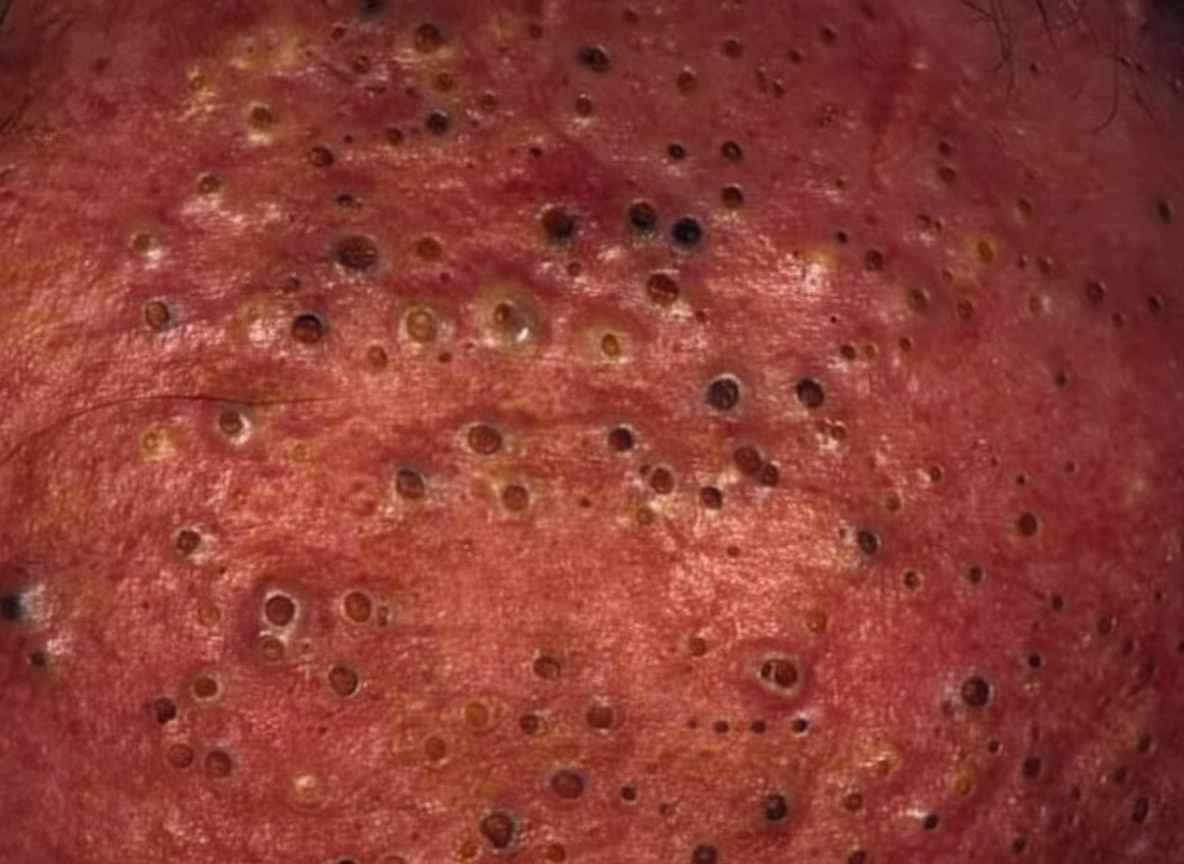
A young boy with oily skin presents with acne as shown. What is the appropriate treatment?
Which of the following is not true about hydroquinone?
A cosmetic dermatologist plans to introduce microneedling radiofrequency for acne scars. Which parameter combination would provide optimal collagen remodeling with minimal risk of thermal injury in Fitzpatrick type IV skin?
A 50-year-old man with Fitzpatrick skin type V desires treatment for melasma. He was previously treated with triple combination cream with partial response. What would be the most evidence-based next step considering safety and efficacy?
A patient treated with Q-switched Nd:YAG laser for nevus of Ota develops paradoxical darkening after 4 weeks. What is the most likely explanation for this phenomenon?
A 42-year-old woman develops sudden onset vision loss in one eye 2 hours after hyaluronic acid filler injection in the glabella. Fundoscopy shows retinal whitening. What is the underlying pathophysiology?
Explanation: ***All of the options*** - All listed options (Isotretinoin, Topical erythromycin, and Oral Minocycline) are well-established and commonly used **treatment options for acne vulgaris**, depending on the severity and type of acne. - The choice of treatment often follows a stepped approach, starting with topical agents for mild to moderate acne and progressing to oral medications like antibiotics or isotretinoin for more severe or resistant cases. *Isotretinoin* - **Isotretinoin** is a powerful oral retinoid primarily used for **severe, recalcitrant nodular acne** that has not responded to other treatments. - It works by reducing sebum production, follicular hyperkeratinization, inflammation, and the growth of *P. acnes*. *Topical erythromycin* - **Topical erythromycin** is an **antibiotic** used to treat mild to moderate inflammatory acne by reducing the growth of *Cutibacterium acnes* (formerly *Propionibacterium acnes*) and decreasing inflammation. - It is often combined with other topical agents like benzoyl peroxide to minimize the development of **antibiotic resistance**. *Oral Minocycline* - **Oral minocycline** is a **tetracycline antibiotic** used for moderate to severe inflammatory acne. - It reduces bacterial populations on the skin and exhibits **anti-inflammatory properties**, making it effective for widespread or deeper lesions.
Explanation: ***Mucocutaneous dryness*** - This is the **most common side effect** of retinoids, particularly oral isotretinoin, occurring in nearly all patients - Manifests as **cheilitis** (dry, cracked lips), **xerosis** (dry skin), **dry nasal mucosa**, and **conjunctival dryness** - Direct result of decreased sebaceous gland activity and altered epithelial differentiation - Managed with **emollients and lip balm** *Headache* - Can occur with retinoid use, but less common than mucocutaneous effects - **Severe headaches** with visual changes may indicate **pseudotumor cerebri** (benign intracranial hypertension), a rare but serious complication requiring immediate discontinuation *Diarrhoea* - **Gastrointestinal side effects** are uncommon with systemic retinoids - Not a characteristic adverse effect of this drug class *Photosensitivity* - While retinoids can increase susceptibility to **sunburn**, this is not the most common side effect - Patients should be advised to use **sunscreen** and avoid excessive sun exposure - Less universal than mucocutaneous dryness
Explanation: ***Decreasing bacterial count*** - **Benzoyl peroxide** is a highly effective topical treatment for acne primarily due to its potent **antimicrobial activity** against *Cutibacterium acnes*, the bacterium implicated in acne pathogenesis. - It works by releasing **free radicals** that disrupt bacterial cell membranes and metabolism, thereby reducing the bacterial load in follicles. *Reduces sebum production* - While sebaceous gland activity is critical in acne, benzoyl peroxide does **not directly reduce sebum production**; retinoids like isotretinoin are known for this effect. - Its primary action is focused on combating bacteria and mildly promoting desquamation rather than affecting **lipid synthesis**. *Acts as a keratolytic agent* - Benzoyl peroxide does possess some **keratolytic activity**, aiding in the shedding of dead skin cells and preventing pore blockage. - However, its keratolytic action is **less pronounced** compared to agents like salicylic acid or tretinoin, and it is not its primary mechanism of action. *Increases epithelial turnover* - While benzoyl peroxide does promote a mild increase in **epithelial cell turnover**, helping to clear clogged pores, it is not its main mechanism of action or defining characteristic. - **Topical retinoids** (e.g., tretinoin, adapalene) are far more effective and primarily used to normalize follicular keratinization and increase cell turnover.
Explanation: ***Minocycline*** - **Minocycline** is known to cause different types of hyperpigmentation, including blue-grey discoloration of the skin, scars, mucosa, eyes, and teeth, especially with long-term use. - This pigmentation can be due to the accumulation of **iron oxide** and **minocycline degradation products** in tissues. *Doxycycline (a tetracycline antibiotic)* - While doxycycline is a tetracycline, it is **less commonly associated with significant hyperpigmentation** compared to minocycline. - It can cause photosensitivity, which might lead to hyperpigmentation in sun-exposed areas, but direct drug-induced blue-grey discoloration is rare. *Tetracycline (a tetracycline antibiotic)* - **Tetracycline** can cause tooth discoloration, especially in children, and photosensitivity, but direct drug-induced skin hyperpigmentation as described is **less common** than with minocycline. - Other side effects like gastrointestinal upset are more prominent. *Erythromycin (a macrolide antibiotic)* - **Erythromycin** is a macrolide antibiotic and is **not typically associated with significant skin hyperpigmentation** as a side effect. - Common side effects include gastrointestinal disturbances like nausea, vomiting, and diarrhea.
Explanation: ***Topical retinoic acid*** - The image shows **comedonal acne** with numerous small bumps, which typically responds well to topical retinoids like retinoic acid. - **Topical retinoids** work by normalizing follicular keratinization and reducing comedone formation, making them the **first-line treatment** for comedonal and mild to moderate inflammatory acne. - Retinoids are superior to other agents for comedonal acne due to their comedolytic properties. *Oral isotretinoin* - **Oral isotretinoin** is reserved for **severe cystic or nodular acne**, or acne that is unresponsive to other treatments, which does not appear to be the case here. - It has significant side effects and requires close monitoring, making it inappropriate for the initial treatment of mild to moderate acne. *Oral steroid* - **Oral steroids** are not a primary treatment for acne and are usually reserved for severe, **fulminant acne** (like acne conglobata) or to manage acute exacerbations of inflammatory acne due to their numerous side effects. - Their primary role is potent **anti-inflammatory action**, but they do not address the underlying pathogenesis of acne. *Benzoyl peroxide* - **Benzoyl peroxide** is effective against **inflammatory acne** due to its antibacterial and keratolytic properties. - While it can be used for comedonal acne and is often combined with retinoids for enhanced efficacy, **topical retinoids are preferred as monotherapy** for predominantly comedonal acne as shown in this image. - Benzoyl peroxide is particularly useful when there are inflammatory lesions (papules, pustules) present.
Explanation: ***It should not be used for melasma or chloasma of pregnancy*** - This statement is **NOT TRUE** - hydroquinone is actually a **first-line treatment for melasma** including chloasma (melasma of pregnancy) - Hydroquinone 2-4% is one of the **most effective topical agents** for treating melasma and is widely recommended in dermatological guidelines - While hydroquinone use during **active pregnancy** is approached with caution (FDA Category C), it is definitely indicated for treating melasma/chloasma **after pregnancy** and for general melasma in non-pregnant patients - The condition (melasma/chloasma) is appropriately treated with hydroquinone; only the **timing during pregnancy** requires consideration *Response is incomplete and pigmentation may recur* - This is a **TRUE statement** about hydroquinone therapy - Treatment response is often **incomplete** with partial lightening of hyperpigmentation - **Recurrence is common** after discontinuation, especially with continued sun exposure or hormonal triggers - Maintenance therapy is often needed to sustain results *It inhibits tyrosinase* - This is a **TRUE statement** - hydroquinone's primary mechanism of action - Acts as a **competitive inhibitor of tyrosinase**, the rate-limiting enzyme in melanin synthesis - This inhibition reduces melanin production in melanocytes, leading to depigmentation *It requires prescription strength concentrations above 2%* - This is a **TRUE statement** in most countries including India and the USA - Hydroquinone concentrations **≤2%** are available over-the-counter (OTC) - Concentrations **>2% (typically 3-4%)** require a prescription - Higher concentrations provide greater efficacy but also increased risk of side effects like ochronosis
Explanation: ***Needle depth 1.5-2 mm, temperature 60-65°C, pulse duration 100-200 ms*** - Optimal **collagen remodeling** occurs when the tissue is heated to **60-65°C**, which triggers the denaturation of proteins and the subsequent production of new collagen and elastin. - A depth of **1.5-2 mm** specifically targets the **papillary and mid-reticular dermis**, while the shorter pulse duration minimizes **Post-Inflammatory Hyperpigmentation (PIH)** in **Fitzpatrick type IV** skin. *Needle depth 3.5 mm, temperature 70°C, pulse duration 1000 ms* - Temperatures reaching **70°C** and very high pulse durations significantly increase the risk of **thermal necrosis** and bulk heating injuries. - A depth of **3.5 mm** is often too deep for standard facial acne scarring and may damage underlying **subcutaneous structures** or cause permanent scarring. *Needle depth 4 mm, temperature 75°C, pulse duration 500 ms* - High temperatures of **75°C** cause excessive tissue coagulation, which can lead to localized **skin burns** and prolonged downtime. - Excessive needle depth combined with high energy delivery poses a severe risk for **atrophic scarring** and pigmentary changes in darker skin types. *Needle depth 0.5 mm, temperature 55°C, pulse duration 50 ms* - A depth of **0.5 mm** is generally insufficient to reach the collagen-rich dermis required for significant improvement of **depressed acne scars**. - A temperature of **55°C** is below the threshold for effective **collagen denaturation**, resulting in suboptimal clinical outcomes for scar revision.
Explanation: ***Q-switched Nd:YAG laser 1064 nm with low fluence*** - This approach, often called **laser toning**, uses a long wavelength that spares the epidermis, making it the safest laser option for **Fitzpatrick skin type V** to avoid **post-inflammatory hyperpigmentation (PIH)**. - It is a clinically sound next step for **recalcitrant melasma** that has only partially responded to first-line therapies like **triple combination cream**. *Fractional CO2 laser resurfacing* - This is an **ablative** treatment that causes significant thermal damage, which carries an unacceptably high risk of **PIH** and scarring in darker skin types. - While effective for skin remodeling, it is generally contraindicated for treating melasma in **type V skin** due to the likelihood of worsening the pigmentation. *Intense pulsed light therapy* - **IPL** uses a broad spectrum of light which is poorly targeted for melasma in dark-skinned individuals and is frequently associated with **rebound hyperpigmentation**. - The melanin in the surrounding **darker skin (Type V)** competes for the energy, leading to a high risk of **thermal burns** and uneven results. *TCA 35% chemical peel* - A 35% concentration of **Trichloroacetic acid (TCA)** is considered a **medium-depth peel**, which is generally too aggressive for patients with Fitzpatrick skin type V. - Medium-depth peels in dark skin types are likely to cause **persistent dyschromia** or permanent **hypopigmentation**, whereas superficial peels (like glycolic or salicylic acid) are safer.
Explanation: ***Increased melanogenesis due to suboptimal fluence*** - Paradoxical darkening in **nevus of Ota** during **Q-switched Nd:YAG** therapy often results from **suboptimal fluence**, which triggers reactive **melanogenesis** instead of destroying the target cells. - This occurs when the energy delivered is sufficient to stimulate **dermal melanocytes** but remains below the threshold required for **selective photothermolysis** and cell destruction. *Delayed clearance in deeper dermal melanocytes* - Delayed clearance typically results in a slow resolution of the lesion rather than an actual **increase in pigmentation** or darkening. - The darkening suggests an active production of **melanin** rather than a passive failure of the lymphatic system to clear debris. *Post-inflammatory hyperpigmentation due to epidermal injury* - **Post-inflammatory hyperpigmentation (PIH)** usually presents as a more generalized or superficial brownish tan following **epidermal damage**. - While common in darker skin types, the term "paradoxical darkening" in the context of dermal lesions specifically refers to the reactive stimulation of **dermal melanocytes**. *Conversion to melanoma* - There is no clinical or histopathological evidence that **Q-switched lasers** induce **malignant transformation** or conversion of a benign nevus to **melanoma**. - While **nevus of Ota** has a small baseline risk of ocular or CNS melanoma, laser-induced darkening is a transient physiological response, not a neoplastic change.
Explanation: ***Retrograde embolization via angular artery to ophthalmic artery*** - Glabellar filler injection can inadvertently enter the **angular artery**, where high injection pressure forces the filler **retrograde** into the **ophthalmic artery**. - Once pressure is released, the filler travels antegrade into the **central retinal artery**, causing occlusion and classic **retinal whitening** due to ischemia. *Compression of supraorbital nerve* - This would lead to **sensory changes** or pain in the forehead region rather than sudden, painless vision loss. - Nerve compression does not explain the **fundoscopic finding** of retinal whitening or vascular compromise. *Direct traumatic optic nerve injury* - The **optic nerve** is located deep within the orbit and is not typically reachable by standard aesthetic needles used in the glabella. - Traumatic injury would likely present with an **afferent pupillary defect** without the characteristic **ischemic retinal whitening** associated with artery occlusion. *Allergic reaction causing optic neuritis* - **Optic neuritis** presents with painful eye movements and inflammatory changes, rather than the hyper-acute vision loss seen in arterial embolization. - A localized allergic reaction to **hyaluronic acid** would cause significant swelling and redness at the injection site rather than sudden **retinal ischemia**.
Get full access to all questions, explanations, and performance tracking.
Start For Free