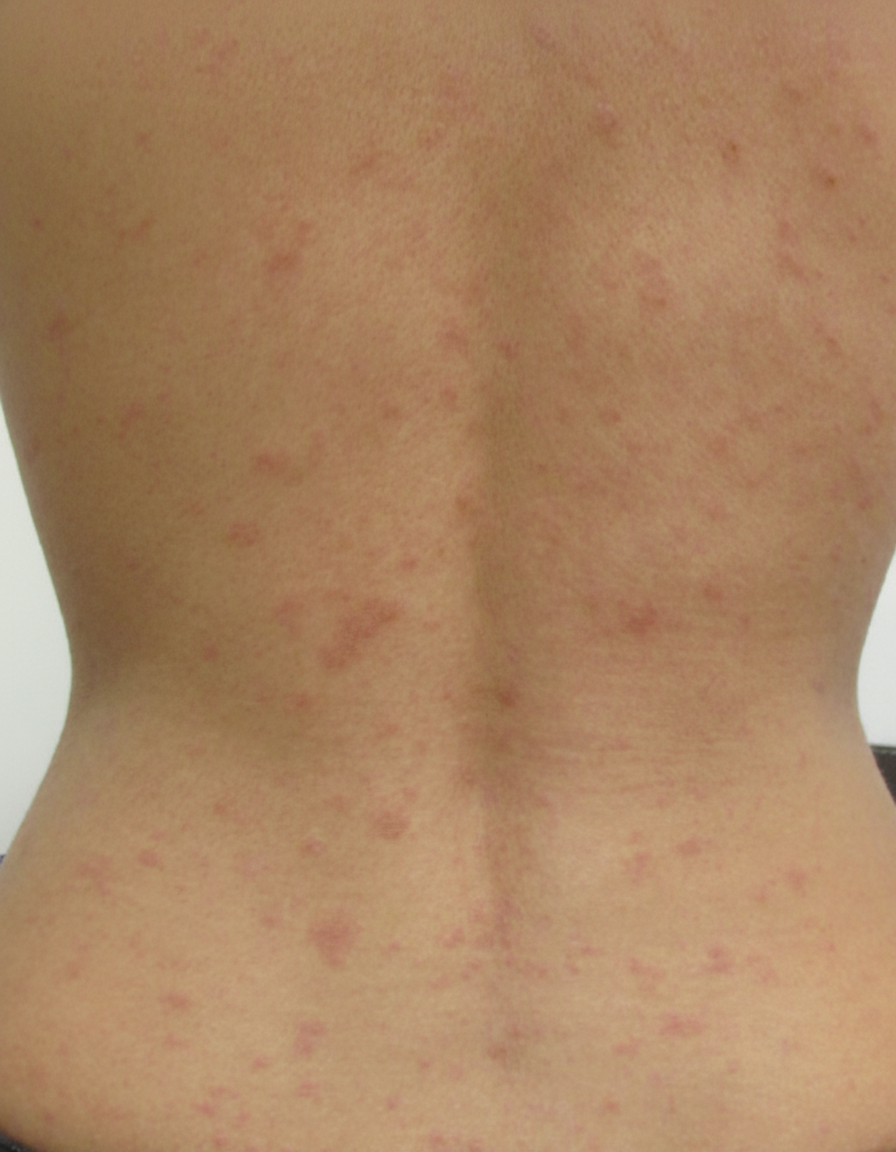
Which condition is characterized by 'Iris lesions'?
Which of the following cells is known as the first cousin of the melanocyte?
A 60-year-old diabetic female presents with a burning sensation related to spicy food. Intraoral examination reveals multiple periodontal abscesses and a keratotic area in a lace pattern with occasional erosive areas within the lace pattern. What is the provisional diagnosis for this patient?
Which of the following is FALSE about erythema nodosum?
Keratoderma is/are seen in?
Which of the following is/are not a subtype of lichen planus?
A 'fir tree pattern' lesion on the trunk is characteristic of which condition?
The oral mucosa becomes rigid, blanched and opaque in which of the following conditions?
Which of the following statements is NOT true about Porphyria cutanea tarda (PCT)?
What is the suspected etiology of Pityriasis rosea?
Explanation: **Explanation:** **Erythema Multiforme (EM)** is the classic condition associated with **Iris lesions**, also known as **Target lesions** or **Bull’s eye lesions**. These are pathognomonic and typically consist of three concentric zones: 1. **Central zone:** Dusky, dark red, or purpuric (sometimes with a central blister). 2. **Middle zone:** A pale, edematous ring. 3. **Outer zone:** A bright red erythematous halo. This morphology results from a cell-mediated (Type IV) hypersensitivity reaction, most commonly triggered by **Herpes Simplex Virus (HSV)** or certain medications. **Analysis of Incorrect Options:** * **SLE (A):** Characterized by a **Malar (Butterfly) rash**—an erythematous, confluent rash over the cheeks and bridge of the nose, sparing the nasolabial folds. * **Aphthous ulcers (C):** These are painful, shallow oral ulcers with a yellow-gray base and an erythematous border, but they do not manifest as targetoid cutaneous lesions. * **DLE (D):** Characterized by well-defined, scaly, erythematous plaques that lead to **atrophy, scarring, and telangiectasia**, often found in sun-exposed areas. **NEET-PG High-Yield Pearls:** * **Most common trigger for EM:** Herpes Simplex Virus (HSV-1 and HSV-2). * **Distribution:** Lesions are typically **acral** (hands and feet) and symmetrical. * **Nikolsky Sign:** Negative in Erythema Multiforme (unlike Pemphigus Vulgaris or SJS/TEN). * **EM Major vs. Minor:** EM Major involves significant mucosal involvement (at least two sites), whereas EM Minor involves minimal or no mucosal involvement.
Explanation: **Explanation:** **Why Nevus Cells are the "First Cousin" of Melanocytes:** Both melanocytes and nevus cells share a common embryological origin—the **neural crest**. While they are closely related, they differ in morphology and behavior. Melanocytes are dendritic cells located in the basal layer of the epidermis that transfer melanin to keratinocytes. In contrast, **nevus cells** (the cells forming a melanocytic nevus or "mole") are considered modified melanocytes. They lack dendrites, are larger, and have a tendency to cluster in nests (thecae). Because they are derived from the same lineage but exhibit distinct structural differences, they are colloquially termed "first cousins." **Analysis of Incorrect Options:** * **B. Junctional cell:** This is not a distinct cell type but rather a descriptive term for nevus cells located at the dermo-epidermal junction (as seen in junctional nevi). * **C. Myelin cell (Schwann cell):** While Schwann cells also originate from the neural crest, they are involved in the myelination of peripheral nerves. Although they share a common "ancestor," they are more distantly related to melanocytes than nevus cells are. **High-Yield Clinical Pearls for NEET-PG:** * **Embryology:** Remember that melanocytes migrate from the neural crest to the skin between the **8th and 12th weeks** of gestation. * **Abtropfung Phenomenon:** This refers to the "dropping down" of nevus cells from the epidermis into the dermis as a nevus matures (Junctional → Compound → Intradermal). * **Key Marker:** Both melanocytes and nevus cells are typically **S-100 positive** on immunohistochemistry. * **Dendrites:** The presence of dendrites is the primary morphological feature that distinguishes a mature melanocyte from a nevus cell.
Explanation: ### Explanation **Correct Answer: B. Oral lichen planus** The clinical presentation is classic for **Oral Lichen Planus (OLP)**. The "lace pattern" described is the pathognomonic **Wickham striae**—a network of white, keratotic lines. OLP commonly presents in two forms: the asymptomatic reticular type (lace-like) and the symptomatic **erosive type**, which causes the burning sensation triggered by spicy food. The presence of periodontal abscesses and diabetes in this patient suggests a possible association with **Grinspan’s Syndrome** (a triad of Hypertension, Diabetes Mellitus, and Oral Lichen Planus). **Why other options are incorrect:** * **Oral hairy leukoplakia:** Typically seen in HIV/immunocompromised patients, it presents as non-scrapable white corrugated patches on the **lateral borders** of the tongue, not as a generalized lace-like pattern. * **Oral squamous cell carcinoma:** Usually presents as a chronic non-healing ulcer with indurated borders or a persistent exophytic growth. While OLP has a small risk of malignant transformation, the "lace pattern" specifically points to a lichenoid etiology. * **Oral pemphigus:** Characterized by fragile vesicles that rupture to leave painful, ragged erosions. It lacks the characteristic hyperkeratotic Wickham striae. **NEET-PG High-Yield Pearls:** * **Wickham Striae:** White lacy lines due to focal hypergranulosis. * **Histopathology:** Shows "saw-tooth" rete ridges, liquefaction degeneration of the basal layer, and a band-like lymphocytic infiltrate at the dermo-epidermal junction. * **Civatte Bodies:** Apoptotic keratinocytes found in the lower epidermis/upper dermis. * **Koebner Phenomenon:** Development of lesions at sites of trauma (also seen in Psoriasis and Vitiligo).
Explanation: **Explanation:** Erythema Nodosum (EN) is the most common form of **septal panniculitis** (inflammation of the subcutaneous fat). It represents a delayed-type hypersensitivity reaction to various systemic stimuli. **1. Why Option A is False (The Correct Answer):** The **shins (pretibial area)** are the most common site for erythema nodosum, not the trunk. The lesions are typically symmetrical, tender, erythematous nodules located on the lower extremities. While they can occasionally appear on the forearms or thighs, truncal involvement is extremely rare. **2. Analysis of Other Options:** * **Option B:** The lesions undergo a characteristic color change. They begin as bright red, tense nodules and, as they resolve over 2–6 weeks, they evolve into a **bruise-like appearance** (changing from blue/purple to yellowish-green). This is known as *erythema contusiformis*. * **Option C:** Sarcoidosis is a well-known cause of EN. When EN is associated with bilateral hilar lymphadenopathy, fever, and arthralgia, it is termed **Löfgren’s syndrome**, which carries a good prognosis. * **Option D:** The lesions are classically **exquisitely tender and painful** to touch, which is a hallmark clinical feature helping to differentiate it from other dermatological nodules. **High-Yield Clinical Pearls for NEET-PG:** * **Histopathology:** Shows **septal panniculitis** without vasculitis. Look for **Miescher’s radial granulomas** (small nodules of spindle-shaped cells around a central cleft). * **Etiology Mnemonic (SHOUT):** **S**arcoidosis, **H**istoplasmosis (and other fungi), **O**CPs/Pregnancy, **U**lcerative colitis (IBD), **T**uberculosis/Streptococcal infections (most common trigger in children). * **Management:** Usually self-limiting; treated with NSAIDs, bed rest, and treating the underlying cause.
Explanation: **Explanation:** **Keratoderma** refers to the marked thickening of the stratum corneum (hyperkeratosis) on the palms and soles. **Why Pityriasis Rubra Pilaris (PRP) is correct:** PRP is a chronic inflammatory dermatosis characterized by the "red-orange" triad. One of its hallmark features is **diffuse, orange-red palmoplantar keratoderma**. Other diagnostic features include follicular papules on an erythematous base (nut-meg grater sensation), "islands of sparing" (normal skin amidst affected areas), and progression to erythroderma. **Why other options are incorrect:** * **Pemphigus:** This is a group of autoimmune blistering diseases (Type II hypersensitivity) characterized by acantholysis (loss of cell-to-cell adhesion) and intraepidermal blisters. It does not typically present with hyperkeratotic thickening. * **Pityriasis Rosea:** A self-limiting inflammatory condition characterized by a "herald patch" followed by a "Christmas tree" distribution of scaly papules and plaques. It involves fine scaling (collarette scale) rather than keratoderma. * **Dermatitis Herpetiformis:** An intensely pruritic, autoimmune blistering disorder associated with Celiac disease. It presents with grouped (herpetiform) vesicles on extensor surfaces, not keratoderma. **High-Yield Clinical Pearls for NEET-PG:** * **PRP Triad:** Follicular plugging, orange-red keratoderma, and islands of sparing. * **Differential for Palmoplantar Keratoderma:** Psoriasis, PRP, Eczema (Tylotic), Tinea pedis, and hereditary syndromes (e.g., Papillon-Lefèvre syndrome). * **Treatment of choice for PRP:** Oral Retinoids (Acitretin) are the first-line systemic therapy.
Explanation: **Explanation:** The question asks to identify which option is **not** a subtype of Lichen Planus (LP). While the provided answer key marks **Ulcerative Lichen Planus** as the correct choice, it is important to note a clinical nuance: Ulcerative (or erosive) LP is indeed a recognized clinical variant. However, in the context of standard dermatological classification for exams like NEET-PG, **Lichen Nitidus** and **Lichen Scrofulosorum** are distinct clinical entities entirely separate from the Lichen Planus spectrum. 1. **Why Ulcerative Lichen Planus is the marked answer:** In some traditional classifications, "Ulcerative LP" is considered a complication or a specific manifestation of mucosal/palmoplantar LP rather than a primary morphological subtype. However, from a strictly competitive exam perspective, if this is the designated key, it implies the examiner distinguishes between "Erosive" (common) and "Ulcerative" (rare/distinct). 2. **Lichen Nitidus (Option B):** This is a separate chronic inflammatory disease characterized by tiny, shiny, skin-colored papules ("pinhead-sized"). While it shares some histological features with LP (like a lichenoid infiltrate), it is a **distinct entity**, not a subtype. 3. **Hypertrophic Lichen Planus (Option C):** This is a **classic subtype** of LP, typically presenting as thick, itchy plaques on the shins. It is the most common variant to undergo malignant transformation into Squamous Cell Carcinoma. 4. **Lichen Scrofulosorum (Option D):** This is a **Tuberculid** (a hypersensitivity reaction to *M. tuberculosis*). It presents as follicular, lichenoid papules in children with systemic TB. It has no relation to Lichen Planus. **Clinical Pearls for NEET-PG:** * **P's of LP:** Planar, Purple, Polygonal, Pruritic, Papules, and Plaques. * **Wickham Striae:** White reticulate lines on the surface of lesions (due to focal hypergranulosis). * **Koebner Phenomenon:** Positive in LP (lesions appearing at sites of trauma). * **Histology:** "Saw-tooth" appearance of rete ridges and Civatte bodies (apoptotic keratinocytes).
Explanation: **Explanation:** **Pityriasis Rosea (PR)** is a self-limiting, inflammatory skin condition characterized by the **"Fir Tree" (or Christmas tree) pattern**. The condition typically begins with a single, large, scaly "Herald Patch." This is followed 1–2 weeks later by a generalized eruption of smaller, oval, salmon-colored macules and papules. These lesions follow the lines of cleavage (**Langer’s lines**) on the trunk, creating a symmetrical distribution resembling the branches of a fir tree. A characteristic "collarette of scales" (peripheral scaling with the free edge pointing inward) is often seen. **Why other options are incorrect:** * **Pemphigoid:** An autoimmune blistering disease characterized by large, tense bullae. It does not present with a patterned scaly rash. * **Psoriasis:** Typically presents as well-demarcated erythematous plaques with silvery-white scales, most commonly on extensors (knees, elbows). While it can involve the trunk, it does not follow Langer's lines. * **Pityriasis Versicolor:** A fungal infection (Malassezia) causing hypo- or hyperpigmented macules with fine scaling (branny/furfuraceous). It lacks the specific fir tree distribution. **High-Yield Clinical Pearls for NEET-PG:** * **Etiology:** Associated with Human Herpesvirus 6 and 7 (**HHV-6 & HHV-7**). * **Herald Patch:** The initial lesion, usually 2–10 cm, seen in 80% of cases. * **Collarette Scale:** Scaling that is attached at the periphery and free in the center. * **Management:** Reassurance (self-limiting in 6–8 weeks); antihistamines for pruritus. * **Differential:** Secondary syphilis (always rule out if lesions involve palms and soles).
Explanation: **Explanation:** **Oral Submucous Fibrosis (OSMF)** is a chronic, progressive, premalignant condition characterized by juxta-epithelial inflammatory reaction followed by **fibroelastic change** of the lamina propria. 1. **Why the correct answer is right:** The hallmark of OSMF is the excessive deposition of collagen in the oral mucosa. This leads to the mucosa becoming **rigid** (due to vertical fibrous bands), **blanched** (due to decreased vascularity from fibrosis), and **opaque/marble-like** in appearance. Clinically, this manifests as a progressive inability to open the mouth (trismus) and a burning sensation when eating spicy food. It is strongly associated with **Areca nut (betel nut)** chewing. 2. **Why the incorrect options are wrong:** * **Pemphigus vulgaris:** An autoimmune blistering disorder characterized by flaccid bullae and painful erosions (Nikolsky sign positive). It causes mucosal "sloughing," not rigidity or blanching. * **Lupus erythematosus:** Oral involvement typically presents as "discoid" lesions with a central atrophic area and peripheral radiating white striae, often associated with ulceration, but not generalized rigidity. * **Ehlers-Danlos syndrome:** A connective tissue disorder characterized by hypermobility and tissue **fragility/laxity**. It is the opposite of rigidity; patients often show the *Gorlin sign* (ability to touch the tip of the nose with the tongue). **High-Yield Clinical Pearls for NEET-PG:** * **Etiology:** Areca nut is the primary risk factor (contains alkaloids like arecoline that stimulate collagen synthesis). * **Clinical Sign:** "Hockey-stick" uvula or bud-shaped uvula due to fibrosis. * **Pre-malignant Potential:** OSMF has a high malignant transformation rate (approx. 7–13%) to **Squamous Cell Carcinoma**. * **Treatment:** Cessation of habit, intralesional steroids, and hyaluronidase; surgical intervention for severe trismus.
Explanation: **Explanation:** **Porphyria Cutanea Tarda (PCT)** is the most common type of porphyria worldwide. The question asks for the statement that is **NOT** true; however, Option A states it is the most common type, which is a **factually correct** statement. In the context of this specific question format, Option A is the intended answer because it is the defining characteristic of the disease's prevalence, though usually, such questions provide a false statement to be identified. 1. **Enzyme Deficiency (Option B):** PCT is caused by a deficiency or decreased activity of **Uroporphyrinogen Decarboxylase (UROD)**. This leads to the accumulation of uroporphyrins, which are photo-sensitizing agents. 2. **Risk Factors (Option C):** **Hepatitis C Virus (HCV)** is a major independent risk factor and trigger for PCT. Other triggers include alcohol consumption, estrogen therapy, and iron overload (hemochromatosis). 3. **Treatment (Option D):** The mainstay of treatment is **repeated phlebotomy** to reduce hepatic iron stores. Low-dose antimalarials (Chloroquine or Hydroxychloroquine) are also used to increase the excretion of porphyrins. **Clinical Pearls for NEET-PG:** * **Clinical Presentation:** Characterized by **fragile skin, subepidermal blisters, and erosions** on sun-exposed areas (dorsum of hands). * **Hypertrichosis:** Facial hair growth (especially malar) is a classic sign. * **Diagnosis:** Urine shows "tea-colored" or "port-wine" discoloration; under **Wood’s lamp**, urine exhibits **coral-red fluorescence**. * **Histopathology:** Shows subepidermal blisters with "caterpillar bodies" in the roof of the blister.
Explanation: ### Explanation **Pityriasis Rosea (PR)** is an acute, self-limiting inflammatory skin condition. The correct answer is **Herpes virus** because current medical evidence strongly links the reactivation of **Human Herpesvirus 6 (HHV-6) and Human Herpesvirus 7 (HHV-7)** to the pathogenesis of this condition. While the exact mechanism is debated, the viral prodrome often seen in patients and the seasonal clustering of cases support an infectious etiology. #### Analysis of Options: * **Option A: Malassezia furfur:** This is a lipophilic yeast responsible for **Pityriasis versicolor** and Seborrheic dermatitis. Despite the similar name, it has no role in Pityriasis rosea. * **Option C: Autoimmune disorder:** PR is an inflammatory reaction, but it is not classified as an autoimmune disease. It does not require long-term immunosuppression and typically does not recur. * **Option D: Staphylococcus:** Bacterial infections like Staphylococcus cause pyodermas (e.g., Impetigo or Folliculitis). PR is not a bacterial infection. #### High-Yield Clinical Pearls for NEET-PG: 1. **Herald Patch:** The first sign in 50-90% of cases; a single, large (2-10 cm), oval, erythematous plaque with peripheral scaling. 2. **Christmas Tree Pattern:** Secondary eruption follows 1-2 weeks later, consisting of smaller papulosquamous lesions along the lines of cleavage (Langer’s lines) on the trunk. 3. **Collarette of Scale:** A characteristic fine scale attached at the periphery with the free edge facing inwards. 4. **Hanging Curtain Sign:** When the skin is pinched, the scales fold inward (useful for clinical diagnosis). 5. **Management:** Usually reassurance (self-limiting in 6-8 weeks). Severe cases may be treated with Acyclovir or Macrolides.
Structure and Function of Skin
Practice Questions
Cutaneous Histopathology
Practice Questions
Dermatological Examination
Practice Questions
Skin Lesions: Morphology and Description
Practice Questions
Principles of Diagnosis in Dermatology
Practice Questions
Dermatological Procedures
Practice Questions
Wound Healing
Practice Questions
Cutaneous Immunology
Practice Questions
Genetics in Dermatology
Practice Questions
Cutaneous Manifestations of Systemic Diseases
Practice Questions
Geriatric Dermatology
Practice Questions
Pediatric Dermatology Basics
Practice Questions
Get full access to all questions, explanations, and performance tracking.
Start For Free