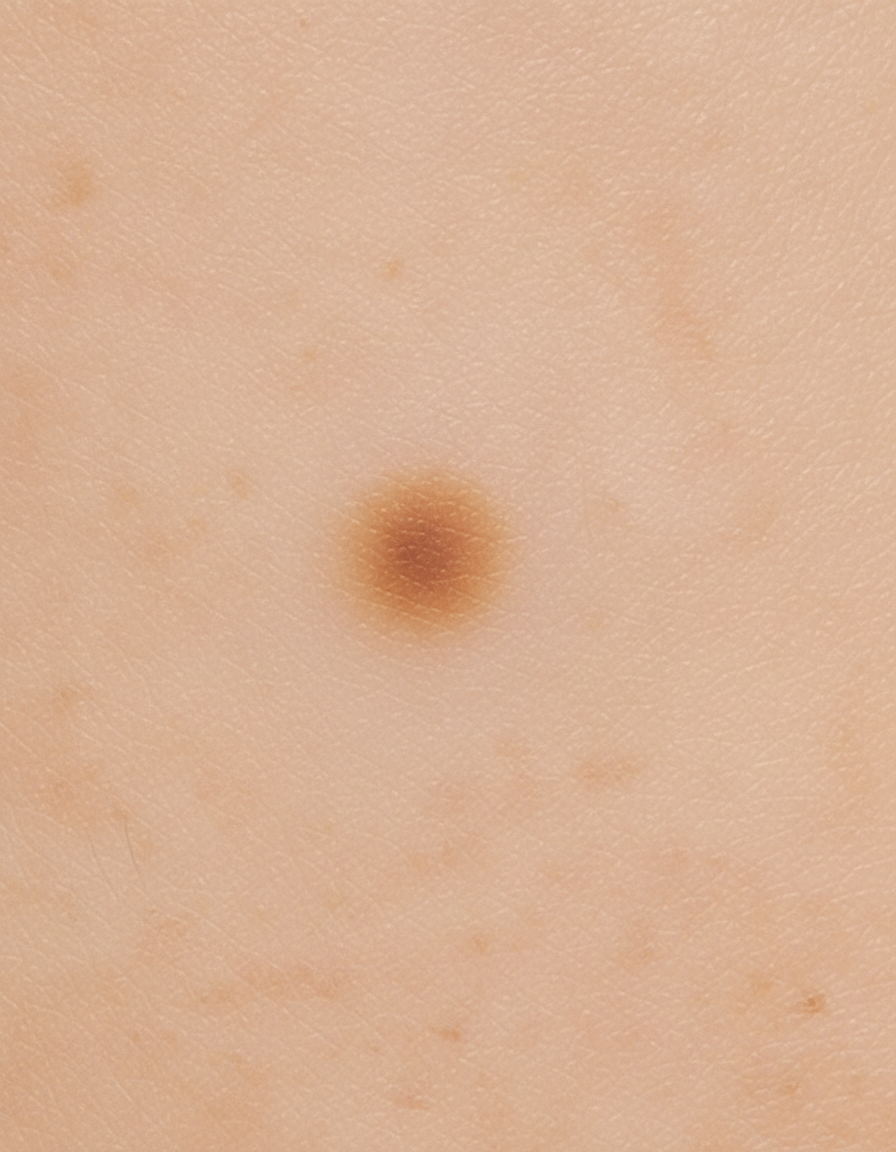
Which of the following skin layers contains melanocytes responsible for skin pigmentation?
A 20-year-old patient with focal seizures was prescribed Carbamazepine. Four weeks later he presents with fever and multiple skin lesions with periorbital edema. On examination generalized lymph nodes enlargement is noted. Blood work shows marked eosinophilia with atypical lymphocytosis. What is the diagnosis?
Identify the type of ulcer shown on the heel of the foot.

The following image shows

What is the most likely diagnosis of the image given below?

A patient presents with intensely pruritic vesicular lesions on extensor surfaces. What is the most likely diagnosis based on the clinical image?

A 41-year-old male complains of itching on the upper chest for one month. What is the most likely diagnosis?

Identify the lesion:

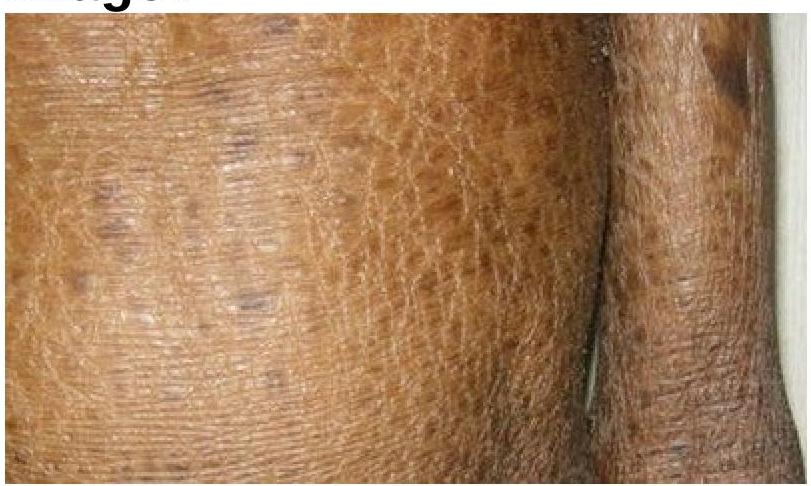
A 16-year-old boy with cryptorchidism presents with dry skin. Identify the lesion:

Identify the lesion: (Recent NEET Pattern 2016-17)

Explanation: ***Stratum basale (basal layer)*** - Melanocytes are specialized dendritic cells located predominantly in the **stratum basale** (basal layer) of the epidermis. - Their primary function is the synthesis of **melanin**, which is subsequently transferred to adjacent keratinocytes, determining skin color and shielding the nuclei from **UV radiation**. - This is the correct answer as it specifically identifies the layer containing melanocytes. *Dermis* - The dermis is the connective tissue layer located below the epidermis, mainly composed of **collagen fibers** and **elastin**. - It contains structures like hair follicles, glands, nerves, and blood vessels, but not the active melanocytes responsible for normal physiological skin pigmentation. *Stratum granulosum* - This is the granular layer of the epidermis, located above the stratum spinosum and below the stratum lucidum/corneum. - It contains keratinocytes with **keratohyalin granules** that contribute to the barrier function, but melanocytes are not found in this layer. *Stratum corneum* - This is the outermost layer of the epidermis, composed entirely of dead, flattened **keratinocytes** (corneocytes). - Functioning as a protective barrier, this layer lacks viable cells, and thus cannot harbor melanocytes.
Explanation: ***DRESS syndrome*** - The combination of **fever**, widespread **skin lesions**, **periorbital edema**, **generalized lymphadenopathy**, **eosinophilia**, and atypical lymphocytosis following **carbamazepine** use is highly characteristic of Drug Reaction with Eosinophilia and Systemic Symptoms (DRESS) syndrome. - DRESS syndrome typically has a **delayed onset** (2-8 weeks) after drug initiation and involves multiple organ systems, which aligns with the patient's presentation. *TEN/SJS* - While both Toxic Epidermal Necrolysis (TEN) and Stevens-Johnson Syndrome (SJS) are severe cutaneous adverse reactions to drugs, they are primarily characterized by **epidermal detachment** and severe mucosal involvement, which are not explicitly described here. - Although these can present with fever and skin lesions, they typically do not involve prominent **lymphadenopathy** or **marked eosinophilia** to the extent seen in this case. *Fixed drug eruption* - A fixed drug eruption is characterized by **recurrent skin lesions** that appear in the **same location** each time a particular drug is administered. - It does not typically involve systemic symptoms such as **fever**, **lymphadenopathy**, or significant **eosinophilia**. *Hypereosinophilic syndrome* - This syndrome is a persistent, unexplained **eosinophilia** (typically >1500 cells/µL) that lasts for at least 6 months and is associated with signs and symptoms of **organ dysfunction** due to eosinophil infiltration. - While this patient has eosinophilia, the clear association with a drug (carbamazepine), the presence of widespread skin lesions, fever, and lymphadenopathy point more towards a drug-induced hypersensitivity reaction like DRESS syndrome rather than primary hypereosinophilic syndrome.
Explanation: ***Correct Option: Arterial ulcer*** - Arterial ulcers are typically found on the **distal parts of the extremities**, such as the toes, feet, and bony prominences like the heel, where blood supply is most compromised. - They often appear as **punched-out lesions** with a pale, necrotic base, minimal granulation tissue, and **well-demarcated edges**, as seen in the image. - Clinical features include **pain** (especially at rest or elevation), **pale or cyanotic skin**, **absent pulses**, and **hair loss** over the affected area. *Incorrect Option: Venous ulcer* - Venous ulcers usually occur around the **medial malleolus (ankle bone)**, not typically on the heel. - They present with an **irregular shape**, a red, granular base, and are surrounded by **edematous, hyperpigmented skin** (brawny edema), which is not visible here. - Associated features include **varicose veins**, **edema**, and **lipodermatosclerosis**. *Incorrect Option: Neuropathic ulcer* - Neuropathic ulcers commonly develop on the **pressure points of the foot**, such as the plantar surface (sole) or under the metatarsal heads, in patients with peripheral neuropathy (e.g., diabetes). - They often have a **callused rim** and are **painless** due to nerve damage, and are not typically seen on the heel in this manner. - The heel can be affected in neuropathic ulcers, but they present with surrounding callus and occur at pressure-bearing areas. *Incorrect Option: Bazin's ulcer* - Bazin's ulcer, or erythema induratum, is a form of **panniculitis** (inflammation of subcutaneous fat) that typically affects the **calves of young to middle-aged women**. - It presents as multiple, tender, subcutaneous nodules that can ulcerate, which is a different clinical picture than the focal, well-defined ulcer on the heel shown. - Historically associated with **tuberculosis**, though most cases are now idiopathic.
Explanation: ***Encephalocele*** - The image shows a **protrusion (sac) on the scalp** of a child, suggesting a congenital defect where brain tissue and/or meninges herniate through a defect in the skull. This is characteristic of an **encephalocele**. - **Encephaloceles** often present as a skin-covered or membranous sac, typically found along the midline of the skull, as depicted in the image. *Dermoid cyst* - A dermoid cyst is a **benign tumor** that contains mature skin structures like hair follicles and sebaceous glands. - While they can occur on the scalp, they are typically **smaller, firmer, and do not communicate with the intracranial cavity**, unlike the large, soft-appearing protrusion in the image. *Sebaceous cyst* - A sebaceous cyst, or epidermoid cyst, is a **closed sac under the skin** filled with keratin and fatty material. - These are generally **firm, mobile, and do not represent a herniation of intracranial contents**, making them unlikely given the size and appearance of the lesion. *Neurofibroma* - A neurofibroma is a **benign tumor of nerve sheath cells** that can manifest as a skin lesion or subcutaneous nodule. - While they can vary in size, they usually appear as soft, fleshy growths and are **not associated with a skull defect or herniation of brain tissue**, which is the defining feature of the lesion shown.
Explanation: ***Dermatomyositis*** - The image displays a characteristic **heliotrope rash** (violaceous/purple-red discoloration) around the eyes and periorbital area, which is pathognomonic for dermatomyositis. - This condition is an **inflammatory myopathy** distinguished by distinct cutaneous manifestations (including Gottron's papules, shawl sign, and V-sign) alongside proximal muscle weakness. - The periorbital violaceous erythema with associated edema is highly characteristic and helps differentiate it from other facial rashes. *Acne rosacea* - Characterized by **facial erythema**, papules, pustules, and telangiectasias, primarily affecting the central face (cheeks, nose, chin, forehead). - Does not typically involve the marked periorbital (heliotrope) rash with violaceous discoloration seen in dermatomyositis. - Usually presents with flushing and visible blood vessels rather than periorbital edema. *Dermatitis herpetiformis* - Presents with intensely **pruritic (itchy) papules and vesicles** (blisters), typically symmetrical on extensor surfaces like elbows, knees, buttocks, and scalp. - Strongly associated with **celiac disease** (gluten-sensitive enteropathy). - Does not present as facial erythema or periorbital discoloration; the lesions are vesicular and intensely itchy. *Erythema marginatum* - A skin manifestation of **acute rheumatic fever**, characterized by an evanescent, **serpiginous (snake-like) migratory rash** with distinct, raised borders and clear centers. - Typically appears on the trunk and proximal limbs, sparing the face. - Does not present as periorbital discoloration and has a distinctive migrating, annular pattern.
Explanation: ***Dermatitis herpetiformis*** - This image shows **urticarial plaques** and **grouped vesicles/bullae**, which are classic features of **dermatitis herpetiformis**. - These lesions are typically **extremely pruritic**, often appearing symmetrically on extensor surfaces like the elbows, knees, and buttocks. *Psoriasis* - Psoriasis typically presents as well-demarcated, **erythematous plaques** with **silvery scales**, predominantly on extensor surfaces and the scalp. - While it can involve various morphologies, the vesicular nature seen in the image is not characteristic of typical psoriasis. *Erythema marginatum* - Erythema marginatum is characterized by **pink or red macular lesions** with **raised, serpiginous borders** that are typically non-pruritic and rapidly migratory. - It is a minor criterion for **rheumatic fever** and looks distinctly different from the vesicular eruption shown. *Lichen planus* - Lichen planus presents with "6 Ps": **pruritic, purple, polygonal, planar, papules, and plaques**, often with **Wickham's striae** (fine white lines). - It usually affects the wrists, ankles, and oral mucosa, and does not typically feature the prominent vesicles or bullae seen in the image.
Explanation: ***Pityriasis rosea*** - This condition often starts with a **herald patch**, followed by a widespread rash of smaller, oval, pinkish-brown patches, often on the trunk, back, and upper extremities. - The lesions classically align along skin cleavage lines forming a **Christmas tree pattern**, and are frequently associated with pruritus (itching). *Dermatitis herpetiformis* - Characterized by intensely pruritic, **grouped vesicles and papules**, most commonly symmetrical on extensor surfaces like elbows, knees, and buttocks. This presentation is not typical of the provided image. - It is strongly associated with **celiac disease** and is usually seen in younger individuals. *Erythema marginatum* - This is a rare, transient, and **non-pruritic rash** characterized by rapidly enlarging, ring-shaped lesions with a raised, red border and clear center. - It's a key diagnostic criterion for **acute rheumatic fever** and does not typically present with the widespread itchy lesions seen in the image. *Dermatomyositis* - This is an inflammatory myopathy presenting with characteristic skin rashes such as **Gottron's papules** (over knuckles), a heliotrope rash (periorbital edema with a violaceous discoloration), and photosensitivity. - While it can cause itching, the primary skin lesions are distinct from those seen in the image and it is usually accompanied by **muscle weakness**.
Explanation: ***Erythema multiforme*** - The image displays characteristic **“target lesions”** with concentric rings of redness and sometimes a central blister, which are hallmarks of erythema multiforme. - This condition is an acute, self-limiting inflammatory skin reaction, often triggered by infections (especially **HSV**) or medications. *Psoriasis* - Psoriasis typically presents as well-demarcated, **erythematous plaques** covered with **silvery scales**, which are not seen here. - Lesions frequently occur on extensor surfaces (elbows, knees) and the scalp. *Dermatitis herpetiformis* - Characterized by intensely **pruritic (itchy) vesicles and bullae** (blisters) that often appear in a symmetrical distribution. - It is strongly associated with **celiac disease** and typically affects the extensor surfaces and buttocks. *Erythema marginatum* - Consists of **migratory, macular, non-pruritic, erythematous lesions with central clearing** and serpiginous (wavy) borders. - It is a rare manifestation of **acute rheumatic fever** and does not typically show the concentric rings or blister formation seen in the image.
Explanation: ***X-linked ichthyosis*** - This condition is characterized by **dry, scaly skin**, particularly prominent on the trunk and extremities, often appearing in male infants and worsening with age. - The association with **cryptorchidism** (undescended testes) is a key diagnostic clue for X-linked ichthyosis, as both conditions are linked to deficiencies in the **steroid sulfatase gene**. *Ichthyosis vulgaris* - This is the most common form of ichthyosis, presenting with **fine, powdery scales**, typically sparing the flexural folds. - It does **not typically present with cryptorchidism** and scales are usually less severe than seen in the image. *Lamellar ichthyosis* - Characterized by **large, dark, plate-like scales** covering the entire body, often accompanied by ectropion (eversion of the eyelids) and palmoplantar hyperkeratosis. - This more severe form is usually evident at birth (collodion baby) and is not generally associated with cryptorchidism. *Kindler syndrome* - A rare genodermatosis characterized by **blistering, photosensitivity, poikiloderma**, and progressive skin fragility. - While it involves skin abnormalities, its clinical presentation with **bullae** and **skin atrophy** is distinct from the dry, scaly skin and cryptorchidism seen in the patient.
Explanation: ***Erythema multiforme*** - The image displays characteristic **targetoid lesions** with multiple concentric rings of color (erythema, edema, pallor), typical of **erythema multiforme**. - These lesions often appear suddenly, symmetrically, and commonly on the extremities, often triggered by infections (e.g., **herpes simplex virus**) or medications. *Gianotti-Crosti syndrome* - Characterized by **monomorphic, flesh-colored to erythematous papules** and papulovesicles, often on the cheeks, buttocks, and extensor surfaces of the limbs. - This condition is typically observed in **children** after viral infections and does not usually present with target lesions. *Pityriasis rosea* - Starts with a single **"herald patch,"** followed by smaller, oval, pinkish-red patches with fine scales, often arranged in a **"Christmas tree pattern"** on the trunk. - The morphology of the lesions in the image, specifically the targetoid appearance, is not consistent with pityriasis rosea. *Acne rosacea* - Marked by **facial erythema**, papules, pustules, and telangiectasias, primarily affecting the central face. - It does not present with the widespread, distinct target lesions seen in the image.
Structure and Function of Skin
Practice Questions
Cutaneous Histopathology
Practice Questions
Dermatological Examination
Practice Questions
Skin Lesions: Morphology and Description
Practice Questions
Principles of Diagnosis in Dermatology
Practice Questions
Dermatological Procedures
Practice Questions
Wound Healing
Practice Questions
Cutaneous Immunology
Practice Questions
Genetics in Dermatology
Practice Questions
Cutaneous Manifestations of Systemic Diseases
Practice Questions
Geriatric Dermatology
Practice Questions
Pediatric Dermatology Basics
Practice Questions
Get full access to all questions, explanations, and performance tracking.
Start For Free