Fordyce granules occur in all of the following areas EXCEPT:
What is acantholysis?
Which of the following is responsible for protection from ultraviolet rays?
Acanthosis with intraepithelial vacuolation and hyperkeratosis is seen in which of the following conditions?
Chronic desquamative gingivitis is seen in which type of lichen planus?
What is the characteristic finding of a beaded margin of the eyelid?
Darrier's sign is seen in which of the following conditions?
Cutaneous signs of diabetes mellitus are all except?
A young 8-year-old boy presents with multiple, small, pinpoint, shiny, papular lesions on the dorsal aspect of his hands, forearms, and penis. What is the most likely diagnosis?
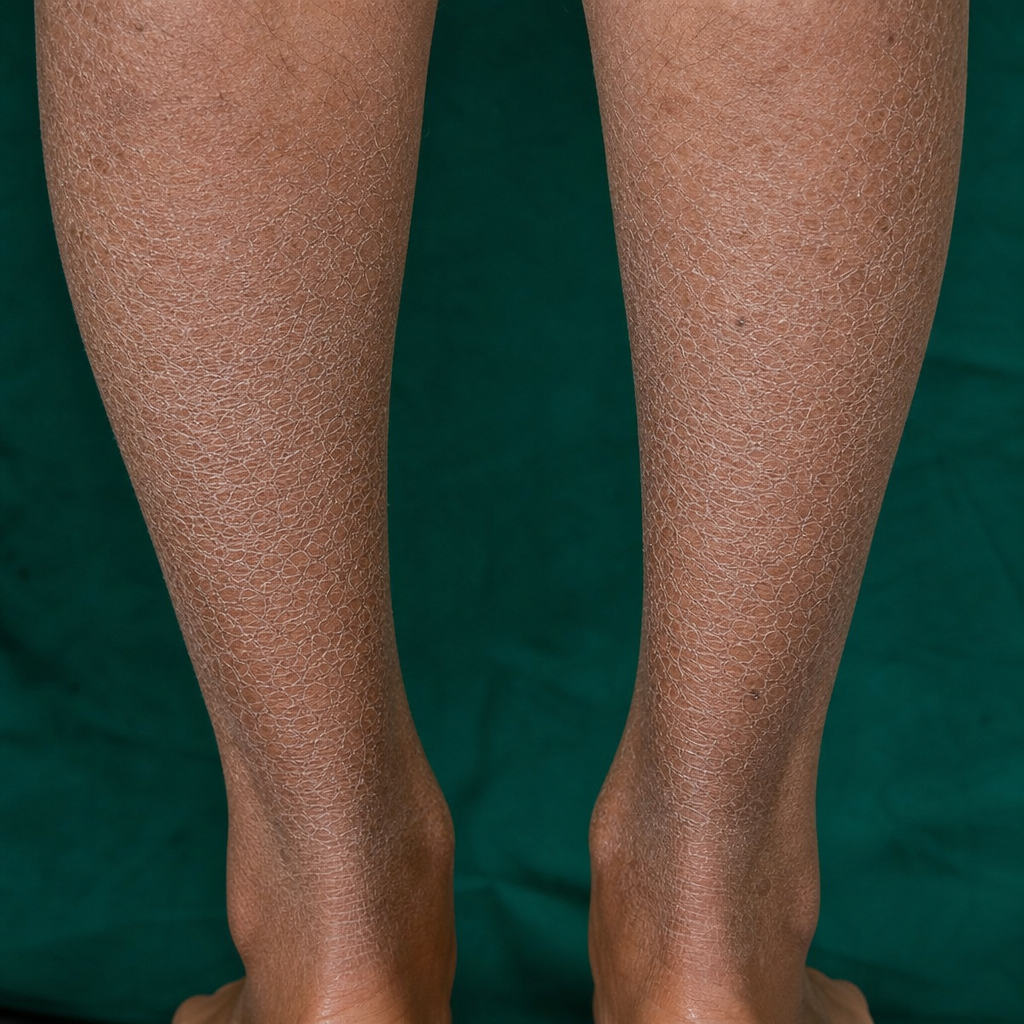
Which of the following deficiencies causes follicular hyperkeratosis?
Explanation: **Explanation:** **Fordyce granules** are ectopic sebaceous glands that occur in the oral mucosa or genital skin. Unlike normal sebaceous glands, they are not associated with hair follicles (non-pilosebaceous). **Why the Alveolar Ridge is the Correct Answer:** Fordyce granules are typically found in areas of the oral cavity that undergo fusion during embryonic development. The **alveolar ridge** (the gum line) is a site of "attached gingiva," which is highly keratinized and generally devoid of these ectopic glands. Therefore, it is the least likely site among the options provided. **Analysis of Other Options:** * **Vermillion of the lip:** This is the most common site for Fordyce granules. They appear as asymptomatic, 1–3 mm, creamy-yellow papules. * **Posterior tonsillar pillar & Palate:** These are recognized, though less common, sites for ectopic sebaceous glands. The buccal mucosa (inner cheeks) is another very frequent location, often occurring bilaterally. **NEET-PG High-Yield Pearls:** * **Clinical Appearance:** They appear as multiple, small, yellowish-white, slightly elevated spots. * **Histology:** They are identical to normal sebaceous glands but lack an associated hair follicle. * **Significance:** They are considered a **normal anatomical variant**, not a pathology. They are asymptomatic and require no treatment (reassurance is key). * **Prevalence:** They are more apparent in adults than children due to the hormonal stimulation of sebaceous glands during puberty. * **Differential Diagnosis:** Must be distinguished from Milia (which are keratin cysts) or Candidiasis (which can be scraped off).
Explanation: ### Explanation **Acantholysis** is the loss of intercellular connections (desmosomes) between keratinocytes, leading to the **separation of keratinocytes** within the epidermis. This process results in the formation of intraepidermal clefts and blisters. When keratinocytes lose their attachments, they become rounded and float freely within the blister fluid; these are known as **Tzanck cells**. #### Analysis of Options: * **Option B (Correct):** Acantholysis specifically refers to the breakdown of desmosomal bridges, causing keratinocytes to detach from one another. * **Option A:** Lysis of the basal cell layer is termed **liquefaction degeneration** or vacuolar degeneration, typically seen in Lichen Planus or Lupus Erythematosus. * **Option C:** Thickening of the granular layer is called **hypergranulosis** (e.g., Lichen Planus). * **Option D:** Thickening of the stratum corneum is called **hyperkeratosis** (e.g., Psoriasis, Ichthyosis). #### High-Yield Clinical Pearls for NEET-PG: 1. **Pemphigus Group:** The classic example of acantholysis. * *Pemphigus Vulgaris:* Suprabasal acantholysis (Tombstone appearance). * *Pemphigus Foliaceus:* Subcorneal/Superficial acantholysis. 2. **Genetic Conditions:** Acantholysis is also seen in **Hailey-Hailey disease** (dilapidated brick wall appearance) and **Darier disease**. 3. **Diagnosis:** The **Tzanck Smear** is the bedside test used to identify acantholytic cells. 4. **Nikolsky Sign:** Clinically, acantholysis manifests as a positive Nikolsky sign (shearing of skin with lateral pressure).
Explanation: **Explanation:** The correct answer is **Melanocyte**. Melanocytes are dendritic cells located in the *stratum basale* of the epidermis. Their primary function is the synthesis of **melanin** within specialized organelles called melanosomes. Melanin acts as a biological physical sunscreen by absorbing and scattering ultraviolet (UV) radiation, thereby protecting the DNA of underlying keratinocytes from mutagenic damage and photocarcinogenesis. **Analysis of Options:** * **Stratum corneum (Option A):** This is the outermost layer of the epidermis consisting of dead keratinocytes (corneocytes). While it provides a mechanical barrier against pathogens and prevents transepidermal water loss (TEWL), it is not the primary defense against UV rays. * **Langerhans cells (Option B):** These are dendritic, antigen-presenting cells (APCs) located in the *stratum spinosum*. They play a crucial role in the skin's immune surveillance but do not provide UV protection. * **Apocrine sweat glands (Option C):** These glands are primarily located in the axilla and anogenital regions. They are involved in emotional sweating and pheromone release, having no role in UV filtration. **High-Yield NEET-PG Pearls:** * **Epidermal Melanin Unit:** One melanocyte serves approximately **36 keratinocytes** via its dendritic processes. * **Skin Color:** The difference in skin color between races is not due to the *number* of melanocytes (which is relatively constant), but due to the **size, number, and distribution of melanosomes**. * **UVB vs. UVA:** UVB is primarily responsible for sunburn and DNA damage (direct), while UVA is associated with aging (photoaging) and indirect DNA damage via reactive oxygen species.
Explanation: **Explanation:** **Speckled Leukoplakia** (also known as Erythroleukoplakia) is a clinical variant of leukoplakia characterized by white patches on an erythematous (red) base. Histopathologically, it exhibits **acanthosis** (thickening of the stratum spinosum), **hyperkeratosis** (thickening of the stratum corneum), and **intraepithelial vacuolation** (clear spaces within cells, often representing hydropic degeneration or intracellular edema). This combination of features, particularly when associated with epithelial dysplasia, is a hallmark of premalignant oral lesions. **Analysis of Incorrect Options:** * **Hairy Tongue (Lingua villosa):** This condition is characterized by extreme hypertrophy and elongation of the **filiform papillae** on the dorsal tongue. While there is marked hyperkeratosis, the specific pattern of intraepithelial vacuolation seen in speckled leukoplakia is absent. * **Hyperplastic Candidiasis:** While this presents as a white patch, the histopathology typically shows fungal hyphae (PAS positive) invading the superficial epithelium and a prominent **neutrophilic infiltrate** forming "microabscesses" in the parakeratin layer. * **Desquamative Gingivitis:** This is a clinical descriptor, not a specific diagnosis. It is most commonly associated with **Lichen Planus** or **Mucous Membrane Pemphigoid**. Histology usually shows subepithelial or intraepithelial clefting/blistering rather than the acanthotic-vacuolated pattern. **High-Yield Clinical Pearls for NEET-PG:** * **Malignant Transformation:** Speckled leukoplakia has a significantly higher risk of malignant transformation (up to 20-30%) compared to homogenous leukoplakia. * **Site:** The floor of the mouth and the lateral/ventral tongue are high-risk sites for dysplasia. * **Differential:** Always differentiate from **Oral Hairy Leukoplakia** (associated with EBV/HIV), which specifically shows "ballooning degeneration" of cells in the upper spinous layer.
Explanation: **Explanation:** **Lichen Planus (LP)** is a chronic inflammatory condition that frequently involves the oral mucosa. **Desquamative gingivitis (DG)** is a clinical term describing a condition where the gingiva appears erythematous, friable, and sheds its surface epithelium. 1. **Why Atrophic Lichen Planus is correct:** In the **Atrophic (Erythematous) variant** of oral lichen planus, there is significant thinning of the mucosal epithelium. When this occurs specifically on the marginal and attached gingiva, it manifests as **chronic desquamative gingivitis**. The thinning makes the underlying vasculature visible (erythema) and leads to the characteristic "peeling" or desquamation of the gums. 2. **Analysis of Incorrect Options:** * **Hypertrophic LP:** Characterized by thick, verrucous plaques, most commonly found on the shins. It is not typically associated with gingival desquamation. * **Ulcerative (Erosive) LP:** While this variant involves painful mucosal breaches and can coexist with atrophic areas, "desquamative gingivitis" specifically refers to the diffuse thinning and shedding seen in the atrophic phase. * **Hyperplastic LP:** This is a rare variant characterized by firm, white elevated plaques (similar to leukoplakia) rather than the red, peeling surface seen in desquamative gingivitis. **High-Yield Clinical Pearls for NEET-PG:** * **Wickham Striae:** The characteristic white, reticulate (lace-like) pattern seen in the reticular variant of LP. * **Civatte Bodies:** Histopathological hallmark representing apoptotic keratinocytes in the basal layer. * **Max-Joseph Spaces:** Small subepidermal clefts formed due to extensive basal cell degeneration. * **Differential Diagnosis of Desquamative Gingivitis:** Apart from LP, it is also seen in **Cicatricial Pemphigoid** (most common cause) and **Pemphigus Vulgaris**. * **Koebner Phenomenon:** LP is a classic example of a condition showing the development of lesions at sites of trauma.
Explanation: ### Explanation **Correct Answer: D. Lipoid Proteinosis** **Lipoid proteinosis** (also known as Urbach-Wiethe disease) is a rare autosomal recessive disorder caused by mutations in the **ECM1 gene**. This leads to the deposition of hyaline-like material in the skin, mucosa, and internal organs. * **The "Beaded Margin":** The pathognomonic clinical finding is **moniliform blepharosis**, which refers to rows of small, pearly, waxy papules along the eyelid margins. These papules create a "beaded" appearance and are a classic high-yield finding for NEET-PG. * **Other Key Features:** Patients often present with early-childhood **hoarseness of voice** (due to laryngeal infiltration) and a thickened, "woody" tongue with a shortened frenulum. **Why the other options are incorrect:** * **A & C. Granuloma Annulare (GA):** GA typically presents as annular (ring-shaped) plaques with a border of firm, skin-colored to erythematous papules. While it has a "beaded" border in a circular configuration, it classically affects the dorsal hands and feet, not the eyelid margins. * **B. Leprosy:** Ocular involvement in leprosy (especially Lepromatous) includes madarosis (loss of eyebrows/eyelashes), lagophthalmos, and corneal anesthesia, but it does not present with a beaded eyelid margin. **High-Yield Clinical Pearls for NEET-PG:** * **Radiology:** Look for bilateral, **comma-shaped (bean-shaped) calcifications** in the temporal lobes/hippocampus on a CT scan. * **Histopathology:** Periodic Acid-Schiff **(PAS) positive**, diastase-resistant hyaline material is deposited around blood vessels and sweat glands. * **Inheritance:** Autosomal Recessive (ECM1 gene on chromosome 1q21). * **Triad to Remember:** Hoarseness + Moniliform blepharosis + Temporal lobe calcification.
Explanation: **Explanation:** **Darier’s Sign** is a classic clinical finding in dermatology characterized by the development of a localized wheal and flare (erythema and edema) within minutes of briskly stroking or rubbing a lesion. **1. Why Urticaria Pigmentosa is Correct:** Urticaria pigmentosa is the most common form of **Cutaneous Mastocytosis**. The underlying mechanism involves an abnormal accumulation of mast cells in the dermis. When these lesions are rubbed, it triggers the physical degranulation of mast cells, leading to the release of inflammatory mediators, primarily **histamine**. This results in localized vasodilation and increased capillary permeability, manifesting as the characteristic wheal (Darier's sign). **2. Why the other options are incorrect:** * **Darier’s Disease (Option A):** Despite the name, this is a disorder of keratinization (acantholytic dyskeratosis) caused by a mutation in the *ATP2A2* gene. It presents with greasy, warty papules in seborrheic areas, but it does **not** exhibit Darier’s sign. * **Allergic Vasculitis (Option C):** This involves inflammation of the blood vessel walls, typically presenting as palpable purpura. It does not involve mast cell degranulation upon stroking. * **Atopic Dermatitis (Option D):** This is a chronic inflammatory skin condition. While it involves itching, stroking the skin typically results in **White Dermographism** (vasoconstriction) rather than a wheal. **3. Clinical Pearls for NEET-PG:** * **Pseudo-Darier’s Sign:** A similar firming or rippling of a lesion upon rubbing, seen in **Smooth Muscle Hamartomas**. * **Dermographism:** A "wheal and flare" on normal-appearing skin after stroking; it is the most common form of physical urticaria. * **Auspitz Sign:** Pinpoint bleeding after peeling a scale, seen in **Psoriasis**. * **Nikolsky Sign:** Separation of the epidermis from the dermis with lateral pressure, seen in **Pemphigus Vulgaris**.
Explanation: **Explanation:** The correct answer is **D. Angiokeratomas**. Angiokeratomas are benign vascular ectasias (dilated capillaries) characterized by dark red to purple papules with a scaly surface. They are classically associated with **Fabry disease** (alpha-galactosidase A deficiency) or can occur idiopathically (e.g., Angiokeratoma of Fordyce). They have no pathophysiological link to Diabetes Mellitus (DM). **Analysis of Incorrect Options:** * **Necrobiosis Lipoidica (NL):** A highly specific (though rare) sign of DM. It presents as yellowish-brown, atrophic, telangiectatic plaques on the pretibial area. It is caused by collagen degeneration and microangiopathy. * **Carotinosis (Carotenemia):** Diabetics often have impaired conversion of beta-carotene to Vitamin A in the liver, leading to yellow discoloration of the skin (especially palms and soles), while the sclera remains white (unlike jaundice). * **Shin Spots:** This is the most common cutaneous manifestation of DM. While the option mentions **Granuloma Annulare (GA)** in parentheses, it is important to note: * **Diabetic Dermopathy (Shin Spots):** Presents as circumscribed, atrophic, hyperpigmented macules on the shins. * **Granuloma Annulare:** Disseminated GA is strongly associated with DM. The question likely groups these as "pretibial/necrobiotic" manifestations common in diabetics. **High-Yield Clinical Pearls for NEET-PG:** * **Most common skin finding in DM:** Diabetic Dermopathy (Shin spots). * **Most specific skin finding in DM:** Necrobiosis Lipoidica. * **Acanthosis Nigricans:** A marker of insulin resistance (Type 2 DM). * **Scleredema Adultorum of Buschke:** Woody induration of the upper back/neck seen in poorly controlled diabetics. * **Bullosis Diabeticorum:** Spontaneous, non-inflammatory blistering, usually on the feet.
Explanation: ### **Explanation** The clinical presentation of multiple, small, pinpoint, shiny, flesh-colored papules in a child is classic for **Lichen Nitidus**. #### **Why Lichen Nitidus is Correct** Lichen nitidus is a chronic inflammatory dermatosis characterized by tiny (1–2 mm), uniform, **flat-topped, shiny (glistening)**, skin-colored papules. It typically affects children and young adults. Common sites of involvement include the **dorsal hands, forearms, chest, and the shaft/glans of the penis**. A key histopathological feature often tested is the **"claw clutching a ball"** appearance (elongated rete ridges encircling a dermal lymphocytic infiltrate). #### **Why Other Options are Incorrect** * **Molluscum Contagiosum:** These are larger, pearly-white papules characterized by **central umbilication**. They are viral (Poxvirus) and usually not as "pinpoint" or numerous in a localized area like the hands. * **Scabies:** While it involves the hands and penis, it presents with **intense nocturnal pruritus**, burrows, and inflammatory vesicles/pustules rather than shiny, uniform papules. * **Lichen Planus (LP):** Although related, LP presents with larger, **violaceous (purple), polygonal, pruritic** plaques often associated with **Wickham striae**. Lichen nitidus is often considered a variant of LP but is clinically distinct due to its smaller size and lack of color. #### **NEET-PG High-Yield Pearls** * **Koebner Phenomenon:** Lichen nitidus (like Lichen Planus and Psoriasis) can show linear lesions due to trauma. * **Clinical Sign:** The lesions are often described as having a **"glistening"** or "sand-like" appearance under bright light. * **Treatment:** Usually asymptomatic and self-limiting; topical steroids or tacrolimus can be used if pruritic. * **Histology Keyword:** "Claw clutching a ball" (Infiltrate of lymphocytes and histiocytes trapped by epidermal colrettes).
Explanation: ***Vitamin A***- Deficiency in Vitamin A (retinol) impairs the differentiation of **keratinizing epithelia**, leading to **squamous metaplasia**.- This results in **follicular hyperkeratosis** (also known as **phrynoderma** or 'toad skin'), where keratin plugs block the hair follicles, giving the skin a rough, bumpy appearance.*Vitamin C*- Deficiency causes **scurvy**, primarily due to defective collagen synthesis, leading to fragile blood vessels.- The characteristic skin finding is **perifollicular hemorrhage** (petechiae around hair follicles) and **painless gum bleeding**, not hyperkeratosis due to keratin plugging.*Vitamin E*- This deficiency primarily acts as an **antioxidant deficiency**, leading to increased susceptibility of cell membranes to oxidative damage.- Clinical manifestations often include **hemolytic anemia** (due to erythrocyte membrane damage) and **neurological symptoms** (e.g., ataxia, peripheral neuropathy).*Vitamin B6*- Deficiency of pyridoxine is often associated with cutaneous symptoms like a **seborrheic dermatitis-like rash** and **cheilosis** (cracked lips).- It is crucial for coenzyme functions but does not directly cause the severe keratin plugging characterized by widespread follicular hyperkeratosis.
Structure and Function of Skin
Practice Questions
Cutaneous Histopathology
Practice Questions
Dermatological Examination
Practice Questions
Skin Lesions: Morphology and Description
Practice Questions
Principles of Diagnosis in Dermatology
Practice Questions
Dermatological Procedures
Practice Questions
Wound Healing
Practice Questions
Cutaneous Immunology
Practice Questions
Genetics in Dermatology
Practice Questions
Cutaneous Manifestations of Systemic Diseases
Practice Questions
Geriatric Dermatology
Practice Questions
Pediatric Dermatology Basics
Practice Questions
Get full access to all questions, explanations, and performance tracking.
Start For Free