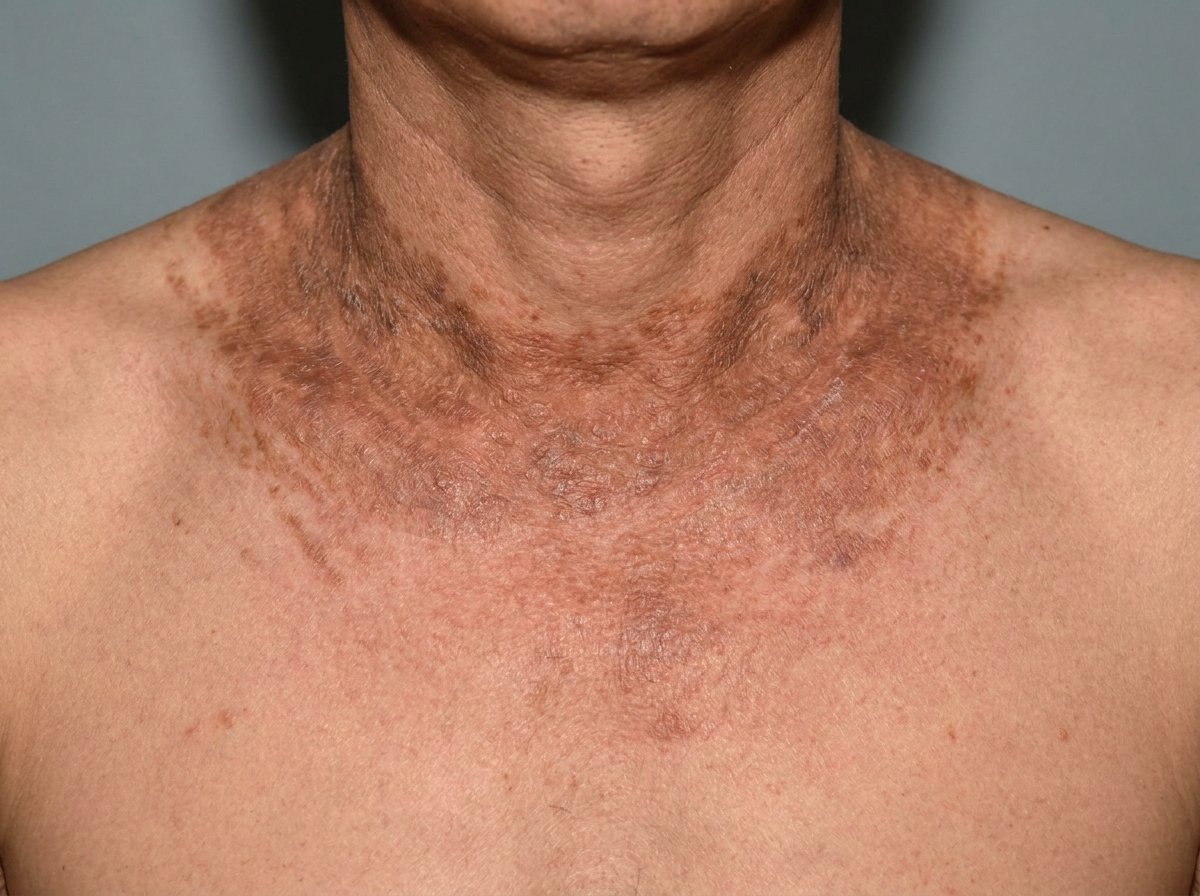
Which of the following are characteristic features of lichen planus?
A 38-year-old woman presented with a 2-week history of tender, swollen nodules on her lower legs. Her only current medication was a triphasic oral contraceptive. She denies any history of inflammatory bowel disease, sarcoidosis, or chronic infections. Physical examination revealed erythematous nodular swellings on the anterior lower legs. A punch biopsy specimen obtained from a lesion on the left anterior tibia reveals a septal inflammation of subcutaneous fat. What is the best description of this rash?
Thin zone of Grenz is seen in which of the following conditions?
A young lady presents with white lacy lesions in the oral cavity and her proximal nail fold has extended onto the nail bed. What is the likely diagnosis?
A patient presents with diffuse, nonencapsulated fatty deposits. Which of the following is the most likely associated history?
All are true about the features of erythromelalgia, EXCEPT:
A 40-year-old woman presents with a burning sensation in the mouth. Clinical examination reveals lesions consisting of radiating white striations in a retiform arrangement affecting the buccal mucosa, tongue, lips, and gingiva bilaterally. An incisional biopsy is suggestive of lichen planus. Which of the following is NOT a clinical form of Lichen Planus?
What is true about this condition?

All of the following are primary cutaneous diseases except?
What is the characteristic histological feature of lichen planus?
Explanation: **Explanation:** Lichen Planus (LP) is a chronic inflammatory, T-cell mediated autoimmune condition affecting the skin and mucous membranes. The diagnosis is primarily clinical, based on a classic constellation of features often referred to as the **"6 Ps" of Lichen Planus**: **P**lanar (flat-topped), **P**urple (violaceous), **P**olygonal, **P**ruritic, **P**apules, and **P**laques. * **Option A (Pruritus):** This is a hallmark symptom. The itching in LP is typically intense and "paroxysmal." Interestingly, patients often rub the lesions rather than scratch them, which is why excoriation marks are rarely seen. * **Option B (Purple color):** The lesions have a characteristic violaceous or purple hue, which is a result of the dense band-like lymphocytic infiltrate at the dermo-epidermal junction and subsequent pigmentary incontinence. * **Option C (Papules):** The primary lesion is a small, flat-topped (planar), polygonal papule. These papules may coalesce to form larger plaques. Since all three features are defining characteristics of the disease, **Option D** is the correct answer. **High-Yield Clinical Pearls for NEET-PG:** 1. **Wickham Striae:** Fine, white, lace-like patterns seen on the surface of the papules (best visualized with oil). 2. **Koebner Phenomenon:** Development of new lesions at sites of trauma (also seen in Psoriasis and Vitiligo). 3. **Histopathology:** Characterized by "saw-tooth" rete ridges, Civatte bodies (apoptotic keratinocytes), and a band-like lymphocytic infiltrate. 4. **Associations:** Strongly associated with **Hepatitis C virus** infection. 5. **Treatment:** Topical corticosteroids are the first-line treatment for localized disease.
Explanation: **Explanation:** The clinical presentation and histopathology are classic for **Erythema Nodosum (EN)**. EN is the most common form of **septal panniculitis** without vasculitis. It typically presents as tender, erythematous, non-ulcerated nodules on the pretibial (anterior) area of the lower legs. In this patient, the use of **oral contraceptives** is a well-known trigger, alongside other common causes like Streptococcal infections, Sarcoidosis, and IBD. **Why the other options are incorrect:** * **Koebner phenomenon:** Refers to the development of skin lesions at sites of trauma (seen in Psoriasis, Lichen Planus, and Vitiligo). It does not describe a specific nodular rash. * **Livedo racemosa:** A permanent, broken, lace-like purple pattern on the skin caused by impaired blood flow. It is associated with Sneddon syndrome or SLE, not tender subcutaneous nodules. * **Cutaneous Lupus Erythematosus (CLE):** Typically presents with photosensitive malar rashes (Acute CLE) or scarred, discoid plaques (Chronic CLE). While Lupus Profundus involves fat, it usually presents as firm, depressed areas on the face or proximal limbs, not acute pretibial nodules. **NEET-PG High-Yield Pearls:** * **Histopathology Gold Standard:** Septal panniculitis with **Miescher’s radial granulomas** (small nodules of spindle-shaped cells around a central cleft). * **Most Common Cause:** Idiopathic (up to 50%), followed by Streptococcal pharyngitis. * **Key Associations:** Pregnancy, OCPs, Sarcoidosis (Lofgren’s Syndrome: EN + Bilateral hilar lymphadenopathy + Arthralgia), and Tuberculosis. * **Clinical Course:** Lesions do not ulcerate and heal without scarring, often changing color like a bruise (**Erythema contusiforme**).
Explanation: **Explanation:** The **Grenz zone** (from the German word *Grenz* meaning "border") is a narrow, clear band of uninvolved papillary dermis that separates the epidermis from a dense underlying dermal inflammatory infiltrate. It occurs because the inflammatory process does not involve the subepidermal region, often due to the lack of specific tropism for the basement membrane zone by the causative agent. **Why Lepromatous Leprosy (LL) is correct:** In LL, there is a massive proliferation of *Mycobacterium leprae* within macrophages (Virchow cells). These cells form a dense dermal infiltrate. However, they do not invade the uppermost layer of the dermis, leaving a characteristic **Grenz zone**. This is a classic histopathological hallmark of LL, distinguishing it from Tuberculoid Leprosy, where the granulomatous infiltrate typically extends right up to the epidermis (eroding it). **Analysis of Incorrect Options:** * **Sarcoidosis:** While sarcoidosis features "naked" non-caseating granulomas in the dermis, a prominent Grenz zone is not its defining feature; the granulomas are usually well-circumscribed throughout the dermis. * **Lymphoma:** While some cutaneous lymphomas (like Mycosis Fungoides) show epidermotropism (cells invading the epidermis), others may show a Grenz zone (e.g., Leukemia cutis). However, LL is the most classic and frequently tested association for NEET-PG. * **Syphilis:** Secondary syphilis typically shows a psoriasiform hyperplasia with a plasma cell-rich infiltrate that often involves the dermo-epidermal junction, rather than sparing it. **High-Yield Clinical Pearls for NEET-PG:** * **Conditions showing a Grenz zone:** Lepromatous Leprosy (LL), Granuloma Faciale (most prominent), Leukemia Cutis, and Acrodermatitis Chronica Atrophicans. * **LL Histology:** Look for "Virchow cells" (foamy macrophages), "Globi" (acid-fast bacilli clusters), and the Grenz zone. * **Contrast:** In Tuberculoid Leprosy (TT), the Grenz zone is **absent** because the granulomas invade the papillary dermis.
Explanation: **Explanation:** The clinical presentation describes two classic features of **Lichen Planus (LP)**: **Wickham striae** (white lacy lesions in the oral cavity) and **Pterygium formation** (extension of the proximal nail fold onto the nail bed). 1. **Lichen Planus (Correct):** LP is a chronic inflammatory condition affecting the skin, mucous membranes, and nails. The oral lesions are typically reticulate, white, and lacy (Wickham striae). Nail involvement occurs in 10% of cases; the hallmark is **dorsal pterygium**, where the nail fold fuses with the nail matrix/bed due to scarring, leading to a V-shaped extension and permanent nail loss. 2. **Psoriasis:** While it affects nails, it typically presents with **pitting**, onycholysis, and "oil spots." Oral involvement is rare and usually manifests as geographic tongue, not lacy striae. 3. **Geographic Tongue:** Also known as benign migratory glossitis, it presents as red patches with white borders on the tongue that change shape. It does not cause nail pterygium. 4. **Candidiasis:** Oral candidiasis (thrush) presents as white curd-like plaques that **can be scraped off**, leaving an erythematous base. It does not cause the scarring nail changes described. **High-Yield Clinical Pearls for NEET-PG:** * **The 6 P’s of LP:** Planar, Purple, Polygonal, Pruritic, Papules, and Plaques. * **Koebner Phenomenon:** Development of lesions at sites of trauma (also seen in Psoriasis and Vitiligo). * **Histopathology:** Characterized by "saw-tooth" rete ridges, Civatte bodies (apoptotic keratinocytes), and a band-like lymphocytic infiltrate at the dermo-epidermal junction. * **Drug-induced LP:** Commonly caused by NSAIDs, Beta-blockers, and Thiazides.
Explanation: The clinical presentation of diffuse, nonencapsulated fatty deposits is characteristic of **Madelung’s disease**, also known as **Multiple Symmetric Lipomatosis (MSL)**. ### **Explanation of the Correct Answer** **Madelung’s disease** is a rare metabolic condition characterized by the symmetrical accumulation of unencapsulated adipose tissue, typically around the neck ("horse collar" appearance), shoulders, and upper trunk. * **Association:** There is a very strong clinical association with **chronic alcohol dependency** (seen in 60–90% of cases). * **Pathophysiology:** It is thought to involve a defect in the adrenergic-stimulated lipolysis of brown fat, often exacerbated by alcohol's effect on mitochondrial function and lipid metabolism. ### **Analysis of Incorrect Options** * **B. Hypercalcemia:** Not associated with fatty deposits. It is typically linked to subcutaneous fat necrosis of the newborn or calciphylaxis, but not symmetric lipomatosis. * **C. Renal insufficiency:** While associated with metabolic changes, it does not cause diffuse fatty deposits. It is more commonly linked to pruritus, perforating dermatoses, or nephrogenic systemic fibrosis. * **D. Rheumatoid arthritis:** This is an autoimmune inflammatory condition. While patients may have subcutaneous nodules (Rheumatoid nodules), these are firm, localized, and histologically distinct from the diffuse fatty masses seen in Madelung’s. ### **High-Yield Clinical Pearls for NEET-PG** * **Madelung’s Disease (MSL):** Most common in middle-aged males of Mediterranean descent with a history of alcoholism. * **Clinical Appearance:** "Horse collar" (Launois-Bensaude syndrome) or "Hamster cheeks." * **Complications:** While benign, the deposits can cause compression of the trachea or esophagus, leading to dyspnea or dysphagia. * **Treatment:** Alcohol abstinence (to slow progression), surgical excision, or liposuction (though recurrence is common).
Explanation: **Explanation:** **Erythromelalgia** is a rare neurovascular peripheral pain syndrome characterized by the triad of **erythema (redness), burning pain, and increased skin temperature**, typically affecting the extremities (feet more than hands). **Why Option D is the Correct Answer (The "Except"):** The mainstay of treatment for erythromelalgia is **not steroids**. Management depends on the subtype. For primary cases, sodium channel blockers (like mexiletine) or neuropathic agents (gabapentin) are used. For secondary cases associated with myeloproliferative disorders, **Aspirin** is the drug of choice as it provides dramatic relief. Steroids have no proven role in the pathophysiology or management of this condition. **Analysis of Other Options:** * **A. Unknown etiology:** True. Primary erythromelalgia is often idiopathic or associated with a mutation in the **SCN9A gene** (voltage-gated sodium channel). * **B. Thrombocytosis is seen:** True. Secondary erythromelalgia is frequently associated with **myeloproliferative neoplasms**, most commonly **Essential Thrombocythemia** and Polycythemia Vera. * **C. Digital infarction is seen:** True. In secondary cases related to thrombocytosis, platelet aggregation can lead to microvascular occlusion, resulting in digital ischemia, cyanosis, and potentially infarction/gangrene. **Clinical Pearls for NEET-PG:** * **The "Cold Water" Sign:** Patients often seek relief by immersing their limbs in ice-cold water (a diagnostic clue). * **Primary vs. Secondary:** Primary is often bilateral and symmetrical; secondary is associated with hematological malignancies. * **Key Association:** Always screen a patient with erythromelalgia for an underlying blood disorder using a Complete Blood Count (CBC).
Explanation: **Explanation:** The correct answer is **D. Verrucous Lichen Planus**. In dermatology, terminology is precise. While **Hypertrophic Lichen Planus** (Option B) is a well-recognized variant characterized by thick, itchy, verrucous-like plaques (typically on the shins), the term "Verrucous Lichen Planus" is not a standard clinical classification. Instead, "Verrucous" is a morphological description often used for viral warts or other conditions like *Lichen Planus Hypertrophicus*, but it is not the formal name of a clinical subtype. **Analysis of Incorrect Options:** * **A. Atrophic Lichen Planus:** A recognized variant where there is thinning of the epidermis. It often presents as well-demarcated, erythematous, atrophic plaques, commonly seen on the legs or in intertriginous areas. * **B. Hypertrophic Lichen Planus:** The most common cutaneous variant after the classic form. It presents as intensely pruritic, thickened, purplish-grey plaques, usually on the pretibial areas. * **C. Bullous Lichen Planus:** A rare variant where vesicles or bullae develop within existing lichen planus lesions due to extensive liquefaction degeneration of the basal layer. **High-Yield Clinical Pearls for NEET-PG:** * **Oral Lichen Planus (OLP):** The question describes **Wickham’s Striae** (reticulate white lines), which is the hallmark of the reticular type of OLP. * **Histopathology:** Look for the "Big Four": Hyperkeratosis, Wedge-shaped hypergranulosis, Saw-tooth rete ridges, and a Band-like lymphocytic infiltrate at the dermo-epidermal junction. * **Civatte Bodies:** These are apoptotic keratinocytes found in the basal layer, also known as colloid or hyaline bodies. * **Koebner Phenomenon:** Lichen Planus is "Koebner positive" (lesions appear at sites of trauma).
Explanation: ***Hamartoma of naevo-melanocytes*** - **Congenital melanocytic nevus (CMN)** is indeed a **hamartoma** composed of proliferating **naevo-melanocytes** (nevus cells). - These are **benign proliferations** of melanocytic cells that are present at birth and represent a developmental malformation. *Increased risk of squamous cell carcinoma* - **CMN** carries an increased risk of **malignant melanoma**, not squamous cell carcinoma. - The **melanoma risk** is particularly significant in **giant CMN** (>20cm diameter) with lifetime risk up to **5-10%**. *Limited to the dermis* - **CMN** typically extends **beyond the dermis** into the **subcutaneous tissue** and sometimes deeper structures. - The **depth of involvement** often correlates with the **size** of the nevus, with larger lesions showing deeper penetration. *Regresses completely by 7 years* - **CMN does not regress** spontaneously and typically **persists throughout life** without treatment. - Unlike **acquired nevi**, congenital lesions are **permanent** and may actually **darken** or become more prominent with age.
Explanation: **Explanation:** The distinction between primary and secondary cutaneous diseases is a fundamental concept in dermatology. **Why Reiter’s Disease is the correct answer:** Reiter’s disease (now more commonly referred to as **Reactive Arthritis**) is a **multisystem inflammatory disorder** that typically follows a gastrointestinal or genitourinary infection. It is characterized by the classic triad of **Urethritis, Conjunctivitis, and Arthritis** ("Can't see, can't pee, can't climb a tree"). While it has significant skin manifestations (such as *Keratoderma blennorrhagicum* and *Circinate balanitis*), the primary pathology is systemic and immunologic rather than purely dermatological. **Why the other options are incorrect:** * **Psoriasis:** A chronic, primary inflammatory skin disease characterized by hyperproliferation of keratinocytes. * **Lichen Planus:** A primary T-cell mediated inflammatory disease affecting the skin and mucous membranes. * **Ichthyosis / Bowen’s Disease:** Ichthyosis is a primary genetic disorder of keratinization. Bowen’s disease is a primary intraepidermal squamous cell carcinoma (SCC in situ). These are localized primarily to the skin. **High-Yield Clinical Pearls for NEET-PG:** * **Reactive Arthritis (Reiter’s):** Strongly associated with the **HLA-B27** allele. * **Keratoderma Blennorrhagicum:** These are vesicopustular, waxy lesions on the palms and soles that are histologically indistinguishable from pustular psoriasis. * **Circinate Balanitis:** Painless, superficial erosions on the glans penis, a common cutaneous marker of the disease. * **Primary vs. Secondary:** Always look for systemic involvement (joints, eyes, mucosal surfaces) to differentiate systemic syndromes from primary dermatoses.
Explanation: **Explanation:** Lichen Planus (LP) is a chronic inflammatory condition characterized histologically by a "saw-tooth" appearance of the epidermis. The hallmark of its pathogenesis is a T-cell mediated autoimmune attack on the basal layer of the epidermis. **Why Basal Cell Degeneration is Correct:** The primary pathological event in Lichen Planus is **liquefactive degeneration (hydropic degeneration) of the basal cell layer**. This destruction of basal keratinocytes leads to the formation of **Civatte bodies** (apoptotic keratinocytes) and the characteristic "saw-tooth" pattern of the dermo-epidermal junction. This is the most specific and diagnostic histological feature among the choices provided. **Analysis of Incorrect Options:** * **A. Acanthosis:** While LP does show irregular acanthosis (thickening of the stratum spinosum), it is a common feature in many inflammatory skin diseases (like psoriasis) and is not as pathognomonic as basal cell degeneration. * **B. Interface Dermatitis:** This is a broad histological category where inflammation occurs at the dermo-epidermal junction. While LP is the classic example of interface dermatitis, "Basal cell degeneration" is the specific cellular process defining it in this context. * **C. Non-specific:** LP has very distinct, diagnostic histological features; it is never considered non-specific. **NEET-PG High-Yield Pearls:** * **6 P’s of LP:** Planar (flat-topped), Purple, Polygonal, Pruritic, Papules, and Plaques. * **Wickham Striae:** White reticular lines on the surface of papules due to focal orthohyperkeratosis. * **Max-Joseph Spaces:** Small areas of separation between the epidermis and dermis due to extensive basal cell damage. * **Koebner Phenomenon:** Development of lesions at sites of trauma (also seen in Psoriasis and Vitiligo). * **Civatte/Colloid Bodies:** PAS-positive apoptotic keratinocytes found in the lower epidermis/upper dermis.
Structure and Function of Skin
Practice Questions
Cutaneous Histopathology
Practice Questions
Dermatological Examination
Practice Questions
Skin Lesions: Morphology and Description
Practice Questions
Principles of Diagnosis in Dermatology
Practice Questions
Dermatological Procedures
Practice Questions
Wound Healing
Practice Questions
Cutaneous Immunology
Practice Questions
Genetics in Dermatology
Practice Questions
Cutaneous Manifestations of Systemic Diseases
Practice Questions
Geriatric Dermatology
Practice Questions
Pediatric Dermatology Basics
Practice Questions
Get full access to all questions, explanations, and performance tracking.
Start For Free