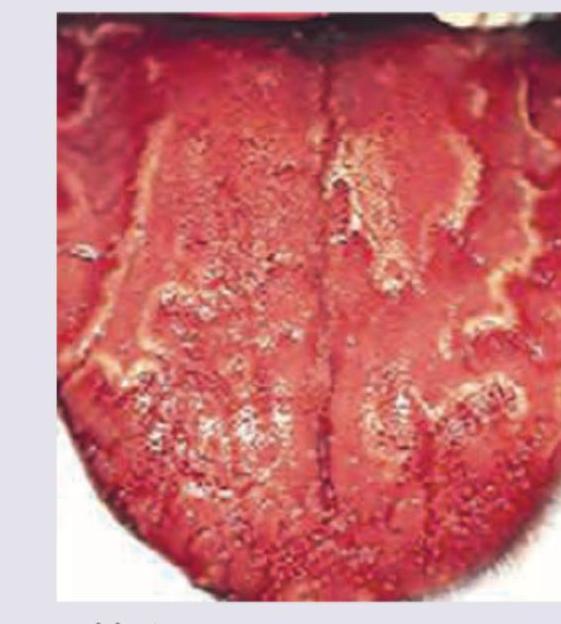
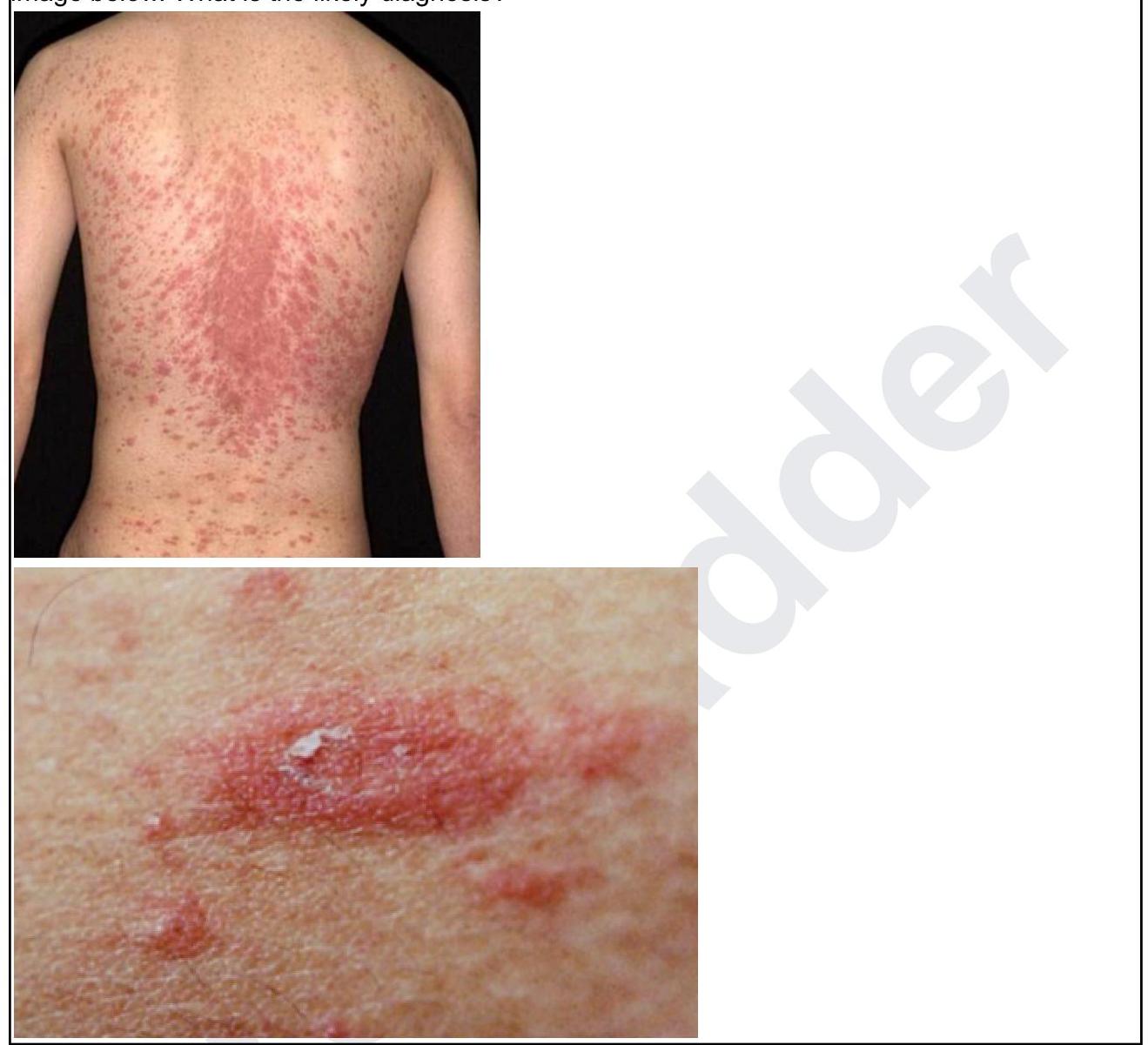
Which of the following diseases is itchy and involves the mucosa and the nails?
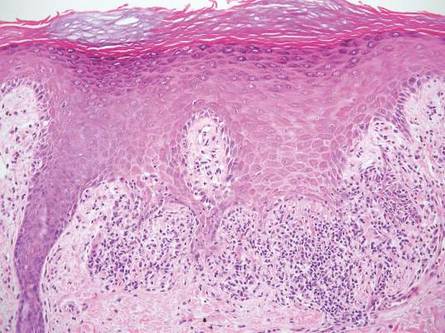
The 'Max Joseph space' is a characteristic histopathological feature of which dermatological condition?
Which of the following conditions exhibits the Koebner phenomenon?
What is the type of inheritance in Tuberous sclerosis?
Adenoma sebaceum is a characteristic finding in which of the following conditions?
Acantholysis is due to destruction of:
Cayenne-pepper appearance on diascopy is seen in which of the following conditions?
Urticarial lesions are best described as?
A flat discolouration on the skin, measuring 1 cm, is called:
Presence of erythema nodosum indicates:
Explanation: **Lichen Planus (LP)** is a chronic inflammatory condition classically characterized by the **"6 Ps"**: Planar (flat-topped), Purple, Polygonal, Pruritic, Papules, and Plaques. It is the most likely diagnosis because it frequently involves the skin, mucous membranes, and nails. * **Mucosal Involvement:** Seen in about 50% of cases, most commonly as **Wickham striae** (reticulate white lines) on the buccal mucosa. * **Nail Involvement:** Occurs in 10% of patients. The pathognomonic finding is **Pterygium formation** (v-shaped scarring of the proximal nail fold onto the nail bed), along with longitudinal ridging and thinning of the nail plate. * **Pruritus:** LP is characteristically very itchy, often leading to the **Koebner phenomenon** (lesions appearing at sites of trauma). **Analysis of Incorrect Options:** * **Psoriasis:** While it involves the skin and nails (pitting, oil spots, onycholysis), it **spares the mucous membranes**. It is also typically less itchy than LP. * **Solar Urticaria:** This is a physical urticaria triggered by UV radiation. It presents with transient wheals on sun-exposed skin and does not involve the nails or mucosa. * **Eczema:** While intensely itchy, eczema (dermatitis) primarily affects the skin. While chronic hand eczema can cause nail dystrophy, it does not typically involve the oral mucosa. **High-Yield Clinical Pearls for NEET-PG:** * **Histopathology:** Look for "Saw-tooth" rete ridges, Civatte bodies (apoptotic keratinocytes), and a band-like lymphocytic infiltrate at the dermo-epidermal junction. * **Associations:** Lichen planus is strongly associated with **Hepatitis C virus** infection. * **Drug-induced LP:** Commonly caused by Beta-blockers, Thiazides, and Antimalarials.
Explanation: **Explanation:** **Lichen Planus (LP)** is a chronic inflammatory condition characterized histologically by a "lichenoid" or interface dermatitis. The **Max Joseph space** refers to small, subepidermal clefts or gaps that form at the dermo-epidermal junction. These spaces occur due to extensive **liquefactive degeneration** (hydropic degeneration) of the basal cell layer and the resulting destruction of the basement membrane zone. As the basal cells undergo apoptosis (forming Civatte bodies), the adhesion between the epidermis and dermis weakens, leading to these characteristic microscopic separations. **Analysis of Incorrect Options:** * **Psoriasis:** Characterized by regular epidermal hyperplasia (test-tube-like rete ridges), parakeratosis, absent granular layer, and Munro’s microabscesses (neutrophils in the stratum corneum). * **Pityriasis Rosea:** Shows non-specific features like focal parakeratosis ("mound-like"), mild acanthosis, and a superficial perivascular lymphocytic infiltrate. * **Parapsoriasis:** Histology is often subtle and non-specific, showing mild spongiosis and a lymphohistiocytic infiltrate, lacking the intense interface dermatitis seen in LP. **High-Yield Clinical Pearls for NEET-PG:** * **6 P’s of LP:** Planar (flat-topped), Purple (violaceous), Polygonal, Pruritic, Papules, and Plaques. * **Wickham Striae:** White reticular lines on the surface of papules due to focal hypergranulosis. * **Koebner Phenomenon:** Development of lesions at sites of trauma (also seen in Psoriasis and Vitiligo). * **Civatte/Colloid Bodies:** Eosinophilic, shrunken, apoptotic keratinocytes found in the lower epidermis/upper dermis. * **Saw-tooth Rete Ridges:** The characteristic shape of the epidermal-dermal interface in chronic LP lesions.
Explanation: **Explanation:** The **Koebner phenomenon** (also known as the isomorphic response) refers to the development of new skin lesions of a pre-existing dermatosis at the site of trauma or physical injury on previously healthy skin. **Why Option A is Correct:** **Molluscum contagiosum** is a viral infection caused by the Poxvirus. It exhibits the Koebner phenomenon (specifically "pseudo-Koebnerization") because trauma, such as scratching, autoinoculates the virus into the surrounding skin, leading to the formation of new umbilicated papules along the line of trauma. **Why Other Options are Incorrect:** * **B. Pemphigus:** This is an autoimmune blistering disease characterized by the **Nikolsky sign** (detachment of the epidermis with lateral pressure), not the Koebner phenomenon. * **C. Atopic Dermatitis:** While scratching is a hallmark of this condition, it does not typically result in the linear reproduction of specific lesions characteristic of Koebnerization. **High-Yield Clinical Pearls for NEET-PG:** To master this topic, categorize conditions showing Koebner phenomenon into: 1. **True Koebnerization:** Psoriasis (most common), Lichen Planus, and Vitiligo. 2. **Pseudo-Koebnerization (Infectious):** Molluscum contagiosum, Verruca (Warts). 3. **Occasional/Rare:** Darier’s disease, Lichen nitidus. 4. **Reverse Koebner Phenomenon:** Disappearance of a lesion following trauma (e.g., Psoriasis). 5. **Wolf’s Isotopic Response:** Appearance of a new skin disease at the site of a previously healed unrelated disease (e.g., Granuloma annulare appearing at the site of healed Herpes Zoster).
Explanation: **Explanation:** **Tuberous Sclerosis Complex (TSC)** is a multisystem neurocutaneous disorder characterized by the growth of benign tumors (hamartomas) in various organs. The correct answer is **Autosomal Dominant (A)** because TSC follows a classic dominant inheritance pattern. It is caused by mutations in either the **TSC1 gene** (encoding Hamartin on chromosome 9q34) or the **TSC2 gene** (encoding Tuberin on chromosome 16p13). While it is inherited dominantly, approximately 60-70% of cases arise from *de novo* mutations. **Why other options are incorrect:** * **Autosomal Recessive (B):** Most structural/neurocutaneous syndromes (like Neurofibromatosis and TSC) are dominant. Recessive inheritance is more common in metabolic/enzymatic defects (e.g., Xeroderma Pigmentosum). * **X-linked Dominant (C):** Examples include Incontinentia Pigmenti. TSC affects males and females equally, which is inconsistent with X-linked patterns. * **X-linked Recessive (D):** Examples include Ichthyosis Nigricans (Steroid sulfatase deficiency). **High-Yield Clinical Pearls for NEET-PG:** * **Vogt’s Triad:** Adenoma sebaceum (Angiofibromas), Mental retardation, and Seizures (present in only ~30% of cases). * **Earliest Sign:** **Ash-leaf spots** (Hypomelanotic macules), best seen under **Wood’s lamp**. * **Pathognomonic Skin Sign:** **Koenen tumors** (Periungual fibromas). * **Shagreen Patch:** Connective tissue nevus usually found on the lumbosacral area. * **Systemic Associations:** Cardiac rhabdomyomas (often regress), Renal Angiomyolipomas (AML), and Giant Cell Astrocytomas (SEGA).
Explanation: **Explanation:** **Adenoma sebaceum** is a hallmark cutaneous manifestation of **Tuberous Sclerosis Complex (TSC)**, an autosomal dominant neurocutaneous syndrome (phakomatosis). Despite the name, these lesions are not tumors of the sebaceous glands; histologically, they are **angiofibromas**. They typically appear as small, red-to-pink papules in a butterfly distribution over the nose and cheeks, usually manifesting between ages 4 and 6. **Why the other options are incorrect:** * **Scleroderma / Systemic Sclerosis:** These conditions are characterized by skin thickening (sclerosis), Raynaud’s phenomenon, and telangiectasia. They do not feature angiofibromas. * **Systemic Lupus Erythematosus (SLE):** The characteristic facial finding in SLE is the **malar rash** (butterfly rash), which is an erythematous, inflammatory maculopapular eruption that spares the nasolabial folds, unlike the discrete papules of adenoma sebaceum. **NEET-PG High-Yield Clinical Pearls for Tuberous Sclerosis:** * **Vogt’s Triad:** Epiloia (Epilepsy, Low IQ/Mental retardation, Adenoma sebaceum). Note: Only 30% of patients show the full triad. * **Ash-leaf spots:** Hypopigmented macules; often the *earliest* sign (visible under Wood’s lamp). * **Shagreen patch:** Connective tissue nevus usually found on the lumbosacral area (leathery texture). * **Koenen’s tumor:** Periungual or subungual fibromas. * **Internal findings:** Renal angiomyolipomas, Cardiac rhabdomyomas, and Cortical tubers (seen on MRI). * **Genetics:** Mutations in *TSC1* (Hamartin) or *TSC2* (Tuberin) genes.
Explanation: **Explanation:** **Acantholysis** is defined as the loss of intercellular connections (cohesion) between keratinocytes, resulting in the formation of intraepidermal clefts or blisters. 1. **Why the Correct Answer is Right:** The primary mechanism of acantholysis is the destruction or dysfunction of the **intercellular substance** (specifically the desmosomes). Desmosomes act as the "glue" holding keratinocytes together. In autoimmune conditions like Pemphigus, IgG antibodies target proteins within this substance (Desmogleins 1 and 3). When these connections are severed, the cells detach from one another and become rounded, a process known as "acantholytic cells" (Tzanck cells). 2. **Why the Other Options are Wrong:** * **Epidermis:** This is too broad. While acantholysis occurs *within* the epidermis, it refers to a specific cellular process, not the destruction of the entire layer. * **Subepidermis:** This refers to the area below the epidermis. Destruction here leads to subepidermal blisters (e.g., Bullous Pemphigoid), where the entire epidermis lifts off the dermis. * **Basement Membrane:** Damage here (specifically to hemidesmosomes) causes the epidermis to detach from the dermis, not the keratinocytes to detach from each other. **High-Yield Clinical Pearls for NEET-PG:** * **Tzanck Smear:** Used to identify acantholytic cells (large, round keratinocytes with hyperchromatic nuclei and a peripheral halo of cytoplasm). * **Nikolsky Sign:** Usually positive in conditions involving acantholysis (e.g., Pemphigus Vulgaris, SSSS). * **Key Associations:** * *Primary Acantholysis:* Pemphigus group, Hailey-Hailey disease, Darier’s disease. * *Secondary Acantholysis:* Herpes simplex (HSV), Varicella-zoster (VZV).
Explanation: **Explanation:** **Discoid Lupus Erythematosus (DLE)** is the correct answer. The "cayenne-pepper appearance" on diascopy refers to the visualization of dilated, tortuous capillaries and small hemorrhagic spots (petechiae) within the follicular plugs of a DLE lesion. When pressure is applied using a glass slide (diascopy), the surrounding erythema blanches, making these orange-red punctate spots more prominent. This is a classic clinical sign used to differentiate DLE from other erythematous scaly plaques. **Analysis of Incorrect Options:** * **Psoriasis:** Characterized by the **Auspitz sign** (pinpoint bleeding upon removal of scales) and **Grattage test**. Diascopy typically shows uniform blanching of the erythematous plaque. * **Pemphigus:** An autoimmune bullous disorder characterized by the **Nikolsky sign** and **Asboe-Hansen sign**. Diascopy is not a primary diagnostic tool here. * **Systemic Sclerosis:** Characterized by skin tightening (sclerodactyly) and Raynaud’s phenomenon. While telangiectasia may be seen, the specific "cayenne-pepper" follicular pattern is absent. **High-Yield Clinical Pearls for NEET-PG:** * **Apple-jelly nodules:** Seen on diascopy in **Lupus Vulgaris** (Cutaneous TB) and Sarcoidosis. * **Follicular plugging (Carpet tack sign):** A hallmark of DLE where removing the scale reveals projections that fit into dilated follicles. * **DLE Triad:** Erythema, adherent scaling, and follicular plugging leading to atrophic scarring (cicatricial alopecia if on the scalp). * **Histopathology of DLE:** Interface dermatitis, vacuolar degeneration of the basal layer, and periadnexal lymphocytic infiltrate.
Explanation: **Explanation:** Urticaria, commonly known as wheals or hives, is a vascular reaction of the skin characterized by transient upper dermal edema. **Why "Evanescent" is the correct answer:** The hallmark of a classic urticarial wheal is its **evanescent** nature. By definition, individual lesions of urticaria appear rapidly and **resolve within 24 hours** (usually within 2–12 hours) without leaving any residual scarring, pigmentation, or scaling. This occurs because the localized edema (caused by histamine-mediated capillary vasodilation and leakage) is reabsorbed by the lymphatic system. **Analysis of Incorrect Options:** * **A. Nonpruritic:** This is incorrect. Urticaria is almost always **intensely pruritic** (itchy) due to the release of histamine and other mediators that stimulate sensory nerve endings. * **B. Linear:** While "linear urticaria" can occur in **Dermatographism** (physical urticaria triggered by stroking the skin), it is not the standard description for general urticarial lesions, which are typically round, oval, or polycyclic. * **C. Macular:** This is incorrect. A macule is a flat, non-palpable lesion. Urticaria consists of **wheals**, which are elevated, palpable, edematous papules or plaques. **High-Yield Clinical Pearls for NEET-PG:** * **Urticarial Vasculitis:** If an individual urticarial lesion persists for **more than 24 hours**, leaves behind purpura or hyperpigmentation, or is painful rather than itchy, suspect Urticarial Vasculitis (confirmed via skin biopsy). * **Angioedema:** This represents the same pathological process as urticaria but involves the **deep dermis and subcutaneous tissue**. * **Darier’s Sign:** Rubbing a lesion of Mastocytosis (Urticaria Pigmentosa) results in a localized wheal; this is a classic exam favorite. * **Treatment:** The first-line treatment for acute and chronic urticaria is **Second-generation H1 antihistamines** (e.g., Cetirizine, Loratadine).
Explanation: **Explanation:** The correct answer is **Macule**. In dermatology, primary skin lesions are classified based on their morphology (flat vs. raised) and their size. **1. Why Macule is correct:** A **macule** is defined as a flat, circumscribed area of altered skin color that is not palpable (you cannot feel it with your eyes closed). By standard dermatological definition, a macule is **≤ 1 cm** in diameter. If a flat lesion exceeds 1 cm, it is termed a **patch**. Common examples include freckles or vitiligo (early stage). **2. Why the other options are incorrect:** * **B. Plaque:** This is a solid, raised (elevated), flat-topped lesion that is **> 1 cm** in diameter. It is often formed by the confluence of papules (e.g., Psoriasis). * **C. Boil (Furuncle):** This is a deep-seated inflammatory nodule or pustule involving a hair follicle, usually caused by *Staphylococcus aureus*. It is an elevated, painful, and fluctuant lesion, not a flat discolouration. * **D. Papule:** This is a solid, elevated (palpable) lesion that is **≤ 1 cm** in diameter. The key distinction is that a papule is raised, while a macule is flat. **High-Yield Clinical Pearls for NEET-PG:** * **Size Cut-off:** Remember the **1 cm rule**. * Flat: Macule (≤1cm) → Patch (>1cm). * Raised: Papule (≤1cm) → Plaque (>1cm). * Fluid-filled: Vesicle (≤1cm) → Bulla (>1cm). * **Nodule:** A solid, palpable, circumscribed lesion >1 cm, which has a significant dermal or subcutaneous component (depth). * **Wheal:** A transient, edematous papule or plaque caused by dermal edema (characteristic of Urticaria).
Explanation: **Explanation:** **Erythema Nodosum (EN)** is the most common form of **septal panniculitis** (inflammation of the subcutaneous fat). It is considered a delayed-type hypersensitivity reaction (Type IV) to a wide variety of systemic stimuli or antigens. It clinically presents as tender, erythematous, non-ulcerative nodules, most commonly located on the pretibial area (shins). **Why "All the Above" is Correct:** Erythema Nodosum is not a disease itself but a reactive clinical sign. Its etiology is multifactorial: * **Tuberculosis (Option A):** Historically and globally, TB remains a significant infectious cause of EN. It represents an immune response to the mycobacterial antigens. * **Sarcoidosis (Option B):** EN is a classic cutaneous manifestation of sarcoidosis. When paired with bilateral hilar adenopathy and arthralgia, it is known as **Lofgren’s Syndrome**, which carries a good prognosis. * **Malignancies (Option C):** Though less common than infections, internal malignancies (especially hematologic ones like leukemia or lymphoma) can trigger EN as a paraneoplastic phenomenon. **Other Common Causes:** * **Infections:** Streptococcal pharyngitis (most common trigger in children), Leprosy (Type 2 reaction/ENL), and Fungal infections (Coccidioidomycosis). * **Drugs:** Oral contraceptives, Sulfonamides, and Penicillins. * **Inflammatory Bowel Disease (IBD):** Both Crohn’s disease and Ulcerative Colitis. **NEET-PG High-Yield Pearls:** 1. **Histopathology:** The hallmark is **"Septal Panniculitis"** without vasculitis. Look for **Miescher’s radial granulomas** (small aggregates of macrophages around a central cleft). 2. **Lofgren’s Syndrome:** A triad of Erythema Nodosum + Bilateral Hilar Adenopathy + Polyarthritis. 3. **Differential:** Do not confuse EN with **Erythema Induratum (Bazin’s disease)**, which is a *lobular* panniculitis, usually involves the calves (posterior leg), and tends to ulcerate.
Structure and Function of Skin
Practice Questions
Cutaneous Histopathology
Practice Questions
Dermatological Examination
Practice Questions
Skin Lesions: Morphology and Description
Practice Questions
Principles of Diagnosis in Dermatology
Practice Questions
Dermatological Procedures
Practice Questions
Wound Healing
Practice Questions
Cutaneous Immunology
Practice Questions
Genetics in Dermatology
Practice Questions
Cutaneous Manifestations of Systemic Diseases
Practice Questions
Geriatric Dermatology
Practice Questions
Pediatric Dermatology Basics
Practice Questions
Get full access to all questions, explanations, and performance tracking.
Start For Free