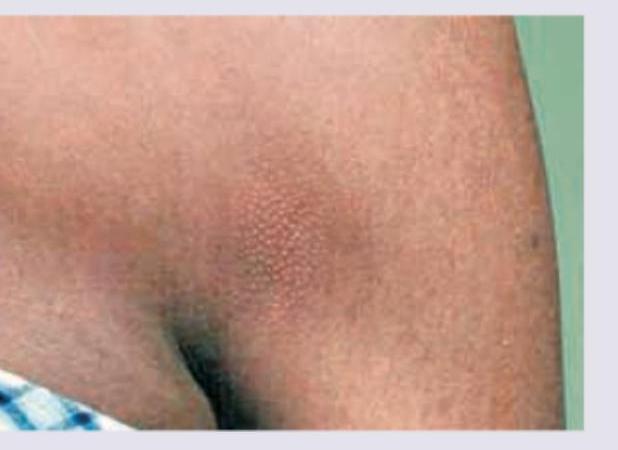
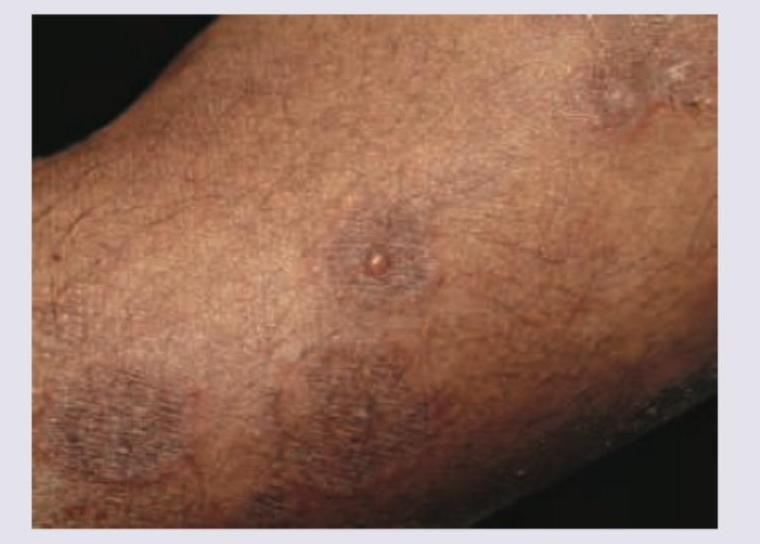
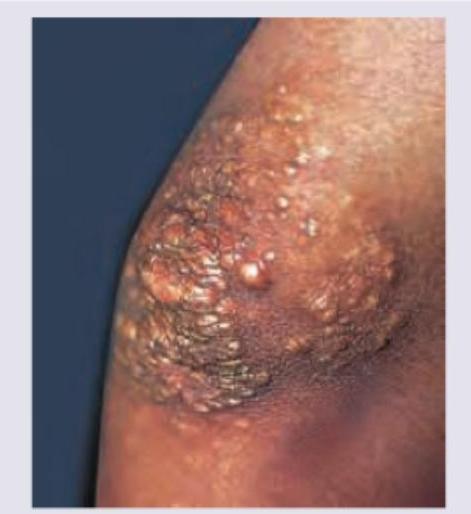
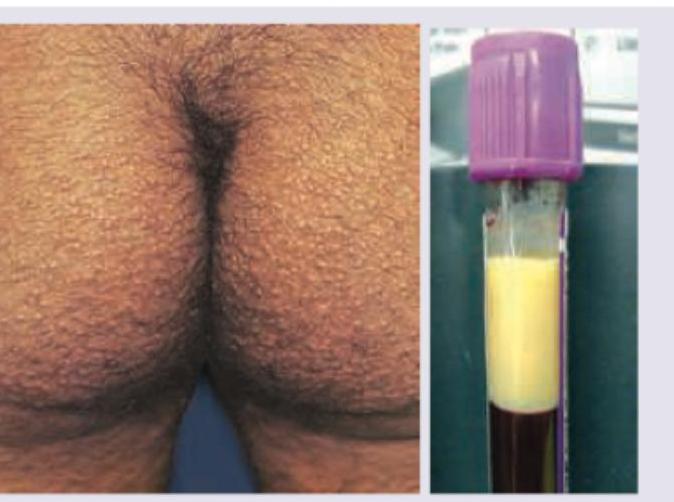
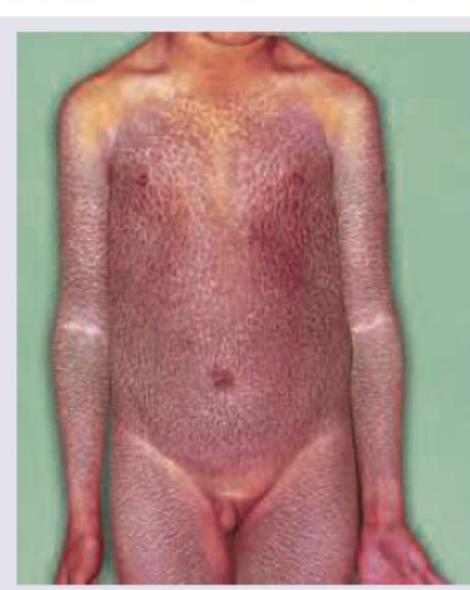
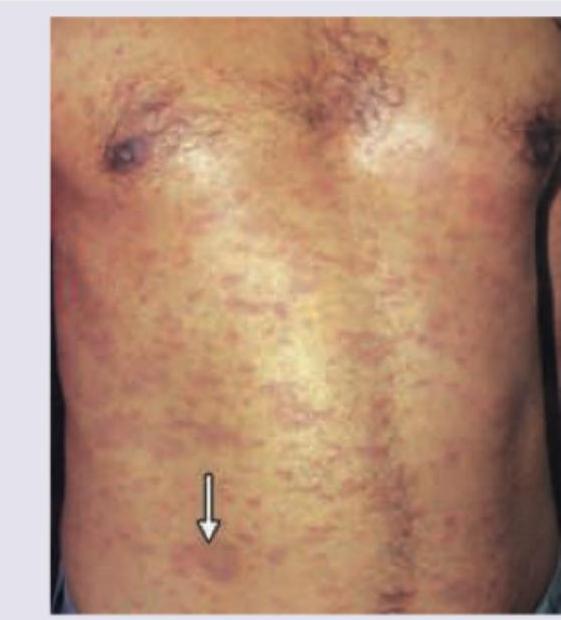
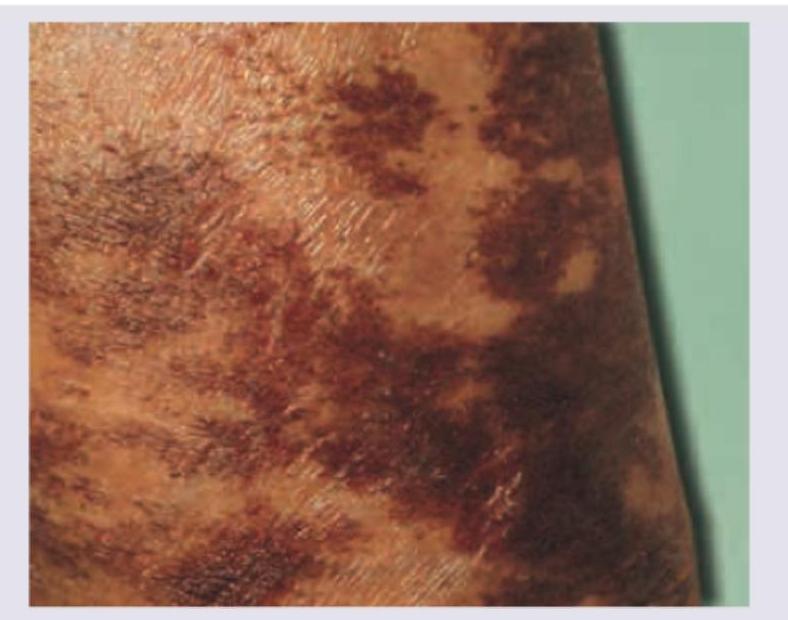
A linear lesion is seen in which of the following conditions?
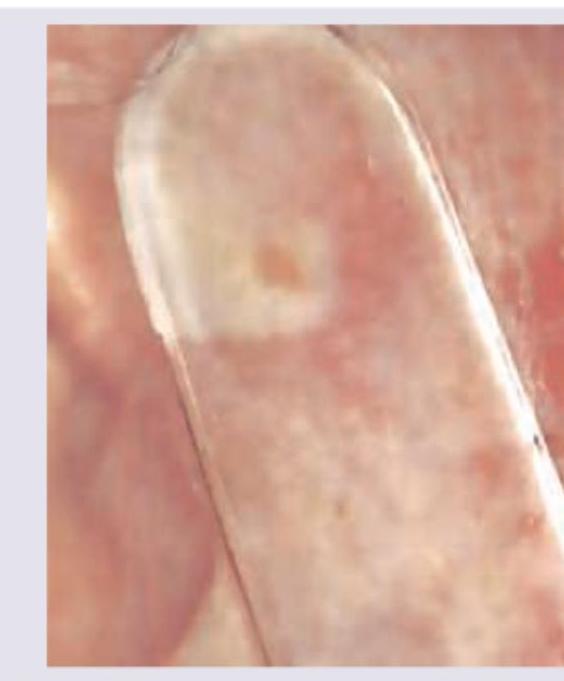
Which of the following is an oral manifestation of lichen planus?
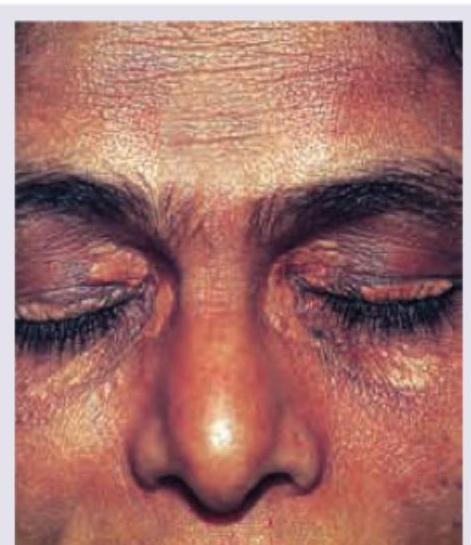
A 45-year-old woman presents with a 2-year history of slowly progressive, minimally pruritic, confluent plaques involving the perioral and centrofacial areas. The eruption was preceded by oral mucosal plaques. On examination, multiple, confluent, fibrotic, scaly, hypopigmented plaques with central atrophy, peripheral hyperpigmentation, and crusts are noted in the involved areas. A skin biopsy demonstrates granulomatous inflammation. Which of the following would be true about this patient?
Cigarette paper scars in the skin are classically seen in which of the following conditions?
Ectopic sebaceous glands are present at:
Patches are circumscribed, flat lesions distinguished from surrounding skin, with a size greater than what dimension?
Hereditary hemorrhagic telangiectasia is commonly seen on which of the following locations?
Mutation in Keratin 1 and 10 are associated with which condition?
Civatte bodies are found in which of the following conditions?
What is the characteristic histological finding of Lichen planus?
Explanation: **Explanation:** The correct answer is **Sporotrichosis (Option A)**. In dermatology, "linear lesions" can be classified into different categories based on their pathophysiology. Sporotrichosis, caused by the fungus *Sporothrix schenckii*, typically presents as **Sporotrichoid spread (Nodular Lymphangitis)**. After inoculation (often via a rose thorn), a primary nodule forms, followed by the appearance of secondary nodules along the path of the draining lymphatics in a characteristic **linear distribution**. **Analysis of Options:** * **Lichen planus (Option B) & Psoriasis (Option C):** While these conditions can show linear lesions due to the **Koebner phenomenon** (isomorphic response), they are primarily characterized by papulosquamous morphology (polygonal papules in LP and silvery-scale plaques in Psoriasis). In the context of "linear spread" as a primary diagnostic feature, Sporotrichosis is the more specific answer for lymphatic linearity. * **Pemphigus (Option D):** This is an autoimmune blistering disease characterized by flaccid bullae and erosions. It does not typically present in a linear pattern. **Clinical Pearls for NEET-PG:** * **Sporotrichoid Spread (Differential Diagnosis):** Remember the mnemonic **"MALS"** – **M**ycobacterium marinum, **A**typical mycobacteria, **L**eishmaniasis, and **S**porotrichosis. All can present with linear nodules along lymphatics. * **Koebner Phenomenon:** Linear lesions occurring at the site of trauma. Common in Psoriasis, Lichen Planus, and Vitiligo. * **Linear Blaschkoid distribution:** Follows the lines of Blaschko (e.g., Incontinentia Pigmenti, Linear Epidermal Nevus). * **Treatment of choice for Sporotrichosis:** Oral **Itraconazole** (historically, Saturated Solution of Potassium Iodide - SSKI was used).
Explanation: **Explanation:** **Lichen Planus (LP)** is a chronic inflammatory condition affecting the skin and mucous membranes. The correct answer is **White radiating lines on the buccal mucosa**, which are clinically known as **Wickham’s striae**. In the oral cavity, LP most commonly presents as a reticular pattern of white, lacy, interconnected lines, typically involving the posterior buccal mucosa bilaterally. This occurs due to the destruction of the basal cell layer by T-cells, leading to hyperkeratosis and a characteristic "saw-tooth" appearance of the rete ridges on histology. **Analysis of Incorrect Options:** * **Dentinogenesis imperfecta:** This is a genetic disorder of tooth development (dentin formation) often associated with Osteogenesis Imperfecta; it is not related to inflammatory dermatoses. * **Fordyce spots:** These are ectopic sebaceous glands appearing as small, yellowish-white papules on the oral mucosa. They are a normal anatomical variant, not a pathology. * **White, chalky enamel surface:** This is a classic sign of early **Dental Caries** or **Fluorosis**, representing demineralization or hypomineralization of the enamel. **High-Yield Clinical Pearls for NEET-PG:** * **The 6 P’s of LP:** Planar, Purple, Polygonal, Pruritic, Papules, and Plaques. * **Koebner Phenomenon:** New lesions appearing at the site of trauma (also seen in Psoriasis and Vitiligo). * **Variants:** Oral LP can be reticular (most common), erosive (painful/premalignant), or bullous. * **Histology:** Look for "Saw-tooth" rete ridges, Civatte bodies (apoptotic keratinocytes), and a band-like lymphocytic infiltrate at the dermo-epidermal junction.
Explanation: ### Explanation The clinical presentation described is characteristic of **Lupus Vulgaris (LV)**, the most common form of chronic, progressive cutaneous tuberculosis. **1. Why Option A is Correct:** Lupus Vulgaris typically presents as "apple-jelly" nodules on diascopy, which progress to form confluent, fibrotic, and atrophic plaques. The **centrofacial area** (nose and cheeks) is the most common site. A key diagnostic feature is the involvement of **oral mucosa** preceding or accompanying skin lesions. Histopathology reveals well-formed **tuberculoid granulomas** with minimal caseation. Since LV is a **paucibacillary** form of TB (occurring in individuals with high immunity), bacilli are difficult to find on AFB staining, but **cultures** or PCR are the gold standard for confirming *Mycobacterium tuberculosis*. **2. Why the Other Options are Incorrect:** * **Option B:** While deep fungal infections (like blastomycosis) can cause granulomatous plaques, the specific progression from oral mucosa to centrofacial atrophy is classic for TB. * **Option C:** Erythema Nodosum Leprosum (ENL) is a Type 2 Lepra reaction seen in lepromatous leprosy. This patient’s presentation (fibrotic plaques, granulomatous histology) points toward TB, not leprosy. * **Option D:** Visceral leishmaniasis (Kala-azar) presents with systemic symptoms (fever, hepatosplenomegaly). Post-Kala-azar Dermal Leishmaniasis (PKDL) presents with macules or nodules, but typically lacks the scarring, atrophy, and mucosal-first progression seen in LV. **3. High-Yield Clinical Pearls for NEET-PG:** * **Lupus Vulgaris:** Most common cutaneous TB; "Apple-jelly nodules" on diascopy; high risk of **Squamous Cell Carcinoma (Marjolin’s ulcer)** in long-standing scars. * **Classification:** LV is a **paucibacillary** form (High immunity/Low bacilli). * **Differential:** Sarcoidosis and Discoid Lupus Erythematosus (DLE) also cause facial scarring, but mucosal involvement and specific granulomatous histology favor LV.
Explanation: **Explanation:** **Ehlers-Danlos Syndrome (EDS)** is a group of inherited connective tissue disorders characterized by defects in collagen synthesis. The hallmark of EDS is **skin hyperextensibility, joint hypermobility, and tissue fragility**. The correct answer is **Ehlers-Danlos Syndrome** because the defective collagen leads to poor wound healing. When the skin is injured, it heals with thin, atrophic, and translucent scars that resemble crumpled tissue paper—hence the term **"Cigarette paper scars"** (also known as papyraceous scars). These are most commonly seen over pressure points like the knees and elbows. **Analysis of Incorrect Options:** * **Osteogenesis Imperfecta:** Caused by defects in Type I collagen. While it presents with blue sclera and bone fragility, it does not typically feature cigarette paper scars. * **Chondrodysplasia:** A group of disorders affecting cartilage and bone growth (skeletal dysplasias); it does not primarily manifest with atrophic skin scarring. * **Alport Syndrome:** Caused by mutations in Type IV collagen (basement membranes). It presents with the triad of sensorineural deafness, progressive renal failure, and ocular anomalies (lenticonus), but not skin fragility. **High-Yield Clinical Pearls for NEET-PG:** * **Gorlin’s Sign:** The ability to touch the tip of the nose with the tongue (seen in 50% of EDS patients). * **Molluscoid Pseudotumors:** Small, fleshy, violet-colored growths found over pressure points in EDS. * **Spheroids:** Small, hard subcutaneous nodules (calcified fat) often felt over the shins. * **Vascular EDS (Type IV):** The most severe form, associated with life-threatening arterial or visceral rupture (COL3A1 mutation).
Explanation: ### Explanation **Core Concept: Ectopic Sebaceous Glands** Sebaceous glands are typically associated with hair follicles (pilosebaceous units). However, **ectopic sebaceous glands** are those found in areas devoid of hair follicles. These are normal anatomical variants and are not considered pathological. **Analysis of Options:** * **Buccal Mucosa & Lips:** When ectopic sebaceous glands occur here, they are clinically known as **Fordyce spots**. They appear as asymptomatic, small (1–3 mm), yellowish-white papules. They are extremely common, occurring in up to 80% of adults. * **Orbit/Eyelids:** Sebaceous glands in the eyelids that are not associated with hair follicles include the **Meibomian glands** (within the tarsal plate) and the **Glands of Zeis** (though Zeis are usually associated with eyelashes, ectopic variants occur in the palpebral conjunctiva). * **Other Sites:** They are also found on the prepuce/glans penis (**Tyson’s glands**), the female labia, and the nipple/areola (**Montgomery tubercles**). Since ectopic sebaceous glands are found in all the listed locations, **Option D** is the correct answer. **High-Yield Clinical Pearls for NEET-PG:** 1. **Fordyce Spots:** Most common on the vermilion border of the lips and buccal mucosa. They are benign and require no treatment. 2. **Montgomery Tubercles:** Ectopic sebaceous glands on the areola that enlarge during pregnancy. 3. **Tyson’s Glands:** Small whitish bumps on the coronal sulcus of the penis; often confused with Pearly Penile Papules (PPP). 4. **Meibomian Glands:** Modified sebaceous glands; their dysfunction is a leading cause of dry eye syndrome.
Explanation: **Explanation:** In dermatology, primary skin lesions are classified based on their morphology (flat vs. raised) and their size. Flat, non-palpable lesions that are level with the surrounding skin are categorized as either **Macules** or **Patches**. The standard clinical threshold used to differentiate these two is **5 mm (0.5 cm)**. * **Macule:** A flat lesion measuring **< 5 mm** in diameter. * **Patch:** A flat lesion measuring **> 5 mm** in diameter. **Analysis of Options:** * **Option C (5 mm):** This is the correct cutoff. A patch is essentially a "large macule." Common examples include Vitiligo patches or Port-wine stains. * **Option A & B (1 mm & 2.5 mm):** These dimensions are too small. Lesions of this size are classified as macules. * **Option D (10 mm):** While some older Western textbooks (like Fitzpatrick) occasionally use 1 cm (10 mm) as a cutoff, the standard teaching for NEET-PG and the benchmark used in most Indian dermatological references is **5 mm**. **NEET-PG High-Yield Pearls:** 1. **Raised Lesions:** The same 5 mm rule applies to raised, solid lesions: **Papules** are < 5 mm, while **Nodules** are > 5 mm. 2. **Plaque:** A broad, plateau-like elevation that is typically > 10 mm (1 cm) in diameter. 3. **Fluid-filled Lesions:** **Vesicles** are < 5 mm, whereas **Bulla** are > 5 mm. 4. **Memory Tip:** Think of "5 mm" as the universal "magic number" in basic dermatology for distinguishing small vs. large primary lesions.
Explanation: **Explanation:** **Hereditary Hemorrhagic Telangiectasia (HHT)**, also known as **Osler-Weber-Rendu syndrome**, is an autosomal dominant vascular dysplasia characterized by multiple telangiectasias and arteriovenous malformations (AVMs). **Why Lips are the Correct Answer:** The hallmark of HHT is the presence of small, ruby-red, blanchable telangiectasias. These are most characteristically and frequently found on the **lips** (especially the vermilion border), tongue, and fingertips. In clinical practice and exam scenarios, the lips are considered the most common and visible site for these mucocutaneous lesions, often serving as the primary diagnostic clue during physical examination. **Analysis of Incorrect Options:** * **B. Buccal mucosa:** While HHT can involve any part of the oral cavity, the buccal mucosa is less frequently involved compared to the lips and tongue. * **C. Tongue:** The tongue is a very common site for telangiectasias in HHT; however, statistically and for examination purposes, the **lips** are prioritized as the most classic location. * **D. Palate:** Involvement of the palate is rare compared to the prominent involvement of the labial and lingual surfaces. **Clinical Pearls for NEET-PG:** * **Triad of HHT:** Telangiectasia, recurrent epistaxis (most common presenting symptom), and a positive family history. * **Curacao Criteria:** Used for diagnosis (Epistaxis, Telangiectasias, Visceral lesions, First-degree relative). * **Visceral AVMs:** Most commonly occur in the lungs, liver, and brain; pulmonary AVMs can lead to paradoxical embolic strokes or brain abscesses. * **Genetics:** Mutations in *ENG* (HHT1) or *ACVRL1* (HHT2) genes.
Explanation: ### Explanation **Correct Answer: B. Epidermolytic hyperkeratosis (EHK)** Keratins are intermediate filament proteins that provide structural integrity to epithelial cells. They are expressed in specific pairs depending on the layer of the skin. **Keratin 1 (K1) and Keratin 10 (K10)** are the primary keratins of the **suprabasal layers** (stratum spinosum and granulosum). Mutation in K1 or K10 leads to **Epidermolytic Hyperkeratosis** (also known as Bullous Congenital Ichthyosiform Erythroderma). The defect causes the keratin filaments to clump, weakening the structural support of the cells. This results in intraepidermal blistering (due to cytolysis) and subsequent massive compensatory hyperkeratosis. **Analysis of Incorrect Options:** * **A. Epidermolysis bullosa simplex (EBS):** This is caused by mutations in **K5 and K14**, which are expressed in the **basal layer** of the epidermis. * **C. Epidermolytic palmoplantar keratoderma (EPPK):** This condition (Vorner type) is specifically associated with mutations in **K9**, which is uniquely expressed in the palms and soles. * **D. Meesmann epithelial corneal dystrophy:** This is caused by mutations in **K3 and K12**, which are specific to the corneal epithelium. **High-Yield Clinical Pearls for NEET-PG:** * **K5/K14:** Basal layer (EBS). * **K1/K10:** Suprabasal layers (EHK/BCIE). * **K6/K16:** Nail bed and palmoplantar skin (Pachyonychia Congenita Type 1). * **K1/K9:** Palmoplantar Keratoderma. * **Histopathology of EHK:** Characterized by "granular degeneration"—vacuolization of the keratinocytes in the stratum spinosum and granulosum with large, irregular keratohyalin granules.
Explanation: **Explanation:** **Civatte bodies** (also known as colloid or cytoid bodies) are a hallmark histopathological finding in **Lichen Planus**. They represent apoptotic or degenerated keratinocytes located in the lower epidermis or papillary dermis. 1. **Why Lichen Planus is correct:** Lichen planus is characterized by an interface dermatitis where a T-cell mediated immune response attacks the basal layer of the epidermis. This leads to **liquefactive degeneration** of basal keratinocytes. As these cells die (apoptosis), they shrink and become eosinophilic, rounded structures known as Civatte bodies. They stain positively for PAS (Periodic Acid-Schiff) and contain IgM on direct immunofluorescence. 2. **Why other options are incorrect:** * **Psoriasis:** Characterized by regular epidermal hyperplasia (acanthosis), parakeratosis, and Munro’s microabscesses (neutrophils in the stratum corneum), not apoptotic keratinocytes. * **Dermatophytosis:** A fungal infection identified by fungal hyphae/spores in the stratum corneum (best seen with KOH mount or PAS stain). * **Vitiligo:** An autoimmune destruction of melanocytes; histopathology shows a complete absence of melanocytes and melanin pigment in the basal layer. **High-Yield Clinical Pearls for NEET-PG:** * **Histopathology Mnemonic (Lichen Planus):** Remember the "6 P's" (Planar, Purple, Polygonal, Pruritic, Papules, Plaques) and the "Saw-tooth" appearance of rete ridges. * **Wickham Striae:** White reticular lines on the surface of papules caused by focal orthohyperkeratosis. * **Max-Joseph Spaces:** Small clefts formed between the epidermis and dermis due to extensive basal cell degeneration. * **Koebner Phenomenon:** Development of lesions at sites of trauma (also seen in Psoriasis and Vitiligo).
Explanation: **Explanation:** Lichen Planus (LP) is a chronic inflammatory condition characterized histologically by an **interface dermatitis**. The primary pathology involves a T-cell mediated autoimmune attack on the basal layer of the epidermis. The correct answer is **D (All of the above)** because LP exhibits a classic "pentad" of histological features: 1. **Basal Cell Degeneration (Liquefaction Degeneration):** This is the hallmark of LP. The immune system attacks the basal keratinocytes, leading to their destruction and the formation of apoptotic bodies known as **Civatte bodies** (or Colloid bodies). 2. **Hyperkeratosis:** There is a significant thickening of the stratum corneum (outermost layer), typically without parakeratosis (orthokeratosis). 3. **Acanthosis:** The stratum spinosum thickens, often in a characteristic **"saw-tooth" appearance** of the rete ridges. 4. **Hypergranulosis:** Thickening of the granular layer, which clinically corresponds to the white lacy patterns known as **Wickham striae**. 5. **Band-like Infiltrate:** A dense, lymphocytic infiltrate is seen at the dermo-epidermal junction. **Why other options are included:** Options A, B, and C are all individual components of the classic histological picture. Selecting only one would be incomplete, as LP is defined by the coexistence of these epidermal and dermal changes. **High-Yield Clinical Pearls for NEET-PG:** * **Clinical 6 P's:** Planar (flat-topped), Purple, Polygonal, Pruritic, Papules, and Plaques. * **Koebner Phenomenon:** New lesions appear at sites of trauma (also seen in Psoriasis and Vitiligo). * **Wickham Striae:** Reticulate white lines on the surface of papules or oral mucosa. * **Max Joseph Space:** Small areas of separation between the epidermis and dermis due to extensive basal cell damage.
Structure and Function of Skin
Practice Questions
Cutaneous Histopathology
Practice Questions
Dermatological Examination
Practice Questions
Skin Lesions: Morphology and Description
Practice Questions
Principles of Diagnosis in Dermatology
Practice Questions
Dermatological Procedures
Practice Questions
Wound Healing
Practice Questions
Cutaneous Immunology
Practice Questions
Genetics in Dermatology
Practice Questions
Cutaneous Manifestations of Systemic Diseases
Practice Questions
Geriatric Dermatology
Practice Questions
Pediatric Dermatology Basics
Practice Questions
Get full access to all questions, explanations, and performance tracking.
Start For Free