What does acantholysis mean?
What is the approximate ratio of keratinocytes to melanocytes in the epidermal melanin unit?
What is true about a macule?
Lipodermatosclerosis is most commonly seen on which aspect of the leg?
A 25-year-old male presents with pigmented macules on his palms, soles, and oral mucosa. He also has anemia and abdominal pain. What is the most probable diagnosis?
Which of the following is true regarding lichen planus?
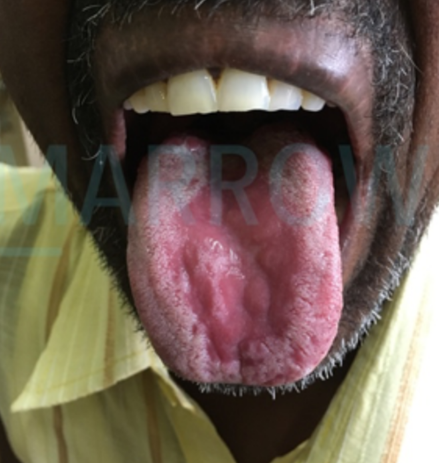
Which of the following statements about geographic tongue is FALSE?
All of the following are true regarding Fordyce spots except?
Which of the following is a dermatological manifestation of Inflammatory Bowel Disease?
Diffuse epidermal hyperplasia is:
Explanation: **Explanation:** **Acantholysis** is the hallmark pathological process characterized by the **loss of intercellular connections** (specifically desmosomes) between keratinocytes. This leads to the separation of epidermal cells, resulting in the formation of intraepidermal clefts or blisters. 1. **Why Option B is Correct:** The term is derived from *akantha* (spine) and *lysis* (destruction). In conditions like Pemphigus Vulgaris, autoantibodies (IgG) attack desmogleins (1 and 3), destroying the "bridges" that hold cells together. This causes cells to become rounded and float freely within the blister fluid (known as **Tzanck cells**). 2. **Why Other Options are Incorrect:** * **Option A (Diffuse epidermal hyperplasia):** This is termed **Acanthosis**. It involves thickening of the stratum spinosum and is classically seen in Psoriasis. * **Option C (Intercellular edema):** This is termed **Spongiosis**. It is the hallmark of Eczema/Dermatitis, where fluid accumulates between cells, stretching the intercellular bridges but not necessarily destroying them. * **Option D (Abnormal keratinization):** This is termed **Dyskeratosis**. It refers to premature keratinization of individual cells below the stratum granulosum, seen in Darier’s disease or Squamous Cell Carcinoma. **High-Yield Clinical Pearls for NEET-PG:** * **Tzanck Smear:** Used to identify acantholytic cells (large, round, hyperchromatic nuclei with a peripheral rim of cytoplasm). * **Nikolsky Sign:** Positive in acantholytic conditions like Pemphigus Vulgaris and SSSS (Staphylococcal Scalded Skin Syndrome). * **Primary Acantholysis:** Occurs due to direct damage to desmosomes (e.g., Pemphigus). * **Secondary Acantholysis:** Occurs due to damage to keratinocytes (e.g., Herpes Simplex infection).
Explanation: ### Explanation **Concept of the Epidermal Melanin Unit** The correct answer is **D (36 keratinocytes : 1 melanocyte)**. The "Epidermal Melanin Unit" is a functional concept describing the relationship between a single melanocyte and the group of keratinocytes to which it supplies melanin. Melanocytes are dendritic cells located in the **stratum basale**. Through their long cytoplasmic processes (dendrites), they transfer melanosomes to surrounding keratinocytes. In the human epidermis, one melanocyte is functionally associated with approximately **36 keratinocytes**. This ratio ensures uniform pigmentation and protection of keratinocyte nuclei from UV radiation. **Analysis of Options:** * **Option A & C:** These ratios (26:1 and 16:1) are incorrect as they underestimate the extensive dendritic reach of a single melanocyte. * **Option B:** While the math (36:2) simplifies to 18:1, the standard physiological definition specifically identifies a **single** melanocyte as the hub of the unit. * **Option D:** This is the established physiological ratio cited in standard dermatology textbooks (like Fitzpatrick or Rook’s). **High-Yield Clinical Pearls for NEET-PG:** * **Melanocyte Origin:** They are derived from the **Neural Crest** (not the ectoderm). * **Distribution:** While the *number* of melanocytes is roughly the same across all races, the *size, number, and distribution* of melanosomes within the keratinocytes differ. * **Dermal-Epidermal Ratio:** In the basal layer specifically, the ratio of melanocytes to keratinocytes is roughly **1:10**. Do not confuse this "basal ratio" with the "epidermal melanin unit" (1:36). * **Stains:** Melanocytes can be identified using **HMB-45, S-100, or MART-1** immunohistochemistry.
Explanation: **Explanation:** In dermatology, primary skin lesions are classified based on their morphology (flat vs. elevated) and their size. **1. Why the correct answer is right:** A **macule** is defined as a flat, non-palpable change in skin color that is flush with the surrounding skin. According to standard dermatological nomenclature (often cited in Fitzpatrick and IADVL textbooks), a macule is typically **less than 1 cm or 2 cm** in diameter (the cutoff varies slightly by source, but in the context of this question, <2 cm is the defining criteria). Since it is non-palpable, you cannot feel it if you close your eyes and run your finger over it. **2. Analysis of incorrect options:** * **Option A (Flat, >2 cm):** A flat lesion larger than 1–2 cm is termed a **Patch**. Examples include Vitiligo or Port-wine stains. * **Option C (Elevated, >2 cm):** A solid, elevated, flat-topped lesion greater than 1 cm is a **Plaque** (e.g., Psoriasis). If it is a deep, solid mass, it is a **Nodule** or **Tumor**. * **Option D (Elevated, <2 cm):** A small, solid, elevated lesion less than 0.5–1 cm is termed a **Papule** (e.g., Plane warts). **High-Yield Clinical Pearls for NEET-PG:** * **Macule vs. Patch:** Both are flat; the only difference is size. * **Papule vs. Plaque:** Both are elevated; the only difference is size/surface area. * **Vesicle vs. Bulla:** Both are fluid-filled; Vesicles are <0.5 cm, Bullae are >0.5 cm. * **Key Exam Tip:** If a question mentions "non-palpable," always look for Macule or Patch. If it mentions "palpable," look for Papule, Nodule, or Plaque.
Explanation: **Explanation:** **Lipodermatosclerosis (LDS)** is a localized form of chronic panniculitis and fibrosis of the skin and subcutaneous tissues. It is a hallmark of **Chronic Venous Insufficiency (CVI)**. **Why the Medial Aspect is Correct:** The condition is most commonly seen on the **medial aspect of the lower leg**, specifically just above the medial malleolus. This is because the medial leg is the site of the **Great Saphenous Vein** and its associated perforators (e.g., Cockett’s perforators). In CVI, venous hypertension is most pronounced in this region, leading to the extravasation of macromolecules and red blood cells, which triggers an inflammatory cascade and subsequent fibrosis of the subcutaneous fat. **Analysis of Incorrect Options:** * **Anterior aspect of the leg:** While skin changes can wrap around the leg, the primary pathology originates medially due to the venous anatomy. * **Anterior/Posterior aspect of the thigh:** LDS is a disease of the lower leg (the "gaiter area"). Venous pressure is highest at the distal extremities due to gravity; therefore, the thigh is rarely involved. **Clinical Pearls for NEET-PG:** * **Inverted Champagne Bottle Appearance:** Chronic LDS leads to tapering of the lower leg (due to fibrosis) with proximal edema, giving the leg this classic shape. * **Acute vs. Chronic:** Acute LDS can mimic cellulitis (pain, redness), but it is non-febrile and does not respond to antibiotics. * **Stasis Dermatitis:** Often precedes LDS; look for "cayenne pepper" spots (hemosiderin staining). * **Treatment:** Compression therapy is the gold standard.
Explanation: **Explanation:** The clinical triad of **mucocutaneous pigmentation**, **gastrointestinal polyposis**, and **anemia** is classic for **Peutz-Jeghers Syndrome (PJS)**. It is an autosomal dominant disorder caused by a mutation in the **STK11 (LKB1)** gene. 1. **Why Option C is correct:** The hallmark is melanocytic macules (lentigines) appearing in early childhood on the lips, buccal mucosa (most specific), palms, and soles. Unlike common freckles, these do not fade with sun exposure. The abdominal pain and anemia are due to intestinal hamartomatous polyps, which can cause chronic occult bleeding or intussusception. 2. **Why other options are incorrect:** * **Albright’s Syndrome (McCune-Albright):** Characterized by large, unilateral "Café-au-lait" spots with irregular "Coast of Maine" borders, polyostotic fibrous dysplasia, and precocious puberty. It does not involve oral mucosal pigmentation. * **Cushing’s Syndrome:** Presents with systemic features like moon facies, buffalo hump, and purple striae. While hyperpigmentation can occur in ACTH-dependent cases, it is generalized rather than localized to the palms/soles/mucosa. * **Incontinentia Pigmenti:** An X-linked dominant condition that follows the Lines of Blaschko. It progresses through four stages (vesicular, verrucous, hyperpigmented, and atrophic) and typically affects females, as it is lethal in males. **NEET-PG High-Yield Pearls:** * **Most common site for PJS polyps:** Small intestine (specifically the jejunum). * **Malignancy Risk:** Patients have a significantly increased risk of GI and extra-GI cancers (breast, pancreas, ovary, and testis). * **Differential Diagnosis:** Laugier-Hunziker syndrome also presents with oral and acral pigmentation but lacks the systemic GI polyposis.
Explanation: **Lichen Planus (LP)** is a chronic, inflammatory, T-cell-mediated autoimmune condition affecting the skin, hair, nails, and mucous membranes. ### **Explanation of the Correct Option** **A. Can undergo malignant change:** Chronic erosive or hypertrophic variants of Lichen Planus, particularly **Oral Lichen Planus (OLP)** and **Lichen Planus Hypertrophicus (LPH)**, are considered premalignant conditions. Long-standing inflammation can lead to the development of **Squamous Cell Carcinoma (SCC)**. The risk is estimated at approximately 1% for oral lesions. ### **Explanation of Incorrect Options** * **B. Treated only by medication:** While topical/systemic steroids and retinoids are the mainstays, treatment also includes lifestyle modifications (avoiding Koebnerization) and phototherapy (PUVA/NB-UVB). * **C. Must be excised:** LP is an inflammatory condition, not a primary surgical one. Excision is generally avoided because of the **Koebner phenomenon** (new lesions appearing at the site of trauma/surgery). Surgery is reserved only for biopsy or if malignancy is suspected. * **D. Is an idiosyncrasy reaction:** LP is an autoimmune process. "Idiosyncrasy" usually refers to unpredictable drug reactions (e.g., Lichenoid drug eruptions), but classic LP is idiopathic or associated with Hepatitis C. ### **High-Yield NEET-PG Pearls** * **6 P’s of LP:** Planar (flat-topped), Purple (violaceous), Polygonal, Pruritic, Papules, and Plaques. * **Wickham Striae:** White reticular patterns on the surface of papules (due to focal hypergranulosis). * **Histopathology:** Characteristic "saw-tooth" appearance of rete ridges, Max-Joseph spaces, and a band-like lymphocytic infiltrate at the dermo-epidermal junction. * **Civatte Bodies:** Degenerating keratinocytes (colloid bodies) in the lower epidermis. * **Koebner Phenomenon:** Also seen in Psoriasis and Vitiligo.
Explanation: **Explanation:** **Geographic Tongue**, also known as **Benign Migratory Glossitis**, is a common, inflammatory, but non-neoplastic condition of the tongue. 1. **Why Option C is the correct answer (False statement):** Geographic tongue is a completely **benign** condition. It has **no malignant potential** and is not considered a precancerous or premalignant lesion. Unlike conditions like oral leukoplakia or erythroplakia, it does not require biopsy or aggressive monitoring for cancer. 2. **Analysis of other options:** * **Option A:** Lesions are characterized by depapillated red patches with a serpiginous white border. These lesions frequently appear in a **bilaterally symmetrical** pattern on the dorsum and lateral borders of the tongue. * **Option B:** Since the condition is asymptomatic in most cases and self-limiting, **no treatment is typically required** other than reassurance. If burning occurs (glossodynia), topical steroids or zinc supplements may be used. * **Option D:** The exact etiology is unknown, but it is strongly associated with **emotional stress**, psoriasis (HLA-Cw6), and atopy. **High-Yield Clinical Pearls for NEET-PG:** * **Pathology:** It involves the loss of **filiform papillae** (atrophy), while fungiform papillae remain. * **Clinical Feature:** The "migratory" nature is key—lesions heal in one area and reappear in another, changing the "map" of the tongue daily. * **Association:** It is often seen in patients with **Psoriasis** and **Fissured Tongue** (Scrotal tongue). * **Histology:** Shows Munro’s microabscesses (neutrophils in the epithelium), similar to psoriasis.
Explanation: **Explanation:** **Fordyce spots** are a common, benign dermatological condition characterized by **ectopic sebaceous glands**. The correct answer is **Option C** because these glands are unique in that they are **not associated with hair follicles** (unlike typical sebaceous glands found on the skin, which form part of the pilosebaceous unit). Instead, they open directly onto the mucosal surface. * **Option A (Ectopic sebaceous glands):** This is the defining feature of Fordyce spots. They are normal sebaceous glands located in an abnormal (ectopic) location, specifically the mucosal surfaces. * **Option B (Asymptomatic):** These spots are physiological variants rather than a disease. They are painless, non-itchy, and do not require treatment unless for cosmetic reasons. * **Option C (Associated with hair follicles):** This is **incorrect** (and thus the right answer). Fordyce spots are "free" sebaceous glands, meaning they lack an associated hair follicle. * **Option D (Upper lip):** This is a classic clinical presentation. They most commonly occur on the vermilion border of the upper lip and the buccal mucosa. **Clinical Pearls for NEET-PG:** 1. **Appearance:** They present as small (1–3 mm), yellowish-white, discrete papules. 2. **Common Sites:** Upper lip vermilion, buccal mucosa (often bilateral/symmetrical), and occasionally the glans penis or labia. 3. **Prevalence:** They are present in about 80% of adults; their visibility increases after puberty due to hormonal stimulation of sebaceous glands. 4. **Differential Diagnosis:** Must be distinguished from Milia (keratin cysts) or Molluscum Contagiosum (umbilicated papules). No biopsy is usually required as the diagnosis is clinical.
Explanation: **Explanation:** **Pyoderma gangrenosum (PG)** is a classic cutaneous manifestation of **Inflammatory Bowel Disease (IBD)**, particularly Ulcerative Colitis. It is a neutrophilic dermatosis characterized by a rapidly enlarging, painful ulcer with a characteristic "undermined" violaceous border. The underlying medical concept is an autoinflammatory response where neutrophils infiltrate the dermis. Notably, the clinical course of PG does not always correlate with the activity of the bowel disease. **Analysis of Incorrect Options:** * **B. Necrolytic migratory erythema:** This is the pathognomonic skin finding associated with a **Glucagonoma** (an alpha-cell pancreatic tumor). It presents as erythematous, scaly plaques with central clearing, typically in the intertriginous areas. * **C. Impetigo:** This is a common superficial **bacterial infection** (usually *Staph. aureus* or *Strep. pyogenes*) characterized by honey-colored crusts. It is not an autoimmune or systemic manifestation of IBD. * **D. Psoriasis:** While there is a known genetic and inflammatory overlap between Psoriasis and IBD (both involve the IL-23/IL-17 pathway), Psoriasis is considered a separate comorbid condition rather than a direct dermatological manifestation of IBD. **High-Yield Clinical Pearls for NEET-PG:** * **Erythema Nodosum (EN):** The *most common* skin manifestation of IBD. Unlike PG, EN activity **does** correlate with the severity of the intestinal flare. * **Pathergy:** PG exhibits pathergy, where minor trauma (like a needle prick or surgery) triggers new lesions. * **Sweet Syndrome:** Another neutrophilic dermatosis occasionally associated with IBD, presenting with "juicy" erythematous plaques and fever.
Explanation: **Explanation:** **Acanthosis** refers to the diffuse hyperplasia of the **stratum spinosum** (prickle cell layer) of the epidermis. This results in an increased thickness of the Malpighian layer, often accompanied by the elongation of rete ridges. It is a hallmark histological feature of chronic inflammatory skin conditions, most notably **Psoriasis** (where it is regular) and **Chronic Eczema/Lichen Simplex Chronicus** (where it is irregular). **Analysis of Incorrect Options:** * **Hyperkeratosis (A):** This is the thickening of the **stratum corneum** (the outermost keratin layer), not the entire epidermis. It is seen in conditions like ichthyosis and calluses. * **Parakeratosis (B):** This refers to the retention of **nuclei** in the stratum corneum. It signifies rapid epidermal turnover where cells do not have enough time to mature and lose their nuclei (e.g., Psoriasis). * **Erosion (C):** This is a clinical term for the partial loss of the epidermis that heals without scarring. It is a loss of tissue, the opposite of hyperplasia. **High-Yield Clinical Pearls for NEET-PG:** * **Acanthosis Nigricans:** A clinical condition characterized by velvety hyperpigmentation and acanthosis, often associated with **insulin resistance**, obesity, or internal malignancy (Gastric Adenocarcinoma). * **Pseudoepitheliomatous Hyperplasia:** An extreme form of acanthosis that mimics squamous cell carcinoma, often seen at the edges of chronic ulcers or fungal infections (e.g., Chromoblastomycosis). * **Acantholysis:** Distinct from acanthosis, this is the loss of intercellular connections (desmosomes) resulting in intraepidermal blisters (e.g., Pemphigus Vulgaris).
Structure and Function of Skin
Practice Questions
Cutaneous Histopathology
Practice Questions
Dermatological Examination
Practice Questions
Skin Lesions: Morphology and Description
Practice Questions
Principles of Diagnosis in Dermatology
Practice Questions
Dermatological Procedures
Practice Questions
Wound Healing
Practice Questions
Cutaneous Immunology
Practice Questions
Genetics in Dermatology
Practice Questions
Cutaneous Manifestations of Systemic Diseases
Practice Questions
Geriatric Dermatology
Practice Questions
Pediatric Dermatology Basics
Practice Questions
Get full access to all questions, explanations, and performance tracking.
Start For Free