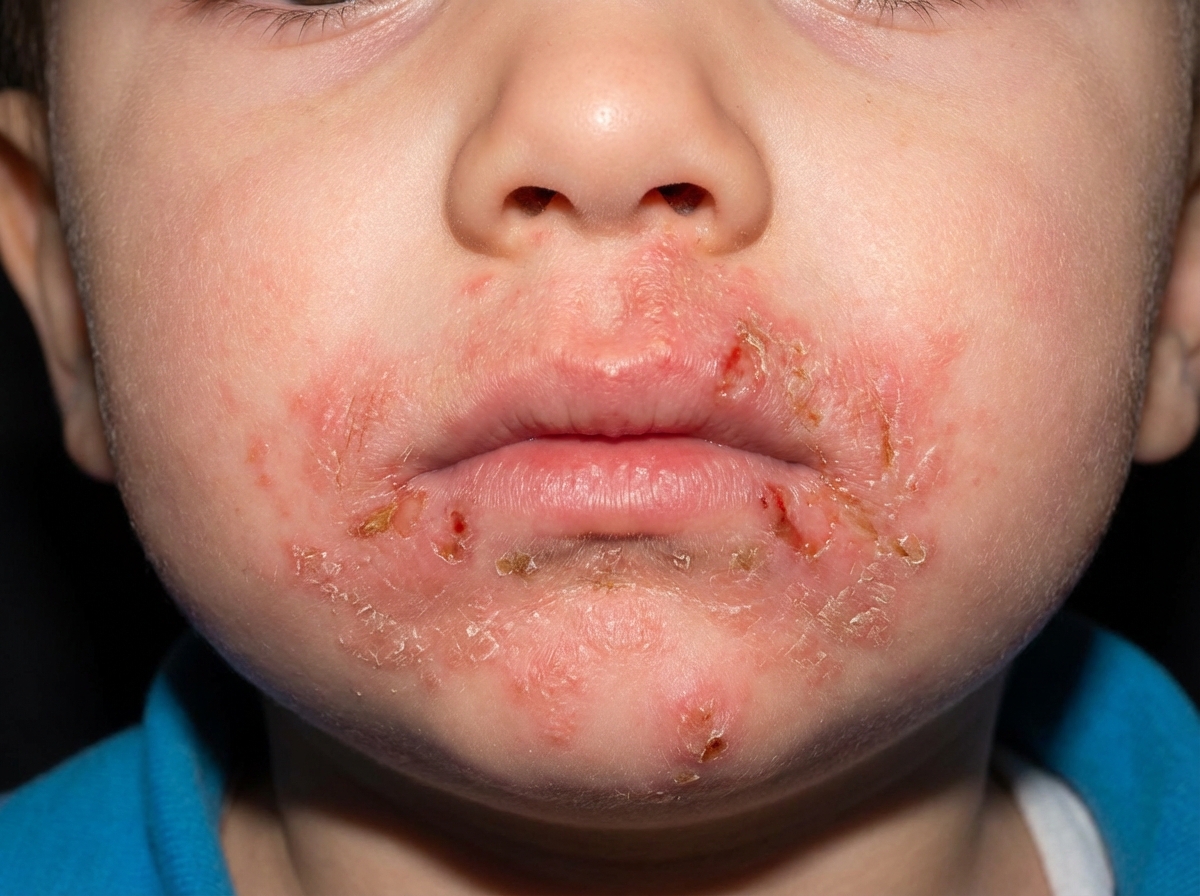
Pyoderma gangrenosum is commonly associated with which of the following conditions?
Fox-Fordyce spots represent which of the following?
Which of the following is NOT included under the diagnostic criteria for Neurofibromatosis type 1?
What is true about lichen planus?
Bull's eye lesions are clinically seen in which of the following conditions?
Which of the following conditions is characterized by a 'bull's eye' type of radiologic feature?
A patient presented with scarring alopecia, thinned nails, hypopigmented macular lesions over the trunk and oral mucosa. What is the most likely diagnosis?
Which of the following conditions is associated with a defect in DNA repair mechanisms?
All are true about lichen planus except:
Which of the following drugs is used in generalized lichen planus?
Explanation: **Explanation:** **Pyoderma Gangrenosum (PG)** is a rare, non-infectious neutrophilic dermatosis characterized by rapidly progressing, painful skin ulcers with undermined, violaceous borders. It is classically associated with systemic inflammatory conditions. **Why Ulcerative Colitis (UC) is the correct answer:** While PG is associated with both types of Inflammatory Bowel Disease (IBD), it is significantly more common in **Ulcerative Colitis** (occurring in approximately 5–12% of patients) than in Crohn’s disease (1–2%). The pathogenesis involves neutrophilic dysfunction and a heightened inflammatory response. Notably, the clinical course of PG does not always correlate with the activity of the underlying bowel disease. **Analysis of Incorrect Options:** * **A. Crohn's disease:** Although PG is associated with Crohn’s, UC remains the most frequent systemic association. In Crohn's, skin lesions are more likely to be "metastatic Crohn's" or perianal fistulas. * **B. Diverticulosis:** This is a structural abnormality of the colon wall and lacks the systemic immunological/neutrophilic triggers required to manifest PG. * **C. Colon cancer:** While PG can be a paraneoplastic manifestation of **hematologic malignancies** (like AML or IgA Monoclonal Gammopathy), it is not typically associated with solid organ tumors like colon cancer. **NEET-PG High-Yield Pearls:** 1. **Pathergy Phenomenon:** PG often exhibits pathergy, where minor trauma (like a needle prick or surgery) triggers new lesions or worsens existing ones. 2. **Morphology:** Look for the "violaceous (purple) undermined border" and "cribriform scarring" upon healing. 3. **Treatment:** The mainstay of treatment is **systemic corticosteroids** or Cyclosporine; surgical debridement is contraindicated due to pathergy. 4. **Other Associations:** Rheumatoid arthritis and Myelodysplastic Syndrome (MDS).
Explanation: **Explanation:** **Fox-Fordyce disease** (also known as apocrine miliaria) is a chronic inflammatory disorder caused by the **obstruction of the apocrine sweat gland ducts**. The correct answer is **D**. The condition occurs when a keratinous plug blocks the infundibulum of the hair follicle, leading to the rupture of the apocrine duct. This causes sweat to leak into the surrounding dermis, resulting in intense pruritus and the characteristic clinical appearance of multiple, small, firm, skin-colored to yellowish papules. **Analysis of Options:** * **A & B (Pilosebaceous/Sebaceous glands):** While Fox-Fordyce disease involves the hair follicle unit, it specifically affects the apocrine component. Note: **Fordyce spots** (without the "Fox") are ectopic sebaceous glands found on the lips or oral mucosa; these are distinct from Fox-Fordyce disease. * **C (Eccrine sweat glands):** Obstruction of eccrine glands leads to **Miliaria** (rubra, crystallina, or profunda), not Fox-Fordyce disease. **Clinical Pearls for NEET-PG:** * **Demographics:** Predominantly affects young women (ages 13–35). * **Distribution:** Occurs in "apocrine-rich" areas—most commonly the **axilla**, followed by the anogenital region and the areola. * **Key Symptom:** Severe, paroxysmal **itching**, which often worsens with emotional stress or heat (stimuli that trigger apocrine secretion). * **Histopathology:** Characterized by "spongiosis" of the follicular infundibulum and the presence of a keratotic plug. * **Treatment:** First-line treatments include topical retinoids and topical steroids; oral contraceptives may help some patients.
Explanation: The diagnostic criteria for **Neurofibromatosis Type 1 (NF1)**, also known as von Recklinghausen disease, are based on the **NIH Consensus Criteria**. To make a diagnosis, a patient must meet at least **two** of the seven specific clinical features. **Explanation of the Correct Answer:** The question asks which is **NOT** included. While **Cafe-au-lait macules (CALMs)** are a hallmark feature of NF1, they must meet a specific threshold to count toward diagnosis: **six or more** macules (>5 mm in prepubertal and >15 mm in postpubertal individuals). Option B is technically the "incorrect" inclusion here because **Periungual fibromas (Koenen tumors)** are a pathognomonic feature of **Tuberous Sclerosis**, not NF1. *(Note: In standard MCQ formats, if "Cafe-au-lait macules" is marked as the correct answer to a "NOT" question, it is usually because the option lacks the numerical requirement (6+) or because Periungual fibroma is the intended distractor belonging to another neurocutaneous syndrome.)* **Analysis of Options:** * **A. Optic Glioma:** A major NIH criterion. These are low-grade pilocytic astrocytomas occurring in about 15% of NF1 patients. * **C. Periungual Fibroma:** These are flesh-colored growths around the nails seen in **Tuberous Sclerosis Complex (TSC)**. They are NOT part of NF1 criteria. * **D. Sphenoid Dysplasia:** A specific skeletal lesion included in the NIH criteria, along with thinning of long bone cortex (with or without pseudoarthrosis). **High-Yield Clinical Pearls for NEET-PG:** * **NIH Criteria Mnemonic (1-7):** 1. **6+** CALMs. 2. **2+** Neurofibromas or 1 Plexiform neurofibroma. 3. **Axillary/Inguinal freckling** (Crowe’s sign). 4. **Optic Glioma**. 5. **2+ Lisch Nodules** (iris hamartomas seen on slit-lamp). 6. **Distinctive Bone Lesion** (Sphenoid dysplasia). 7. **First-degree relative** with NF1. * **Genetics:** NF1 gene is on **Chromosome 17** (codes for Neurofibromin). * **Crowe Sign:** Axillary freckling is highly specific for NF1.
Explanation: **Explanation:** Lichen Planus (LP) is a chronic inflammatory dermatosis characterized by the **"6 Ps"**: Planar, Purple, Polygonal, Pruritic, Papules, and Plaques. The histopathology of LP is classic and frequently tested in NEET-PG. **Why "All of the Above" is correct:** The hallmark of LP is an interface dermatitis where T-cells attack the dermo-epidermal junction. * **Basal cell degeneration (Option A):** This is the primary event. Liquefactive degeneration (hydropic degeneration) of the basal layer occurs due to the T-cell mediated attack on keratinocytes. * **Colloid bodies (Option B):** Also known as **Civatte bodies** or Cytoid bodies, these are shrunken, eosinophilic, apoptotic keratinocytes found in the lower epidermis and papillary dermis. They represent the end result of basal cell damage. * **Epidermal hyperplasia (Option C):** In response to chronic inflammation, the epidermis thickens. This manifests as irregular acanthosis, often described as a **"Saw-tooth" appearance** of the rete ridges. **High-Yield Clinical Pearls for NEET-PG:** * **Wickham Striae:** White reticular lines on the surface of papules caused by focal **wedge-shaped hypergranulosis**. * **Max-Joseph Spaces:** Small clefts between the epidermis and dermis due to extensive basal cell damage. * **Direct Immunofluorescence (DIF):** Characterized by **shaggy linear deposits of Fibrinogen** along the basement membrane zone. * **Koebner Phenomenon:** Development of lesions at sites of trauma (also seen in Psoriasis and Vitiligo). * **Associations:** Strongly associated with **Hepatitis C infection**.
Explanation: **Explanation:** **Erythema Multiforme (EM)** is the correct answer because it is the classic clinical condition associated with **"Bull’s eye"** or **"Target" lesions**. These lesions are pathognomonic and typically consist of three concentric zones: 1. **A central dusky/dark area:** Often showing a blister or crust. 2. **A pale edematous ring:** Surrounding the center. 3. **A peripheral erythematous halo:** Representing the outer border. The underlying medical concept involves a **Type IV hypersensitivity reaction**, most commonly triggered by infections (especially **Herpes Simplex Virus**) or certain medications (like sulfonamides or NSAIDs). The immune system attacks the keratinocytes, leading to the characteristic concentric morphology. **Analysis of Incorrect Options:** * **Lingually impacted 3rd molar (A):** This is a dental/radiological condition and does not present with cutaneous targetoid lesions. * **Taurodontism (C):** This is a dental anomaly where the body of the tooth is enlarged and the roots are reduced in size (resembling a bull’s tooth), but it has no clinical correlation with "Bull's eye" skin lesions. **High-Yield Clinical Pearls for NEET-PG:** * **Distribution:** EM lesions are typically symmetrical and favor the **acral surfaces** (palms, soles, and extensor surfaces of limbs). * **EM Minor vs. Major:** EM Minor involves minimal mucosal involvement, while EM Major involves at least two mucosal surfaces (oral, ocular, or genital). * **Differential Diagnosis:** Targetoid lesions can also be seen in **Stevens-Johnson Syndrome (SJS)**, but in SJS, they are usually "atypical" (two zones instead of three) and more widespread on the trunk. * **Commonest Trigger:** HSV-1 is the most frequent cause of recurrent EM.
Explanation: **Explanation:** The **'bull’s eye' appearance** in dental radiology is a classic sign of a **lingually impacted mandibular third molar**. When a lower third molar is displaced towards the lingual plate, its long axis becomes parallel to the X-ray beam. This projection causes the crown and the root to overlap, creating a radio-opaque circular image with a central radiolucency (representing the pulp canal), mimicking a target or bull’s eye. **Analysis of Options:** * **Lingual impaction of 3rd molar (Correct):** As described, the radiographic foreshortening and overlap of the tooth structures create the characteristic targetoid appearance on a periapical or panoramic radiograph. * **Erythema Multiforme (Incorrect):** While Erythema Multiforme is famous for **'target' or 'bull’s eye' lesions**, these are **clinical skin findings** (concentric erythematous rings), not radiologic features. In a Dermatology or Oral Medicine context, this is a common distractor. * **Ameloblastoma (Incorrect):** This is a benign but aggressive odontogenic tumor. Its classic radiologic appearance is described as **'soap bubble'** or **'honeycomb'** multilocular radiolucency, not a bull’s eye. **High-Yield Clinical Pearls for NEET-PG:** * **Target Lesions (Clinical):** Erythema Multiforme, Stevens-Johnson Syndrome (SJS), and sometimes Fixed Drug Eruptions. * **Target Lesions (Radiological):** Apart from lingual impaction, a 'target' sign on ultrasound can indicate **Intussusception** (Gastrointestinal). * **Buccal vs. Lingual Impaction:** If the impacted tooth appears shifted in the same direction as the tube (SLOB rule), it is lingual; if it appears as a 'bull's eye', it confirms the specific orientation towards the lingual plate.
Explanation: ### Explanation The clinical presentation described is a classic manifestation of **Lichen Planus (LP)**, a chronic inflammatory condition affecting the skin, mucous membranes, hair, and nails. **Why Lichen Planus is Correct:** Lichen planus is characterized by the "6 Ps" (Planar, Purple, Polygonal, Pruritic, Papules, and Plaques). However, it frequently involves other appendages: * **Scalp:** It causes **Lichen Planopilaris**, which leads to follicular destruction and **scarring (cicatricial) alopecia**. * **Nails:** Typical changes include **thinning of the nail plate**, longitudinal ridging, and the pathognomonic **pterygium formation** (fusion of proximal nail fold to the nail bed). * **Mucosa:** Oral LP often presents as a reticulate pattern (Wickham striae) or erosions. * **Skin:** While classic lesions are violaceous, resolving lesions often leave behind significant **post-inflammatory hyper/hypopigmentation**. **Why Other Options are Incorrect:** * **Psoriasis:** Characterized by silvery-white scales and Auspitz sign. Nail changes include pitting and oil spots (onycholysis), but it **never** causes scarring alopecia. * **Leprosy:** Presents with anesthetic patches and nerve thickening. While it can cause eyebrow loss (madarosis), it does not typically cause generalized scarring alopecia or the specific nail thinning seen here. * **Pemphigus:** An autoimmune blistering disorder. While it involves oral mucosa (erosions), it does not present with scarring alopecia or the specific nail dystrophy described. **High-Yield Clinical Pearls for NEET-PG:** * **Pterygium:** If it's "Dorsal," think Lichen Planus; if it's "Ventral," think Scleroderma. * **Grinspan’s Syndrome:** Triad of Lichen Planus, Diabetes Mellitus, and Hypertension. * **Histopathology:** Look for "saw-tooth" rete ridges, Civatte bodies (apoptotic keratinocytes), and a band-like lymphocytic infiltrate at the dermo-epidermal junction. * **Koebner Phenomenon:** Positive in Lichen Planus, Psoriasis, and Vitiligo.
Explanation: **Explanation:** **Xeroderma Pigmentosum (XP)** is the correct answer because it is a rare autosomal recessive disorder characterized by a fundamental defect in **Nucleotide Excision Repair (NER)**. In healthy individuals, the NER pathway repairs DNA damage (specifically pyrimidine dimers) caused by ultraviolet (UV) radiation. In XP patients, this mechanism fails, leading to extreme photosensitivity, premature skin aging, and a 10,000-fold increased risk of developing skin cancers (BCC, SCC, and Melanoma) at a very young age. **Analysis of Incorrect Options:** * **Ichthyosis:** This refers to a group of genetic skin disorders characterized by dry, thickened, and "fish-like" scaly skin. The defect usually lies in keratinization or skin barrier proteins (e.g., **Filaggrin** in Ichthyosis vulgaris or **Transglutaminase-1** in Lamellar ichthyosis), not DNA repair. * **Mosaicism:** This is a genetic phenomenon where an individual has two or more genetically different cell lines derived from a single zygote. It is caused by post-zygotic mutations (e.g., McCune-Albright syndrome or Segmental Vitiligo) rather than a generalized defect in DNA repair machinery. **High-Yield Clinical Pearls for NEET-PG:** * **Inheritance:** Autosomal Recessive. * **Earliest Sign:** Severe "sunburn" after minimal exposure and prominent **freckling** (ephelides) before age 2. * **Associated Features:** Progressive neurological degeneration (in 20-30% of cases, known as **De Sanctis-Cacchione syndrome**) and ocular abnormalities like photophobia and corneal clouding. * **Diagnosis:** Clinically suspected; confirmed by functional assays for DNA repair or genetic testing. * **Management:** Strict UV protection is the mainstay of treatment.
Explanation: **Explanation:** Lichen Planus (LP) is a chronic inflammatory condition affecting the skin and mucous membranes. The correct answer is **Option A** because Lichen Planus is frequently associated with oral involvement (seen in up to 50% of patients). **Oral Lichen Planus** can present as reticulate (white lacy patterns), atrophic, or **erosive/ulcerative** lesions. Ulcerative oral LP is a well-recognized clinical variant and carries a small risk of malignant transformation into squamous cell carcinoma. **Analysis of other options:** * **Option B: Wickham’s Striae:** These are characteristic fine, white, lacy lines found on the surface of the papules or oral lesions, caused by focal thickening of the granular layer (orthokeratosis). * **Option C: Colloid Bodies:** Also known as **Civatte bodies** or Cytoid bodies, these are found on histology. They represent apoptotic keratinocytes in the lower epidermis/basal layer and are a hallmark of the interface dermatitis seen in LP. * **Option D: 5 'P's:** This is the classic clinical mnemonic for LP: **P**lanar (flat-topped), **P**urple (violaceous), **P**olygonal, **P**ruritic, and **P**apules. **High-Yield Clinical Pearls for NEET-PG:** 1. **Koebner Phenomenon:** Development of lesions along the site of trauma (also seen in Psoriasis and Vitiligo). 2. **Histology Triad:** Hyperkeratosis (without parakeratosis), "Saw-tooth" appearance of rete ridges, and a band-like lymphocytic infiltrate at the dermo-epidermal junction. 3. **Max-Joseph Spaces:** Small areas of separation between the epidermis and dermis due to basal cell degeneration. 4. **Association:** Often associated with **Hepatitis C** infection. 5. **Treatment:** Topical corticosteroids are the first-line treatment.
Explanation: **Explanation:** Lichen Planus (LP) is a chronic inflammatory, T-cell mediated autoimmune condition characterized by the "6 Ps": Planar, Purple, Polygonal, Pruritic, Papules, and Plaques. While localized LP is typically managed with topical corticosteroids, **generalized or eruptive lichen planus** requires systemic intervention to control the widespread inflammation and prevent post-inflammatory hyperpigmentation. * **Systemic Steroids (Option A):** These are the first-line systemic treatment for generalized LP. They work by rapidly suppressing the T-cell mediated immune response, reducing itching, and halting the progression of new lesions. * **Dapsone (Option B):** This is a recognized second-line or adjunctive treatment. It possesses anti-inflammatory and immunomodulatory properties that are particularly effective in treating the bullous variant of LP and generalized cases that are resistant to or require a steroid-sparing agent. Since both drugs are established systemic therapies for extensive disease, **Option C** is the most accurate choice. **Why other options are incorrect:** * **Methotrexate (Option D):** While sometimes used in recalcitrant or erosive mucosal LP, it is not considered a standard first-line systemic therapy for generalized cutaneous LP compared to steroids and Dapsone. **High-Yield Clinical Pearls for NEET-PG:** * **Wickham Striae:** Fine white reticular scales on the surface of papules (due to hypergranulosis). * **Histopathology:** Characterized by "saw-tooth" rete ridges, Civatte bodies (apoptotic keratinocytes), and a band-like lymphocytic infiltrate at the dermo-epidermal junction. * **Koebner Phenomenon:** Development of lesions along the line of trauma (also seen in Psoriasis and Vitiligo). * **Associations:** Strongly associated with **Hepatitis C virus** infection.
Structure and Function of Skin
Practice Questions
Cutaneous Histopathology
Practice Questions
Dermatological Examination
Practice Questions
Skin Lesions: Morphology and Description
Practice Questions
Principles of Diagnosis in Dermatology
Practice Questions
Dermatological Procedures
Practice Questions
Wound Healing
Practice Questions
Cutaneous Immunology
Practice Questions
Genetics in Dermatology
Practice Questions
Cutaneous Manifestations of Systemic Diseases
Practice Questions
Geriatric Dermatology
Practice Questions
Pediatric Dermatology Basics
Practice Questions
Get full access to all questions, explanations, and performance tracking.
Start For Free