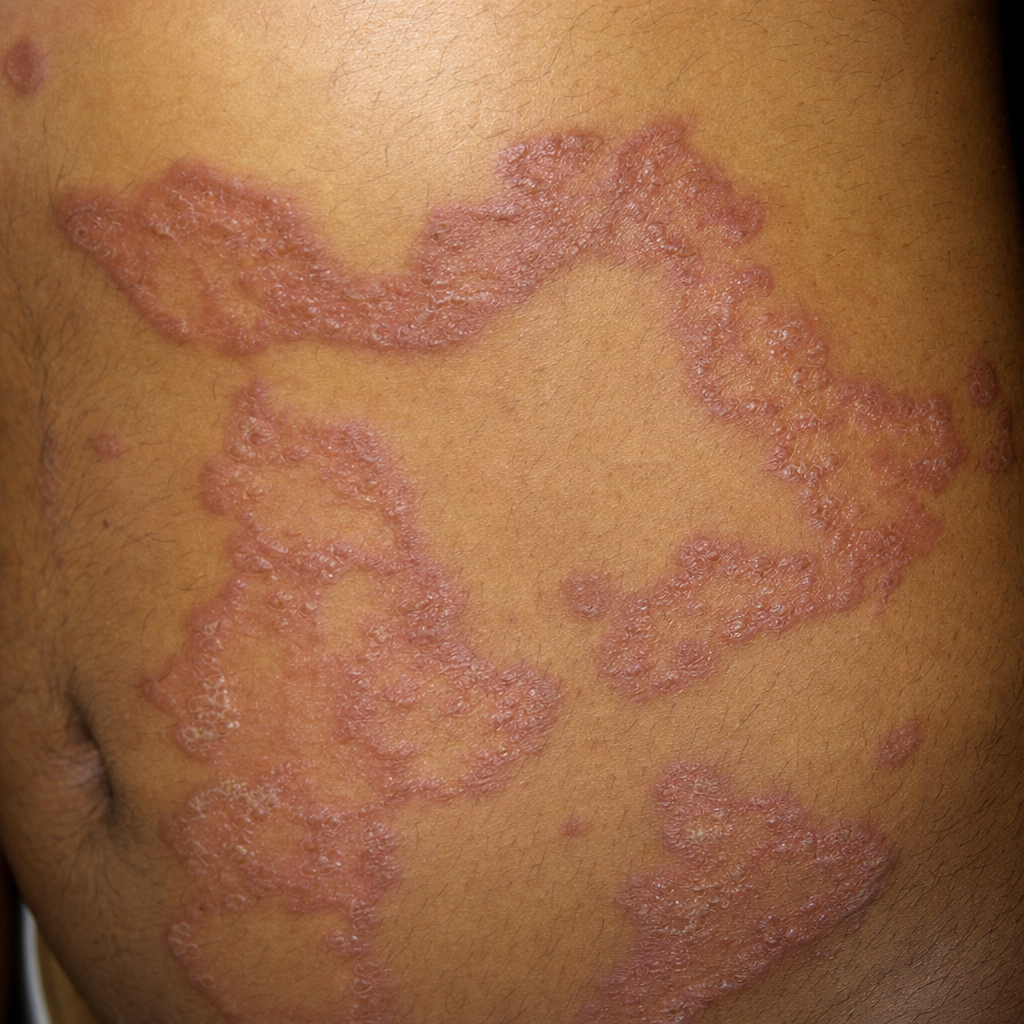
Which of the following is NOT a scrapable white lesion?
What is the term for large vesicles that are >1cm in diameter?
What are Fordyce spots?
Ash leaf macules are seen in which of the following conditions?
Trophic ulcers are seen in all of the following conditions, except:
Which of the following is not a vascular malformation?
A 30-year-old woman with type I diabetes, managed with insulin, presents for a dental examination. She reports not having seen a dentist in two years. Intraoral examination reveals a thick, matted appearance on the dorsum of her tongue, leading to a diagnosis of hairy tongue. Which type of papillae is affected, causing this hairlike appearance?
Facial hemiatrophy is a characteristic feature of which of the following conditions?
Oculo-orogenital syndrome is a feature of which of the following conditions?
Christmas tree arrangement of skin lesions is seen in which condition?
Explanation: In dermatology and oral pathology, white lesions are clinically categorized based on whether the white patch can be removed by scraping with a tongue depressor or gauze. **Explanation of the Correct Answer:** **C. Chemical Burns:** This is the correct answer because acute chemical burns (e.g., aspirin burn or phenol) result in **coagulative necrosis** of the epithelium. This necrotic tissue forms a pseudomembrane that is loosely attached and **can be easily scraped off**, leaving behind a raw, erythematous, or bleeding base. Therefore, it is a scrapable lesion. **Why the other options are incorrect (Non-scrapable lesions):** * **A. Leukoplakia:** Defined as a clinical term for a white patch that cannot be characterized clinically or pathologically as any other disease. It involves **hyperkeratosis** (thickening of the keratin layer), making it firmly attached and **non-scrapable**. * **B. Lichen Planus:** Specifically the reticular type (Wickham striae), this is an inflammatory condition characterized by hyperkeratosis and a "saw-tooth" appearance of rete ridges. It is **non-scrapable**. * **D. White Sponge Nevus:** A genetic condition (mutation in Keratin 4 or 13) causing thick, bilateral white plaques. Since the pathology involves the entire thickness of the epithelium, it is **non-scrapable**. **NEET-PG High-Yield Pearls:** * **Scrapable White Lesions:** Oral Candidiasis (Thrush) – the most common; Chemical burns; Diphtheritic membrane; Morsicatio buccarum (cheek biting - early stages). * **Non-Scrapable White Lesions:** Leukoplakia; Lichen Planus; White Sponge Nevus; Oral Hairy Leukoplakia (associated with EBV/HIV). * **Clinical Tip:** If a white lesion scrapes off and leaves a bleeding surface, think **Candidiasis**. If it does not scrape off, it requires a biopsy to rule out **dysplasia/malignancy**.
Explanation: **Explanation:** In dermatology, primary skin lesions are classified based on their morphology and size. Fluid-filled elevations of the skin are categorized into vesicles or bullae depending on their diameter. **1. Why Bulla is correct:** A **Bulla** (plural: bullae) is defined as a circumscribed, elevated, fluid-filled lesion that measures **greater than 1 cm (or >10 mm)** in diameter. These lesions can be located intraepidermally (e.g., Pemphigus vulgaris) or subepidermally (e.g., Bullous pemphigoid). **2. Why other options are incorrect:** * **Vesicle:** While also a fluid-filled elevation, a vesicle is smaller, measuring **less than 1 cm (<1 cm)** in diameter. Examples include Herpes simplex or early Varicella lesions. * **Pustule:** This is a circumscribed elevation of the skin that contains **purulent exudate (pus)** rather than clear serous fluid. Pustules can be seen in conditions like Acne vulgaris or Pustular psoriasis. **Clinical Pearls for NEET-PG:** * **Size Cut-off:** Remember the "1 cm rule" for distinguishing between Macule/Patch, Papule/Plaque, and Vesicle/Bulla. * **Nikolsky Sign:** Often tested alongside bullous disorders; it is positive in Pemphigus vulgaris (flaccid bullae) and negative in Bullous pemphigoid (tense bullae). * **Tzanck Smear:** A rapid bedside test used to examine the contents of vesicles/bullae to look for acantholytic cells or multinucleated giant cells.
Explanation: **Explanation:** **Fordyce spots** (also known as Fordyce granules) are a common, benign dermatological finding. They represent **ectopic sebaceous glands**, meaning they are sebaceous glands located in areas where they are not typically associated with hair follicles. * **Why Option B is correct:** Histologically, Fordyce spots are identical to normal sebaceous glands but lack an associated hair follicle. They appear as small (1–3 mm), painless, pale yellow or white papules. They are most commonly found on the **vermilion border of the lips** and the **buccal mucosa**. * **Why Option A is incorrect:** Fordyce spots are physiological variants and have no association with internal malignancy. They are entirely asymptomatic and do not require treatment. * **Why Option C is incorrect:** While sebaceous glands are ubiquitous, Fordyce spots specifically refer to ectopic glands on mucosal surfaces (lips, cheeks, or genitalia). The axillae contain normal pilosebaceous units and apocrine glands; "ectopic" spots are not typically described there. **High-Yield Clinical Pearls for NEET-PG:** * **Prevalence:** They are present in up to 80% of adults but become more prominent after puberty due to hormonal stimulation of sebaceous activity. * **Common Sites:** Vermilion border of the upper lip (most common), buccal mucosa (often bilateral/symmetrical), and the shaft of the penis or labia. * **Differential Diagnosis:** On the lips, they may be mistaken for Milia or Herpes Simplex; on the genitalia, they are often confused with Pearly Penile Papules or Condyloma Acuminata. * **Management:** Reassurance is the treatment of choice. If cosmetically concerning, CO2 laser or electrodessication can be used.
Explanation: **Explanation:** **Ash leaf macules** (hypomelanotic macules) are the earliest cutaneous sign of **Tuberous Sclerosis Complex (TSC)**, also known as **Bourneville’s disease**. These are lanceolate, leaf-shaped patches of hypopigmentation that appear at birth or in early infancy. They are best visualized using a **Wood’s lamp**, which accentuates the contrast between the macule and normal skin. **Analysis of Options:** * **Bourneville's disease (Correct):** This is an autosomal dominant neurocutaneous syndrome characterized by the triad of seizures, mental retardation, and adenoma sebaceum (Vogt’s Triad). Ash leaf macules are found in over 90% of patients. * **Von Hippel-Lindau syndrome:** Characterized by hemangioblastomas of the retina and cerebellum, and renal cell carcinoma. It does not typically present with specific hypopigmented skin macules. * **Neurofibromatosis (NF-1):** The hallmark cutaneous findings are **Café-au-lait spots** (hyperpigmented), Lisch nodules, and neurofibromas, rather than hypopigmented macules. * **Sturge-Weber syndrome:** A phakomatosis characterized by a **Port-wine stain** (Nevus Flammeus) in the distribution of the trigeminal nerve, glaucoma, and leptomeningeal angiomas. **High-Yield Clinical Pearls for TSC:** 1. **Cutaneous Markers:** Ash leaf macules (earliest), **Adenoma sebaceum** (angiofibromas), **Shagreen patches** (connective tissue nevi on the lower back), and **Koenen tumors** (periungual fibromas). 2. **Confirmatory Test:** Genetic testing for mutations in **TSC1 (Hamartin)** or **TSC2 (Tuberin)** genes. 3. **Imaging:** CT/MRI may show "Candle-guttering" appearance due to subependymal nodules.
Explanation: **Explanation:** The correct answer is **Poliomyelitis**. **1. Understanding Trophic Ulcers:** A trophic ulcer (also known as a neuropathic ulcer) is a chronic, painless ulceration that occurs due to **loss of protective sensation** (sensory neuropathy) and/or **autonomic dysfunction**. When a limb is anesthetic, repetitive trauma and pressure go unnoticed, leading to tissue ischemia, necrosis, and subsequent ulceration. **2. Why Poliomyelitis is the correct answer:** Poliomyelitis is a disease of the **Anterior Horn Cells (Lower Motor Neurons)**. It causes pure motor paralysis. Since the **sensory pathways remain intact**, the patient retains the ability to feel pain and pressure. Therefore, they naturally shift their weight or protect the limb from injury, preventing the formation of trophic ulcers. **3. Why the other options are incorrect:** * **Leprosy:** This is the most common cause of trophic ulcers in India. It involves peripheral nerves, leading to profound anesthesia (sensory loss) and anhidrosis (autonomic loss), making the feet highly susceptible to pressure ulcers. * **Syringomyelia:** This condition involves a syrinx in the spinal cord, typically causing **dissociated sensory loss** (loss of pain and temperature with preserved touch). This lack of pain perception leads to painless ulcers, typically on the upper limbs/fingers (Morvan’s disease). **Clinical Pearls for NEET-PG:** * **Common Sites:** Most commonly seen over pressure points like the ball of the great toe or the heel. * **Characteristic Appearance:** Punched-out edges with a thick rim of hyperkeratosis (callus) surrounding the ulcer. * **Differential Diagnosis:** Other causes include Diabetes Mellitus (most common cause globally), Tabes Dorsalis (Syphilis), and Spina Bifida. * **Management Principle:** The "Off-loading" technique (e.g., Total Contact Casting) is the gold standard for healing.
Explanation: **Explanation:** The fundamental distinction in vascular dermatology lies between **Vascular Tumors** and **Vascular Malformations** (ISSVA Classification). **1. Why Infantile Haemangioma (Option A) is the correct answer:** Infantile haemangioma is a **vascular tumor**, not a malformation. It is characterized by cellular proliferation (hyperplasia of endothelial cells). Clinically, it follows a predictable life cycle: it is usually absent at birth, undergoes a rapid **proliferative phase** during infancy, followed by slow **involution** over several years. It is typically **GLUT-1 positive** on immunohistochemistry. **2. Why the other options are Vascular Malformations:** Vascular malformations are structural abnormalities present at birth (though they may become visible later). They grow proportionately with the child and do not involute. * **Salmon Patch (Option B):** A common capillary malformation (nevus simplex) often found on the nape of the neck ("stork bite") or eyelids ("angel’s kiss"). * **Port Wine Stain (Option C):** A permanent capillary malformation (nevus flammeus) that darkens and thickens over time; it is associated with Sturge-Weber Syndrome. * **Naevus Anaemicus (Option D):** A localized vascular anomaly where the blood vessels have increased sensitivity to catecholamines, leading to permanent vasoconstriction (appearing as a pale patch). **High-Yield Clinical Pearls for NEET-PG:** * **GLUT-1 Marker:** The most specific marker to differentiate Infantile Haemangioma (+ve) from vascular malformations (-ve). * **Treatment of Choice:** Oral **Propranolol** is the first-line treatment for complicated infantile haemangiomas. * **Kasabach-Merritt Phenomenon:** Associated with Tufted Angioma or Kaposiform Hemangioendothelioma, **not** with common infantile haemangioma. * **Pulsed Dye Laser (PDL):** The gold standard treatment for Port Wine Stains.
Explanation: **Explanation:** **Hairy Tongue (Lingua Villosa)** is a benign condition characterized by the hypertrophy and elongation of the **filiform papillae** on the dorsal surface of the tongue. 1. **Why Filiform is correct:** Filiform papillae are the most numerous papillae on the tongue. Unlike other types, they are heavily keratinized and do not contain taste buds. In hairy tongue, there is a lack of normal desquamation of the keratin layer, leading to the formation of elongated, hair-like projections (often >15mm). These "hairs" trap debris, bacteria, and fungi, which can lead to discoloration (Black Hairy Tongue). Common triggers include poor oral hygiene, smoking, antibiotics, and systemic conditions like diabetes. 2. **Why other options are incorrect:** * **Foliate:** These are vertical folds located on the lateral margins of the tongue. They contain taste buds but are not involved in the "hairy" presentation. * **Circumvallate:** These are large, circular papillae arranged in a V-shape at the back of the tongue (sulcus terminalis). They contain numerous taste buds and von Ebner’s glands. * **Fungiform:** These are mushroom-shaped, reddish spots scattered mostly at the tip and sides of the tongue. They contain taste buds and do not undergo the keratinization required to produce a "hairy" appearance. **NEET-PG High-Yield Pearls:** * **Filiform papillae** are the only papillae **without taste buds**. * **Black Hairy Tongue** is often associated with *Aspergillus niger* or chromogenic bacteria. * **Geographic Tongue (Benign Migratory Glossitis)** involves the *loss* (atrophy) of filiform papillae, appearing as red patches with white borders. * **Median Rhomboid Glossitis** is a chronic fungal infection (Candidiasis) presenting as a red, depapillated area in the midline of the posterior dorsal tongue.
Explanation: **Explanation:** **Parry-Romberg Syndrome (Progressive Facial Hemiatrophy)** is the correct answer. It is a rare, acquired neurocutaneous disorder characterized by slow, progressive atrophy of the skin, subcutaneous tissue, muscles, and sometimes the underlying bony structures of one side of the face. * **Clinical Presentation:** It typically begins in the first or second decade of life. A classic finding associated with this condition is **"en coup de sabre,"** a linear scleroderma-like lesion appearing on the forehead or scalp. * **Pathophysiology:** While the exact etiology is unknown, it is often considered a localized form of scleroderma (morphea). **Why other options are incorrect:** * **Peutz-Jeghers Syndrome:** This is an autosomal dominant hamartomatous polyposis syndrome. It is characterized by **mucocutaneous hyperpigmentation** (melanotic macules on the lips, buccal mucosa, and digits) and gastrointestinal hamartomatous polyps. It does not involve tissue atrophy. * **Options C and D:** These are incorrect as the clinical features of the two syndromes are distinct and do not overlap. **High-Yield Clinical Pearls for NEET-PG:** * **En coup de sabre:** Linear scleroderma on the scalp/forehead; often co-exists with Parry-Romberg. * **Neurological Associations:** Patients may present with trigeminal neuralgia, migraine, or focal epilepsy. * **Ocular Involvement:** Enophthalmos (due to loss of retro-orbital fat) is the most common eye finding. * **Treatment:** Primarily involves immunosuppressants (Methotrexate/Steroids) during the active phase and reconstructive surgery (fat grafting) once the disease stabilizes.
Explanation: **Explanation:** **Behcet’s Disease** is a chronic, multisystem inflammatory disorder characterized by a relapsing-remitting course of systemic vasculitis. The classic clinical triad, often referred to as the **oculo-orogenital syndrome**, consists of: 1. **Oral ulcers:** Recurrent, painful aphthous-like ulcers (most common initial sign). 2. **Genital ulcers:** Painful ulcers, typically on the scrotum in men or labia in women. 3. **Ocular involvement:** Most commonly **posterior uveitis** or hypopyon, which can lead to blindness if untreated. The underlying pathology is a **leukocytoclastic vasculitis** affecting both small and large vessels. A key diagnostic feature is the **Pathergy test** (development of a papule/pustule 24-48 hours after a sterile needle prick). **Why other options are incorrect:** * **Lichen Planus:** Characterized by the "6 Ps" (Planar, Purple, Polygonal, Pruritic, Papules, and Plaques) and Wickham striae. While it can involve oral and genital mucosa, it lacks the characteristic uveitis/ocular involvement of Behcet’s. * **Systemic Lupus Erythematosus (SLE):** Presents with a malar rash, photosensitivity, and systemic involvement (renal, joint, serositis). While oral ulcers occur, they are typically painless and not part of an oculo-orogenital triad. * **Psoriasis:** Primarily a papulosquamous disorder with silvery scales and the Auspitz sign. Mucosal involvement is rare (except for geographic tongue). **NEET-PG High-Yield Pearls:** * **HLA Association:** Strongly linked with **HLA-B51**. * **Pathergy Test:** Highly specific for Behcet's (also seen in Sweet syndrome and Pyoderma gangrenosum). * **Most common cause of death:** Rupture of large vessel aneurysms (e.g., pulmonary artery). * **Treatment:** Colchicine for mucocutaneous lesions; systemic steroids/immunosuppressants for ocular or systemic disease.
Explanation: **Explanation:** **Pityriasis Rosea (PR)** is a self-limiting, inflammatory skin disorder. The "Christmas tree" (or fir tree) appearance is the classic clinical hallmark of this condition. It occurs because the oval, erythematous, scaly plaques align their long axes along the **Langer’s lines** (cleavage lines) of the skin. On the back, these lines run obliquely downward and outward from the spine, creating a silhouette resembling the branches of a Christmas tree. **Analysis of Options:** * **Pityriasis Rosea (Correct):** Typically begins with a single, large **"Herald Patch"** followed by a generalized eruption of smaller maculopapular lesions with a characteristic **"collarette of scale"** (scales attached at the periphery, pointing inward). * **Pityriasis Versicolor:** Caused by *Malassezia furfur*, it presents as hypo- or hyperpigmented macules with fine scaling (spaghetti and meatballs appearance on KOH), but lacks a specific dermatomal or Langer’s line distribution. * **Pityrosporum Folliculitis:** An inflammatory condition presenting as monomorphic pruritic papules and pustules, usually on the upper trunk; it does not follow a Christmas tree pattern. * **Tinea Corporis:** Characterized by annular (ring-shaped) lesions with central clearing and active peripheral scaling. While it can be multiple, it does not follow cleavage lines. **NEET-PG High-Yield Pearls:** * **Etiology:** Associated with Human Herpesvirus **HHV-6 and HHV-7**. * **Herald Patch:** The initial lesion (2-10 cm) that precedes the generalized rash by 1-2 weeks. * **Collarette Scale:** A pathognomonic finding where the scale is attached at the edge and free in the center. * **Management:** Usually self-limiting (6-8 weeks); symptomatic treatment with antihistamines or topical steroids. Narrowband UVB or Acyclovir may be used in severe cases.
Structure and Function of Skin
Practice Questions
Cutaneous Histopathology
Practice Questions
Dermatological Examination
Practice Questions
Skin Lesions: Morphology and Description
Practice Questions
Principles of Diagnosis in Dermatology
Practice Questions
Dermatological Procedures
Practice Questions
Wound Healing
Practice Questions
Cutaneous Immunology
Practice Questions
Genetics in Dermatology
Practice Questions
Cutaneous Manifestations of Systemic Diseases
Practice Questions
Geriatric Dermatology
Practice Questions
Pediatric Dermatology Basics
Practice Questions
Get full access to all questions, explanations, and performance tracking.
Start For Free