Which of the following is a type of observational study that analyzes population-level data?
Which of the following is not a criterion suggesting causality in non communicable diseases?
Leading questions are permitted only in-
The study unit of an ecological study is
An example of a two-way discussion is:
All of the following are done to remove Confounding except:
What is the primary purpose of interventional studies in clinical research?
Which of the following is not a method of random sampling?
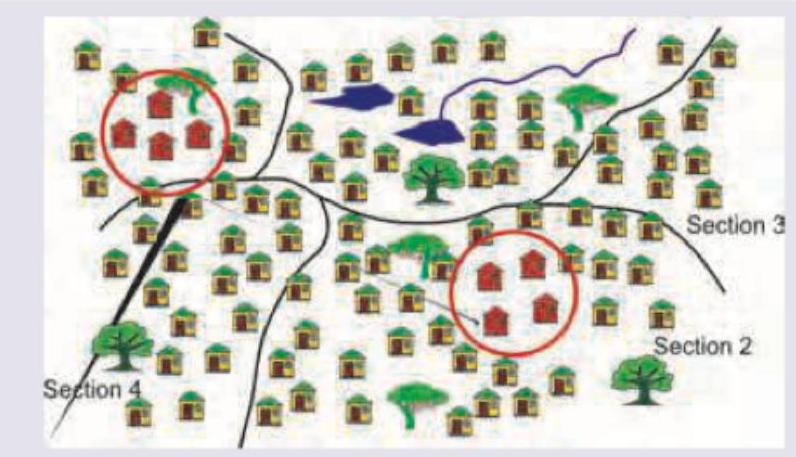
This is a map of an urban slum in New Delhi. The medical officer of PHC notified the higher authorities on observing multiple cases of measles in 1-2 years age group. The authorities conducted a survey of vaccine coverage in the area in the manner shown below. Which sampling is depicted here?
Consider the following management methods/techniques : 1. System analysis 2. Organizational design 3. Personnel management 4. Information systems Which of the above methods/techniques are based on behavioural sciences?
Explanation: ***Ecological study*** - This type of study examines the relationship between an exposure and an outcome at the **population level** rather than the individual level. - It often uses aggregated data, such as incidence rates of disease in different geographic areas, to identify associations. *Case-control study* - This is an **individual-level observational study** that compares individuals with a disease (cases) to individuals without the disease (controls) and looks back retrospectively at their exposures. - It is used to investigate potential risk factors for a disease but does not analyze population-level data directly. *Randomized controlled trial* - This is an **experimental study design** where participants are randomly assigned to an intervention group or a control group. - It is considered the gold standard for establishing causality but does not analyze observational population-level data. *Longitudinal study* - This is an **individual-level observational study** that follows the same group of individuals over a period of time, collecting data at multiple points. - While it observes changes over time, it typically focuses on individual-level trends and outcomes, not aggregated population data.
Explanation: ***Lack of temporal association*** - For an exposure to cause a non-communicable disease, the exposure must precede the disease onset; therefore, a **lack of temporal association** explicitly argues *against* causality. - This criterion is a fundamental principle of causality, as the **cause must occur before the effect**. *Specificity of association* - This criterion suggests that a single exposure should lead to a single disease. However, in non-communicable diseases, a single risk factor may contribute to multiple diseases (e.g., smoking and lung cancer, heart disease, stroke), and a single disease can have **multiple causes**. - While it was important in the original Bradford Hill criteria, its relevance is diminished in modern epidemiology due to the **multifactorial nature of chronic diseases**. *Dose response relationship* - This criterion implies that as the **amount or duration of exposure increases**, the **risk or severity of the disease also increases**. - This is a strong indicator of causality because it suggests a biological gradient. *Strength of association* - A strong association, often measured by a **high relative risk or odds ratio**, increases the likelihood of a causal relationship. - A weak association, while not ruling out causality, makes it less likely to be directly causal and more likely to be influenced by other factors or confounding variables.
Explanation: ***Cross examination*** - **Leading questions** are questions that suggest the answer the examiner wishes to elicit. They are generally permitted in **cross-examination** to challenge the witness's testimony and probe for inconsistencies. - The purpose of cross-examination is to test the **veracity** and **accuracy** of the evidence given by the witness during direct examination. *Re-examination* - **Re-examination** follows cross-examination and is conducted by the party who called the witness, but it is limited to explaining or clarifying matters raised during cross-examination. - **Leading questions** are generally not allowed during re-examination, as its purpose is to rehabilitate the witness, not introduce new evidence or suggest answers. *Examination in chief* - **Examination in chief** (or direct examination) is when a lawyer questions their own witness to elicit factual information relevant to their case. - **Leading questions** are typically prohibited during examination in chief to ensure that the testimony is the witness's own and not influenced by the lawyer. *Dying declaration* - A **dying declaration** is a statement made by a person who is conscious and believes death is imminent, regarding the cause and circumstances of their impending death. - It is an exception to the **hearsay rule** and is usually recorded as a statement, not as a process involving direct questioning where leading questions would be applied in a court setting.
Explanation: ***Population*** - An **ecological study** examines health phenomena at a **population or group level**, not at the individual level. - The study unit is the **population** (also referred to as community or group), where aggregate data such as disease rates, mortality statistics, or average exposures are analyzed. - This design investigates correlations between exposure and outcome across different populations or within the same population over time. - Examples include comparing cancer rates between countries with different dietary patterns, or analyzing disease trends over time in a specific region. *Individual Patient* - An **individual patient** is the unit of study in **clinical trials**, cohort studies at individual level, or case reports. - Ecological studies specifically use aggregate data at the population level, not individual-level data. - The focus is on group characteristics rather than individual characteristics. *Case* - A **case** refers to an individual with a specific disease or condition. - This is the primary unit in **case-control studies** or **case reports** where individual patients are identified and studied. - Ecological studies do not collect data on individual cases but rather use population-level aggregated data. *Family* - A **family** can be a unit of study in family-based studies or genetic epidemiology research. - However, ecological studies operate at a broader population level, not at the family unit level. - Family studies focus on clustering of disease within families, which is different from ecological study design.
Explanation: ***Group discussion*** - A **group discussion** involves multiple participants actively exchanging ideas and perspectives, representing a classic example of **two-way communication**. - Participants engage in speaking and listening, providing **feedback** and allowing for a dynamic exchange of thoughts. *A seminar* - A **seminar** is typically a more formal presentation where an expert delivers information to an audience with limited opportunity for extensive **two-way discussion**. - While questions may be asked, the primary flow of information is often **one-way**, from presenter to attendees. *Role playing* - **Role-playing** is an instructional technique where individuals act out specific roles or scenarios, focusing on **experiential learning** rather than open discussion. - While there is interaction between participants, the primary goal is often to practice skills or understand a perspective, not necessarily to have an unstructured **two-way debate** or idea exchange. *Symposium* - A **symposium** is a meeting or conference at which experts deliver papers on a particular subject, typically followed by a relatively brief **question-and-answer session**. - The format is largely **one-way**, with experts presenting information and the audience primarily receiving it.
Explanation: ***Blinding*** - **Blinding** is a technique used to minimize **bias** (e.g., observer bias, participant bias) by preventing study participants, researchers, or data analysts from knowing treatment assignments. It does **not address confounding variables**. - Blinding ensures that knowledge of the intervention does not influence the outcomes or their assessment, thereby controlling **information bias** and **performance bias**. *Randomization* - **Randomization** is a key method in experimental studies to control for **confounding variables** by distributing them equally among study groups. - It ensures that each participant has an **equal chance** of being assigned to any study group, thus minimizing systematic differences between groups at baseline. *Random Selection* - **Random selection** (or random sampling) is used primarily to create a sample that is **representative** of the larger population, thereby improving **external validity** and **generalizability**. - While it reduces **selection bias**, random selection is **not a standard method for controlling confounding**. Some sources suggest it may help balance unknown confounders compared to convenience sampling, but it is not classified among the primary confounding control methods (randomization, restriction, matching, stratification, multivariable analysis). - In this question context, if we consider standard epidemiological methods, random selection's role in confounding control is indirect at best. *Matching* - **Matching** is a technique used in observational studies to control for known **confounding variables** by selecting controls who are similar to cases with respect to these confounders. - For example, if age and sex are confounders, controls are matched to cases based on these characteristics to ensure comparability and reduce confounding.
Explanation: ***Testing Hypotheses*** - Interventional studies, such as **randomized controlled trials**, are specifically designed to **test cause-and-effect relationships** by actively intervening. - They aim to determine if a specific intervention (e.g., a drug, a therapy) produces a hypothesized outcome. *Confirming Hypotheses* - While interventional studies can confirm hypotheses, their primary role is not just confirmation but the initial **rigorous testing** of a hypothesis under controlled conditions. - Confirmation often implies that previous evidence already strongly supports the hypothesis. *Manipulating Hypotheses* - Hypotheses themselves are not "manipulated"; rather, the **variables** within the study design (e.g., treatment groups, dosages) are manipulated to test the hypothesis. - This option incorrectly applies the concept of manipulation to the hypothesis. *Formulating Hypotheses* - Hypothesis formulation usually occurs during the **observational research phase** or through literature review, *before* interventional studies are designed. - Observational studies or descriptive research are more typically used for generating new hypotheses.
Explanation: ***Quota sampling*** - **Quota sampling** is a non-probability sampling method where researchers select a sample based on pre-defined characteristics to match the population's proportions. - It does not involve random selection at any stage, making it a non-random sampling technique. *Cluster sampling* - **Cluster sampling** is a probability (random) sampling technique where the population is divided into clusters, and then a random sample of these clusters is selected. - All units within the selected clusters are then included in the sample, or a random sample is taken from within the selected clusters. *Stratified sampling* - **Stratified sampling** is a probability (random) sampling method that involves dividing the population into homogeneous subgroups (strata) and then taking a random sample from each stratum. - This method ensures representation from all important subgroups within the population. *Simple random* - **Simple random sampling** is a basic probability (random) sampling technique where every member of the population has an equal chance of being selected for the sample. - This method is considered the most fundamental type of random sampling.
Explanation: ***Cluster sampling*** - The image shows **groups (clusters)** of houses (red houses within red circles) being selected, and then all units within those selected groups are included in the sample. - This method is typically used when the population is naturally divided into groups, such as geographical areas or blocks, making it **cost-effective** and practical, especially in large, dispersed populations like an urban slum. *Simple random sampling* - This method would involve **randomly selecting individual houses** from the entire slum without any pre-defined grouping, which is not depicted in the image. - Each house would have an **equal chance of being selected**, and sampling would not be restricted to specific clusters. *Systematic random sampling* - Involves selecting houses at a **fixed interval** (e.g., every 5th house) from a sorted list or along a defined path after a random starting point. - The image does not show a systematic selection process or an underlying order for sampling the houses. *Stratified random sampling* - This method involves **dividing the population into homogeneous subgroups** (strata) based on a characteristic (e.g., age, income level) and then drawing a random sample from each stratum. - While the map shows 'sections', these are not necessarily strata based on a relevant characteristic, and the sampling is not shown to be proportional or disproportional across these sections.
Explanation: ***1, 2 and 3*** - **System analysis** in management context involves understanding human behavior within organizational systems, analyzing workflows, and interpersonal dynamics to optimize processes and structures. When applied to organizational management, it incorporates behavioral principles. - **Organizational design** is fundamentally rooted in behavioral sciences, focusing on structuring roles, relationships, and hierarchies to enhance human interaction, motivation, and performance based on principles from organizational psychology and sociology. - **Personnel management** directly deals with human resource management, applying behavioral science principles including motivation theory, leadership styles, group dynamics, employee relations, and organizational behavior. *1, 2 and 4* - This option incorrectly includes **information systems**, which are primarily technology-focused and rooted in computer science and data management rather than behavioral sciences. - While information systems may influence organizational behavior, their core methodologies are not based on behavioral science principles. *2, 3 and 4* - This option incorrectly includes **information systems** while excluding **system analysis**. - Information systems are technology-based rather than behavioral science-based. *1, 3 and 4* - This option incorrectly includes **information systems**, which are technology-focused rather than behavioral science-based. - It also excludes **organizational design**, which is a fundamental behavioral science application in management, focusing on how structure affects human behavior and organizational effectiveness.
Get full access to all questions, explanations, and performance tracking.
Start For Free