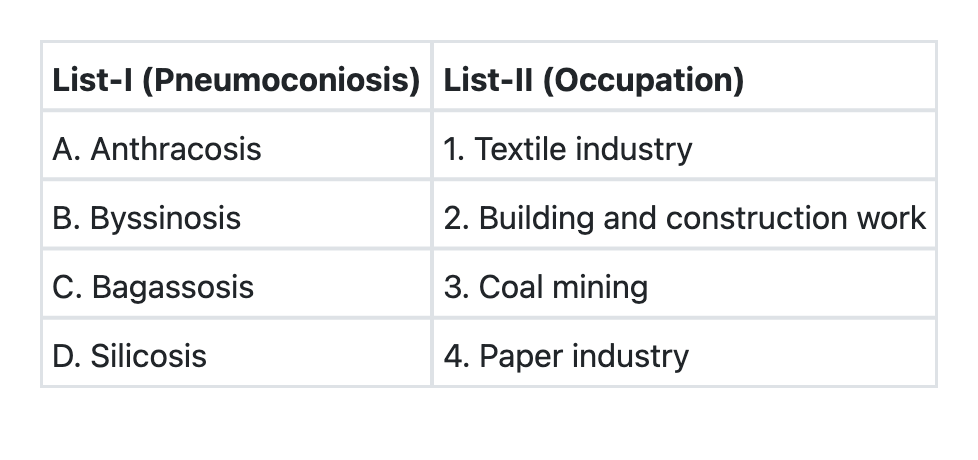
What is the size limit of respirable dust responsible for pneumoconiosis?
Which cancer is predisposed by radon exposure?
Silicosis occurs with?
Mesothelioma is seen in which type of pneumoconiosis?
What is the size of dust particles that can reach the alveoli?
Which of the following occupational exposures is most strongly associated with the development of lung cancer?
Which of the following are true statements about asbestosis?
Which of the following is true about pneumoconiosis?
Byssinosis is most commonly seen in which industry?
What is the definition of ergonomics?
Explanation: ### Explanation **Concept:** The pathogenicity of inhaled dust depends primarily on its particle size. For a particle to cause **pneumoconiosis**, it must reach the gas-exchange units of the lungs (alveoli). This fraction of dust is known as **respirable dust**. * **Correct Answer (B):** Particles **less than 5 microns** (specifically between 0.5 and 5 microns) are of the ideal size to bypass the upper respiratory defenses (cilia and mucus) and settle in the alveoli via sedimentation. Once in the alveoli, they are ingested by macrophages, triggering the inflammatory and fibrotic processes characteristic of pneumoconiosis. **Analysis of Incorrect Options:** * **Option A (< 1 micron):** While particles this small can reach the alveoli, many particles smaller than 0.5 microns remain suspended in the air and are simply exhaled without settling (Brownian motion). * **Option C (< 10 micron):** Particles between 5 and 10 microns are generally trapped in the upper respiratory tract (nose and nasopharynx) and are cleared by the mucociliary escalator. They do not reach the deep lung tissue to cause pneumoconiosis. * **Option D (< 100 micron):** These are "inhalable" but not "respirable." They are too heavy and are filtered out immediately by the nasal hairs or impact the back of the throat. **High-Yield Clinical Pearls for NEET-PG:** * **The "Danger Zone":** The most hazardous particle size for the lungs is **0.5 to 3 microns**. * **Silicosis:** The most common pneumoconiosis; look for "Egg-shell calcification" of hilar lymph nodes on X-ray. * **Anthracosis:** Caused by coal dust; typically involves the upper lobes. * **Byssinosis:** Caused by cotton fiber dust; characterized by "Monday Morning Fever." * **Asbestosis:** Associated with "ferruginous bodies" and increases the risk of Mesothelioma and Bronchogenic Carcinoma.
Explanation: **Explanation:** **Radon** is a naturally occurring, colorless, and odorless radioactive gas produced by the decay of uranium in soil and rocks. It is the **second leading cause of lung cancer** globally, after tobacco smoking, and the leading cause among non-smokers. **Why Lung Cancer is the Correct Answer:** When radon gas is inhaled, its decay products (radon daughters or progeny) emit **alpha particles**. These high-energy particles damage the DNA of the respiratory epithelium, leading to mutations and malignant transformation. Because radon is inhaled, the primary site of impact is the pulmonary system, specifically predisposing individuals to **bronchogenic carcinoma**. **Why Other Options are Incorrect:** * **Cervix:** Primarily caused by persistent infection with high-risk strains of Human Papillomavirus (HPV 16, 18). * **Oral Cavity:** Strongly associated with tobacco chewing (betel quid), smoking, and alcohol consumption. * **Bladder:** Associated with occupational exposure to **aromatic amines** (e.g., benzidine, naphthylamine in dye/rubber industries), smoking, and *Schistosoma haematobium* infection. **High-Yield Clinical Pearls for NEET-PG:** * **Synergistic Effect:** The risk of lung cancer from radon is significantly higher (multiplicative) in **smokers** compared to non-smokers. * **Indoor Air Pollution:** Radon often accumulates in poorly ventilated basements and underground mines (e.g., uranium miners). * **Other Occupational Lung Cancers:** * **Asbestos:** Mesothelioma and Bronchogenic carcinoma (Bronchogenic is more common). * **Bis-chloromethyl ether:** Small cell lung cancer. * **Arsenic:** Lung, skin, and liver (angiosarcoma) cancers.
Explanation: **Explanation:** **Silicosis** is the most common and serious form of pneumoconiosis (occupational lung disease) caused by the inhalation of **free silica (silicon dioxide)** particles. When silica dust is inhaled, it is ingested by alveolar macrophages, leading to their destruction and the release of lysosomal enzymes. This triggers a chronic inflammatory response and massive fibrotic nodule formation in the lungs, typically in the upper lobes. **Analysis of Options:** * **B. Silica fibres (Correct):** Silica is found in abundance in industries like stone crushing, mining (gold, coal, mica), sandblasting, and ceramics. It is characterized by "eggshell calcification" of hilar lymph nodes on X-ray. * **A. Cotton:** Inhalation of cotton dust leads to **Byssinosis** (also known as Monday Morning Fever). * **C. Sugarcane fibres:** Exposure to moldy sugarcane dust (bagasse) causes **Bagassosis**, a type of hypersensitivity pneumonitis. * **D. Carbon particles:** Inhalation of coal dust or carbon particles leads to **Anthracosis** or Coal Workers' Pneumoconiosis (CWP). **High-Yield Clinical Pearls for NEET-PG:** * **Pathognomonic Feature:** The **Silicotic Nodule** is the characteristic lesion. * **Radiology:** Shows "Snowstorm appearance" (miliary mottling) and **Eggshell calcification** of hilar nodes. * **Complication:** Silicosis significantly increases the risk of **Pulmonary Tuberculosis** (Silicotuberculosis) because silica impairs macrophage function. * **Prevention:** Use of personal protective equipment (PPE) and "wet drilling" to suppress dust. It is a **notifiable disease** under the Factories Act.
Explanation: **Explanation:** **Asbestosis** is the correct answer because **Mesothelioma** (a malignant tumor of the pleura or peritoneum) is a specific and highly characteristic complication of asbestos exposure. While bronchogenic carcinoma is the most common cancer associated with asbestos, mesothelioma is the most **specific** one. It typically occurs after a long latent period (20–40 years) and, unlike lung cancer, its risk is not significantly increased by smoking. **Analysis of Incorrect Options:** * **Anthracosis:** Caused by the inhalation of coal dust. It primarily leads to Coal Workers' Pneumoconiosis (CWP) or "Black Lung Disease," but is not associated with mesothelioma. * **Byssinosis:** Also known as "Monday Morning Fever," it is caused by cotton, flax, or hemp dust. It presents with chest tightness and airway obstruction, not malignancy. * **Silicosis:** Caused by silica dust (sandblasting, mining). It is characterized by "eggshell calcification" of hilar lymph nodes and predisposes patients to **Tuberculosis** (Silicotuberculosis), but not mesothelioma. **High-Yield Clinical Pearls for NEET-PG:** * **Asbestos bodies:** Ferruginous bodies (iron-coated fibers) seen in sputum or lung biopsy. * **Pleural Plaques:** The most common radiological finding in asbestos exposure (usually on the parietal pleura). * **Crocidolite (Blue asbestos):** The most carcinogenic type of asbestos fiber linked to mesothelioma. * **Statutory Notification:** Under the Factories Act, Asbestosis and Silicosis are notifiable diseases in India.
Explanation: **Explanation:** The correct answer is **A. <5 microns**. In occupational health, the pathogenicity of dust depends on its chemical composition, concentration, and, most importantly, its **particle size**. The respiratory system acts as a mechanical filter: 1. **Particles >10 microns:** These are trapped in the nasal passage and upper respiratory tract by nasal hairs and mucus. 2. **Particles 5–10 microns:** These are deposited in the mid-respiratory tract (trachea and bronchi) and are usually cleared by the mucociliary escalator. 3. **Particles <5 microns (Respirable Dust):** These are small enough to bypass the upper airway defenses and reach the **alveoli**. Particles between **0.5 to 3 microns** are considered the most hazardous as they settle in the alveolar sacs, leading to chronic inflammation and fibrotic lung diseases (Pneumoconioses). **Analysis of Incorrect Options:** * **B, C, and D:** Particles in these size ranges (5 to >15 microns) are too large to reach the deep lung parenchyma. They are either filtered out by the nose or deposited in the tracheobronchial tree, where they are eventually swallowed or coughed out. **High-Yield Clinical Pearls for NEET-PG:** * **Respirable Dust:** Defined specifically as particles <5 microns in diameter. * **Pneumoconiosis:** A permanent deposition of dust in the lungs. Common examples include **Silicosis** (most common), **Anthracosis** (coal dust), and **Asbestosis**. * **Droplet Nuclei:** In the context of infections like Tuberculosis, droplet nuclei are also typically **1–5 microns**, allowing them to remain airborne and reach the alveoli of a new host. * **PM 2.5:** In environmental health, particulate matter <2.5 microns is a major focus because it can enter the bloodstream directly from the alveoli.
Explanation: **Explanation:** **1. Why Asbestosis is Correct:** Asbestos is a well-established Group 1 human carcinogen. Exposure to asbestos fibers is strongly associated with two primary malignancies: **Bronchogenic Carcinoma** (the most common) and **Mesothelioma** (the most specific). The risk of lung cancer is significantly potentiated in asbestos workers who smoke, demonstrating a synergistic effect that increases the risk by nearly 50-fold compared to non-exposed non-smokers. **2. Analysis of Incorrect Options:** * **Silicosis (Option B):** While chronic silicosis is associated with an increased risk of lung cancer, its primary clinical significance lies in its strong predisposition to **Pulmonary Tuberculosis** (Silico-tuberculosis). * **Byssinosis (Option C):** Caused by cotton, flax, or hemp dust, this is an occupational airway disease (Monday Chest Tightness). It leads to chronic bronchitis and emphysema but is **not** associated with an increased risk of lung cancer. * **Benzene Exposure (Option D):** Benzene is a potent hematotoxin. It is strongly associated with **Acute Myeloid Leukemia (AML)** and other hematological malignancies, rather than primary lung cancer. **3. High-Yield Clinical Pearls for NEET-PG:** * **Most common cancer in Asbestosis:** Bronchogenic Carcinoma (NOT Mesothelioma). * **Most specific cancer in Asbestosis:** Malignant Mesothelioma. * **Marker of exposure:** Ferruginous bodies (Asbestos bodies) in sputum or BAL fluid. * **Radiological hallmark:** Pleural plaques (usually involving the parietal pleura). * **Pneumoconiosis with highest TB risk:** Silicosis (Egg-shell calcification of hilar lymph nodes).
Explanation: **Explanation:** Asbestosis is a chronic fibrotic lung disease caused by the inhalation of asbestos fibers. It is a multisystemic occupational hazard that affects the pulmonary parenchyma, the pleura, and even extrapulmonary sites. **Why "All of the Above" is Correct:** Asbestos fibers are chemically inert but physically indestructible. Once inhaled, they penetrate deep into the lungs and migrate to various tissues, leading to chronic inflammation and DNA damage (carcinogenesis). * **Lung Cancer (Bronchogenic Carcinoma):** This is the **most common** malignancy associated with asbestos exposure. The risk is synergistically increased (up to 50-90 times) in workers who also smoke. * **Pleural Mesothelioma:** This is a rare, highly aggressive tumor of the pleura. Asbestos exposure is the primary risk factor, and unlike lung cancer, it is **not** related to smoking. * **Peritoneal Mesothelioma:** Asbestos fibers can reach the abdominal cavity via the lymphatic system or by swallowing cleared fibers, leading to malignancy of the peritoneal lining. **High-Yield Clinical Pearls for NEET-PG:** * **Pathognomonic Finding:** **Asbestos bodies** (ferruginous bodies) in the sputum or lung tissue—these are golden-brown, fusiform, or beaded rods coated with iron and protein. * **Radiology:** Characterized by "ground-glass" opacities and **calcified pleural plaques** (most common finding), typically involving the lower lobes. * **Latency Period:** Asbestosis has a long latent period, often appearing 15–20 years after the initial exposure. * **Restriction:** It presents as a **Restrictive Lung Disease** with a decreased Diffusion Capacity (DLCO). * **Occupational Exposure:** Mining, insulation work, shipbuilding, and construction.
Explanation: **Explanation:** **1. Why Option C is Correct:** The synergistic relationship between **asbestos exposure and cigarette smoking** is a classic high-yield concept in occupational health. While asbestos exposure alone increases the risk of bronchogenic carcinoma by approximately 5-fold and smoking alone by 10-fold, their combined effect is **multiplicative (synergistic)**, increasing the risk by nearly **50 to 90 times**. This occurs because tobacco smoke impairs mucociliary clearance, allowing more asbestos fibers to remain lodged in the lungs, leading to chronic inflammation and DNA damage. **2. Why Other Options are Incorrect:** * **Option A:** Pleural plaques are the most common manifestation of asbestos exposure. However, they are typically **asymptomatic** and do not impair lung function; they are often incidental findings on chest X-rays (appearing as "holly leaf" calcifications). * **Option B:** Silicosis is strongly associated with **Tuberculosis (Silicotuberculosis)**. Silica particles are toxic to alveolar macrophages, impairing their ability to kill mycobacteria. A patient with silicosis has a 30-fold increased risk of developing TB. * **Option C:** Anthracosis (Coal Workers' Pneumoconiosis) is generally considered a "non-industrial" pigment deposition. Simple anthracosis is usually benign and is **not** associated with an increased risk of lung cancer. **Clinical Pearls for NEET-PG:** * **Most common cancer in Asbestosis:** Bronchogenic Carcinoma (NOT Mesothelioma, though Mesothelioma is the most *specific*). * **Eggshell calcification** of hilar lymph nodes is characteristic of **Silicosis**. * **Caplan’s Syndrome:** Combination of Rheumatoid Arthritis and pneumoconiosis (most commonly seen in coal miners). * **Byssinosis:** "Monday Morning Fever" caused by cotton dust.
Explanation: **Explanation:** **Byssinosis** (also known as "Monday Morning Fever" or "Brown Lung Disease") is a chronic occupational lung disease caused by the inhalation of **cotton, flax, or hemp dust**. 1. **Why Option A is correct:** The disease is most prevalent in the **textile industry**, specifically in the **spinning and blow-room sections**. These areas have the highest concentration of fine cotton dust. The condition is characterized by chest tightness and dyspnea that is typically worse on the first day of the work week (Monday) after a weekend break, improving as the week progresses. 2. **Why other options are incorrect:** * **Sugarcane industry (B):** Exposure to bagasse (sugarcane residue) leads to **Bagassosis**, caused by the fungus *Thermoactinomyces sacchari*. * **Dyes industry (C):** Workers in the dye and rubber industries are at a high risk of **Bladder Cancer** due to exposure to aromatic amines like benzidine and beta-naphthylamine. * **Weaving industry (D):** While part of the textile process, the weaving section has significantly lower dust concentrations compared to the spinning and opening rooms, making Byssinosis much less common here. **High-Yield Clinical Pearls for NEET-PG:** * **Schilling’s Classification:** Used to grade the severity of Byssinosis (Grade 0 to Grade 3). * **Pathogenesis:** It is not a typical fibrosis; it is thought to be caused by endotoxins from Gram-negative bacteria present in the cotton bracts. * **Other Pneumoconioses:** * **Silicosis:** "Snowstorm" appearance on X-ray; most common occupational lung disease. * **Anthracosis:** Coal miners (Black Lung). * **Farmer’s Lung:** Grain dust/moldy hay.
Explanation: **Explanation:** **Ergonomics** is derived from the Greek words *Ergon* (work) and *Nomos* (law). In occupational health, it is defined as the science of **"fitting the job to the worker"** and **"adjusting the worker to the job."** The primary objective is to optimize human well-being and overall system performance by designing machines, tools, and work environments that match the physiological and psychological capabilities of the human body. * **Why Option A is correct:** Ergonomics focuses on the interaction between the worker and their environment. By adjusting the worker to the job (through training and proper posture) and the job to the worker (through ergonomic design), we minimize physical stress, prevent musculoskeletal disorders (MSDs), and increase productivity. * **Why Option B is incorrect:** The study of human behavior is **Psychology**. While ergonomics considers psychological factors (cognitive ergonomics), it is primarily a multidisciplinary engineering and health science. * **Why Option C is incorrect:** The study of social mobility refers to **Sociology**, specifically the movement of individuals or groups between different social strata. **High-Yield Clinical Pearls for NEET-PG:** * **The Goal of Ergonomics:** To achieve the "best fit" between the worker and the machine to reduce fatigue and accidents. * **Common Ergonomic Injuries:** Carpal Tunnel Syndrome (CTS), Tenosynovitis, and Lower Back Pain are the most frequently cited occupational hazards related to poor ergonomics. * **Sickness Absenteeism:** Poor ergonomic design is a leading cause of sickness absenteeism in industrial settings. * **Anthropometry:** This is a key component of ergonomics, involving the measurement of human body dimensions to design equipment (e.g., chair height, desk reach).
Occupational Hazards: Classification
Practice Questions
Occupational Diseases
Practice Questions
Ergonomics
Practice Questions
Industrial Toxicology
Practice Questions
Occupational Cancers
Practice Questions
Work-Related Musculoskeletal Disorders
Practice Questions
Occupational Health Services
Practice Questions
Industrial Hygiene
Practice Questions
Assessment of Work Environment
Practice Questions
Personal Protective Equipment
Practice Questions
Occupational Health Legislation
Practice Questions
Workers' Compensation
Practice Questions
Get full access to all questions, explanations, and performance tracking.
Start For Free