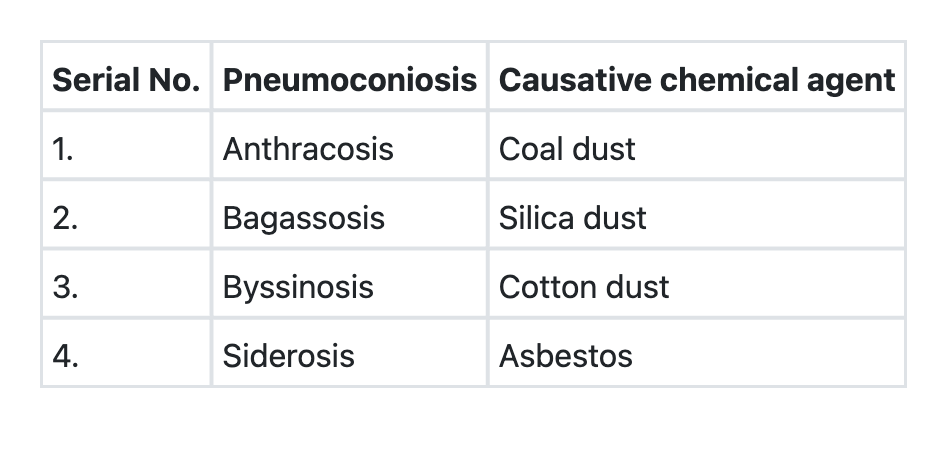
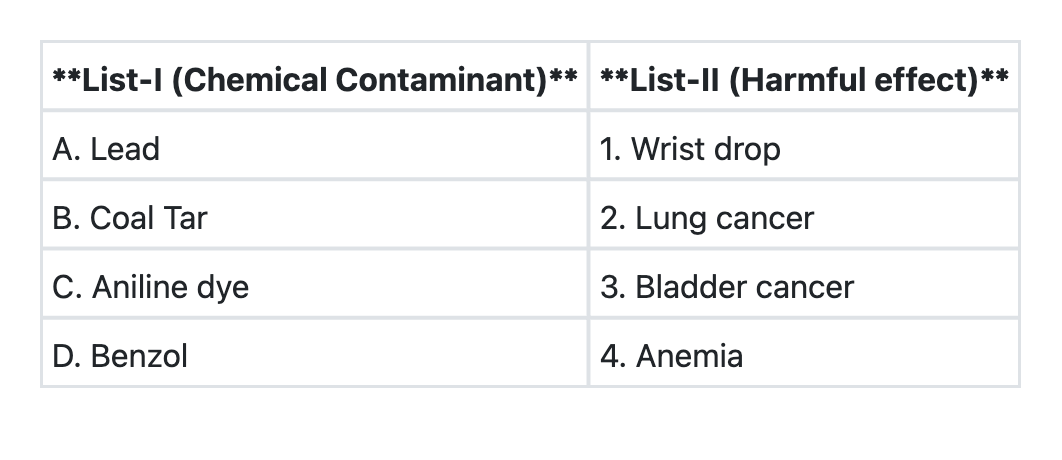
Which carcinoma is common in dye industry workers?
What is the minimum duration for the development of coal worker's pneumoconiosis?
"Snow-storm" appearance is seen in which condition?
Asbestosis is not associated with which of the following?
A nationwide survey of industries and factories was conducted. While arranging the data, the researchers observed that the most common occupational cancer was:
What is the study of designing equipment and devices that fit the human body, its movements, and its cognitive abilities?
Bagassosis is caused by?
A paper mill worker presents with respiratory distress and occupational pneumonia. What is the most probable diagnosis?
All the following form part of an occupational health history except?
Which of the following statements is true under the Factories Act?
Explanation: **Explanation:** **Correct Option: C. Urinary Bladder** The association between the dye industry and **Urinary Bladder Carcinoma** is a classic concept in occupational toxicology. Workers in the dye, rubber, and textile industries are frequently exposed to **Aromatic Amines**, specifically **Benzidine** and **Beta-naphthylamine**. These chemicals are absorbed through the skin or lungs, metabolized in the liver, and excreted via the kidneys. While stored in the bladder, these metabolites act as potent carcinogens on the urothelium. The latent period between exposure and tumor development is typically long, often 10–20 years. **Analysis of Incorrect Options:** * **A. Skin:** While skin cancers are associated with exposure to UV radiation, coal tar, and mineral oils, they are not the primary malignancy linked to aromatic amine exposure in the dye industry. * **B. Scrotum:** Scrotal cancer (Percivall Pott’s "Chimney Sweep Cancer") is historically linked to soot and polycyclic aromatic hydrocarbons (PAHs) found in coal tar and mineral oils, rather than dye chemicals. * **D. Maxilla:** Carcinoma of the maxillary sinus is specifically associated with the **woodworking and furniture industry** (due to hardwood dust) and the leather industry, not the dye industry. **High-Yield Clinical Pearls for NEET-PG:** * **Screening:** Workers exposed to aromatic amines should undergo regular **Papanicolaou (Pap) smears of urine** (Exfoliative Cytology) to detect early malignant changes. * **Key Carcinogens:** Benzidine, Beta-naphthylamine, and Magenta are the primary culprits. * **Other Occupational Cancers:** * **Angiosarcoma of Liver:** Vinyl Chloride (PVC industry). * **Mesothelioma/Lung Cancer:** Asbestos. * **Leukemia:** Benzene. * **Nasal Sinus Cancer:** Nickel and Wood dust.
Explanation: **Explanation:** **Coal Worker’s Pneumoconiosis (CWP)**, also known as "Black Lung Disease," is a chronic occupational lung disease caused by the prolonged inhalation of coal dust. **Why "More than 10 years" is correct:** The development of CWP is a slow, progressive process. It depends on the cumulative "dust burden" in the lungs. Coal dust is less fibrogenic compared to silica; therefore, it takes a significantly longer duration of exposure—typically **at least 10 to 12 years** of underground mining—for the dust to accumulate in the terminal bronchioles and cause detectable coal macules or nodules on a chest X-ray. **Why other options are incorrect:** * **A & B (2–6 years):** These durations are too short for the pathophysiology of CWP. Such rapid onset is usually only seen in "Acute Silicosis" (Silicoproteinosis), which occurs after massive exposure to fine silica dust over 1–3 years. * **C (8–10 years):** While some early radiological changes might begin to appear, the standard clinical and epidemiological consensus for the manifestation of established CWP is a duration exceeding 10 years. **High-Yield Clinical Pearls for NEET-PG:** * **Pathognomonic Lesion:** The **Coal Macule** is the fundamental lesion of CWP. * **Progressive Massive Fibrosis (PMF):** This is the complicated stage of CWP, characterized by large masses of black fibrous tissue (>1 cm). * **Caplan’s Syndrome:** The association of CWP (or Silicosis) with Rheumatoid Arthritis, presenting as multiple necrobiotic nodules in the lungs. * **Radiology:** CWP typically affects the **upper lobes** of the lungs initially. * **Statutory Notification:** In India, CWP is a **notifiable disease** under the Factories Act and the Mines Act.
Explanation: ### Explanation **Correct Answer: B. Silicosis** **Why Silicosis is correct:** Silicosis is a fibrotic lung disease caused by the inhalation of crystalline silica particles. The characteristic **"Snow-storm" appearance** refers to the radiological finding on a chest X-ray, where numerous small, rounded opacities (silicotic nodules) are distributed throughout the lung fields, predominantly in the upper lobes. These nodules are discrete, 1–3 mm in size, and mimic the appearance of falling snow. **Analysis of Incorrect Options:** * **A. Anthracosis:** Caused by coal dust inhalation. It typically presents as "Coal Worker's Pneumoconiosis." Radiologically, it shows small opacities, but the classic "snow-storm" descriptor is specific to silicosis. * **C. Byssinosis:** Caused by cotton dust. It is characterized by "Monday Morning Fever" and progressive dyspnea. It is an airway disease (bronchoconstriction) rather than a nodular fibrotic disease, so it does not show a snow-storm pattern. * **D. Bagassosis:** Caused by sugarcane dust (thermophilic actinomycetes). It is a type of hypersensitivity pneumonitis. X-rays usually show mottling or a "ground-glass" appearance during acute phases, not discrete snow-storm nodules. **High-Yield Clinical Pearls for NEET-PG:** * **Egg-shell Calcification:** Another classic radiological sign of Silicosis, referring to the calcification of hilar lymph nodes. * **Complication:** Silicosis significantly increases the risk of **Tuberculosis** (Silicotuberculosis) due to impaired macrophage function. * **Occupations at risk:** Mining, sandblasting, stone cutting, and glass manufacturing. * **Differential Diagnosis:** A "snow-storm" appearance on X-ray can also be seen in **Miliary Tuberculosis** and **Metastatic Thyroid Carcinoma**, but in the context of occupational health, Silicosis is the primary answer.
Explanation: **Explanation:** Asbestosis is a chronic fibrotic interstitial lung disease caused by the inhalation of asbestos fibers. The correct answer is **Ascites** because it is a clinical sign of fluid accumulation in the peritoneal cavity (often due to liver cirrhosis or heart failure) and is not a direct pathological consequence or malignancy associated with asbestos exposure. **Analysis of Options:** * **Carcinoma of the Lung (Option A):** This is the **most common** malignancy associated with asbestos exposure. There is a synergistic effect between asbestos and cigarette smoking, which exponentially increases the risk of bronchogenic carcinoma. * **Carcinoma of the Esophagus (Option C):** Asbestos fibers can be swallowed after being cleared from the respiratory tract via the mucociliary escalator. This leads to an increased risk of extra-thoracic malignancies, including cancers of the esophagus, stomach, and colon. * **Mesothelioma (Option D):** This is a rare tumor of the pleura or peritoneum. While lung cancer is more common, mesothelioma is the **most specific** marker of asbestos exposure. Unlike lung cancer, its risk is not increased by smoking. **High-Yield Clinical Pearls for NEET-PG:** 1. **Pathognomonic Sign:** Presence of **Asbestos bodies** (ferruginous bodies) in the sputum or lung tissue (golden-brown, dumbbell-shaped). 2. **Radiology:** Characterized by "ground-glass" opacities in the lower lobes and **pleural plaques** (most common radiological finding), often involving the diaphragm. 3. **Latency Period:** Asbestos-related diseases have a long latency period, typically 15–40 years after exposure. 4. **Safe Limits:** The WHO/ILO recommended exposure limit is 0.1 fiber/mL.
Explanation: **Explanation:** **1. Why Option A is Correct:** Occupational skin cancer is recognized as the **most common type of occupational cancer** globally. This is primarily because the skin is the largest organ and has the highest surface area exposed to environmental and industrial carcinogens. The main causative agents include exposure to **Ultraviolet (UV) radiation** (common in outdoor workers like farmers and construction workers), **polycyclic aromatic hydrocarbons (PAHs)** found in coal tar, pitch, and mineral oils, and **arsenic**. Historically, the first described occupational cancer was scrotal skin cancer in chimney sweeps (Percivall Pott, 1775). **2. Why Other Options are Incorrect:** * **Option B (Bladder Cancer):** While highly associated with industries involving **aromatic amines** (e.g., dye, rubber, and leather industries), it is less frequent than skin cancer. It is a classic example of "latent" occupational cancer. * **Option C (Lung Cancer):** This is the most common cause of **occupational cancer mortality** (death), often linked to asbestos, silica, and arsenic. However, in terms of overall incidence (number of cases), skin cancer remains more prevalent. * **Option D (Leukemia):** Specifically associated with **Benzene** exposure and ionizing radiation. While clinically significant, its incidence is much lower compared to epithelial cancers like skin or lung. **3. High-Yield Clinical Pearls for NEET-PG:** * **Most common occupational cancer:** Skin Cancer. * **Most common site of occupational skin cancer:** Hands and forearms (areas of maximum contact). * **Most common cause of occupational cancer death:** Lung Cancer. * **Asbestosis & Malignancy:** Asbestos is most commonly associated with **Bronchogenic Carcinoma**, but its most *specific* association is **Mesothelioma**. * **Bladder Cancer Marker:** Exposure to **Benzidine** and **2-Naphthylamine**. * **Angiosarcoma of Liver:** Classically associated with **Vinyl Chloride** exposure.
Explanation: **Explanation:** The correct answer is **Ergonomics**. **1. Why Ergonomics is Correct:** Derived from the Greek words *Ergon* (work) and *Nomos* (law), Ergonomics is often defined as "fitting the job to the worker" rather than forcing the worker to fit the job. In occupational health, it focuses on designing tools, workstations, and tasks that align with human anatomical, physiological, and psychological capabilities. The goal is to maximize efficiency and productivity while minimizing physical fatigue, discomfort, and the risk of **Musculoskeletal Disorders (MSDs)**. **2. Why Other Options are Incorrect:** * **Economics:** The social science study of the production, distribution, and consumption of goods and services; it is unrelated to physical equipment design. * **Bionomics:** Also known as Ecology, it is the study of the relationship between organisms and their environment. * **Socionomics:** A field that studies how human social behavior and "social mood" influence financial markets and social trends. **3. NEET-PG Clinical Pearls & High-Yield Facts:** * **Objective:** The primary goal of ergonomics is to reduce "Human Error" and "Occupational Hazards" (e.g., Carpal Tunnel Syndrome, Tenosynovitis, and lower back pain). * **Anthropometry:** This is the measurement of human body dimensions used in ergonomics to design seat heights, desk reaches, and tool handle sizes. * **Visual Ergonomics:** Important for preventing **Computer Vision Syndrome**, recommending the "20-20-20 rule" (every 20 minutes, look at something 20 feet away for 20 seconds). * **Key Application:** Proper ergonomic design is a "Primary Prevention" strategy in occupational medicine.
Explanation: **Explanation:** **Bagassosis** is an occupational lung disease caused by the inhalation of dust from **sugar cane** residue (bagasse) after the juice has been extracted. It is classified as a type of **Hypersensitivity Pneumonitis** (Extrinsic Allergic Alveolitis). The specific causative agent is a thermophilic actinomycete, most commonly ***Thermoactinomyces sacchari***, which grows in stored, moldy bagasse. **Analysis of Options:** * **Sugar cane (Correct):** Bagasse is the fibrous waste of sugar cane. When stored in damp conditions, it undergoes fermentation, promoting the growth of fungi/actinomycetes. Inhalation of these spores leads to an allergic reaction in the alveoli. * **Free silica (Incorrect):** Inhalation of free silica (silicon dioxide) causes **Silicosis**, the most common and serious pneumoconiosis, typically seen in mining, sandblasting, and stone cutting. * **Coal (Incorrect):** Inhalation of coal dust leads to **Coal Worker’s Pneumoconiosis (CWP)**, also known as "Black Lung Disease." * **Cotton fibre (Incorrect):** Inhalation of cotton, flax, or hemp dust causes **Byssinosis** (also known as "Monday Chest Tightness"). **High-Yield Clinical Pearls for NEET-PG:** * **Clinical Feature:** Characterized by sudden onset of breathlessness, cough, and fever. * **Radiology:** Shows "miliary mottling" or a "ground-glass appearance" in the lungs. * **Prevention:** The most effective preventive measure is **moistening the bagasse** (spraying with 2% propionic acid) to prevent dust from rising and inhibiting fungal growth. * **Differential:** Do not confuse with **Farmer’s Lung**, which is caused by moldy hay/grain (*Micropolyspora faeni*).
Explanation: **Explanation:** **Bagassosis** is the correct diagnosis because it is a hypersensitivity pneumonitis caused by the inhalation of dust from **bagasse** (crushed sugar cane residue). In India, bagasse is extensively used as a raw material in the **paper manufacturing industry** and for making cardboard. The condition is specifically triggered by a thermophilic actinomycete, *Thermoactinomyces sacchari*, which grows in stored, moist bagasse. Clinically, it presents as acute respiratory distress, cough, and fever, which can progress to chronic lung fibrosis if exposure continues. **Analysis of Incorrect Options:** * **Byssinosis:** Also known as "Monday Morning Fever," this is caused by **cotton dust** inhalation. It is prevalent in textile mill workers, not paper mills. * **Asbestosis:** A form of pneumoconiosis caused by **asbestos fibers**. It is associated with mining, insulation work, and shipbuilding, characterized by interstitial fibrosis and pleural plaques. * **Anthracosis:** Caused by the inhalation of **coal dust**. It is primarily seen in coal miners and is often asymptomatic unless it progresses to Progressive Massive Fibrosis (PMF). **High-Yield Clinical Pearls for NEET-PG:** * **Prevention:** Bagassosis can be prevented by treating bagasse with **2% Propionic acid** (to prevent fungal growth) and maintaining high moisture content to settle dust. * **Radiology:** Chest X-ray typically shows a "mottled" appearance or fine punctate shadows. * **Differentiating Tip:** Always link the **Industry** to the **Dust**: * Sugar/Paper Mill → Bagasse * Textile Mill → Cotton * Foundries/Sandblasting → Silica * Grain Silos/Hay → Farmer’s Lung (*Micropolyspora faeni*)
Explanation: **Explanation:** In occupational medicine, the primary goal of taking a history is to establish a temporal and causal relationship between a patient’s work environment and their clinical symptoms. **Why "Childhood Immunizations" is the correct answer:** While a general medical history includes immunization status, it is **not** a specific component of an *occupational health history*. Occupational history focuses on current and past work exposures, the nature of the job, and the timing of symptoms relative to work shifts. Childhood immunizations (like MMR or Polio) generally do not provide diagnostic clues for work-related pathologies, whereas adult immunizations (like Hepatitis B for healthcare workers or Tetanus for construction workers) are more relevant. **Analysis of Incorrect Options:** * **A. History of previous occupation:** This is crucial because many occupational diseases (e.g., Silicosis, Asbestosis, or Mesothelioma) have long latency periods. A patient’s current job may be safe, but a job held 20 years ago could be the cause of current illness. * **B. Exposure to dust:** Identifying specific hazards (physical, chemical, or biological) is the core of the history. Dust exposure is a leading cause of pneumoconiosis. * **C. Safety:** Inquiring about the use of Personal Protective Equipment (PPE), safety protocols, and whether coworkers have similar symptoms helps determine the adequacy of workplace controls. **High-Yield Clinical Pearls for NEET-PG:** * **The "Weekend Effect":** If symptoms improve during weekends or holidays and worsen upon returning to work, it strongly suggests an occupational origin (e.g., Occupational Asthma). * **Latency Period:** Always remember that occupational cancers and fibrotic lung diseases can manifest decades after the initial exposure. * **Key Question:** The single most important screening question in occupational health is: *"What kind of work do you do?"* followed by *"Do you think your health problems are related to your work?"*
Explanation: ### Explanation The **Factories Act (1948)** is a vital piece of social legislation designed to protect the health, safety, and welfare of workers. **1. Why Option A is Correct:** Under Section 67 of the Act, there is a **prohibition of employment of young children**. No child who has not completed his **14th year** shall be required or allowed to work in any factory. This is a fundamental safeguard to prevent child labor and ensure physical and mental development. **2. Analysis of Incorrect Options:** * **Option B:** Adolescents (15–18 years) and women are generally prohibited from working in factories between **7 PM and 6 AM**. Night shifts are restricted to ensure safety and health. * **Option C:** Women and children are strictly prohibited from "hazardous occupations." For example, they cannot be employed for cleaning or lubricating machinery in motion or in areas where cotton openers are at work. * **Option D:** An adolescent (15–18 years) can only work in a factory if they carry a **Certificate of Fitness** granted by a **Certifying Surgeon**. This certificate must be renewed annually to ensure the individual is physically capable of the assigned task. **3. NEET-PG High-Yield Pearls:** * **Child:** Person who has not completed 15 years of age. * **Adolescent:** Person who has completed 15 years but not 18 years. * **Adult:** Person who has completed 18 years. * **Working Hours:** Adults should not work more than **48 hours/week** or **9 hours/day**. * **Creche Facility:** Mandatory if more than **30 women** are employed. * **Welfare Officer:** Mandatory if the factory employs **500 or more** workers. * **Safety Officer:** Mandatory if the factory employs **1000 or more** workers.
Occupational Hazards: Classification
Practice Questions
Occupational Diseases
Practice Questions
Ergonomics
Practice Questions
Industrial Toxicology
Practice Questions
Occupational Cancers
Practice Questions
Work-Related Musculoskeletal Disorders
Practice Questions
Occupational Health Services
Practice Questions
Industrial Hygiene
Practice Questions
Assessment of Work Environment
Practice Questions
Personal Protective Equipment
Practice Questions
Occupational Health Legislation
Practice Questions
Workers' Compensation
Practice Questions
Get full access to all questions, explanations, and performance tracking.
Start For Free