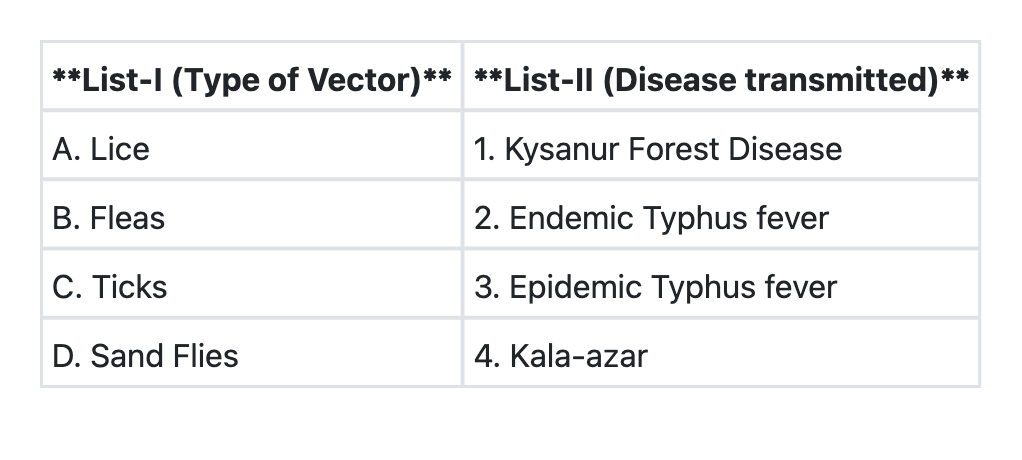
Chandler's Index is used for -
Which of the following infectious diseases are transmitted through rats?
Which is most dangerous for transmitting plague?
Infections transmitted to man from vertebrate animals are known as:
Soft tick transmits:
All the following statements regarding transmission of HIV are true EXCEPT:
Which of the following is known as monkey fever?
Xavier and Yogender stay in the same hostel of the same university. Xavier develops an infection due to group B meningococcus. After a few days, Yogender develops an infection due to Group C meningococcus. All of the following statements are true except -
Mass chemoprophylaxis in endemic areas is recommended for all of the following, except:
False about Japanese encephalitis is -
Explanation: ***Ascaris lumbricoides*** - **Chandler's Index** (also known as the **Ascaris index**) is a method used to assess the presence and intensity of **Ascaris lumbricoides** infection. - It involves examining the number of **adult worms expelled** either spontaneously or after anthelmintic treatment, typically in children. *Trichuris trichiura* - This parasite is also known as **whipworm** and causes **trichuriasis**. - Its presence is primarily diagnosed through the **identification of eggs in stool samples** via microscopic examination. *Ankylostoma duodenale* - This is a type of **hookworm** found in various parts of the world, particularly in regions with poor sanitation. - Diagnosis is based on identifying **hookworm eggs in stool samples** during microscopic examination. *Strongyloides* - **Strongyloides stercoralis** is a nematode that can cause chronic infections, especially in immunocompromised individuals. - Diagnosis typically involves detecting **larvae in stool samples** rather than eggs, or through serological tests.
Explanation: ***Leptospirosis*** - **Leptospirosis** is a bacterial infection primarily transmitted through contact with urine from infected animals, particularly **rats**, which are the most important reservoir host. - Humans contract the disease through contact with contaminated water, soil, or food, or through direct contact with infected animal tissues or urine. - In Community Medicine, **rodent control and proper sanitation** are key preventive measures. - Other rat-transmitted diseases include **Plague** (via rat fleas), **Rat-bite fever**, and **Hantavirus infections**. *Measles* - **Measles** is a highly contagious viral infection transmitted through respiratory droplets from person to person. - It is not transmitted through rats or other animals; **humans are the only natural host**. - Not a zoonotic disease. *Influenza* - **Influenza** is a viral infection that primarily spreads through airborne respiratory droplets from infected individuals. - While some strains originate in animals like birds (avian flu) or pigs (swine flu), **rats are not a reservoir** for human influenza. - Direct transmission through rats is not a recognized mode of infection. *Tetanus* - **Tetanus** is caused by *Clostridium tetani* bacteria found in soil and feces, entering the body through breaks in the skin, typically deep puncture wounds. - It is **not vector-borne or transmitted by rats** but rather through environmental exposure to spores. - Prevention relies on wound care and vaccination, not rodent control.
Explanation: ***Blocked flea*** - A **blocked flea** is most dangerous for transmitting plague because the proventriculus becomes obstructed by a biofilm of *Yersinia pestis* bacteria. - The blockage prevents normal blood ingestion, causing the flea to **regurgitate infected blood back into the bite wound** with each feeding attempt. - The blocked flea remains persistently hungry and makes **repeated desperate attempts to feed**, injecting bacteria into multiple hosts before eventually dying of starvation. - This mechanism results in highly efficient transmission with multiple bacterial inoculations per bite attempt. *Partially blocked flea* - While a partially blocked flea can transmit plague, it is less efficient than a fully blocked flea because some blood can still pass through. - The partial blockage means less regurgitation occurs compared to complete blockage, resulting in lower bacterial loads being transmitted. *Unblocked flea* - An **unblocked flea** can feed normally and may transmit bacteria during feeding, but lacks the regurgitation mechanism that makes blocked fleas so dangerous. - It typically feeds once, becomes satiated, and is less likely to make repeated feeding attempts on the same or multiple hosts. *Both* - This option is incorrect because there is a clear difference in transmission efficiency between blocked and unblocked fleas. - The blocked flea's unique regurgitation mechanism makes it distinctly more dangerous than other flea states.
Explanation: ***Anthropozoonoses*** - **Anthropozoonoses**, also known simply as **zoonoses**, are diseases primarily of animals that can be transmitted to humans. - This term specifically refers to infections that are naturally transmissible from **vertebrate animals** to humans. *Zooanthroponoses* - **Zooanthroponoses** refer to infections that are naturally transmissible from humans to animals. - While reflecting a human-animal disease relationship, the direction of transmission is opposite to what is described in the question. *Exotic* - An **exotic** disease refers to an infection or pathogen that is not native or endemic to a particular geographic region. It does not describe the mode of transmission from animals to humans. - This term describes the geographical origin or presence of a disease, not its interspecies transmissibility. *Epizootic* - An **epizootic** describes a disease outbreak in an animal population, analogous to an epidemic in humans. - This term defines the pattern and occurrence of disease within animal populations, rather than transmission to humans.
Explanation: ***Relapsing fever*** - **Soft ticks** (Ornithodoros species) are the primary vectors for **tick-borne relapsing fever**, specifically transmitting spirochetes of the genus *Borrelia*. - The disease is characterized by recurrent episodes of **fever**, **headache**, and **fatigue**, alternating with afebrile periods. *Tularemia* - While tularemia can be transmitted by ticks, it is primarily associated with **hard ticks** (e.g., Dermacentor, Amblyomma) and not typically soft ticks. - The causative agent is *Francisella tularensis*, which can also be acquired through contact with infected animals or contaminated water. *Indian tick typhus* - This is a form of spotted fever group rickettsiosis caused by *Rickettsia conorii*, typically transmitted by **hard ticks** like *Rhipicephalus sanguineus*. - It is characterized by fever, rash, and a characteristic **eschar** at the bite site. *KFD* - **Kyasanur Forest Disease (KFD)** is a viral hemorrhagic fever transmitted by **hard ticks**, particularly *Haemaphysalis spinigera*. - It is endemic to India and involves symptoms such as high fever, headache, and hemorrhage.
Explanation: ***Associated STDs will not influence the transmission*** - The presence of **sexually transmitted diseases (STDs)**, particularly those causing genital ulcers (e.g., syphilis, herpes), significantly **increases the risk** of both acquiring and transmitting HIV. - STDs create breaks in the skin or mucous membranes and increase inflammatory cells, providing easier entry and exit points for the HIV virus. *Even after vigorous screening, HIV transmission can occur through blood transfusion* - Despite rigorous screening of blood products, there is a very small, but non-zero, residual risk of HIV transmission due to the **"window period"** during which an infected donor may test negative. - This risk has been drastically reduced but not entirely eliminated, making it a true statement that transmission *can* still occur. *Heterosexual contact is the most common route of transmission of HIV* - Globally, **heterosexual contact** is indeed the predominant mode of HIV transmission, especially in regions with high HIV prevalence like Sub-Saharan Africa. - This route accounts for the majority of new infections worldwide. *Circumcision will decrease the frequency of transmission* - Studies have shown that **male circumcision reduces the risk** of heterosexually acquired HIV infection in men. - This protection is thought to be due to the removal of the inner foreskin, which contains a higher density of HIV target cells (Langerhans cells) and is more susceptible to micro-tears during intercourse.
Explanation: ***KFD*** - **Kyasanur Forest Disease (KFD)** is also known as "monkey fever" due to its primary hosts and the observed mortality in monkeys before human outbreaks. - It is a **viral hemorrhagic fever** endemic to certain parts of India, transmitted by **ticks** (primarily *Haemaphysalis spinigera*). *Plague* - **Plague** is a bacterial infection caused by *Yersinia pestis*, primarily transmitted by **fleas** from rodents to humans. - While it can cause severe systemic illness, it is not colloquially known as "monkey fever." *Trench fever* - **Trench fever** is caused by the bacterium *Bartonella quintana* and is transmitted by **body lice**. - It is characterized by recurrent fevers, headaches, and often shin pain, and is not associated with monkeys or called "monkey fever." *Yellow fever* - **Yellow fever** is a viral hemorrhagic disease transmitted by mosquitoes, primarily *Aedes* and *Haemagogus* species. - While it can affect primates, its common name refers to the **jaundice** seen in some patients, not specifically "monkey fever."
Explanation: ***No Chemoprophylaxis available against both group B and group C*** - This statement is incorrect because **chemoprophylaxis** *is* available for contacts of individuals with meningococcal disease, regardless of the serogroup. - **Rifampicin**, **ciprofloxacin**, or **ceftriaxone** are commonly used to eradicate nasopharyngeal carriage and prevent secondary cases. *Vaccine prophylaxis of contacts of Yogendra* - **Vaccines are recommended** for contacts of individuals with **Group C meningococcal disease** if the serogroup is known, as specific conjugate vaccines are available. - This aims to provide **active immunity** and prevent further spread within a close-contact community. *Vaccine prophylaxis of contacts of Xavier* - **Vaccines for Group B meningococcus** are available (e.g., MenB-4C, MenB-FHbp) and may be considered for close contacts during outbreaks or in high-risk settings. - However, the decision for **mass vaccination** depends on local guidelines and the specific outbreak characteristics. *Educate students about meningococcal trans-mission and take preventive measures* - **Health education** is a crucial public health measure in any meningococcal outbreak, as it empowers individuals to reduce transmission risk. - Preventive measures include **avoiding sharing personal items** like drinks and cigarettes, and practicing good hand hygiene.
Explanation: ***Leprosy*** - **Mass chemoprophylaxis** for leprosy is generally *not recommended* due to concerns about drug resistance and the long incubation period. - Instead, the focus is on **early detection** and *multi-drug therapy (MDT)* for diagnosed cases, and contact tracing with single-dose rifampicin (SDR) as post-exposure prophylaxis for close contacts in some settings. *Trachoma* - **Mass drug administration (MDA)** of *azithromycin* is a cornerstone of the **SAFE strategy** (Surgery, Antibiotics, Facial cleanliness, Environmental improvement) for eliminating trachoma, recommended in endemic areas. - This aims to reduce the community reservoir of *Chlamydia trachomatis* infection, thus preventing new infections and progression of the disease. *Yaws* - **Mass treatment programs** with a *single oral dose of azithromycin* have been highly effective and are recommended by the WHO for the eradication of yaws in endemic communities. - This strategy aims to interrupt transmission and eliminate the *Treponema pallidum subspecies pertenue* bacterium. *Filaria* - **Mass drug administration (MDA)** with anti-filarial drugs (e.g., *diethylcarbamazine and albendazole*) is a key strategy for the elimination of lymphatic filariasis in endemic areas. - MDA aims to reduce the microfilaria burden in infected individuals, thereby interrupting transmission of the parasite by mosquitoes.
Explanation: ***Overhead tanks serve as breeding site*** - The primary vector for **Japanese encephalitis (JE)** is the *Culex* mosquito, which typically breeds in **rice paddies** and other ground-level water sources, not overhead tanks. - While *Culex* mosquitoes need water to breed, overhead tanks generally circulate human-used water and are not their preferred or typical breeding sites, making this statement false regarding JE transmission. *Pigs are amplifiers* - **Pigs** are known to be **amplifying hosts** for the Japanese encephalitis virus. They develop high viremia (high viral load in the blood) without becoming severely ill, allowing mosquitoes to pick up the virus from them and transmit it to other hosts. - This cycle is crucial for the maintenance and spread of the virus in endemic areas, making the statement true. *Primary dose of vaccine consists of two doses* - The **Japanese encephalitis vaccine** often requires a primary series of **two doses** for optimal protection, administered at least 28 days apart, followed by a booster dose if continued exposure is anticipated. - This regimen ensures a robust and lasting immune response against the virus, making the statement true. *Transmitted by Culex mosquitoes* - **Japanese encephalitis** is predominantly transmitted through the bite of infected **Culex mosquitoes**, particularly *Culex tritaeniorhynchus*. - These mosquitoes are ubiquitous in endemic regions of Asia and are the main vector responsible for spreading the virus between animal hosts and to humans, making the statement true.
Communicable Disease Control Principles
Practice Questions
Vector-Borne Diseases
Practice Questions
Water-Borne Diseases
Practice Questions
Air-Borne Diseases
Practice Questions
Zoonotic Diseases
Practice Questions
Sexually Transmitted Infections
Practice Questions
HIV/AIDS Control Program
Practice Questions
Tuberculosis Control
Practice Questions
Leprosy Elimination
Practice Questions
Emerging and Re-emerging Infections
Practice Questions
Hospital-Acquired Infections
Practice Questions
Integrated Disease Surveillance Project
Practice Questions
Get full access to all questions, explanations, and performance tracking.
Start For Free