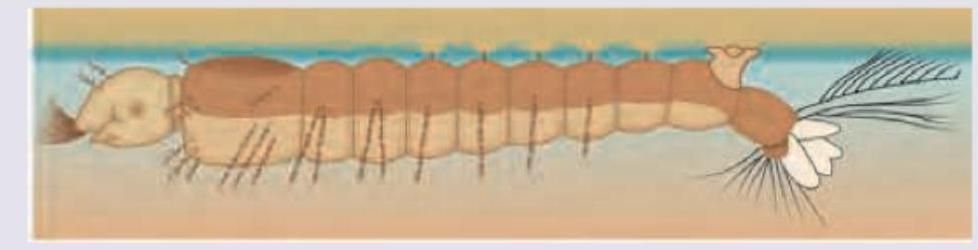
Chiggerosis is due to
World Malaria Day is observed in which month?
White death is
The following statements are true regarding leptospirosis, except -
True statement regarding RNTCP includes all except
All of the following statements about tetanus are true except:
The most practical way of treating typhoid carrier is -
All of the following statements about plague are wrong except -
H5N1 Avian influenza has not become an epidemic till now. What is the most important reason for this?
Zoonoses are all except-
Explanation: ***Chigger (Trombiculid mite larva)*** - **Chiggerosis**, also known as **trombiculosis**, is an intensely itchy dermatitis caused by the bite of the larval stage of **trombiculid mites**. - These larvae attach to the skin, inject digestive enzymes, and feed on liquefied tissue, causing characteristic **pruritic red papules**. *Louse* - **Lice** (e.g., *Pediculus humanus* or *Pthirus pubis*) cause **pediculosis**, characterized by pruritus, excoriations, and nits attached to hair shafts. - Their bites are typically small, red papules, but do not produce the intense, persistent inflammatory reaction associated with chigger bites. *Tick* - **Ticks** are larger arachnids that burrow their mouthparts into the skin to feed on blood, which can transmit various **pathogens** (e.g., Lyme disease, Rocky Mountain spotted fever). - While tick bites can cause localized irritation, they do not typically result in the widespread, intensely itchy rash seen in chiggerosis. *Bed bug* - **Bed bugs** (*Cimex lectularius*) are nocturnal insects that feed on human blood, typically producing small, **itchy red welts** often arranged in a linear pattern ("breakfast, lunch, and dinner"). - The rash is distinct from chiggerosis, which presents as highly inflammatory, localized papules often found in skin folds or tight clothing areas.
Explanation: ***April*** - **World Malaria Day** is observed annually on **April 25th**. - Its purpose is to raise awareness about malaria and celebrate the efforts made globally to control and eradicate this disease. *September* - While September hosts various health observances, it is not the month for **World Malaria Day**. - Other public health campaigns, such as **World Alzheimer's Month**, are observed in September. *May* - May is recognized for several health-related days, but not specifically for **World Malaria Day**. - For example, **World Hypertension Day** is observed in May. *June* - June includes observances like **World Blood Donor Day**, but it is not the month designated for **World Malaria Day**. - Public health calendars indicate April 25th for this specific event.
Explanation: ***TB*** - **Tuberculosis (TB)**, particularly the pulmonary form, has historically been known as the **"White Death"** due to the characteristic pallor, weight loss, and widespread prevalence it caused, leading to death. - This term reflects the devastating impact of the disease, which left victims looking pale and wasted due to chronic illness and cachexia. *Plague* - The **Plague** is famously known as the **"Black Death"** due to the development of **gangrene** and **hemorrhages** that turned the skin black. - It is caused by the bacterium *Yersinia pestis* and is characterized by rapidly progressing, severe symptoms, often in the form of bubonic, pneumonic, or septicemic plague. *Yellow fever* - **Yellow fever** is named for the **jaundice (yellowing of the skin and eyes)** that affects some patients due to liver damage. - It is a viral hemorrhagic disease transmitted by mosquitoes and is not associated with the term "White Death." *HIV* - **HIV (Human Immunodeficiency Virus)** infection leads to **AIDS (Acquired Immunodeficiency Syndrome)**, which was historically known as the **"slim disease"** due to the severe weight loss and wasting it caused, but not specifically the "White Death." - HIV primarily targets the immune system, leading to opportunistic infections and cancers, rather than the pallor associated with chronic lung disease.
Explanation: ***Lice act as reservoirs of infection*** - **Lice** are not known reservoirs or vectors for leptospirosis; the infection is primarily spread through the urine of infected animals. - The main reservoirs are **rodents**, **livestock**, and **wild animals**, which excrete bacteria in their urine. *It is zoonosis* - **Leptospirosis** is indeed a **zoonotic disease**, meaning it is transmitted from animals to humans. - Humans typically acquire the infection through contact with the urine of infected animals or contaminated water/soil. *Man is the dead end host* - Humans are considered **dead-end hosts** for leptospirosis, meaning they typically do not transmit the infection to others. - While humans can become severely ill, their role in maintaining the natural cycle of the disease is minimal. *Man is an accidental host* - Humans are also considered an **accidental host**, as they contract the disease incidentally from the environment rather than being a natural part of the pathogen's life cycle. - The primary cycle of transmission occurs between infected animals and the environment.
Explanation: ***Exclusion of private practitioners*** - The **Revised National Tuberculosis Control Program (RNTCP)** actively encourages and facilitates the engagement of **private practitioners** in TB care and management. - This involvement is crucial for expanding reach, ensuring correct diagnosis, and completing treatment in a country like India where a significant portion of healthcare is provided by the private sector. *Sputum microscopy* - **Sputum microscopy** is a cornerstone diagnostic tool within the RNTCP for identifying **acid-fast bacilli (AFB)** in patients suspected of having pulmonary tuberculosis. - It is a cost-effective and readily available method for confirming TB and monitoring treatment response. *Participation of all health workers* - The RNTCP emphasizes the engagement of **all health workers**, including community health workers, nurses, and doctors, across various levels of healthcare delivery. - This broad participation is essential for **case finding**, treatment adherence, and community education efforts regarding TB. *Provides latest equipment* - The RNTCP continually strives to upgrade its diagnostic and treatment infrastructure by providing **latest equipment** such as **Gene Xpert machines** for rapid molecular diagnosis and drug susceptibility testing. - This ensures access to modern diagnostic tools for more accurate and timely TB diagnosis and management, especially for drug-resistant forms of TB.
Explanation: ***Uterine tetanus is the least severe.*** - Uterine tetanus (or **puerperal tetanus**) is actually a severe form of tetanus, often leading to high morbidity and mortality in mothers and neonates due to complications associated with childbirth. - The severity of tetanus is generally related to the **amount of toxin produced** and disseminated, and uterine infections can lead to significant toxin production due to anaerobic conditions. *Soil and intestines of infected humans and animals act as chief reservoirs.* - **Clostridium tetani** spores are widely distributed in the environment, especially in **soil contaminated with feces** from humans and animals. This makes soil a primary reservoir. - The gastrointestinal tracts of humans and animals can harbor the bacterium without causing disease, thus serving as an additional reservoir. *Incubation period is 6-12 days.* - The typical incubation period for tetanus is generally reported to be **3 to 21 days**, with a common range of **6 to 12 days**. - A shorter incubation period is often associated with more severe disease and a worse prognosis due to greater toxin load or closer proximity to the central nervous system. *Tetanospasmin is the neurotoxin responsible for clinical manifestations* - **Tetanospasmin** is indeed the potent neurotoxin produced by *Clostridium tetani* that is responsible for all the clinical manifestations of tetanus. - This toxin acts by blocking the release of **inhibitory neurotransmitters** (glycine and GABA) in the spinal cord, leading to uncontrolled muscle spasms and rigidity.
Explanation: ***Correct Option: Cholecystectomy*** - **Cholecystectomy** (surgical removal of the gallbladder) is the **most practical and definitive treatment** for chronic typhoid carriers - Chronic carriers harbor *Salmonella typhi* in the **gallbladder**, especially when **gallstones** are present, where bacteria form biofilms - **Success rate >90%** in eliminating the carrier state permanently - Particularly important for **food handlers** and healthcare workers where definitive cure is essential - While surgical, it provides a **permanent solution** unlike antibiotics which have high failure/relapse rates *Incorrect Option: Chemotherapy* - Antibiotic therapy alone has a **poor success rate** (~80% failure) in chronic typhoid carriers - Bacteria in the gallbladder are protected by **biofilms** on gallstones and poor antibiotic penetration - High **relapse rates** even after prolonged courses of ciprofloxacin or ampicillin - May be attempted first but is not the most practical definitive treatment *Incorrect Option: Isolation* - **Isolation** is a public health measure to prevent transmission, not a treatment - Does not eliminate the bacteria from the carrier's body - Only controls spread to others, not a therapeutic intervention *Incorrect Option: Vaccination* - Provides **prophylactic immunity** against future infection but does not treat existing carrier state - Does not eliminate *Salmonella typhi* bacteria already colonizing the gallbladder - Used for prevention, not treatment of carriers
Explanation: ***Bubonic is the most common variety*** - **Bubonic plague** is indeed the most frequent clinical form of plague, accounting for 80-95% of cases. - It results from the bite of an infected flea, leading to the development of **buboes** (swollen, tender lymph nodes). *Incubation period for pneumonic plague is 10-14 days* - The incubation period for **pneumonic plague** is typically much shorter, usually 1 to 3 days, not 10-14 days. - A longer incubation period would be atypical for such an aggressive and rapidly progressing disease. *The causative bacillus can survive up to 10 years in the soil of rodent burrows* - While *Yersinia pestis* can survive in the environment, its survival in soil is typically for days to weeks, not years. - The primary survival mechanism is within infected animals and fleas, not as dormant free-living bacteria for a prolonged period in soil. *Domestic rat is main reservoir* - While domestic rats (Rattus species) can be involved in urban plague cycles, the main reservoirs of *Yersinia pestis* are wild rodents such as **ground squirrels, marmots, and prairie dogs**. - These wild rodents maintain the enzootic cycle in nature, and fleas often transmit the bacteria between them.
Explanation: ***Human to human transmission is rare*** - While H5N1 can infect humans, its **limited ability to spread efficiently from person to person** is the primary reason it has not caused a human pandemic. - Efficient human-to-human transmission is a prerequisite for any widespread epidemic or pandemic. *Seen only in wild birds and not in domestic poultry* - H5N1 can affect both **wild birds and domestic poultry**, contradicting the statement. - The virus's presence in domestic poultry has historically been a significant source of human exposure. *It causes serious illness leading to death of the patient* - The **severity of illness and high mortality rate** in infected humans actually makes epidemic control more challenging, not less, if human-to-human transmission were efficient. - However, this characteristic alone does not prevent the virus from becoming an epidemic unless it can spread between people. *It has avian influenza genes* - The presence of avian influenza genes is simply a **description of the virus's genetic makeup** and its origin in birds. - It does not explain why the virus has or has not become an epidemic in humans; rather, it indicates the source of the virus.
Explanation: ***Guinea worm infestation*** - **Dracunculiasis (Guinea worm disease)** is exclusively a human disease (anthroponosis), meaning humans are the only definitive hosts. - The life cycle involves humans as the primary host and **copepods** (small crustaceans) as intermediate hosts; there is no animal reservoir or transmission to/from other vertebrate animals. - This is **NOT a zoonosis** because it does not involve animal-to-human transmission. *Plague* - **Plague** is a classic zoonosis caused by *Yersinia pestis*, primarily affecting rodents and transmitted to humans via **flea bites**. - Rodents (especially rats) serve as natural reservoirs, making this a clear example of animal-to-human disease transmission. *Rabies* - **Rabies** is a viral zoonotic disease transmitted to humans through the saliva of infected animals, most commonly via **bites from infected animals**. - The main reservoirs are **carnivorous mammals** such as dogs, foxes, bats, and raccoons, making it a classic zoonosis. *Hydatid cyst* - **Hydatid disease (echinococcosis)** is a zoonosis caused by the larval stage of *Echinococcus* tapeworms. - Definitive hosts are **carnivores** (e.g., dogs, wolves), and humans are accidental intermediate hosts who acquire infection through contact with infected animal feces or contaminated food/water.
Communicable Disease Control Principles
Practice Questions
Vector-Borne Diseases
Practice Questions
Water-Borne Diseases
Practice Questions
Air-Borne Diseases
Practice Questions
Zoonotic Diseases
Practice Questions
Sexually Transmitted Infections
Practice Questions
HIV/AIDS Control Program
Practice Questions
Tuberculosis Control
Practice Questions
Leprosy Elimination
Practice Questions
Emerging and Re-emerging Infections
Practice Questions
Hospital-Acquired Infections
Practice Questions
Integrated Disease Surveillance Project
Practice Questions
Get full access to all questions, explanations, and performance tracking.
Start For Free