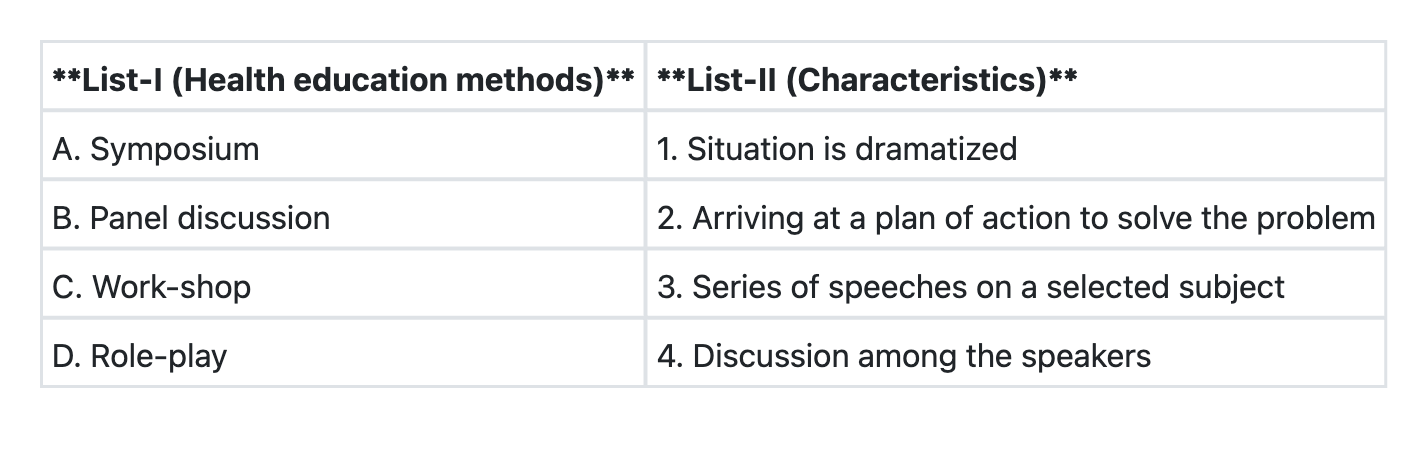
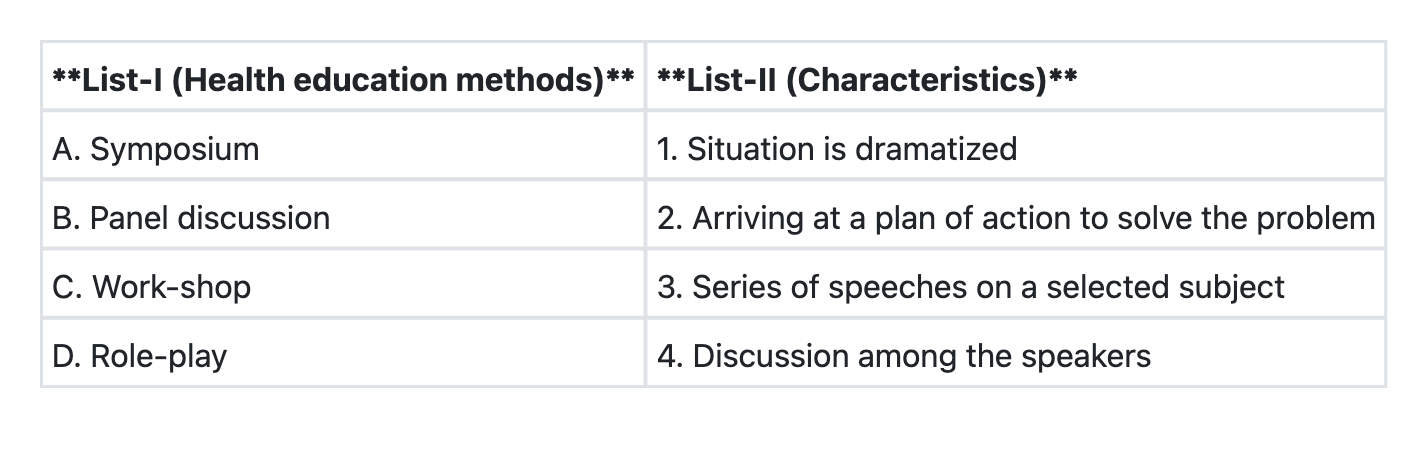
Which of the following is NOT a two-way communication method?
Diarrheal cases among children in an urban slum are on the rise. Most mothers are illiterate and belong to a lower socioeconomic class, making it difficult to explain the use of Oral Rehydration Solution (ORS). What method can provide the best solution in this scenario?
The lecture method is a type of communication?
What was the theme for World Health Day in 1976?
What is the minimum number of people required for a group discussion?
Which mode of intervention is the most cost-effective for disease prevention?
Health education is defined as:
Which of the following statements is NOT true about a panel discussion?
Which of the following statements refers to propaganda?
What is the ideal number of members for a focus group discussion?
Explanation: **Explanation:** In health education, communication methods are classified based on the flow of information between the educator and the audience. **1. Why "Lecture" is the correct answer:** A **Lecture** is primarily a **one-way (didactic)** communication method. The information flows from the speaker to the audience with minimal interaction. While a brief Q&A session may occur at the end, the structure is teacher-centered, making it passive for the learners. It is effective for providing factual information to large groups but is poor at changing behavior or ensuring active participation. **2. Why the other options are incorrect:** * **Group Discussion (A):** This is a classic **two-way (Socratic)** method. It involves a small group (6–12 people) where everyone is encouraged to participate, share experiences, and reach a consensus. * **Workshop (B):** This is a highly interactive method consisting of a series of meetings emphasizing **learning by doing**. It involves hands-on practice and immediate feedback between the facilitator and participants. * **Panel Discussion (C):** In this method, 4–8 experts discuss a specific topic in front of an audience. It is considered two-way because it allows for interaction between the panelists and subsequent interaction with the audience. **High-Yield Clinical Pearls for NEET-PG:** * **Role Play (Socio-drama):** Best method for teaching human relations and communication skills. * **Demonstration:** The "Gold Standard" for teaching a new skill (e.g., ORS preparation or handwashing). * **Symposium:** A series of short speeches by different experts on various aspects of a single topic; unlike a panel, there is no discussion among speakers. * **Flashcards:** Best suited for small groups (10–12 people) to reinforce specific points.
Explanation: ### Explanation **Correct Option: C. Role playing** **Why it is correct:** In health education, the choice of method depends on the target audience's literacy level, socioeconomic status, and the complexity of the skill being taught. **Role playing** (a socio-drama technique) is a highly effective **group discussion method** for illiterate or semi-literate populations. It bridges the communication gap by using visual storytelling and emotional engagement rather than complex terminology. It allows mothers to observe the step-by-step preparation of ORS in a relatable, real-life context, making it easier to replicate at home. It is particularly useful for changing attitudes and teaching specific behavioral skills. **Why other options are incorrect:** * **A. Radio Programme:** This is a mass communication medium. While it reaches many people, it is a **one-way channel** with no feedback. It cannot demonstrate the physical process of mixing ORS or ensure the mothers have understood the correct proportions. * **B. Poster competition:** This is inappropriate for an **illiterate population**. Furthermore, a "competition" implies the audience is creating the content, whereas here the goal is to teach a specific life-saving skill to a vulnerable group. * **C. Lectures:** Lectures are the least effective method for this demographic. They are **didactic, passive**, and rely heavily on the audience's ability to process verbal/written information, which is difficult for those with no formal education. **NEET-PG High-Yield Pearls:** * **Classification:** Role playing is a **Group Approach** to health education. * **Best for Skill Acquisition:** For teaching "how-to" tasks (like ORS preparation or handwashing), **Demonstration** is the gold standard, but **Role Play** is the best for addressing social barriers and behavioral change. * **Cone of Experience (Dale):** People generally remember 90% of what they "do" (simulated experience/role play) compared to only 20% of what they "hear" (lectures). * **Ideal Group Size:** For effective group communication methods like role playing or demonstrations, the ideal group size is usually **6–12 people**.
Explanation: **Explanation:** In the context of health education, the **Lecture Method** is traditionally classified as a **Didactic (or Dialectic) method**. This is a one-way, teacher-centered approach where the educator provides information to a passive audience. The primary objective is to transmit a large volume of factual information in a short period. While modern pedagogy often encourages interaction, in classic public health classification, the lecture remains the prototype of the didactic/dialectic model. **Analysis of Options:** * **D. Dialectic method (Correct):** This refers to the "one-way" or "didactic" flow of information. It is characterized by a top-down approach where the listener has little opportunity for feedback or active participation during the session. * **A. Visual communication:** While a lecture may use slides or chalkboards, it is primarily an **auditory** and verbal method. Visual communication relies solely on charts, posters, or models without the necessity of a spoken lecture. * **B. Formal communication:** While a lecture is a formal setting, this term refers more to the organizational structure (official channels) rather than the educational technique itself. * **C. Socratic method:** This is the opposite of a lecture. It is a **two-way (Socratic)** approach based on asking and answering questions to stimulate critical thinking and draw out ideas. **High-Yield Facts for NEET-PG:** * **One-way (Didactic) methods:** Lecture, Film strips, Posters, Radio, Health exhibits. * **Two-way (Socratic) methods:** Group discussion, Panel discussion, Symposium, Workshop, Roleplay. * **Lecture Limitations:** It does not influence behavior change or stimulate critical thinking; it is best for increasing knowledge only. * **Ideal Group Size:** For a group discussion, the ideal size is **6–12 members**. * **Symposium:** A series of short speeches by different experts on various aspects of a single topic; there is no discussion among speakers (unlike a panel).
Explanation: **Explanation:** The correct answer is **B. Foresight prevents blindness**. World Health Day is celebrated every year on **April 7th** to mark the anniversary of the founding of the World Health Organization (WHO) in 1948. In 1976, the WHO focused its global campaign on the prevention of blindness. The theme "Foresight prevents blindness" was chosen to emphasize that a significant portion of visual impairment is preventable through early detection, public health interventions (like Vitamin A supplementation), and timely treatment. **Analysis of Options:** * **Option A & C:** While "Better eyes better health" and "Better vision better future" sound plausible and align with the spirit of eye care, they were never official WHO themes. They are distractors designed to test the candidate's precise memory of historical public health milestones. * **Option D:** This is incorrect as Option B is the historically documented theme. **High-Yield Clinical Pearls for NEET-PG:** * **World Health Day 2024 Theme:** "My health, my right." * **World Health Day 2023 Theme:** "Health For All" (marking the 75th anniversary of WHO). * **Historical Context:** The 1976 theme was a precursor to the launch of the **NPCB (National Programme for Control of Blindness)** in India, which was also launched in 1976. * **Key Target:** The current global initiative for eye health is "Vision 2020: The Right to Sight," which aims to eliminate avoidable blindness. * **Most Common Cause of Blindness in India:** Cataract (followed by Refractive Errors).
Explanation: **Explanation:** In Community Medicine and Health Education, a **Group Discussion** is a method of two-way communication used to change attitudes and behaviors through group dynamics. For a group discussion to be effective, it must be large enough to provide a variety of opinions but small enough to allow every member to participate actively. 1. **Why Option B (6) is correct:** According to standard textbooks (like Park’s Preventive and Social Medicine), the ideal size for a group discussion is **6 to 12 people**. Therefore, **6** is considered the minimum number required to initiate a meaningful exchange of ideas. A group of this size ensures that the discussion does not become a monologue and that there is sufficient diversity in thought to reach a group decision. 2. **Why other options are incorrect:** * **Options C (5) and D (4):** These numbers are considered too small for a formal "Group Discussion" in health education. In very small groups, the dynamics are often limited, and the "group effect" (where individuals are influenced by the collective consensus) is less pronounced. * **Option A (8):** While 8 is within the ideal range (6–12), it is not the *minimum* requirement. **High-Yield Facts for NEET-PG:** * **Ideal Size:** 6 to 12 members. * **Role of Leader:** The leader initiates the discussion, keeps it on track, and ensures everyone participates. They should not dominate the talk. * **Seating Arrangement:** Members should sit in a **circle** to ensure face-to-face contact and equality. * **Goal:** It is particularly effective for **changing established attitudes** and behaviors rather than just imparting knowledge. * **Panel Discussion:** Differs from group discussion; it involves 4–8 experts discussing a topic in front of an audience.
Explanation: ### Explanation **1. Why Health Education is the Correct Answer:** Health education is considered the most cost-effective mode of intervention because it focuses on **primary prevention** by empowering individuals and communities with knowledge. It requires minimal infrastructure or expensive technology; instead, it utilizes communication to influence attitudes and encourage self-care. By improving health literacy, it prevents the onset of multiple diseases simultaneously (e.g., teaching handwashing prevents both diarrhea and respiratory infections), leading to a high return on investment in public health. **2. Analysis of Incorrect Options:** * **Environmental Modifications:** While highly effective (e.g., providing safe water or improved sanitation), these are capital-intensive. They require significant engineering, infrastructure, and maintenance costs, making them more expensive than education. * **Nutritional Interventions:** These involve direct costs for food fortification, supplementation (e.g., Vitamin A), or distribution programs (e.g., Mid-day meals). While vital, the recurring cost of supplies makes them less cost-effective than simple education. * **Lifestyle and Behavioral Changes:** These are the *outcomes* of successful health education. While they are the ultimate goal for preventing non-communicable diseases, "Lifestyle change" is a broad category that often requires sustained clinical counseling or environmental support, whereas "Health Education" is the specific *mode of intervention* used to achieve them. **3. NEET-PG High-Yield Pearls:** * **Definition:** Health education is the process by which individuals and groups of people learn to behave in a manner conducive to the promotion, maintenance, or restoration of health. * **Levels of Prevention:** Health education is a key component of **Health Promotion**, which is the first stage of Primary Prevention. * **The Goal:** The ultimate aim of health education is **behavioral change**, not just the dissemination of information. * **Cost-Benefit:** In the "Hierarchy of Intervention," education is always prioritized in resource-limited settings due to its scalability and low per-capita cost.
Explanation: **Explanation:** **Why Option A is correct:** Health education is a core component and the primary tool of **Health Promotion**. According to the WHO, health education consists of consciously constructed opportunities for learning involving some form of communication designed to improve health literacy, including improving knowledge and developing life skills which are conducive to individual and community health. It acts as a bridge between health information and health behavior, empowering individuals to take control over their own health—the very definition of health promotion. **Why the other options are incorrect:** * **Option B (Health distortion):** This is the opposite of health education. Distortion implies providing false or misleading information, whereas health education is based on scientific evidence and factual data. * **Option C (Delivered through public health agencies only):** Health education is a multidisciplinary effort. It is delivered by doctors, nurses, teachers, community leaders, NGOs, and mass media, not just government public health agencies. * **Option D (Does not help in prevention of cancer):** This is factually incorrect. Health education is vital in **Primary Prevention** (e.g., anti-tobacco education to prevent lung cancer) and **Secondary Prevention** (e.g., educating women on breast self-examination for early detection). **High-Yield Clinical Pearls for NEET-PG:** * **The Goal of Health Education:** To bring about a change in health **behavior** (Knowledge $\rightarrow$ Attitude $\rightarrow$ Practice). * **Ottawa Charter (1986):** Identified health education as a key strategy for health promotion. * **Levels of Prevention:** Health education is the most cost-effective intervention for **Primordial** and **Primary prevention**. * **The "Socratic Method":** A common health education technique where the educator uses a "question and answer" approach to help the audience find solutions themselves.
Explanation: In health education, a **Panel Discussion** is a group communication method where experts discuss a specific topic in front of an audience. ### Why Option C is the Correct Answer (The "Not True" Statement) Unlike a **Symposium**, where each speaker gives a prepared, formal speech in a specific sequence, a panel discussion is **informal and conversational**. There are no set speeches or fixed orders. The experts interact with each other under the guidance of a moderator, making the discussion spontaneous and dynamic. ### Analysis of Incorrect Options * **Option A:** A panel typically consists of **4 to 8 experts** (the "panelists") and a moderator. This is a standard structural requirement for effective group dynamics. * **Option B:** An **audience** is a core component. The primary purpose of the panel is to provide the audience with multiple perspectives on a complex health issue. * **Option C (Correct):** This describes a **Symposium**, not a Panel Discussion. * **Option D:** Audience participation is encouraged. Usually, after the panelists have discussed the topic among themselves, the floor is opened for a **Question & Answer (Q&A)** session. ### NEET-PG High-Yield Pearls * **Panel vs. Symposium:** Remember: **Symposium = Formal/Set Speeches**; **Panel = Informal/Conversational.** * **Role of Moderator:** The moderator is crucial in a panel discussion to keep the conversation on track and ensure all panelists have equal time. * **Group Size:** If the group is small (6-12 people) and everyone participates equally without an audience, it is a **Group Discussion**. If it involves a large audience and experts, it is a **Panel**. * **Colloquy:** A variation of a panel where audience members can interrupt and ask questions during the discussion, rather than waiting until the end.
Explanation: In Community Medicine, distinguishing between **Health Education** and **Propaganda** is a high-yield topic for NEET-PG. ### Why "Appeals to Emotion" is Correct **Propaganda** is a systematic effort to spread opinions or beliefs, often by distorting facts. Its primary mechanism is to bypass logical reasoning and **appeal to emotions** (fear, pride, or desire) to gain quick, uncritical acceptance of an idea. Unlike health education, which seeks to empower, propaganda aims to "instill" a specific mindset, often using repetitive slogans or biased information. ### Analysis of Incorrect Options * **B. Develops individuality:** Propaganda aims for **conformity** and "herd mentality." It is Health Education that fosters individuality by encouraging personal responsibility for one's health. * **C. The process is behavior-centered:** While both involve behavior, Propaganda is **knowledge-centered** (forcing a specific thought), whereas Health Education is **behavior-centered**, focusing on sustainable lifestyle changes through understanding. * **D. Makes people think for themselves:** This is the hallmark of **Health Education**. Propaganda does the opposite—it tells people *what* to think, discouraging critical analysis or questioning. ### High-Yield Clinical Pearls for NEET-PG | Feature | Health Education | Propaganda | | :--- | :--- | :--- | | **Goal** | Changes habits/behavior | Instills beliefs/dogma | | **Approach** | Dialogue & Discussion | Monologue & Dictation | | **Thinking** | Encourages self-thinking | Prevents self-thinking | | **Discipline** | Self-imposed discipline | Imposed discipline | **Key Distinction:** Health Education is a **two-way process** (Socratic method), while Propaganda is a **one-way process** (Didactic method).
Explanation: **Explanation:** A **Focus Group Discussion (FGD)** is a qualitative research method used in Community Medicine to explore the attitudes, beliefs, and behaviors of a specific population. The goal is to encourage interactive dialogue among participants to gain in-depth insights into a health issue. **1. Why 6 – 12 members is the correct answer:** The ideal size for an FGD is **6 to 12 members**. This range is considered the "Goldilocks zone" for group dynamics: * **Synergy:** It is large enough to provide a diversity of perspectives and stimulate a "snowball effect" where one person’s comment triggers thoughts in others. * **Manageability:** It is small enough for the moderator to maintain control, ensure everyone has a chance to speak, and prevent the discussion from fragmenting into side conversations. **2. Analysis of Incorrect Options:** * **Fewer than 4 members (Option A & D):** Groups smaller than 6 often lack the necessary "critical mass" to sustain a dynamic conversation. They can become dull, or the discussion may stall if one or two participants are quiet. * **More than 12 members (Option C):** Groups larger than 12 become difficult to manage. They often lead to "social loafing" (where some members stay silent), side-talk, and insufficient time for each participant to share detailed insights. **3. High-Yield NEET-PG Pearls for FGD:** * **Homogeneity:** Participants should be **homogeneous** (similar) in terms of socio-economic status, age, or gender to ensure they feel comfortable speaking freely. * **The Moderator:** The role of the moderator is to facilitate, not lead. They use a "Topic Guide" rather than a structured questionnaire. * **Recording:** Data is usually captured via audio/video recording and a dedicated "Note Taker" (observer). * **Seating:** A **circular seating arrangement** is preferred to ensure eye contact and equality among participants.
Principles of Health Education
Practice Questions
Communication Theories
Practice Questions
Methods of Health Education
Practice Questions
Planning Health Education Programs
Practice Questions
Audio-Visual Aids
Practice Questions
Mass Media in Health Communication
Practice Questions
Information, Education, and Communication (IEC)
Practice Questions
Behavior Change Communication (BCC)
Practice Questions
Social Media in Health Education
Practice Questions
Evaluation of Health Education Programs
Practice Questions
Health Literacy
Practice Questions
Risk Communication
Practice Questions
Get full access to all questions, explanations, and performance tracking.
Start For Free