Which of the following is NOT a mass approach in health communication?
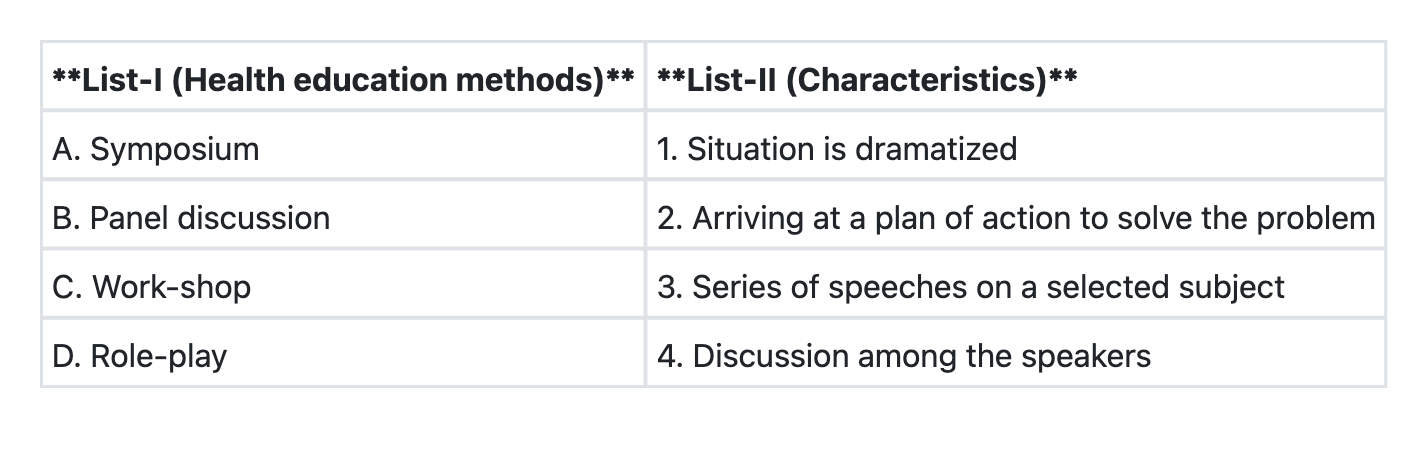
Match List-I with List-II and select the correct answer using the code given below the Lists:
Consider the following statements: Symposium is a method of health education characterised by 1. a series of speeches on a selected topic 2. presentation of different aspects of a topic by 3 or 4 experts. 3. a discussion among the symposium members 4. the chairperson making a comprehensive summary at the end of the session Which of these statements are correct?
All of the following are mass approaches towards education of general public EXCEPT:
In a basic Health Education model, the first step is Awareness, and the second step is Motivation. What is the third step?
All of the following are methods of health promotion except:
An example of a two-way discussion is:
Most persuasive and effective media system for communication is:
Best method for primary prevention of tuberculosis and leprosy
All the following are examples of health promotion except:
Explanation: ***Role play*** - **Role play** is an **interpersonal** or **group communication** technique where individuals act out scenarios to practice skills or understand different perspectives. - It is not a **mass media approach** as it involves direct, interactive participation with a limited number of people. *Posters* - **Posters** are visual aids designed to convey information to a large, undifferentiated audience in public spaces. - They are a classic example of **mass communication** due to their wide reach and static display. *Health exhibition* - A **health exhibition** is a public event designed to educate a large number of people about health topics through various displays, stalls, and interactive presentations. - Such exhibitions utilize a range of media to reach a broad audience, making them a **mass approach**. *Folk methods* - **Folk methods** in health communication include traditional storytelling, skits, and songs performed by local artists or groups in public settings. - These methods are used to disseminate health messages to a community or large gathering, leveraging cultural resonance for **mass appeal**.
Explanation: ***Correct Answer: A→3, B→4, C→2, D→1*** **Understanding Health Education Methods:** **A. Symposium → 3. Series of speeches** - A symposium is a formal meeting where multiple experts deliver **sequential speeches** on different aspects of a selected subject - Each speaker presents their perspective, typically without much interaction between speakers during the presentation **B. Panel Discussion → 4. Discussion among the speakers** - A panel involves **interactive discussion among panelists** (experts) on a particular topic - Characterized by dialogue and exchange of views between speakers, often followed by audience questions **C. Workshop → 2. Arriving at a plan of action** - A workshop is a **participatory, problem-solving session** designed to achieve practical outcomes - Participants actively engage in exercises and activities to develop concrete action plans or solutions **D. Role-play → 1. Dramatizing a situation** - Role-play involves **acting out scenarios** to experience different perspectives - Participants assume roles and dramatize situations to understand behaviors, emotions, and decision-making processes *Key Differentiation:* - Symposium = One-way presentations (speakers → audience) - Panel = Two-way discussion (speakers ↔ speakers) - Workshop = Participatory action planning - Role-play = Experiential learning through dramatization
Explanation: ***1, 2 and 4*** - A symposium is indeed characterized by a **series of speeches on a selected topic** (Statement 1) and the **presentation of different aspects of a topic by 3 or 4 experts** (Statement 2), providing a multifaceted view. - The chairperson typically plays a crucial role in concluding the session by **making a comprehensive summary** at the end (Statement 4), consolidating the diverse perspectives presented. *1, 3 and 4* - This option incorrectly includes "a discussion among the symposium members" (Statement 3) as a defining characteristic of a symposium. While discussion might occur after presentations, it's not the primary or required activity among the presenters themselves during the formal symposium structure. - A symposium primarily focuses on structured presentations from experts rather than an open discussion among them. *1, 2 and 3* - This option, like the first, incorrectly states that "a discussion among the symposium members" (Statement 3) is a core element of a symposium. - The format emphasizes individual expert presentations and a concluding summary over a direct discussion among the experts themselves. *2 and 3 only* - This option omits "a series of speeches on a selected topic" (Statement 1) and "the chairperson making a comprehensive summary at the end of the session" (Statement 4), both of which are fundamental characteristics of a symposium. - It also incorrectly includes Statement 3 ("discussion among symposium members"), which is not a defining feature of this format.
Explanation: ***Roleplaying*** - **Roleplaying** is a participatory **small-group** or individual educational technique where participants act out scenarios, focusing on interpersonal communication and behavioral change. - It is not a **mass approach** because it requires active engagement and interaction from a limited number of participants. *Internet* - The **Internet** allows for the dissemination of health information to a vast, global audience through websites, social media, and digital campaigns. - Many individuals can access and consume this information simultaneously, making it a **mass communication channel**. *Posters, Bill boards and signs* - These are static visual aids designed to be placed in public spaces, reaching a large and diverse audience without direct interaction. - They rely on **exposure** to convey messages to the **general public** en masse. *Direct mailing* - **Direct mailing** involves sending educational materials to a large number of households or individuals through postal services. - Though personalized, it is still a **mass approach** because it targets a broad population segment rather than individual interventions.
Explanation: ***Action*** - Following **awareness** and **motivation**, **action** is the crucial third step where individuals actively engage in the new behaviors or lifestyle changes. - This step involves the practical implementation of learned health information and the commitment to maintaining these changes over time. *Reflection* - **Reflection** typically occurs after an action has been taken, allowing individuals to review their experiences and learn from them. - It is not the immediate next step after motivation in the sequence of most health education models. *Dedication* - **Dedication** is a quality or characteristic often developed over time as an individual commits to a new behavior, rather than a distinct sequential step in health education models. - While important for sustaining change, it doesn't represent the primary third step in the progression from awareness to behavior change. *Contemplation* - **Contemplation** often precedes motivation, representing the stage where an individual is considering making a change but has not yet committed to it. - In models like the **Transtheoretical Model**, contemplation is an earlier stage than the actual "action" of behavior change.
Explanation: ***Immunization (Correct - This is the EXCEPTION)*** - Immunization is primarily a form of **specific protection** under primary prevention, NOT a health promotion strategy - While essential for **disease prevention**, it targets specific diseases rather than enabling broad lifestyle improvements - Health promotion focuses on **non-specific measures** that enable people to increase control over and improve their overall health *Behavioral changes (Incorrect - This IS health promotion)* - Promoting **positive behavioral changes** (e.g., increased physical activity, smoking cessation) is a **core component of health promotion** - These changes empower individuals to adopt healthier lifestyles and reduce disease risk through non-specific measures *Nutritional education (Incorrect - This IS health promotion)* - **Educating individuals** and communities about healthy eating habits is a **fundamental aspect of health promotion** - It helps prevent diet-related diseases and improves overall well-being through lifestyle modification *Health education (Incorrect - This IS health promotion)* - Providing accessible and understandable **health information** is a **key method of health promotion** - This knowledge empowers individuals to make informed decisions about their health and adopt healthier behaviors
Explanation: ***Group discussion*** - A **group discussion** involves multiple participants actively exchanging ideas and perspectives, representing a classic example of **two-way communication**. - Participants engage in speaking and listening, providing **feedback** and allowing for a dynamic exchange of thoughts. *A seminar* - A **seminar** is typically a more formal presentation where an expert delivers information to an audience with limited opportunity for extensive **two-way discussion**. - While questions may be asked, the primary flow of information is often **one-way**, from presenter to attendees. *Role playing* - **Role-playing** is an instructional technique where individuals act out specific roles or scenarios, focusing on **experiential learning** rather than open discussion. - While there is interaction between participants, the primary goal is often to practice skills or understand a perspective, not necessarily to have an unstructured **two-way debate** or idea exchange. *Symposium* - A **symposium** is a meeting or conference at which experts deliver papers on a particular subject, typically followed by a relatively brief **question-and-answer session**. - The format is largely **one-way**, with experts presenting information and the audience primarily receiving it.
Explanation: ***Interpersonal communication*** - This method involves **direct, face-to-face interaction**, allowing for immediate feedback, clarification, and rapport building, making it the **most persuasive and effective** communication method. - It enables **tailored messages** and addresses individual concerns, leading to better understanding and acceptance compared to other media. - Provides **two-way communication** with real-time feedback and the ability to observe non-verbal cues, enhancing persuasiveness. *Mass Media (TV, radio)* - While having a wide reach, mass media offers **limited opportunity for direct feedback** and personalization of messages. - Its effectiveness can be diluted by the sheer volume of information and the **passive reception** by the audience. *Printed media* - This medium allows for the **dissemination of detailed information** but lacks the interactive component necessary for highly persuasive communication. - Readers can easily **ignore or misinterpret information** without an immediate way to ask questions or seek clarification. *Folk media* - Folk media, such as plays, songs, and storytelling, can be culturally relevant and engaging, but their **reach is often localized and limited**. - Its persuasive power is typically within specific communities and may not be as universally effective as direct personal interaction for widespread impact.
Explanation: ***Health education*** - **Health education** empowers individuals through knowledge about disease prevention, effective hygiene practices, and the significance of early detection and treatment for both **tuberculosis** and **leprosy**. - By promoting **awareness** and understanding of risk factors, transmission routes, and common symptoms, health education reduces disease incidence and improves overall public health outcomes. *Chemotherapy* - **Chemotherapy** primarily involves using specific drugs to treat existing infections, making it a **secondary prevention** strategy rather than primary. - While **prophylactic chemotherapy** (e.g., isoniazid for latent TB) can prevent active disease in high-risk individuals, it is not the most encompassing primary prevention method, which focuses on preventing initial exposure or infection. *Early diagnosis and treatment* - **Early diagnosis and treatment** are critical components of **secondary prevention**, aiming to cure the disease and prevent further transmission once an individual is already infected. - These actions reduce the duration of infectivity and morbidity but do not prevent the initial occurrence of the disease. *Isolation* - **Isolation** is a measure used to prevent the spread of an existing infectious disease from an infected individual to others, thus falling under **secondary prevention**. - It does not prevent the initial infection but rather limits further transmission in already infected cases.
Explanation: ***Chemoprophylaxis*** - **Chemoprophylaxis** involves the use of drugs to prevent the development of an infection or disease. This falls under **specific protection** in disease prevention, not broad health promotion. - While it aims to prevent illness, it is a targeted medical intervention rather than a general strategy for improving health and well-being. *Decreased salt intake* - This is an example of **health promotion** through lifestyle modification, aiming to improve cardiovascular health and prevent hypertension. - It encourages healthier dietary habits to maintain and improve overall well-being. *Installation of sanitary latrine* - This is a measure that falls under **environmental sanitation**, which is a key component of **health promotion** by improving public health infrastructure. - It prevents the spread of infectious diseases by ensuring safe disposal of human waste. *Stop smoking* - This is a significant example of **health promotion** as it involves eliminating a major risk factor for numerous chronic diseases like cancer, heart disease, and respiratory illnesses. - It aims to improve overall health and extend longevity through behavioral change.
Principles of Health Education
Practice Questions
Communication Theories
Practice Questions
Methods of Health Education
Practice Questions
Planning Health Education Programs
Practice Questions
Audio-Visual Aids
Practice Questions
Mass Media in Health Communication
Practice Questions
Information, Education, and Communication (IEC)
Practice Questions
Behavior Change Communication (BCC)
Practice Questions
Social Media in Health Education
Practice Questions
Evaluation of Health Education Programs
Practice Questions
Health Literacy
Practice Questions
Risk Communication
Practice Questions
Get full access to all questions, explanations, and performance tracking.
Start For Free