Low air velocity will be measured by
Blackfoot disease is seen in which of the following?
All the following tests are related to pasteurization of milk except
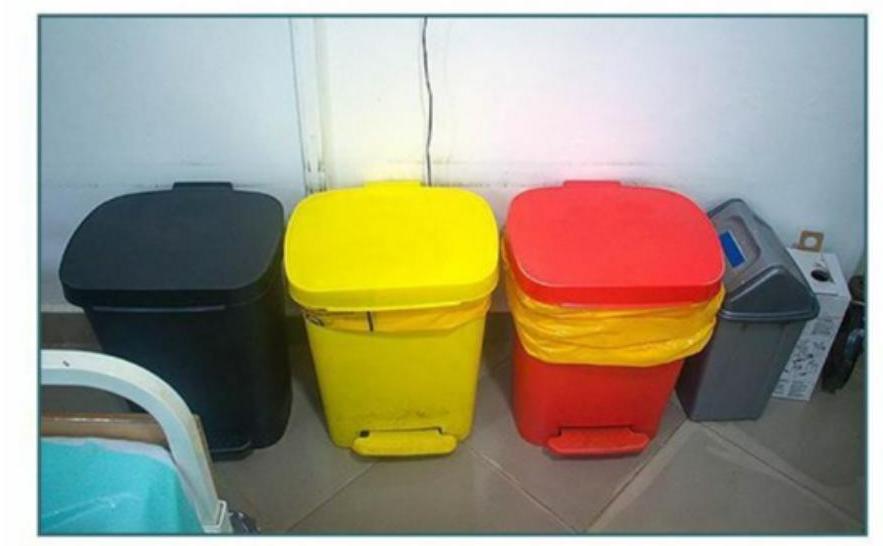
A nurse keeps the bins as shown in the image in the hospital ward. Which of the following items would go into the black bin?
Which of the following is a method for on-site disposal of domestic wastewater?
Contaminated tubing and catheters will be disposed in which bag according to biomedical waste management?
The recommended upper limit for free residual chlorine in drinking water according to WHO guidelines is:
What is the permissible exposure limit of carbon monoxide in the air?
Which of the following Biomedical wastes cannot be disposed of in yellow bags?
All of the following are the criteria for overcrowding except:-
Explanation: ***Kata thermometer*** - A **Kata thermometer** is specifically designed to measure **low air velocities** by assessing the cooling power of the air. - It measures the rate of heat loss from a heated bulb, which is influenced by air movement, providing an indirect measure of low air speed. *Beckmans thermometer* - A **Beckmann thermometer** is used for precise measurement of **small temperature differences** and changes, not air velocity. - It has a large range of mercury in its reservoir and can be adjusted to different starting temperatures, making it unsuitable for air flow. *Globe thermometer* - A **globe thermometer** primarily measures **radiant heat** in an environment. - It consists of a thermometer bulb inside a black sphere, used to assess the mean radiant temperature and effective temperature, not air velocity. *Wet thermometer* - A **wet-bulb thermometer** is part of a psychrometer used to measure **humidity**. - It measures the temperature of evaporation and is used to determine the **dew point** and **relative humidity**, not air velocity.
Explanation: ***Arsenic*** - Chronic arsenic exposure can lead to **Blackfoot disease**, a severe peripheral vascular disease causing **gangrene** and limb loss, particularly affecting the lower extremities. - This condition is characterized by **dark pigmentation** and ischemic changes in the affected limbs due to vascular compromise. *Mercury* - Mercury poisoning (e.g., **Minamata disease**) primarily affects the **nervous system** and kidneys, causing symptoms like tremor, neuropsychiatric disturbances, and renal dysfunction. - It does not typically cause **Blackfoot disease** or similar peripheral ischemic conditions. *Copper* - Copper toxicity can lead to **liver damage** (e.g., in Wilson's disease), neurological symptoms, and gastrointestinal issues. - Excessive copper does not cause **Blackfoot disease**. *Cadmium* - Cadmium toxicity primarily targets the **kidneys** (leading to renal tubular dysfunction), bones (**osteomalacia** as seen in Itai-itai disease), and lungs. - It is not associated with **Blackfoot disease**.
Explanation: ***Iodine test*** - The **iodine test** is used to detect the presence of **starch**, which is not directly related to the pasteurization process or the quality of milk after pasteurization. - This test is more commonly seen in laboratory settings to detect starch hydrolysis or in food science for specific ingredients, not for routine milk quality assurance post-pasteurization. *Standard plate count* - The **Standard Plate Count (SPC)** measures the number of **viable microorganisms** in a milk sample. - A reduction in SPC after pasteurization indicates the effectiveness of the heat treatment in killing bacteria. *Phosphatase test* - The **phosphatase test** is a crucial indicator for the **adequacy of pasteurization**, as alkaline phosphatase is destroyed at temperatures and times similar to those required to kill common pathogens. - If phosphatase activity is detected after pasteurization, it suggests that the milk was either **insufficiently heated** or has been mixed with raw milk. *Methylene blue reduction test* - The **methylene blue reduction test** (MBRT) assesses the microbial quality of milk by measuring the time it takes for bacteria to **decolorize methylene blue**. - A longer reduction time indicates a **lower bacterial count** and better keeping quality, thus indirectly related to the effectiveness of pasteurization.
Explanation: ***Glove paper cover*** - The black bin is typically designated for **general waste** that is neither infectious nor sharp. - A glove paper cover is considered **non-hazardous**, non-recyclable waste and would be appropriately disposed of in a black bin. *Gloves* - **Used gloves**, even if not obviously contaminated with bodily fluids, are considered potentially infectious waste and should not be placed in the black bin. - These should generally be disposed of in a **yellow bag or bin** (infectious waste) to prevent cross-contamination. *Soiled linen bedsheet* - A soiled linen bedsheet is considered **infectious waste**, as it may contain bodily fluids or pathogens. - This type of waste requires specific handling and disposal, usually in **red bags or bins**, not general waste. *Contaminated gloves* - **Contaminated gloves** are classified as infectious waste and must be disposed of in designated containers for biohazard materials. - Placing them in a black bin would pose a **risk of infection** to waste handlers and is against standard medical waste disposal protocols.
Explanation: ***Soakage pit*** - A **soakage pit**, also known as a **seepage pit** or **leach pit**, is an underground chamber that allows treated effluent from a septic tank to seep into the surrounding soil. - It is a common and effective on-site method for the **disposal of domestic wastewater**, particularly in rural or unsewered areas. *Activated sludge process* - The **activated sludge process** is a centralized biological wastewater treatment method used in municipal wastewater treatment plants, not typically for on-site domestic disposal. - It involves aerating wastewater in a tank with suspended microorganisms to consume organic pollutants. *Oxidation pond* - An **oxidation pond**, or **stabilization pond**, is a large, shallow basin where wastewater is treated through natural biological and physical processes. - While it treats wastewater, it is typically a **larger-scale** treatment method for communities or industries, rather than a standalone on-site disposal method for individual domestic units. *All of the options* - This option is incorrect because both the activated sludge process and oxidation ponds are generally larger-scale or centralized treatment methods, not practical for individual on-site domestic disposal. - Only the soakage pit is well-suited for **on-site domestic wastewater disposal**.
Explanation: ***Red Container*** - The **red bag** is designated for **contaminated recyclable waste** including tubing, catheters, intravenous sets, and soiled plastic items. - This waste is highly infectious and undergoes **autoclaving** or **microwaving** to disinfect it before recycling. *Yellow Container* - The **yellow bag** is used for **highly infectious waste** such as human anatomical waste, medical dressings, and microbiological waste. - This waste is typically **incinerated** or undergoes deep burial. *Blue Container* - The **blue/white puncture-proof container** is used for **sharp objects** like needles, syringes with fixed needles, and scalpel blades. - This waste is often **autoclaved** and then shredded or vitrified to prevent reuse and injury. *White Container* - In some biomedical waste management systems, a **white translucent container** is used for **glassware** that is contaminated with blood or body fluids, such as broken glass ampoules or vials. - The specific color codes can vary slightly between regions, but the red bag is consistently for contaminated plastic/tubing.
Explanation: ***0.5 mg/L*** - The World Health Organization (WHO) recommends maintaining a free residual chlorine level of **0.2-0.5 mg/L** at the point of delivery, with **0.5 mg/L representing the upper end of this recommended range**. - This level provides adequate disinfection throughout the distribution system while minimizing taste and odor complaints. - WHO states there is no health-based upper limit for chlorine, as concentrations used for disinfection are well below levels of health concern, but 0.5 mg/L is commonly cited as the practical upper target for operational purposes. *0.4 mg/L* - While this falls within the acceptable range (0.2-0.5 mg/L), it is not the upper end of the WHO recommended range. - This level provides good disinfection but is not the maximum recommended operational target. *0.2 mg/L* - A free residual chlorine level of **0.2 mg/L** represents the **minimum recommended concentration** at the point of delivery to ensure adequate disinfection. - This is the lower end of the WHO recommended range, not the upper limit. *0.3 mg/L* - This concentration falls in the middle of the WHO recommended range (0.2-0.5 mg/L). - While adequate for disinfection, it is neither the minimum nor the maximum recommended operational level.
Explanation: ***0.005%*** - The permissible exposure limit (PEL) for **carbon monoxide (CO)** according to **OSHA standards** is **0.005%**, or **50 parts per million (ppm)**. - This is the maximum concentration allowed for an **8-hour time-weighted average (TWA)** exposure in occupational settings. - Exposure at or below this level is generally considered safe without significant adverse health effects. *0.01%* - A concentration of 0.01% **carbon monoxide** (100 ppm) **exceeds the permissible exposure limit** of 50 ppm. - While not immediately dangerous, prolonged exposure at this level can cause **mild symptoms** such as headache and reduced cognitive function. - This level approaches the threshold for causing measurable health effects. *0.02%* - An environment with 0.02% **carbon monoxide** (200 ppm) significantly exceeds the **permissible exposure limit**. - Exposure to this concentration can lead to symptoms like **headache**, **dizziness**, **nausea**, and **fatigue** within 2-3 hours. - This level is considered the **ceiling limit** by some standards and should not be exceeded at any time. *0.20%* - A concentration of 0.20% **carbon monoxide** (2000 ppm) is **immediately dangerous to life and health (IDLH)**. - Exposure at this level can cause **unconsciousness**, **collapse**, **coma**, and **death** within minutes to hours. - This represents a level that poses an immediate threat requiring evacuation and emergency intervention.
Explanation: ***PVC*** - **Polyvinyl chloride (PVC)** is a chlorinated plastic commonly found in medical devices such as IV bags, tubing, and catheters. - PVC waste is disposed in **RED bags** (for contaminated recyclable waste), NOT yellow bags, as per Bio-Medical Waste Management Rules, 2016. - This segregation prevents toxic dioxin emissions during incineration and allows for proper recycling of chlorinated plastics. *Reactive chemical wastes* - **Reactive chemical wastes** are disposed in **YELLOW bags**. - These include discarded chemicals, chemical reagents, and other hazardous chemical wastes that require incineration or chemical treatment. *Expired medicines* - **Expired or discarded medicines** are disposed in **YELLOW bags**. - This includes cytotoxic drugs, pharmaceutical waste, and expired medications that require incineration. *Human anatomical wastes* - **Human anatomical wastes** (body parts, organs, tissues) are disposed in **YELLOW bags**. - These are typically incinerated or deeply buried as per regulations.
Explanation: ***Correct Option A: Per capita space of ≥90 ft²/person*** - This is **NOT a criterion for overcrowding** because having **90 sq ft or more per person** represents **adequate space**. - Overcrowding is defined when per capita space is **less than 70-90 sq ft per person**, not when it meets or exceeds this threshold. - Adequate space allocation indicates proper housing conditions without overcrowding. *Incorrect Option B: If >1 persons/room* - This **IS a criterion for overcrowding** as having more than one person per room indicates **inadequate room availability**. - It is a standard indicator used to assess housing density and overcrowding conditions. *Incorrect Option C: If sex separation is absent* - The absence of **sex separation IS a criterion for overcrowding**, particularly regarding privacy and appropriate living arrangements. - It indicates insufficient rooms or poor spatial planning, contributing to overcrowded conditions. *Incorrect Option D: 2 people of opposite sex >9 years & not husband and wife sleeping in 1 room* - This **IS a specific criterion for overcrowding** that addresses privacy violations and inappropriate sleeping arrangements. - It represents inadequate space allocation and is used to identify overcrowded housing conditions in Indian housing surveys.
Water Quality and Health
Practice Questions
Air Pollution and Health Effects
Practice Questions
Solid Waste Management
Practice Questions
Hazardous Waste Management
Practice Questions
Housing and Health
Practice Questions
Noise Pollution
Practice Questions
Radiation Health Effects
Practice Questions
Climate Change and Health
Practice Questions
Environmental Impact Assessment
Practice Questions
Disaster Management and Preparedness
Practice Questions
Vector Control
Practice Questions
Environmental Legislation
Practice Questions
Get full access to all questions, explanations, and performance tracking.
Start For Free