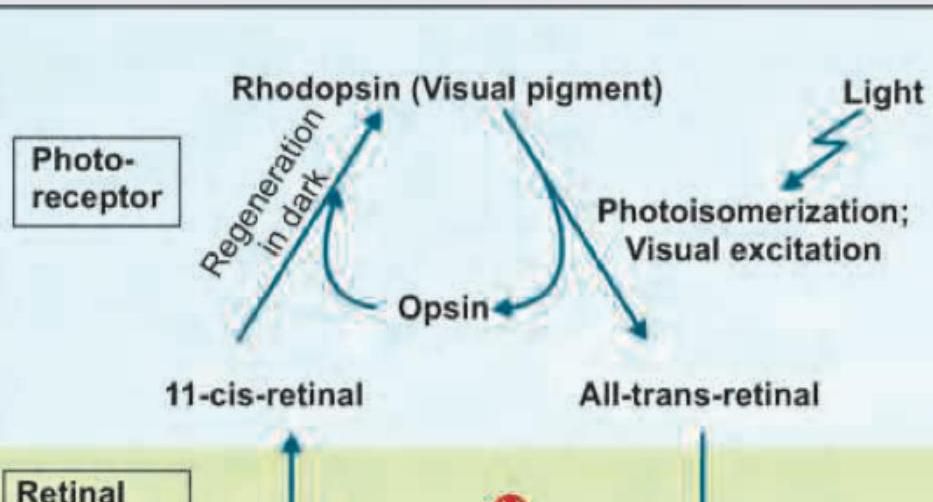
During the dark phase of visual cycle, which form of vitamin A combines with opsin to make Rhodopsin:
Thiamine deficiency is best diagnosed by?
At what age does a child typically know their full name?
Pseudo tumor cerebri is caused by?
Vitamin A is stored in
A child of 8 kg has Bitot's spots in both eyes. Which of the following is the most appropriate schedule to prescribe vitamin A to this child?
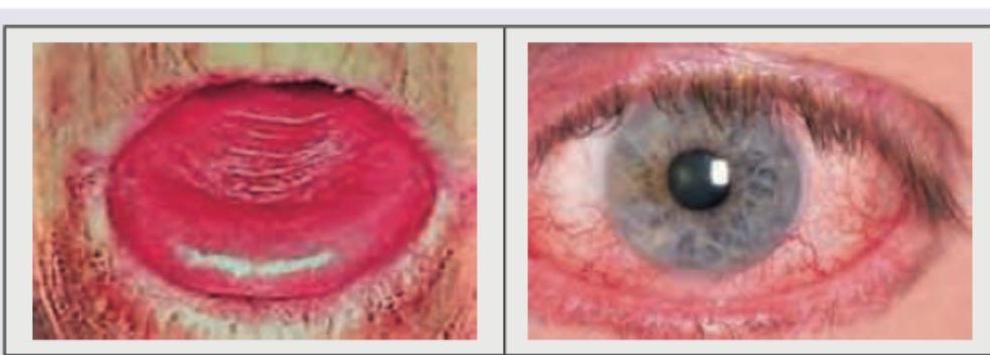
A patient complained of gradual diminution of vision. On examination, the patient had dry eyes and a rough corneal surface. What deficiency is most likely causing these manifestations?
Match the following: A) Caplan syndrome- 1) Found first in coal worker B) Asbestosis- 2) Upper lobe predominance C) Mesothelioma- 3) Involves lower lobe D) Sarcoidosis- 4) Pleural effusion is seen
Name the enzyme involved in this cycle:
All of the following are water-soluble antioxidants except?
Explanation: ***11-cis-Retinaldehyde*** - In the **dark phase** of the visual cycle, **11-cis-retinaldehyde** (retinal) is regenerated and combines with **opsin** to form **rhodopsin**. - This molecule is crucial for initiating the visual transduction pathway in **rod cells** when light is detected. *11-cis-Retinol* - **11-cis-Retinol** is an intermediate in the regeneration of 11-cis-retinaldehyde from all-trans-retinol, but it does not directly bind to opsin to form rhodopsin. - It is converted to 11-cis-retinaldehyde by the enzyme **11-cis-retinol dehydrogenase**. *all trans-Retinol* - **All-trans-retinol** is the form of vitamin A transported to the eye and is also an intermediate in the visual cycle, but it does not combine directly with opsin. - It is converted to all-trans-retinaldehyde after the absorption of light and then subsequently isomerized to 11-cis-retinol. *All trans-Retinaldehyde* - **All-trans-retinaldehyde** is formed when **rhodopsin** absorbs light, causing the isomerization of 11-cis-retinaldehyde. - This molecule is then released from opsin and subsequently reduced to all-trans-retinol before being recycled back to 11-cis-retinaldehyde in the pigment epithelium.
Explanation: ***Transketolase activity in blood*** - **Transketolase** is a thiamine pyrophosphate (TPP)-dependent enzyme, and its activity in red blood cells is considered the **gold standard** for assessing thiamine status. - A **decrease in transketolase activity** that improves after the addition of TPP in vitro (TPP effect) is highly indicative of thiamine deficiency. *Blood thiamine level* - While a direct measure, **blood thiamine levels** can be influenced by recent dietary intake and may not accurately reflect the body's overall thiamine stores or functional deficiency. - Furthermore, measuring total blood thiamine doesn't always correlate well with the **functional status** of thiamine-dependent enzymes. *Aldolase activity in blood* - **Aldolase** is an enzyme involved in glycolysis, but its activity is **not dependent on thiamine**. - Therefore, measuring aldolase activity provides no information regarding thiamine status. *Urinary thiamine level* - **Urinary thiamine levels** primarily reflect recent thiamine intake and renal excretion rather than the body's total thiamine stores or a functional deficiency. - Low urinary thiamine can suggest deficiency, but it's **less reliable** than functional assays.
Explanation: ***36 months*** - By **36 months old** (3 years), most children can clearly state their **full name** (first and last name) when asked. - This milestone indicates developing **self-awareness** and **language skills**. - This is a standard developmental milestone tested in CDC and AAP guidelines. *15 months* - At **15 months**, children typically know their **first name** and respond to it, but cannot state their full name. - Their language at this age often includes only a few single words with primarily receptive understanding. *24 months* - By **24 months** (2 years), children often use two-to-four-word sentences and can identify familiar objects and people. - While they know their first name and may start recognizing it, they usually cannot articulate their full name yet. *48 months* - At **48 months** (4 years), a child's language skills are much more advanced, and they can typically tell stories and engage in complex conversations. - Knowing their full name is an expected milestone that should have been achieved earlier, typically by 36 months.
Explanation: ***Vitamin A excess*** - **Hypervitaminosis A**, or excess vitamin A, is a known cause of **pseudotumor cerebri** (also called **idiopathic intracranial hypertension**). - This condition involves increased **intracranial pressure**, often without an obvious structural cause. *Vitamin B1 excess* - Excess intake of **vitamin B1 (thiamine)** is generally considered benign and is not known to cause pseudotumor cerebri. - Thiamine is a **water-soluble vitamin**, and excess amounts are typically excreted in urine. *Vitamin D excess* - **Vitamin D toxicity** primarily leads to **hypercalcemia**, which can cause kidney stones, bone pain, and gastrointestinal symptoms. - While it can have neurological effects due to hypercalcemia, it typically does not directly cause pseudotumor cerebri. *Vitamin E excess* - **Vitamin E excess** can interfere with **blood clotting** and may increase the risk of bleeding, especially in individuals taking anticoagulants. - There is no established link between hypervitaminosis E and the development of pseudotumor cerebri.
Explanation: ***Cells of Ito*** - **Ito cells**, also known as **hepatic stellate cells**, are the primary storage site for **vitamin A** in the body, specifically in lipid droplets within their cytoplasm. - These cells play a crucial role in vitamin A homeostasis and are located in the **perisinusoidal space** (space of Disse) of the liver. *Hepatocyte* - **Hepatocytes** are the main functional cells of the liver and are involved in many metabolic processes, but their primary role is not **vitamin A storage**. - While they metabolize and process vitamin A, the bulk of its storage occurs in the adjacent Ito cells. *Endothelial cell* - **Endothelial cells** line the vascular system, including the hepatic sinusoids, and are involved in nutrient and waste exchange, but not in significant **vitamin A storage**. - Their primary function is to regulate vascular tone and permeability. *Kupffer cell* - **Kupffer cells** are specialized **macrophages** found in the liver, acting as antigen-presenting cells and clearing pathogens and debris. - They are involved in immune surveillance and not in the long-term storage of **vitamin A**.
Explanation: ***2 lakh units orally on day 0, 1, 14*** - For a child weighing **8 kg** with **Bitot's spots (WHO classification X1B)**, the therapeutic dose is **200,000 IU** (2 lakh units) of vitamin A. - The standard WHO/IAP schedule for treating **vitamin A deficiency with ocular signs** is administration on **Day 0, Day 1, and Day 14** to rapidly replete stores and prevent progression. - The **oral route** is preferred for **Bitot's spots without corneal ulceration**, as it is effective, safe, and well-tolerated. - **IM route** is reserved for severe xerophthalmia (X2/X3 with corneal ulceration), persistent vomiting, or inability to take oral medications. *2 lakh units orally on day 0, 14* - Although the individual dose of **200,000 IU** is correct for this 8 kg child with **Bitot's spots**, this schedule misses the critical **Day 1 dose**. - The missing dose on Day 1 delays rapid **vitamin A replenishment**, which is crucial for preventing progression of **ocular damage** and achieving adequate tissue stores. *1 lakh units orally on day 0, 14* - This dose of **100,000 IU** is inadequate for a child weighing **8 kg or more** with clinical **vitamin A deficiency**. - WHO guidelines recommend **100,000 IU for children <8 kg** and **200,000 IU for children ≥8 kg**, making this dosage insufficient. - Additionally, the schedule is incomplete as it misses the **Day 1 dose**. *1 lakh units orally on day 0, 1, 14* - While the schedule of Day 0, Day 1, and Day 14 is appropriate, the **dose of 100,000 IU is inadequate** for a child weighing **8 kg**. - This lower dose may not provide sufficient **vitamin A replenishment** to reverse **Bitot's spots** and prevent progression to more severe xerophthalmia.
Explanation: ***Vitamin A*** - **Vitamin A deficiency** is a common cause of **xerophthalmia**, characterized by **dry eyes** (**xerosis conjunctivae**) and roughening of the **cornea** due to impaired mucin production [1]. In vitamin A deficiency, mucus-secreting cells are replaced by keratin-producing cells [2]. - Progression of ocular epithelial keratinization can lead to **Bitot's spots**, corneal ulceration, and ultimately **blindness** [1], [2]. *Iron* - **Iron deficiency** primarily leads to **iron-deficiency anemia**, causing fatigue, pallor, and weakness, but not directly ocular manifestations like dry eyes or rough cornea. - While severe anemia can cause some visual disturbances, it does not typically present with the specific **xerophthalmic** changes seen here. *Protein* - **Protein deficiency** can lead to conditions like **kwashiorkor** (edema, muscle wasting) or **marasmus** (severe wasting), which broadly impair health and immunity. - However, it does not directly cause the specific ocular signs of **dryness** and **corneal roughening** as a primary deficiency, though it can exacerbate other nutritional deficiencies. *Niacin* - **Niacin (Vitamin B3) deficiency** causes **pellagra**, characterized by the "3 Ds": **dermatitis**, **diarrhea**, and **dementia**. - Ocular symptoms are not a common or primary feature of niacin deficiency; it does not cause **dry eyes** or **corneal roughening**.
Explanation: **A-1, B-4, C-3, D-2** - **Caplan syndrome** was first described in **coal workers** with **rheumatoid arthritis** and progressive massive fibrosis. - **Asbestosis** is often associated with **pleural effusion**, which can be benign or malignant. - **Mesothelioma** typically involves the **lower lobes** of the lungs, specifically the pleura, and is strongly linked to asbestos exposure. - **Sarcoidosis** is characterized by **non-caseating granulomas**, which have a predilection for the **upper lobes** of the lungs. *A-3, B-4, C-2, D-1* - This option incorrectly states that Caplan syndrome involves the lower lobe; **Caplan syndrome** is defined by the presence of large nodules in the lungs of coal workers with rheumatoid arthritis, and their specific lobar distribution is not a defining characteristic. - This option incorrectly states that Mesothelioma has an upper lobe predominance; **Mesothelioma** is a pleural malignancy and typically involves the **lower lobes**, extending along the pleura. *A-4, B-2, C-3, D-1* - This option incorrectly associates Caplan syndrome with pleural effusion; **Caplan syndrome** manifests as rheumatoid nodules in the lungs, not primarily pleural effusion. - This option incorrectly states that Asbestosis has an upper lobe predominance; **Asbestosis** predominantly affects the **lower lobes** of the lungs, causing interstitial fibrosis. *A-2, B-4, C-3, D-1* - This option incorrectly states that Caplan syndrome has an upper lobe predominance; the defining feature of **Caplan syndrome** is the combination of rheumatoid arthritis and pneumoconiosis, not specific lobar involvement. - This option correctly identifies pleural effusion with asbestosis and lower lobe involvement with mesothelioma, but **Caplan syndrome** is not characterized by upper lobe predominance.
Explanation: ***Retinal isomerase*** - This enzyme is crucial for the regeneration of **11-cis-retinal** from **all-trans-retinal** in the visual cycle. - It catalyzes the **isomerization** process, which is essential for rhodopsin to be reformed and ready to detect light again. *Retinol isomerase* - This term is a misnomer; the substrate that undergoes isomerization is retinal, not retinol. - While **retinol** is a precursor to retinal, it doesn't directly undergo the isomerization step that is vital for the visual cycle. *Transducin* - **Transducin** is a **G-protein** involved in signal transduction after light activates rhodopsin. - It binds to activated rhodopsin, triggering a cascade that ultimately leads to changes in membrane potential, but it is not an isomerase enzyme. *Gustducin* - **Gustducin** is a **G-protein** primarily involved in the **sensation of taste**, specifically bitter and sweet tastes. - It plays no role in the visual cycle or the isomerization of retinal.
Explanation: ***Carotenes*** - **Carotenes** are **lipid-soluble** antioxidants that are typically found in cell membranes and lipid components of the body. - They protect against **lipid peroxidation**, which is damage to cellular membranes caused by free radicals. *Ascorbate* - **Ascorbate** (Vitamin C) is a well-known **water-soluble** antioxidant that readily donates electrons to neutralize free radicals in aqueous environments. - It plays a crucial role in regenerating other antioxidants, such as **alpha-tocopherol (Vitamin E)**. *Uric acid* - **Uric acid** is a potent **water-soluble** antioxidant present in high concentrations in the plasma. - It scavenges various reactive oxygen species and reactive nitrogen species, especially in the **extracellular fluid**. *Polyphenols* - **Polyphenols** are a large group of **water-soluble** compounds found in plants that act as antioxidants. - They reduce oxidative stress by **scavenging free radicals**, chelating metal ions, and inhibiting enzymes involved in radical generation.
Get full access to all questions, explanations, and performance tracking.
Start For Free