Vitamin A deficiency causes all of the following EXCEPT?
Vitamin E toxicity is associated with which of the following clinical manifestations?
Which of the following is a non-vitamin coenzyme?
Vitamin K is used in which step of clotting factor activation?
Which of the following is NOT true about Vitamin C?
A patient presents with serum calcium of 7.8 mg/dL, high 25-hydroxyvitamin D levels, and low 1-alpha-hydroxylase levels. Which of the following is the most appropriate treatment for this condition?
The carboxylation reaction of carbon dioxide requires which of the following?
Which of the following are fat-soluble vitamins?
Which of the following statements about thiamine is true?
What is the recommended dietary allowance of vitamin A for adults?
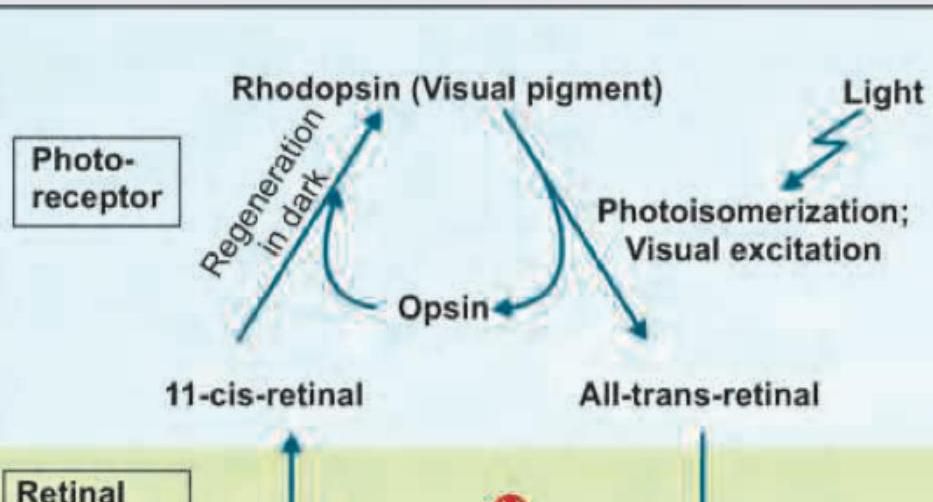
Explanation: **Explanation** The correct answer is **D (Loss of weight, irritability, loss of hair, and joint pains)** because these symptoms are characteristic of **Hypervitaminosis A (Vitamin A Toxicity)**, not deficiency. In NEET-PG, it is crucial to distinguish between the clinical features of deficiency and toxicity. **Why Option D is the correct answer (Toxicity):** Chronic ingestion of excessive Vitamin A (usually >10 times the RDA) leads to toxicity. Key features include: * **Skin/Hair:** Alopecia (loss of hair) and dry, scaly skin. * **Skeletal:** Bone pain and joint pains due to cortical thickening of long bones. * **Neurological:** Irritability and increased intracranial pressure (Pseudotumor cerebri). **Why other options are incorrect (Deficiency features):** * **Option A (Growth retardation):** Vitamin A (Retinoic acid) acts like a hormone, regulating gene expression for osteoblast and osteoclast activity. Deficiency leads to impaired skeletal remodeling and stunted growth. * **Option B (Sterility):** Retinol is essential for maintaining the health of the germinal epithelium. Its absence leads to the degeneration of seminiferous tubules and failure of spermatogenesis. * **Option C (Nyctalopia):** This is the earliest symptom of Vitamin A deficiency. It occurs due to the failure to regenerate **Rhodopsin** (visual purple) in the rod cells of the retina, leading to night blindness. **High-Yield Clinical Pearls for NEET-PG:** * **Earliest Symptom:** Nyctalopia (Night blindness). * **Earliest Sign:** Conjunctival Xerosis. * **Pathognomonic Sign:** Bitot’s spots (triangular, foamy patches on the conjunctiva). * **Keratomalacia:** Liquefactive necrosis of the cornea; a medical emergency. * **Teratogenicity:** Isotretinoin (Vitamin A analogue) is highly teratogenic; a negative pregnancy test is mandatory before prescription.
Explanation: **Explanation:** Vitamin E (Tocopherol) is a potent lipid-soluble antioxidant that protects cell membranes from oxidative damage. While it is generally considered the least toxic of the fat-soluble vitamins, high-dose supplementation can lead to adverse effects. **Why Ataxia is the Correct Answer:** Vitamin E toxicity primarily interferes with the absorption and metabolism of other fat-soluble vitamins, particularly Vitamin K. However, in the context of high-dose toxicity, it can manifest with neurological symptoms. **Ataxia** (impaired coordination) is a recognized clinical manifestation of Vitamin E toxicity. This occurs because excessive Vitamin E can disrupt the normal redox balance in neuronal membranes and interfere with the function of other fat-soluble nutrients, leading to cerebellar dysfunction. **Analysis of Incorrect Options:** * **A & C (Peripheral neuritis and Loss of vibration sense):** These are classic features of Vitamin E **deficiency**, not toxicity. Deficiency leads to posterior column dysfunction and peripheral nerve degeneration (similar to Friedreich’s ataxia). * **D (Exfoliative dermatitis):** This is more commonly associated with Vitamin A toxicity (hypervitaminosis A) or certain drug reactions, rather than Vitamin E. **High-Yield Clinical Pearls for NEET-PG:** * **The "K" Connection:** The most clinically significant risk of Vitamin E toxicity is the **antagonism of Vitamin K**, leading to an increased risk of hemorrhage (prolonged Prothrombin Time). * **Deficiency Mimicry:** Vitamin E deficiency presents almost identically to **Friedreich’s Ataxia** (ataxia, loss of vibration/proprioception, and absent deep tendon reflexes). * **Target Organs:** Toxicity primarily affects the coagulation cascade and the central nervous system (cerebellum). * **Premature Infants:** They are at high risk for deficiency, leading to **hemolytic anemia** due to fragile RBC membranes.
Explanation: **Explanation:** The correct answer is **Lipoic acid** (Option C). **Understanding the Concept:** Coenzymes are non-protein organic molecules required by enzymes for catalytic activity. Most coenzymes are derivatives of water-soluble B-complex vitamins. However, **non-vitamin coenzymes** are substances that function as coenzymes but can be synthesized de novo by the human body in sufficient quantities, meaning they do not meet the strict dietary definition of a "vitamin." **Lipoic acid** (Thioctic acid) is a sulfur-containing fatty acid that acts as a coenzyme for oxidative decarboxylation reactions (e.g., Pyruvate Dehydrogenase and α-Ketoglutarate Dehydrogenase complexes). Since the body can synthesize it from octanoic acid and cysteine, it is classified as a non-vitamin coenzyme. **Analysis of Other Options:** * **A. Niacin:** This is Vitamin B3. It is the precursor for the coenzymes **NAD+ and NADP+**. * **B. Coenzyme A:** This is the active coenzyme form of **Pantothenic acid** (Vitamin B5). * **D. SAM (S-Adenosylmethionine):** While SAM is also a non-vitamin coenzyme (derived from ATP and Methionine), **Lipoic acid** is the more classic textbook example cited in NEET-PG for this category, specifically regarding its role in multi-enzyme complexes. *Note: In some contexts, SAM is considered a co-substrate/methyl donor.* **Clinical Pearls for NEET-PG:** 1. **The "Big Five":** Oxidative decarboxylation of α-keto acids requires five cofactors: **T**hiamine (B1), **R**iboflavin (B2), **N**iacin (B3), **P**antothenic acid (B5), and **L**ipoic acid (Mnemonic: **T**ender **R**omance **N**ever **P**recedes **L**ove). 2. **Arsenic Poisoning:** Arsenite inhibits enzymes by binding to the -SH groups of **Lipoic acid**, leading to lactic acidosis and neurological symptoms. 3. Other non-vitamin coenzymes include **ATP, Coenzyme Q (Ubiquinone), and Heme.**
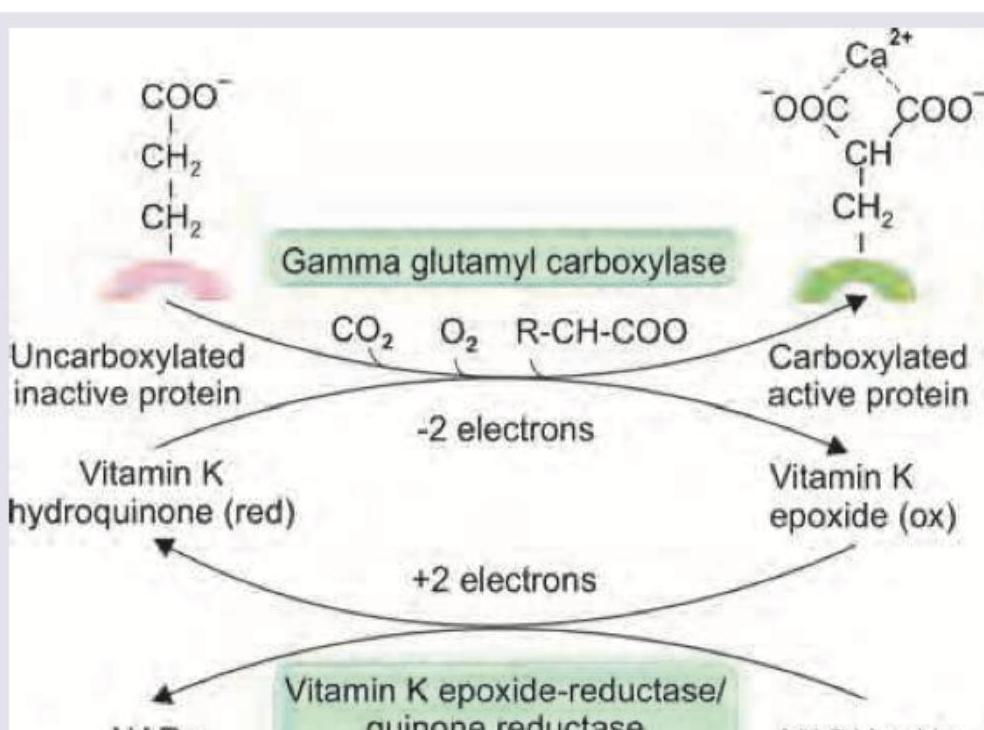
Explanation: ### Explanation **Correct Answer: B. Carboxylation** Vitamin K acts as an essential cofactor for the enzyme **gamma-glutamyl carboxylase**. This enzyme catalyzes the **post-translational modification** of specific glutamic acid residues into **gamma-carboxyglutamic acid (Gla)** on clotting factors **II, VII, IX, and X**, as well as proteins C and S. The addition of a carboxyl group ($CO_2$) gives these proteins a negative charge, allowing them to bind to positively charged **Calcium ions ($Ca^{2+}$)**. This calcium bridge enables the clotting factors to anchor onto the phospholipid surfaces of activated platelets, a critical step in the coagulation cascade. During this reaction, Vitamin K is oxidized to an epoxide form and must be recycled back to its active hydroquinone form by the enzyme **Vitamin K Epoxide Reductase (VKOR)**. **Why other options are incorrect:** * **A. Methylation:** This process involves the addition of a methyl group (e.g., conversion of homocysteine to methionine), typically requiring Vitamin B12 and Folate. * **C. Hydroxylation:** This is characteristic of **Vitamin C**, which is a cofactor for prolyl and lysyl hydroxylase in collagen synthesis. * **D. Transketolation:** This is a part of the Hexose Monophosphate (HMP) shunt, requiring **Thiamine (Vitamin B1)** as a cofactor. **High-Yield Clinical Pearls for NEET-PG:** * **Warfarin Mechanism:** Inhibits VKOR, preventing the recycling of Vitamin K and thus inhibiting the carboxylation of factors II, VII, IX, and X. * **Newborns:** They are Vitamin K deficient due to sterile guts and poor placental transfer; hence, a prophylactic Vitamin K injection is given at birth to prevent **Hemorrhagic Disease of the Newborn**. * **Lab Marker:** Vitamin K deficiency or Warfarin use is primarily monitored using **Prothrombin Time (PT/INR)**.
Explanation: **Explanation:** **1. Why Option D is the Correct Answer (The Incorrect Statement):** Vitamin C (Ascorbic acid) is a powerful reducing agent. In the process of iron absorption, it **reduces ferric iron ($Fe^{3+}$)**—which is the insoluble form found in food—to **ferrous iron ($Fe^{2+}$)**. The ferrous form is the only form that can be absorbed by the intestinal mucosal cells via the divalent metal transporter 1 (DMT1). Therefore, the statement that it reduces ferrous to ferric is chemically reversed and incorrect. **2. Analysis of Other Options:** * **Option A:** Vitamin C is a classic **water-soluble** vitamin. Unlike fat-soluble vitamins, it is not stored in significant amounts in the body (except in the adrenal glands) and is excreted in the urine. * **Option B:** It is the **most heat-labile** vitamin. Cooking, boiling, or even prolonged storage of vegetables significantly reduces their Vitamin C content due to oxidation. * **Option C:** It acts as a **potent antioxidant** by scavenging free radicals and regenerating Vitamin E (tocopherol) from its oxidized form, protecting membranes from lipid peroxidation. **3. High-Yield Clinical Pearls for NEET-PG:** * **Collagen Synthesis:** Vitamin C is a co-factor for **prolyl and lysyl hydroxylase**, essential for the post-translational modification of collagen. Deficiency leads to **Scurvy** (corkscrew hair, bleeding gums, impaired wound healing). * **Bile Acid Synthesis:** It is required for the **7-alpha-hydroxylase** step (rate-limiting step) in converting cholesterol to bile acids. * **Catecholamine Synthesis:** It is a cofactor for **Dopamine $\beta$-hydroxylase**, which converts Dopamine to Norepinephrine. * **Hyperoxaluria:** Excessive intake of Vitamin C can lead to increased oxalate excretion, potentially causing **calcium oxalate kidney stones**.
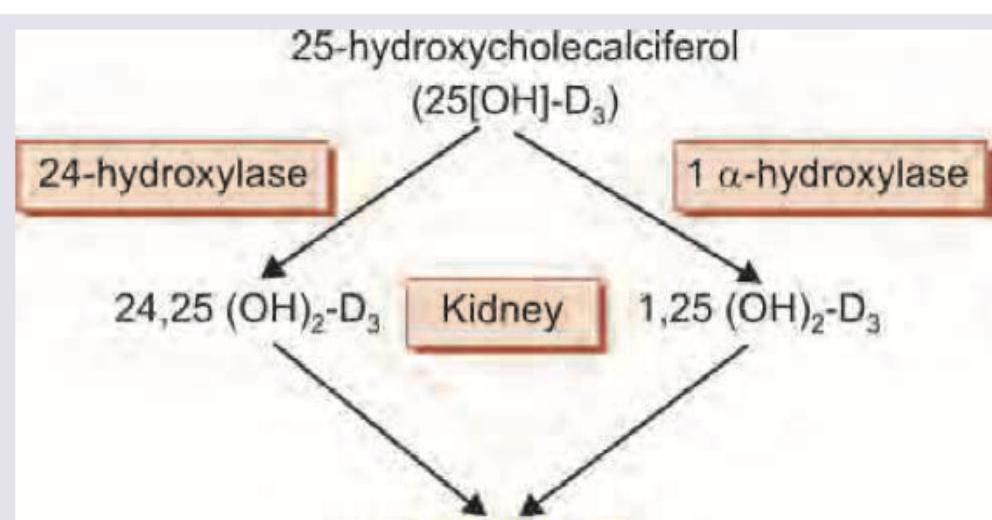
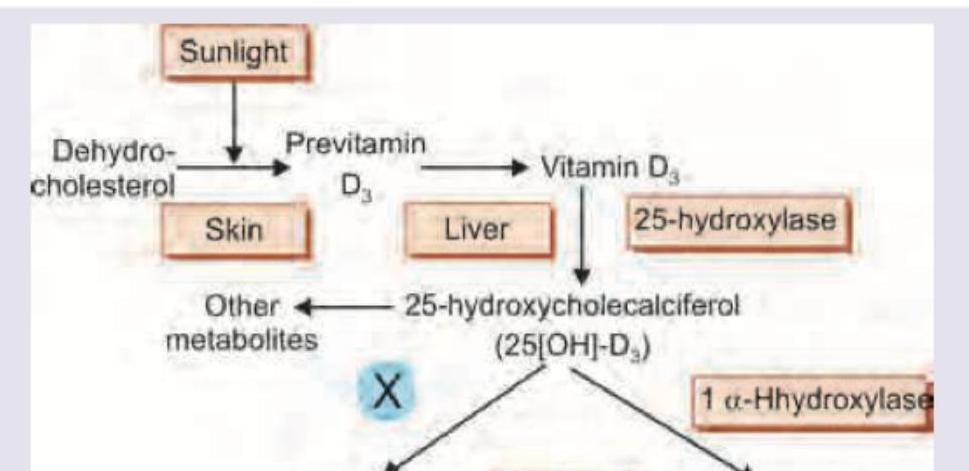
Explanation: ### Explanation The patient presents with **hypocalcemia** (7.8 mg/dL) despite having high levels of 25-hydroxyvitamin D [25(OH)D]. The critical finding is the **low level of 1-alpha-hydroxylase**, the enzyme responsible for converting 25(OH)D (calcifediol) into its active form, 1,25-dihydroxyvitamin D (calcitriol). **Why Calcitriol is correct:** In the presence of 1-alpha-hydroxylase deficiency (commonly seen in Chronic Kidney Disease or Vitamin D-Dependent Rickets Type 1), the body cannot activate vitamin D. Therefore, administering precursors like D3 or calcifediol is ineffective. **Calcitriol** is the active form of Vitamin D and bypasses the need for renal 1-alpha-hydroxylation, directly increasing intestinal calcium absorption and normalizing serum calcium. **Why other options are incorrect:** * **Phosphate supplementation:** This would further lower serum calcium by forming calcium-phosphate complexes and is contraindicated in hypocalcemia. * **Calcifediol [25(OH)D]:** This is the substrate for 1-alpha-hydroxylase. Since the enzyme is deficient, providing more substrate will not lead to the production of the active hormone. * **Vitamin D3 (Cholecalciferol):** This requires two hydroxylation steps (liver then kidney). It is ineffective if the final renal activation step is impaired. **NEET-PG High-Yield Pearls:** * **Rate-limiting step:** The conversion of 25(OH)D to 1,25(OH)₂D by 1-alpha-hydroxylase in the proximal convoluted tubule is the most strictly regulated step in Vitamin D metabolism. * **Stimulators of 1-alpha-hydroxylase:** Low serum Calcium, low serum Phosphate, and high PTH. * **Inhibitor:** High Calcitriol (feedback inhibition) and FGF-23. * **Storage form:** 25-hydroxyvitamin D (Calcifediol) is the major circulating form used to clinically assess a patient's Vitamin D status.
Explanation: **Explanation:** The correct answer is **Biotin (Vitamin B7)**. Biotin serves as a vital coenzyme for **carboxylation reactions**, where it acts as a carrier of activated carbon dioxide ($CO_2$). In these reactions, biotin is covalently attached to the enzyme via a lysine residue (forming a biocytin complex). It utilizes ATP to fix $CO_2$ onto substrates. **Key Carboxylase Enzymes requiring Biotin (High-Yield):** 1. **Pyruvate Carboxylase:** Converts pyruvate to oxaloacetate (Gluconeogenesis). 2. **Acetyl-CoA Carboxylase:** Converts Acetyl-CoA to Malonyl-CoA (Fatty acid synthesis). 3. **Propionyl-CoA Carboxylase:** Converts Propionyl-CoA to Methylmalonyl-CoA (Odd-chain fatty acid metabolism). **Analysis of Incorrect Options:** * **Alanine:** An amino acid involved in the glucose-alanine cycle; it is a substrate for transamination, not a cofactor for carboxylation. * **Pantothenic acid (Vitamin B5):** A precursor for **Coenzyme A (CoA)** and Acyl Carrier Protein (ACP), primarily involved in acyl group transfer, not $CO_2$ fixation. * **Serine:** A non-essential amino acid involved in one-carbon metabolism (via folate) and sphingolipid synthesis. **Clinical Pearls for NEET-PG:** * **Avidin Connection:** Consuming raw egg whites can lead to biotin deficiency because avidin (a protein in egg whites) binds biotin with high affinity, preventing its absorption. * **Mnemonic:** Remember the **"ABC"** of carboxylases: **A**TP, **B**iotin, and **C**O2 are required for these reactions. * **Differential:** Do not confuse *Carboxylation* (Biotin) with *Decarboxylation* (Thiamine/B1) or *Hydroxylation* (Vitamin C).
Explanation: **Explanation:** Vitamins are classified into two categories based on their solubility: **Fat-soluble** and **Water-soluble**. This distinction is fundamental in biochemistry as it determines how these vitamins are absorbed, transported, stored, and excreted by the body. **1. Why Option B is Correct:** The fat-soluble vitamins are **A (Retinol), D (Calciferol), E (Tocopherol), and K (Phylloquinone/Menaquinone)**. These vitamins require dietary lipids and bile salts for micelle formation and absorption in the small intestine. Once absorbed, they are transported via chylomicrons into the lymphatic system. Because they are stored in the liver and adipose tissue, they do not need to be consumed daily, but they carry a higher risk of toxicity (hypervitaminosis). **2. Why Other Options are Incorrect:** * **Options A, C, and D** are incorrect because they include **Vitamin B complex** and **Vitamin C (Ascorbic acid)**. These are water-soluble vitamins. Unlike fat-soluble vitamins, they are not stored in significant amounts (except B12), are excreted in the urine, and generally require daily intake to prevent deficiency. **3. NEET-PG High-Yield Clinical Pearls:** * **Absorption Disorders:** Conditions causing fat malabsorption (e.g., Celiac disease, Steatorrhea, Biliary obstruction, or Cystic Fibrosis) lead to deficiencies in vitamins A, D, E, and K. * **Storage:** Vitamin A is stored in the **Ito cells** (Stellate cells) of the liver. * **Toxicity:** Vitamin A and D are the most commonly associated with toxicity. Vitamin A toxicity can lead to pseudotumor cerebri, while Vitamin D toxicity causes hypercalcemia. * **Mnemonic:** Remember **"KADE"** or **"ADEK"** to recall the fat-soluble group.
Explanation: ### Explanation **Correct Answer: D. It is a co-enzyme for pyruvate dehydrogenase and alpha-ketoglutarate dehydrogenase.** Thiamine (Vitamin B1) is converted into its active co-enzyme form, **Thiamine Pyrophosphate (TPP)**, by the enzyme thiamine pyrophosphotransferase. TPP is essential for **oxidative decarboxylation** reactions in carbohydrate metabolism. It acts as a co-enzyme for: 1. **Pyruvate Dehydrogenase (PDH):** Converts pyruvate to Acetyl-CoA (linking glycolysis to the TCA cycle). 2. **$\alpha$-Ketoglutarate Dehydrogenase:** Converts $\alpha$-ketoglutarate to Succinyl-CoA in the TCA cycle. 3. **Branched-chain $\alpha$-ketoacid dehydrogenase:** Involved in the metabolism of Leucine, Isoleucine, and Valine. 4. **Transketolase:** A key enzyme in the Pentose Phosphate Pathway (HMP Shunt). --- ### Analysis of Incorrect Options: * **A. Lactate Dehydrogenase:** This enzyme requires **NAD+ (Vitamin B3/Niacin)** as a co-enzyme, not thiamine. It converts pyruvate to lactate under anaerobic conditions. * **B. Scurvy:** This is caused by a deficiency of **Vitamin C (Ascorbic acid)**. Thiamine deficiency leads to **Beriberi** (Dry/Wet) or **Wernicke-Korsakoff syndrome**. * **C. Thiamine monophosphate:** This is an intermediate. The biologically active co-enzyme form is **Thiamine Pyrophosphate (TPP)**, also known as thiamine diphosphate. --- ### NEET-PG High-Yield Pearls: * **Diagnostic Test:** Erythrocyte **transketolase activity** is the most reliable gold-standard test to measure thiamine status. * **Wernicke’s Encephalopathy Triad:** Ophthalmoplegia, Ataxia, and Confusion. * **Clinical Caution:** Always administer thiamine **before** glucose in a malnourished or alcoholic patient to prevent precipitating acute Wernicke’s encephalopathy (as glucose oxidation consumes the remaining TPP). * **Maple Syrup Urine Disease (MSUD):** Some variants are "thiamine-responsive" because the defective enzyme is branched-chain $\alpha$-ketoacid dehydrogenase.
Explanation: The Recommended Dietary Allowance (RDA) for Vitamin A is a high-yield topic in Biochemistry and Social and Preventive Medicine. The RDA is defined as the average daily dietary intake level sufficient to meet the nutrient requirements of nearly all healthy individuals. ### **Explanation of the Correct Answer** The correct RDA for Vitamin A in adults is **3500 IU (approx. 1000 µg) for men and 2500 IU (approx. 750 µg) for women**. * **Physiological Basis:** Men generally require higher amounts due to larger body mass and metabolic rates. * **Units:** In clinical practice, 1 Retinol Equivalent (RE) is equal to 1 µg of Retinol or 3.33 IU. Therefore, 1000 µg for men translates to roughly 3330–3500 IU. ### **Analysis of Incorrect Options** * **Option B (3000/2000 IU):** These values are below the established threshold required to maintain adequate liver stores of retinol in healthy adults. * **Options C and D (4000+ IU):** While these levels are safe (the Tolerable Upper Intake Level is 10,000 IU), they exceed the standard RDA. Excessive intake, particularly in pregnancy, is avoided due to the **teratogenic risk** of Vitamin A. ### **NEET-PG High-Yield Pearls** * **Storage:** Vitamin A is stored in the **Ito cells (Stellate cells)** of the liver. * **Pregnancy & Lactation:** Requirements increase during lactation (approx. 3800 IU or 1200 µg) to compensate for the vitamin secreted in breast milk. * **Prophylaxis Schedule:** Under the National Prophylaxis Programme against Nutritional Blindness, the first dose (1 lakh IU) is given at 9 months (with Measles vaccine), followed by 2 lakh IU every 6 months up to age 5 (Total 9 doses/17 lakh IU). * **Dark Adaptation:** The earliest clinical sign of deficiency is Nyctalopia (Night blindness) due to impaired rhodopsin regeneration.
Fat-Soluble Vitamins: A, D, E, K
Practice Questions
Vitamin A and Vision
Practice Questions
Vitamin D and Calcium Metabolism
Practice Questions
Vitamin E and Antioxidant Functions
Practice Questions
Vitamin K and Blood Coagulation
Practice Questions
Water-Soluble Vitamins: B Complex and C
Practice Questions
Thiamine (B1) and Pyruvate Dehydrogenase
Practice Questions
Riboflavin (B2) and Flavin Coenzymes
Practice Questions
Niacin and NAD/NADP
Practice Questions
Vitamin B6 and Transamination
Practice Questions
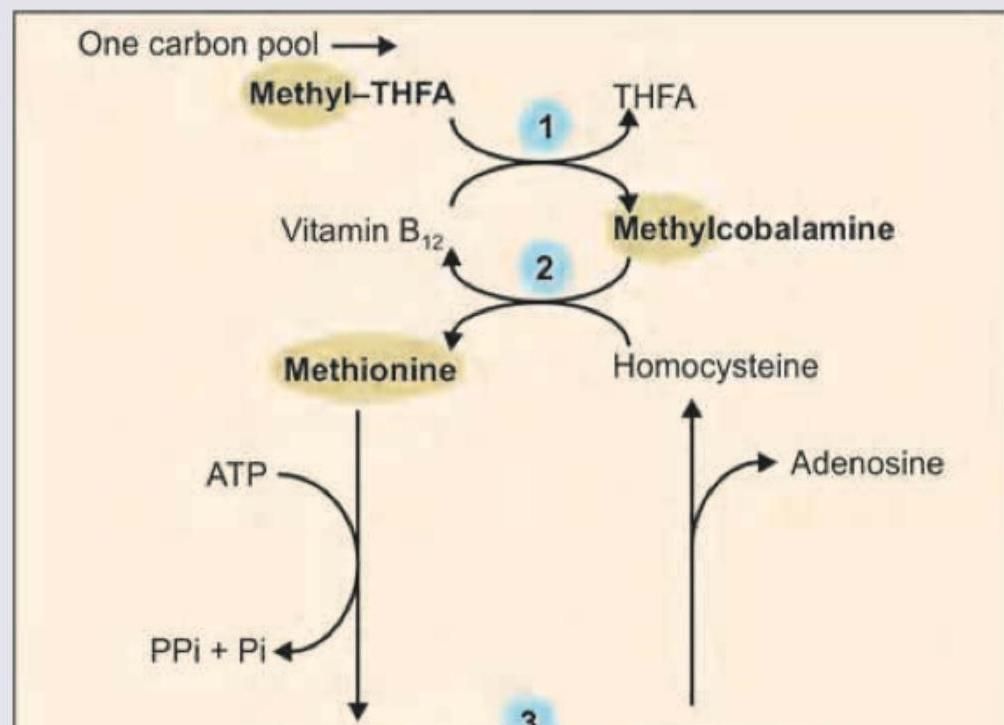
Folate and Vitamin B12 in One-Carbon Metabolism
Practice Questions
Vitamin C and Collagen Synthesis
Practice Questions
Get full access to all questions, explanations, and performance tracking.
Start For Free