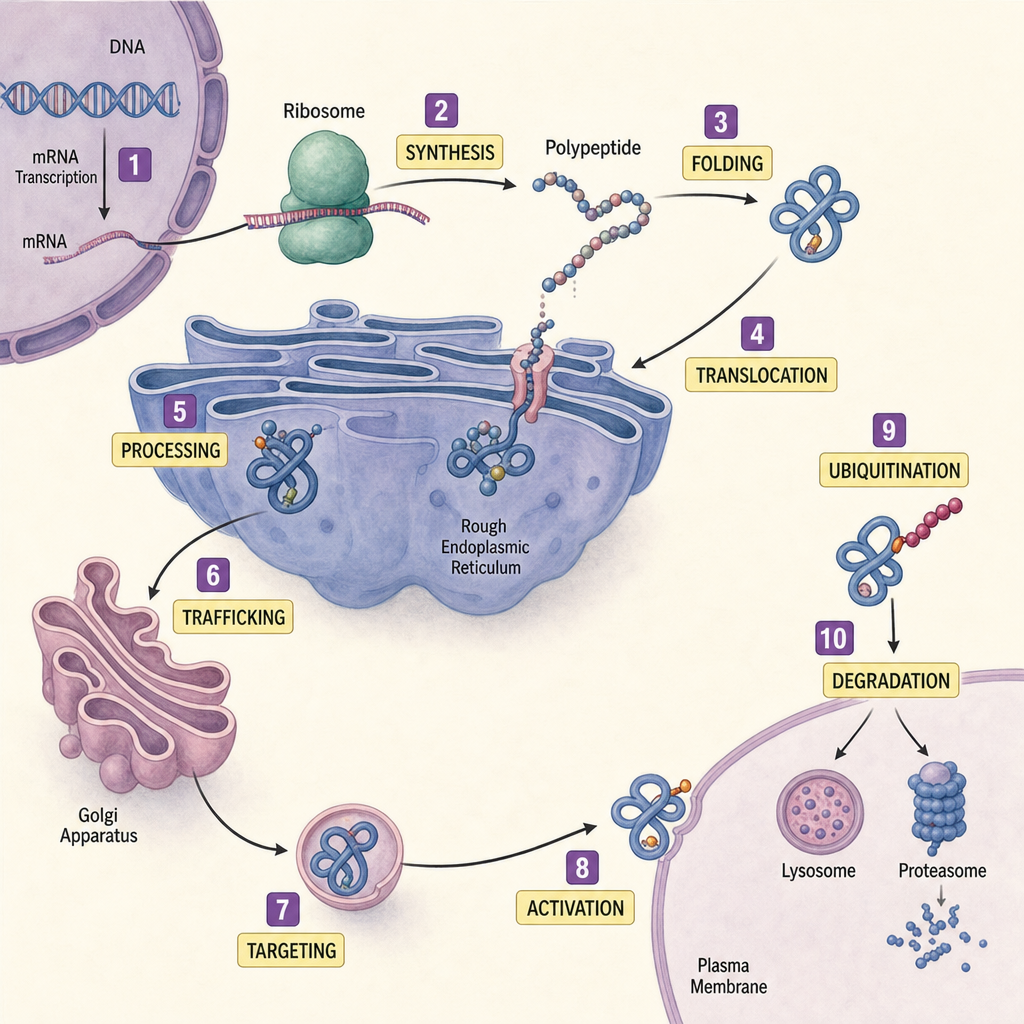
Which of the following helps in protein folding?
Defective proteins are degraded after attaching covalently to which molecule?
Trypsin cleaves which of the following amino acids?
An immunoglobulin molecule represents which level of organized protein structure?
What is the most abundant glycoprotein present in the basement membrane?
What is the role of selenocysteine?
Which of the following is a dipeptide?
How many amino acids are present in a single turn of an alpha-helix?
Which of the following is not a glycoprotein?
Where are secretory proteins synthesized?
Explanation: **Explanation:** **Correct Answer: D. Chaperones** **Mechanism:** Protein folding is the process by which a polypeptide chain acquires its functional 3D conformation. **Chaperones** (also known as Heat Shock Proteins, e.g., HSP70) are specialized proteins that facilitate this process. They prevent the "misfolding" or "aggregation" of nascent polypeptide chains by binding to exposed hydrophobic regions, ensuring the protein reaches its native state efficiently. Some chaperones, like **Chaperonins** (e.g., GroEL-GroES complex), provide a protected environment for folding to occur. **Why other options are incorrect:** * **Proteases (A):** These are enzymes that catalyze **proteolysis** (the breakdown of proteins into peptides or amino acids) by hydrolyzing peptide bonds. They destroy protein structure rather than help form it. * **Proteasomes (B):** These are protein complexes responsible for the **degradation** of damaged or unneeded proteins that have been tagged with **Ubiquitin**. They act as the cell's "garbage disposal" system. * **Histones (C):** These are highly alkaline proteins found in eukaryotic cell nuclei that package and order the DNA into structural units called **nucleosomes**. They are involved in DNA structural organization, not protein folding. **High-Yield Clinical Pearls for NEET-PG:** * **Heat Shock Proteins (HSPs):** Synthesis of chaperones increases under stress (high temperature, toxins) to prevent protein denaturation. * **Prion Diseases:** Result from the accumulation of **misfolded proteins** (PrPsc), which are rich in $\beta$-pleated sheets and resistant to proteases. * **Ubiquitin-Proteasome Pathway:** Defects in this pathway are linked to neurodegenerative diseases like **Parkinson’s** (Lewy bodies) and **Alzheimer’s** (Amyloid plaques).
Explanation: ### Explanation The correct answer is **Ubiquitin**. **Mechanism of Protein Degradation:** In eukaryotic cells, defective, misfolded, or short-lived proteins are marked for destruction via the **Ubiquitin-Proteasome Pathway**. Ubiquitin is a small, highly conserved regulatory protein. The process involves the covalent attachment of multiple ubiquitin molecules (polyubiquitination) to the lysine residues of the target protein. This "molecular tag" directs the protein to the **26S Proteasome**, a barrel-shaped multi-protein complex that acts as the cell's "garbage disposal," where the protein is unfolded and degraded into small peptides. **Analysis of Incorrect Options:** * **A. Clathrin:** A protein that plays a major role in the formation of coated vesicles. it is essential for **receptor-mediated endocytosis** and intracellular trafficking from the Golgi apparatus. * **B. Pepsin:** A digestive protease secreted by gastric chief cells in the stomach. It breaks down dietary proteins into smaller peptides in the digestive tract, not intracellularly. * **C. Laminin:** A major structural glycoprotein of the **basal lamina** (extracellular matrix). It is involved in cell adhesion, signaling, and tissue phenotype maintenance. **Clinical Pearls for NEET-PG:** * **ATP-Dependence:** The attachment of ubiquitin is an energy-dependent process requiring ATP and three enzymes: E1 (Activating), E2 (Conjugating), and E3 (Ligase). * **Clinical Correlation:** Defects in the ubiquitin-proteasome system are linked to neurodegenerative diseases like **Parkinson’s disease** (accumulation of Lewy bodies) and **Alzheimer’s disease**. * **Bortezomib:** A proteasome inhibitor used clinically in the treatment of **Multiple Myeloma**.
Explanation: **Explanation:** Trypsin is a serine protease found in the digestive system that acts as an endopeptidase. It specifically cleaves peptide bonds at the **carboxyl side** of basic (positively charged) amino acids, namely **Lysine (K)** and **Arginine (R)**. In this question, while both Arginine and Lysine are targets for Trypsin, Lysine is the most appropriate choice provided. The specificity of Trypsin is due to its "specificity pocket" (S1 pocket), which contains a negatively charged **Aspartate residue (Asp 189)** at its bottom. This Aspartate forms an electrostatic attraction with the positively charged side chains of Lysine or Arginine, positioning the peptide bond for cleavage. **Analysis of Options:** * **Option A (Arginine):** While Trypsin does cleave at Arginine, in many standardized formats where only one "best" answer is sought or if the question implies a specific context, Lysine is frequently highlighted. *Note: In a clinical exam, if both are present, the question may be flawed, but Lysine is a classic textbook answer.* * **Option B (Glutamate):** This is an acidic (negatively charged) amino acid. Enzymes like **Staphylococcal protease (V8 protease)** typically target acidic residues. * **Option D (Proline):** Trypsin **cannot** cleave if the amino acid following Lysine or Arginine is Proline. The rigid ring structure of Proline creates a conformational constraint that prevents the peptide bond from entering the enzyme's active site. **High-Yield Clinical Pearls for NEET-PG:** 1. **Zymogen Activation:** Trypsin is secreted as **Trypsinogen** from the pancreas and is activated by **Enteropeptidase (Enterokinase)** in the duodenum. Once formed, Trypsin autocatalytically activates more trypsinogen and other zymogens (Chymotrypsinogen, Procarboxypeptidase). 2. **Chymotrypsin:** Cleaves at the carboxyl side of **aromatic** amino acids (Phenylalanine, Tyrosine, Tryptophan). 3. **Cyanogen Bromide (CNBr):** A chemical reagent that cleaves specifically at **Methionine** residues. 4. **Clinical Correlation:** Deficiency of Enteropeptidase leads to protein malabsorption and failure to thrive because the entire cascade of pancreatic proteases remains inactive.
Explanation: ### Explanation **Correct Answer: D. Quaternary structure** **Why it is correct:** The quaternary structure refers to the spatial arrangement and interaction of **two or more polypeptide chains** (subunits) held together by non-covalent forces (hydrophobic interactions, hydrogen bonds, ionic bonds) and sometimes covalent bonds (disulfide bridges). An immunoglobulin (IgG) molecule is a heterotetramer consisting of **four polypeptide chains**: two identical heavy (H) chains and two identical light (L) chains. Because it requires the assembly of multiple distinct subunits to form a functional unit, it represents a quaternary level of organization. **Why the other options are incorrect:** * **Primary structure:** Refers only to the linear sequence of amino acids linked by peptide bonds. It does not account for folding or subunit assembly. * **Secondary structure:** Refers to local folding patterns like alpha-helices and beta-pleated sheets, stabilized by hydrogen bonding of the peptide backbone. * **Tertiary structure:** Refers to the overall 3D folding of a **single** polypeptide chain. While each individual heavy or light chain has a tertiary structure (the "immunoglobulin fold"), the complete molecule involves multiple chains. **High-Yield Clinical Pearls for NEET-PG:** * **Stabilization:** In immunoglobulins, the quaternary structure is uniquely stabilized by **interchain disulfide bonds** (covalent) between heavy and light chains, and between the two heavy chains. * **Other Quaternary Examples:** Hemoglobin (tetramer), Insulin (hexamer in storage, dimer/monomer in action), and Lactate Dehydrogenase (tetramer). * **The "Immunoglobulin Fold":** This is a characteristic tertiary structure motif consisting of a sandwich of two anti-parallel beta-sheets. * **Bence-Jones Proteins:** These are free light chains found in the urine of Multiple Myeloma patients; they represent a failure in the proper assembly of the quaternary structure.
Explanation: **Explanation:** The basement membrane is a specialized form of extracellular matrix (ECM) that provides structural support and influences cell behavior. **Why Laminin is the correct answer:** Laminin is a large, cross-shaped heterotrimeric glycoprotein (composed of $\alpha$, $\beta$, and $\gamma$ chains). It is the **most abundant non-collagenous glycoprotein** in the basement membrane. Its primary role is to serve as the "glue" that anchors epithelial cells to the basal lamina by binding to cell surface receptors (integrins) and other ECM components like Type IV collagen and nidogen. **Analysis of Incorrect Options:** * **B. Collagen type IV:** While this is the most abundant **protein** overall in the basement membrane (forming the structural scaffold), it is classified as a structural protein rather than a primary adhesive glycoprotein in this context. * **C. Fibronectin:** This is a major glycoprotein of the **interstitial** extracellular matrix and connective tissue, rather than the basement membrane. It plays a key role in cell adhesion and wound healing. * **D. Heparan sulfate:** This is a **proteoglycan** (specifically Perlecan in the basement membrane), not a glycoprotein. Its primary function is to provide a negative charge barrier for selective filtration (e.g., in the renal glomerulus). **High-Yield Clinical Pearls for NEET-PG:** * **Goodpasture Syndrome:** Autoantibodies against the non-collagenous (NC1) domain of **Type IV Collagen**. * **Alport Syndrome:** Genetic defect in the synthesis of **Type IV Collagen** (presents with nephritis and deafness). * **Junctional Epidermolysis Bullosa:** Often associated with mutations in **Laminin-332**. * **Nidogen (Entactin):** A glycoprotein that functions as a molecular bridge, linking laminin and type IV collagen networks.
Explanation: **Explanation:** **Selenocysteine** is often referred to as the **21st amino acid**. It is unique because it contains selenium in place of the sulfur atom found in cysteine. Its primary physiological role is serving as a critical component of **selenoproteins**, which are essential for cellular redox balance and the **antioxidant mechanism**. 1. **Why Option C is Correct:** The most clinically significant selenoprotein is **Glutathione Peroxidase (GPx)**. This enzyme reduces lipid hydroperoxides and free hydrogen peroxide into water, thereby protecting cells from oxidative damage. Other important selenoproteins include **Thioredoxin Reductase** (maintains cellular redox state) and **Iodothyronine Deiodinase** (converts T4 to active T3). 2. **Why Other Options are Incorrect:** * **Option A (Hydroxylation of dopamine):** This process converts dopamine to norepinephrine via the enzyme *Dopamine beta-hydroxylase*, which requires **Vitamin C (Ascorbate)** and Copper as cofactors, not selenocysteine. * **Option B (Oxidation of drugs):** Drug metabolism and oxidation are primarily handled by the **Cytochrome P450** enzyme system in the liver, which utilizes Heme (Iron) as a cofactor. **High-Yield Clinical Pearls for NEET-PG:** * **Genetic Coding:** Selenocysteine is encoded by the **UGA stop codon**. This "recoding" requires a specific mRNA secondary structure called the **SECIS element** (Selenocysteine Insertion Sequence). * **tRNA:** It has its own unique tRNA, known as **tRNA^Sec**. * **Deficiency:** A deficiency in selenium leads to **Keshan Disease** (an endemic cardiomyopathy). * **Enzyme to Remember:** If a question mentions **Glutathione Peroxidase**, the answer is almost always related to Selenium or Selenocysteine.
Explanation: **Explanation:** **1. Why Carnosine is the Correct Answer:** A dipeptide consists of two amino acids linked by a single peptide bond. **Carnosine** (β-alanyl-L-histidine) is a classic example of a dipeptide. It is composed of **β-alanine** and **L-histidine**. It is found in high concentrations in skeletal muscle and brain tissue, where it acts as a pH buffer and an antioxidant. **2. Why the Other Options are Incorrect:** * **B. Glutathione:** This is a **tripeptide** (γ-glutamyl-cysteinyl-glycine). It is the most abundant intracellular antioxidant. Note the unique γ-glutamyl bond, which protects it from degradation by most peptidases. * **C. Glucagon:** This is a **polypeptide** hormone secreted by the alpha cells of the pancreas. It consists of **29 amino acids** in a single chain. * **D. β-Lipoprotein:** This is a complex **macromolecular assembly** (specifically LDL) composed of lipids and a large apolipoprotein (Apo B-100), which contains over 4,500 amino acids. **3. High-Yield Clinical Pearls for NEET-PG:** * **Anserine:** Another important dipeptide (N-methyl carnosine) found in skeletal muscle. * **Aspartame:** An artificial sweetener that is a dipeptide (L-aspartyl-L-phenylalanine methyl ester). * **Glutathione Function:** It serves as a co-factor for the enzyme **Glutathione Peroxidase** to neutralize free radicals (H₂O₂). * **B-alanine:** It is the rate-limiting precursor for carnosine synthesis; its supplementation is often used by athletes to improve buffering capacity during high-intensity exercise.
Explanation: ### Explanation The **$\alpha$-helix** is the most common secondary structure in proteins, characterized by a tightly packed, right-handed coiled backbone. **Why 3.6 is the Correct Answer:** In an $\alpha$-helix, the polypeptide chain is stabilized by hydrogen bonds between the carbonyl oxygen ($C=O$) of one amino acid and the amide hydrogen ($N-H$) of the amino acid located **four residues ahead** ($i + 4$ hydrogen bonding). This specific bonding pattern results in a repeating unit where: * **Amino acids per turn:** 3.6 residues. * **Pitch (height of one full turn):** 0.54 nm (5.4 Å). * **Rise (distance between consecutive residues):** 0.15 nm (1.5 Å). * Calculation: $3.6 \text{ residues} \times 0.15 \text{ nm} = 0.54 \text{ nm}$. **Analysis of Incorrect Options:** * **Option A (3.3):** This refers to the **$3_{10}$ helix**, which is tighter and thinner than the $\alpha$-helix. It has 3 residues per turn and 10 atoms in the hydrogen-bonded loop. * **Options C & D (10.5 and 11.5):** These values are associated with the **B-DNA double helix**, which has approximately 10.5 base pairs per turn. They are not related to protein secondary structures. **High-Yield Clinical Pearls for NEET-PG:** * **Proline** is known as a **"helix breaker"** because its rigid cyclic structure cannot fit into the $\alpha$-helix and it lacks the necessary N-H group for hydrogen bonding. * **Glycine** also tends to disrupt helices due to its high conformational flexibility. * **Keratin** (hair/nails) and **Hemoglobin** are rich in $\alpha$-helices. * **Amphipathic helices** (one side polar, one side non-polar) are commonly found in transmembrane proteins and serum lipoproteins.
Explanation: **Explanation:** The core concept tested here is the biochemical classification of hormones. Hormones are broadly categorized into steroids, amines, and peptides/proteins. Among protein hormones, a specific subset contains carbohydrate side chains covalently attached to the polypeptide backbone; these are known as **glycoproteins**. **Why ADH is the correct answer:** **Antidiuretic Hormone (ADH)**, also known as Vasopressin, is a **nanopeptide** (consisting of only 9 amino acids). It is synthesized in the hypothalamus and stored in the posterior pituitary. Due to its very small size and simple peptide structure, it lacks the complex post-translational glycosylation required to be classified as a glycoprotein. **Why the other options are incorrect:** * **FSH (Follicle Stimulating Hormone), LH (Luteinizing Hormone), and TSH (Thyroid Stimulating Hormone):** These are all complex glycoproteins produced by the anterior pituitary. * They share a common **alpha ($\alpha$) subunit** (92 amino acids long). * Their biological specificity is determined by their unique **beta ($\beta$) subunits**. * **Human Chorionic Gonadotropin (hCG)** also belongs to this glycoprotein family. **High-Yield Clinical Pearls for NEET-PG:** * **Glycoprotein Family:** Remember the mnemonic **"FLAT"** (FSH, LH, ACTH is an exception, TSH) + **hCG**. Note: ACTH is a polypeptide, not a glycoprotein. * **ADH Synthesis:** It is synthesized in the **supraoptic nucleus** of the hypothalamus (Oxytocin is primarily in the paraventricular nucleus). * **Carbohydrate Content:** In glycoproteins like TSH/FSH, the carbohydrate content (often sialic acid) is crucial for determining the hormone's **half-life** in circulation.
Explanation: **Explanation:** The synthesis of secretory proteins is governed by the **Signal Hypothesis**. While the translation of all proteins begins on free ribosomes in the **cytoplasm**, secretory proteins possess a specific N-terminal **signal peptide**. Once this signal peptide emerges, it is recognized by the **Signal Recognition Particle (SRP)**, which halts translation and docks the ribosome onto the **Rough Endoplasmic Reticulum (RER)**. Consequently, the actual synthesis (elongation) and translocation of the protein into the ER lumen occur exclusively at the RER. **Analysis of Options:** * **Option B (Correct):** Secretory proteins, membrane proteins, and lysosomal enzymes are synthesized on the RER. The ER provides the necessary environment for post-translational modifications (like N-linked glycosylation) and proper folding required for secretion. * **Option A:** Cytoplasmic (free) ribosomes synthesize proteins that remain within the cell, such as hemoglobin, mitochondrial proteins, and enzymes of glycolysis. * **Option C & D:** These are distractors. While translation *initiates* in the cytoplasm, the "synthesis" of the polypeptide chain predominantly occurs at the ER. In NEET-PG, the RER is the definitive site associated with secretory protein production. **High-Yield Clinical Pearls:** * **Rough ER:** Characterized by attached ribosomes; primary site for protein synthesis and N-linked glycosylation. * **Smooth ER:** Site for lipid synthesis, steroid hormone production, and detoxification (Cytochrome P450). * **I-Cell Disease:** A clinical correlate where a defect in trafficking proteins from the ER/Golgi to lysosomes leads to the "secretion" of enzymes into the extracellular space instead of being targeted to lysosomes.
Amino Acids: Structure and Properties
Practice Questions
Peptide Bond Formation
Practice Questions
Primary Structure of Proteins
Practice Questions
Secondary Structure of Proteins
Practice Questions
Tertiary and Quaternary Structures
Practice Questions
Protein Folding and Chaperones
Practice Questions
Protein Domains and Motifs
Practice Questions
Structure-Function Relationships
Practice Questions
Hemoglobin and Myoglobin
Practice Questions
Collagen and Elastin
Practice Questions
Albumin and Plasma Proteins
Practice Questions
Post-Translational Modifications
Practice Questions
Get full access to all questions, explanations, and performance tracking.
Start For Free