For the conversion of aspartate to asparagine, nitrogen comes from which source?
Mechanism of action of allopurinol is
Which of the following increases uric acid excretion?
A 5-year-old presents with intellectual disability, self-mutilation, and hyperuricemia. What enzyme defect is most likely?
A patient presents with hyperuricemia and gout. Which enzyme's overactivity is most likely associated?
Which molecule provides nitrogen-9 to the purine ring?
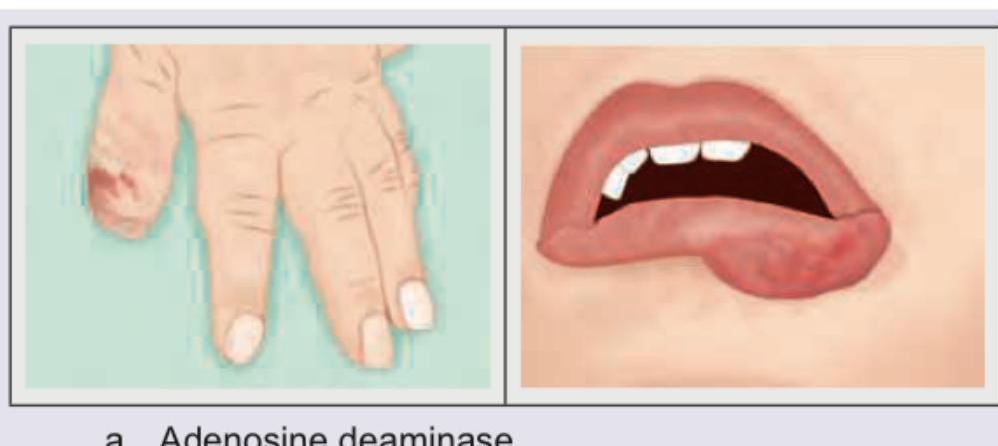
The patient shown here is suffering from deficiency of which enzyme?
Inosinic acid is biological precursor of ?
What is mechanism of action of colchicine in acute gout?
Which of the following organs does not primarily utilize the salvage pathway of purine nucleotide synthesis?
Explanation: ***Glutamine*** - The biosynthesis of **asparagine** from **aspartate** is catalyzed by **asparagine synthetase**. - This enzyme utilizes **ATP** and **glutamine** as the amino group donor, with glutamine being hydrolyzed to **glutamate**. *Alanine* - **Alanine** is primarily involved in the **glucose-alanine cycle** for transporting nitrogen from muscle to liver. - It does not directly donate its amino group for the synthesis of asparagine. *Glutamate* - While **glutamate** is a precursor for glutamine, it does not directly donate an amino group in the conversion of aspartate to asparagine. - Glutamate acts as a general amino group donor in many transamination reactions, but not in this specific amidation. *Histidine* - **Histidine** is an essential amino acid involved in various metabolic roles, including acting as a precursor for histamine. - It is not a donor of nitrogen for the biosynthesis of asparagine from aspartate.
Explanation: ***Xanthine oxidase inhibition*** - **Allopurinol** acts as a **structural analog of hypoxanthine** and competitively inhibits the enzyme **xanthine oxidase**. - By inhibiting **xanthine oxidase**, allopurinol prevents the conversion of hypoxanthine to xanthine and then to uric acid, thereby **decreasing uric acid production**. *Recombinant uricase* - **Recombinant uricase** (e.g., rasburicase, pegloticase) is an enzyme that catalyzes the breakdown of existing uric acid into allantoin, a more soluble compound. - This mechanism is distinct from allopurinol, which **prevents uric acid formation**. *Decrease chemotaxis* - Medications that **decrease chemotaxis**, such as **colchicine**, work by interfering with the migration of neutrophils to sites of inflammation, which is useful in acute gout flares. - This is an **anti-inflammatory mechanism**, not related to uric acid synthesis or excretion. *Increase uric acid excretion* - Drugs that **increase uric acid excretion** are known as **uricosurics** (e.g., probenecid, lesinurad). - These agents act on the renal tubules to **inhibit uric acid reabsorption**, thus promoting its elimination from the body.
Explanation: **Probenecid** - **Probenecid** is a **uricosuric agent** that increases renal excretion of uric acid by inhibiting its reabsorption in the proximal tubule. - It is used in the treatment of **chronic gout** to lower serum uric acid levels. *Allopurinol* - **Allopurinol** works by inhibiting **xanthine oxidase**, an enzyme responsible for uric acid synthesis, thereby reducing its production. - It does not increase uric acid excretion but rather decreases its formation, making it suitable for **overproducers** of uric acid. *Aspirin* - **Low-dose aspirin** can actually *decrease* uric acid excretion by interfering with tubular secretion of uric acid. - **High-dose aspirin** has a uricosuric effect, but it is not typically used for gout due to side effects and more effective alternatives. *Colchicine* - **Colchicine** is an **anti-inflammatory agent** used to treat acute gout flares by inhibiting neutrophil chemotaxis and activation. - It does **not affect uric acid synthesis or excretion** directly, but rather mitigates the inflammatory response to uric acid crystals.
Explanation: ***Hypoxanthine-guanine phosphoribosyltransferase (HGPRT)*** - Deficiency of **HGPRT** an enzyme in the **purine salvage pathway** leads to **Lesch-Nyhan syndrome**, characterized by **hyperuricemia**, **self-mutilation**, **intellectual disability**, and **dystonia**. - The accumulation of **uric acid** due to defective salvage leads to the characteristic symptoms. *Adenosine deaminase deficiency* - This deficiency causes **severe combined immunodeficiency (SCID)** due to the accumulation of toxic metabolites in lymphocytes. - It does not typically present with **self-mutilation** or **hyperuricemia**. *Xanthine oxidase deficiency* - This deficiency leads to **xanthinuria**, characterized by **low uric acid levels** and an increased risk of **xanthine kidney stones**. - The clinical presentation does not include **intellectual disability** or **self-mutilation**. *Glucose-6-phosphatase deficiency* - This enzyme deficiency causes **Glycogen Storage Disease Type Ia (von Gierke disease)**, characterized by **hypoglycemia**, **lactic acidosis**, and **hepatomegaly**. - It is not associated with **self-mutilation** or the primary neurological/behavioral features seen in Lesch-Nyhan syndrome.
Explanation: ***PRPP synthetase*** - **Overactivity** of **PRPP synthetase** leads to increased production of **5-phosphoribosyl-1-pyrophosphate (PRPP)**, a key substrate for *de novo* purine synthesis. - This increased purine synthesis results in an **overproduction of uric acid**, causing **hyperuricemia** and **gout**. *HGPRT* - **Hypoxanthine-guanine phosphoribosyltransferase (HGPRT)** deficiency, not overactivity, is associated with hyperuricemia and gout, as seen in **Lesch-Nyhan syndrome**. - Its normal function is in the **salvage pathway**, recycling purine bases; deficiency leads to increased *de novo* purine synthesis. *Xanthine oxidase* - **Xanthine oxidase** is involved in the catabolism of purines, converting **hypoxanthine to xanthine** and then **xanthine to uric acid**. - While inhibition of this enzyme (e.g., by allopurinol) is a treatment for gout, its **overactivity alone is not typically the primary cause** of hereditary hyperuricemia; rather, altered purine metabolism leading to excess substrates for xanthine oxidase is the issue. *Adenosine deaminase* - Deficiency of **adenosine deaminase (ADA)** is primarily associated with **severe combined immunodeficiency (SCID)**, due to the accumulation of toxic metabolites that impair lymphocyte development. - It is not directly linked to the pathogenesis of **hyperuricemia** or **gout**.
Explanation: ***Glycine*** - Glycine provides the **amino nitrogen at position 9** (N-9) of the purine ring. - It also contributes **carbon atoms at positions 4 and 5** (C-4, C-5) and the **nitrogen at position 7** (N-7). - Glycine is incorporated as an intact molecule early in purine synthesis, forming the **glycinamide ribonucleotide** intermediate. *Glutamine* - The **amide nitrogen** of glutamine donates nitrogen atoms at **positions 3 only** (N-3), not position 9. - This donation occurs during the formation of **formylglycinamide ribonucleotide** (FGAR) from FGAM. - Glutamine contributes two amide nitrogen atoms during purine synthesis, but N-9 is not one of them. *Aspartate* - Aspartate contributes the **nitrogen atom at position 1** (N-1) of the purine ring. - It is incorporated into the intermediate **5-aminoimidazole-4-(N-succinylcarboxamide) ribonucleotide** (SACAIR). - The nitrogen from aspartate remains after fumarate is released. *CO2* - Carbon dioxide (CO2) contributes the **carbon atom at position 6** (C-6) of the purine ring. - It provides a **carbon source** for ring formation, not nitrogen atoms. - CO2 is incorporated during the carboxylation step in the purine biosynthetic pathway.
Explanation: ***HGPRTase*** - **HGPRTase deficiency** causes **Lesch-Nyhan syndrome** with characteristic **self-mutilation behavior**, choreoathetosis, and severe intellectual disability. - Clinical features include **orange sand-like crystals** in diapers due to hyperuricemia, **compulsive self-biting**, and **dystonia** as shown in the patient. *Adenosine deaminase* - **ADA deficiency** causes **SCID** with recurrent infections, lymphopenia, and failure to thrive in early infancy. - Clinical presentation focuses on **immunodeficiency** with chronic infections rather than neurological and behavioral abnormalities. *Xanthine oxidase* - **Xanthine oxidase deficiency** leads to **xanthinuria** with accumulation of xanthine causing kidney stones. - Patients present with **nephrolithiasis** and muscle pain but lack the neurological and self-destructive behaviors seen here. *Glucose-6-phosphate dehydrogenase* - **G6PD deficiency** causes **hemolytic anemia** triggered by oxidative stress from drugs, infections, or fava beans. - Features include **jaundice**, dark urine, and acute hemolysis but not the characteristic **neurological dysfunction** and **self-mutilation** of Lesch-Nyhan syndrome.
Explanation: ***Adenylic acid and guanylic acid*** - Inosinic acid (IMP) is a **key intermediate** in the **de novo purine synthesis pathway**. - It serves as the direct precursor for the synthesis of **adenylic acid (AMP)** and **guanylic acid (GMP)**, which are components of DNA and RNA. *Purines and thymine* - While inosinic acid is a precursor to purines, it is **not a precursor to thymine**. - Thymine is a **pyrimidine base** and is synthesized through a separate pathway. *Orotic acid and uridylic acid* - **Orotic acid** is an intermediate in **pyrimidine synthesis**, not purine synthesis. - **Uridylic acid (UMP)** is also a pyrimidine nucleotide, and its synthesis pathway involves orotic acid, not inosinic acid. *Uracil and thymine* - **Uracil** and **thymine** are pyrimidine bases, and their synthesis pathways are distinct from the purine synthesis pathway involving inosinic acid. - Inosinic acid is exclusively involved in the synthesis of **purine nucleotides**.
Explanation: ***Inhibition of leukocyte migration and microtubule function*** - Colchicine works by disrupting **microtubule polymerization**, which interferes with the **motility and activity of neutrophils and other inflammatory cells** [1]. - Its anti-inflammatory effect in acute gout is primarily due to the inhibition of **leukocyte migration and phagocytosis of urate crystals**, thereby reducing the inflammatory response [1]. - The mechanism involves binding to **tubulin**, preventing microtubule assembly, which affects multiple cellular processes including chemotaxis and cell division [1]. *Inhibition of purine metabolism* - This mechanism is associated with drugs like **allopurinol**, which inhibit **xanthine oxidase** to reduce uric acid production [2]. - Colchicine does not directly inhibit **purine metabolism** or uric acid synthesis; its effect is on the inflammatory response, not uric acid formation [1]. *Inhibition of uric acid conversion* - This mechanism refers to **uricosuric agents** like probenecid that increase renal excretion of uric acid. - Colchicine's action is primarily anti-inflammatory, not related to uric acid metabolism or excretion [1]. *Migration of leukocytes* - While this is partially correct, as colchicine does inhibit **leukocyte migration**, this option is incomplete. - The complete mechanism must include its action as a **microtubule inhibitor**, which is the underlying basis for all its cellular effects including inhibition of migration, phagocytosis, and inflammatory mediator release [1].
Explanation: ***Liver*** - The **liver** is capable of both *de novo* synthesis and the salvage pathway of purine nucleotides, but it primarily utilizes the **de novo pathway** due to its high metabolic capacity and central role in biosynthesis for the entire body. - While salvage pathways exist, the liver's robust *de novo* synthesis allows it to readily produce purines from simple precursors, making it less reliant on salvaging pre-formed bases. *Brain* - The **brain** relies heavily on the **salvage pathway** for purine nucleotide synthesis because it has a limited capacity for *de novo* purine synthesis. - This dependency makes the brain particularly vulnerable to deficiencies in salvage enzymes, such as in **Lesch-Nyhan syndrome** where HGPRT deficiency leads to severe neurological dysfunction. *RBC* - **Red blood cells (RBCs)** are anucleated and lack the machinery for *de novo* purine synthesis, making them entirely dependent on the **salvage pathway** to maintain their purine nucleotide pool. - They salvage pre-formed purine bases and nucleosides from the plasma to synthesize necessary adenine and guanine nucleotides. *Leukocytes* - **Leukocytes**, particularly lymphocytes, have a high turn-over rate and metabolic activity, and they primarily rely on the **salvage pathway** for purine nucleotide synthesis. - The **immune system's rapid proliferation** and response demand efficient nucleotide synthesis, and the salvage pathway offers a quick and energy-efficient way to achieve this.
Get full access to all questions, explanations, and performance tracking.
Start For Free