Which of the following classes of lipoproteins transfers cholesterol from membrane turnover?
Long chain fatty acids penetrate the inner mitochondrial membrane as:
Saponification means hydrolysis of fats by:
Cholesterol is:
Which of the following is a secondary bile acid?
Which of the following is not a component of triglycerides?
Which of the following is a characteristic of dyslipidemia associated with alcohol consumption?
Lipoprotein A resembles which of the following?
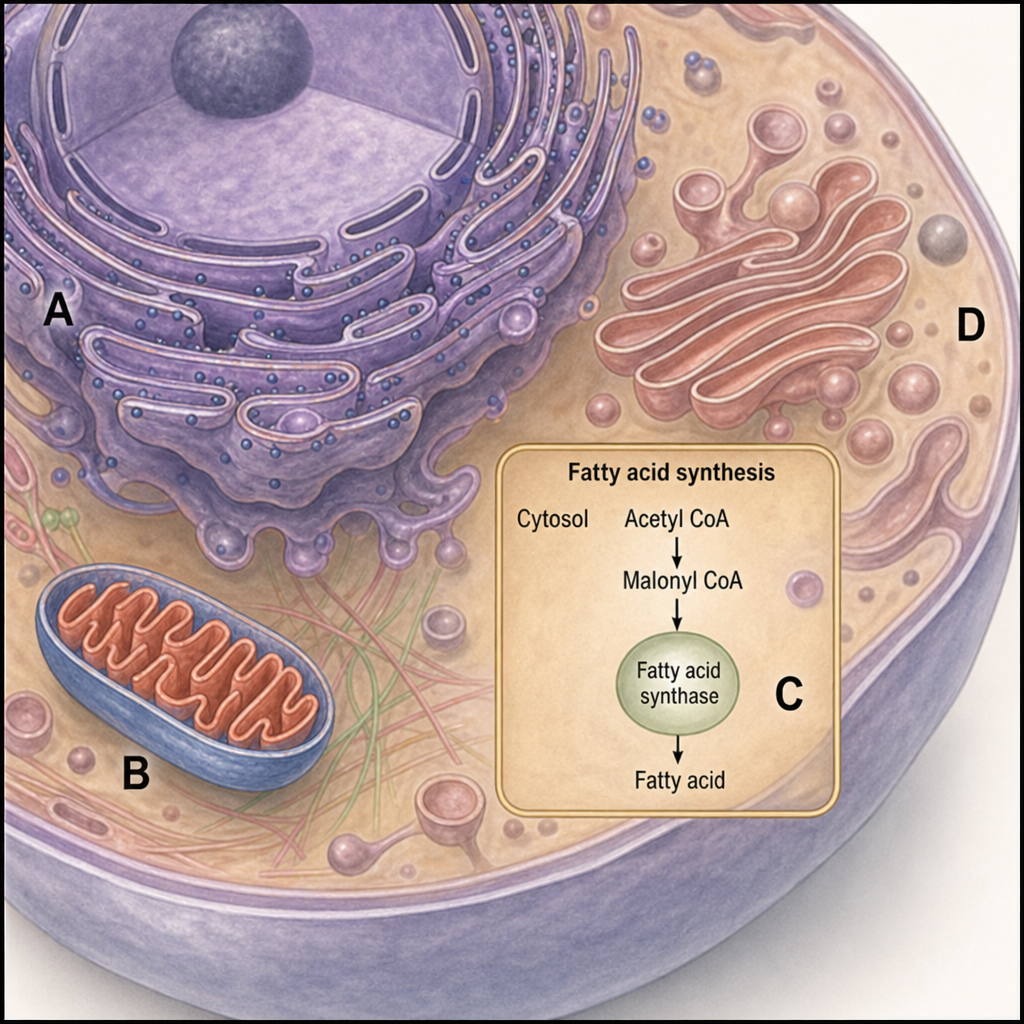
Where is the enzyme Acetyl CoA carboxylase located?
Which of the following is NOT a cause of hypertriglyceridemia?
Explanation: **Explanation:** The correct answer is **HDL (High-Density Lipoprotein)**. This process is known as **Reverse Cholesterol Transport (RCT)**. **Why HDL is correct:** HDL acts as a scavenger of cholesterol in the body. When peripheral tissues undergo membrane turnover or have excess intracellular cholesterol, HDL picks up this free cholesterol. This is mediated by the enzyme **LCAT (Lecithin-Cholesterol Acyltransferase)**, which esterifies free cholesterol into cholesterol esters, allowing them to be packed into the HDL core. HDL then transports this cholesterol back to the liver for excretion in bile or repositioning, thus preventing lipid accumulation in the arterial walls. **Why the other options are incorrect:** * **VLDL (Very Low-Density Lipoprotein):** Produced by the liver to transport endogenous triglycerides to peripheral tissues. * **IDL (Intermediate-Density Lipoprotein):** A transient remnant formed during the conversion of VLDL to LDL; it primarily delivers triglycerides and cholesterol to the liver or becomes LDL. * **LDL (Low-Density Lipoprotein):** Known as "bad cholesterol," its primary role is to transport cholesterol **from** the liver **to** peripheral tissues. High levels are associated with atherosclerosis. **High-Yield NEET-PG Pearls:** * **Apo A-I:** The major apoprotein associated with HDL; it activates LCAT. * **ABCA1 Transporter:** Essential for the efflux of cholesterol from cells to nascent HDL. A deficiency leads to **Tangier Disease**. * **CETP (Cholesterol Ester Transfer Protein):** Facilitates the exchange of cholesterol esters from HDL to VLDL/LDL in exchange for triglycerides. * HDL is considered "cardioprotective" because it clears cholesterol from foam cells in atherosclerotic plaques.
Explanation: ### Explanation **1. Why the Correct Answer is Right:** Long-chain fatty acids (LCFAs) cannot freely cross the inner mitochondrial membrane (IMM) to undergo $\beta$-oxidation. To bypass this barrier, they utilize the **Carnitine Shuttle**. * First, LCFAs are activated to **Acyl-CoA** in the cytosol. * The enzyme **Carnitine Palmitoyltransferase-I (CPT-I)** then converts Acyl-CoA into **Acyl-carnitine** (a carnitine derivative). * This derivative is transported across the IMM by a translocase. Once inside the matrix, CPT-II converts it back into Acyl-CoA for oxidation. Thus, LCFAs penetrate the membrane specifically as carnitine derivatives. **2. Why the Incorrect Options are Wrong:** * **B. Pyruvate:** This is the end-product of glycolysis. It enters the mitochondria via a specific pyruvate carrier to be converted into Acetyl-CoA or Oxaloacetate, but it is not involved in fatty acid transport. * **C. Acetyl-CoA derivatives:** Acetyl-CoA is the *product* of $\beta$-oxidation, not the transport form. Furthermore, Acetyl-CoA itself cannot cross the mitochondrial membrane; it must be converted to Citrate to exit into the cytosol for fatty acid synthesis. * **D. Acyl-CoA:** While LCFAs are activated to Acyl-CoA in the cytosol, the inner mitochondrial membrane is **impermeable** to CoA esters. They must be converted to carnitine derivatives to enter. **3. Clinical Pearls & High-Yield Facts for NEET-PG:** * **Rate-Limiting Step:** CPT-I is the rate-limiting enzyme of $\beta$-oxidation. * **Inhibitor:** **Malonyl-CoA** (an intermediate of FA synthesis) inhibits CPT-I, preventing a futile cycle where fatty acids are synthesized and degraded simultaneously. * **Systemic Carnitine Deficiency:** Presents with non-ketotic hypoglycemia, as the liver cannot oxidize fats to produce energy or ketone bodies during fasting. * **Short and Medium-chain fatty acids** (less than 12 carbons) do **not** require the carnitine shuttle; they cross the IMM directly.
Explanation: **Explanation:** **Saponification** is the process of alkaline hydrolysis of triacylglycerols (fats/oils) to yield **glycerol** and the salts of free fatty acids, which are commonly known as **soaps**. 1. **Why Alkali is Correct:** When a fat is heated with a strong base (alkali) such as **Sodium Hydroxide (NaOH)** or **Potassium Hydroxide (KOH)**, the ester bonds between the glycerol backbone and the fatty acids are cleaved. The alkali reacts with the released fatty acids to form sodium or potassium salts (soaps). Sodium soaps are generally "hard" soaps, while potassium soaps are "soft" soaps. 2. **Why Other Options are Incorrect:** * **Acid:** Acidic hydrolysis of fats yields glycerol and free fatty acids, but it does not produce soap (salts); therefore, it is not termed saponification. * **Water:** Hydrolysis by water alone (hydrolytic rancidity) is a very slow process and does not result in soap formation. * **Enzymes:** Hydrolysis of fats by enzymes (e.g., Pancreatic Lipase) occurs in the human digestive tract. This biological process yields monoacylglycerols and free fatty acids, not soaps. **High-Yield Facts for NEET-PG:** * **Saponification Number:** This is the milligrams of KOH required to saponify 1 gram of fat. * **Inverse Relationship:** The saponification number is **inversely proportional** to the molecular weight (chain length) of the fatty acids in the fat. * **Clinical Relevance:** In pathology, **Fat Necrosis** (commonly seen in acute pancreatitis) involves the release of pancreatic lipases that hydrolyze local fat; the released fatty acids then react with calcium ions to form "calcium soaps," a process visible macroscopically as chalky white deposits.
Explanation: **Explanation:** **Why the correct answer is right:** Cholesterol is structurally classified as a **Steroid**, specifically a **Sterol** (steroid alcohol). It contains the characteristic **cyclopentanoperhydrophenanthrene (CPPP) ring** nucleus, which consists of four fused rings (three cyclohexane rings and one cyclopentane ring). It is an essential component of mammalian cell membranes, providing fluidity and stability, and serves as the primary precursor for the synthesis of bile acids, Vitamin D, and steroid hormones (e.g., cortisol, aldosterone, and sex hormones). **Why the incorrect options are wrong:** * **A. Tocopherol:** This refers to **Vitamin E**, a fat-soluble antioxidant. While it is a lipid-derived molecule, it lacks the steroid ring structure. * **B. Lipoprotein:** These are complex molecular aggregates (like LDL, HDL, VLDL) composed of lipids and proteins (apolipoproteins) that **transport** cholesterol and triglycerides in the blood. Cholesterol is a *component* of lipoproteins, not a lipoprotein itself. * **D. Lipopolysaccharide (LPS):** Also known as endotoxin, these are found in the outer membrane of **Gram-negative bacteria**. They consist of a lipid A moiety and a polysaccharide chain; they are not related to human steroid metabolism. **High-Yield Clinical Pearls for NEET-PG:** * **Rate-limiting enzyme:** HMG-CoA Reductase (target of Statin drugs). * **Excretion:** Humans cannot break down the steroid nucleus; cholesterol is excreted primarily as **bile acids** or free cholesterol in bile. * **Identification:** The **Libermann-Burchard reaction** is the classic chemical test for cholesterol (turns emerald green). * **Precursor:** All 27 carbon atoms of cholesterol are derived from **Acetyl-CoA**.
Explanation: ### Explanation Bile acids are steroid acids synthesized from cholesterol in the liver and are essential for the digestion and absorption of dietary fats. They are classified into two categories: **Primary** and **Secondary**. **1. Why Lithocholic Acid is Correct:** **Lithocholic acid** is a **secondary bile acid**. Secondary bile acids are not synthesized by the liver; instead, they are formed in the colon through the action of bacterial enzymes (specifically 7α-dehydroxylase) on primary bile acids. * **Chenodeoxycholic acid** is dehydroxylated by intestinal bacteria to form **Lithocholic acid**. * **Cholic acid** is dehydroxylated to form **Deoxycholic acid**. **2. Why the Other Options are Incorrect:** * **Option A (Cholic acid):** This is a **primary bile acid**. It is synthesized directly from cholesterol in the hepatocytes. It contains three hydroxyl groups (at positions 3, 7, and 12). * **Option B (Chenodeoxycholic acid):** This is also a **primary bile acid** synthesized in the liver. It contains two hydroxyl groups (at positions 3 and 7). **3. NEET-PG High-Yield Clinical Pearls:** * **Rate-Limiting Step:** The conversion of cholesterol to 7α-hydroxycholesterol by the enzyme **7α-hydroxylase** is the rate-limiting step in bile acid synthesis (inhibited by bile acids via feedback). * **Conjugation:** Before secretion into bile, primary bile acids are conjugated with **Glycine** or **Taurine** (forming glycocholic acid, etc.) to increase their solubility at intestinal pH. * **Enterohepatic Circulation:** Approximately 95% of bile acids are reabsorbed in the **terminal ileum** and returned to the liver; only 5% are excreted in feces. * **Clinical Correlation:** Bile acid sequestrants (like Cholestyramine) lower LDL cholesterol by interrupting this circulation, forcing the liver to use more cholesterol to synthesize new bile acids.
Explanation: ### Explanation **1. Why Sphingosine is the Correct Answer:** Triglycerides (Triacylglycerols) are simple lipids composed of a **glycerol backbone** esterified to **three fatty acid chains**. **Sphingosine** is an 18-carbon amino alcohol that serves as the structural backbone for **sphingolipids** (such as sphingomyelin and glycosphingolipids), not triglycerides. In sphingolipids, a fatty acid attaches to the amino group of sphingosine to form a *ceramide*, which is the fundamental structural unit of that class. **2. Analysis of Incorrect Options:** * **A. Glycerol:** This is the 3-carbon alcohol backbone of all triglycerides. Each of its three hydroxyl (-OH) groups reacts with a fatty acid to form ester bonds. * **B. Linoleic Acid:** This is an essential polyunsaturated fatty acid (PUFA). Fatty acids like linoleic acid are common components that esterify with glycerol to form triglycerides. * **C. Palmitic Acid:** This is a 16-carbon saturated fatty acid. It is the most common fatty acid found in human triglycerides and is the primary product of the Fatty Acid Synthase (FAS) complex. **3. NEET-PG High-Yield Pearls:** * **Storage:** Triglycerides are the highly concentrated storage form of energy in adipose tissue because they are anhydrous and reduced. * **Linkage:** Triglycerides contain **ester bonds**, whereas sphingolipids contain **amide bonds** (linking the fatty acid to sphingosine). * **Clinical Correlation:** Elevated serum triglycerides (>1000 mg/dL) are a significant risk factor for **acute pancreatitis**. * **Niemann-Pick Disease:** A lysosomal storage disorder caused by a deficiency in sphingomyelinase, leading to the accumulation of sphingomyelin (a sphingosine-based lipid).
Explanation: **Explanation:** Alcohol consumption has a complex effect on lipid metabolism, primarily characterized by **increased synthesis of High-Density Lipoprotein (HDL)** and **Hypertriglyceridemia**. **Why "Increased HDL" is correct:** Moderate alcohol consumption stimulates the hepatic synthesis and secretion of **Apolipoprotein A-I and A-II**, which are the primary structural proteins of HDL. Additionally, alcohol inhibits the activity of **Cholesteryl Ester Transfer Protein (CETP)**. Since CETP normally transfers cholesterol from HDL to VLDL/LDL, its inhibition leads to higher circulating levels of HDL-cholesterol (HDL-C), often referred to as the "cardioprotective" effect of moderate drinking. **Analysis of Incorrect Options:** * **A. Decreased HDL:** Incorrect, as alcohol is one of the few substances known to consistently raise HDL levels. * **C. Decreased Triglycerides:** Incorrect. Alcohol increases the NADH/NAD+ ratio in hepatocytes, which inhibits fatty acid oxidation and promotes fatty acid synthesis. This leads to **increased VLDL production** and elevated plasma triglycerides. * **D. Decreased Lipoprotein Lipase (LPL):** Incorrect. Alcohol actually tends to **increase or maintain LPL activity** in adipose tissue and muscle to facilitate the clearance of chylomicrons, though this is often overwhelmed by the massive increase in VLDL production. **High-Yield Clinical Pearls for NEET-PG:** * **Alcoholic Fatty Liver:** Driven by an increased **NADH/NAD+ ratio**, which shifts metabolism toward lipogenesis. * **Type IV Hyperlipidemia:** Chronic alcohol abuse is a common secondary cause of elevated VLDL (Hypertriglyceridemia). * **Wolman Disease:** A differential for lipid storage, caused by Lysosomal Acid Lipase deficiency. * **HDL marker:** Apo A-I is the most specific marker for HDL particles.
Explanation: ### Explanation **Correct Option: A (Plasminogen)** Lipoprotein (a), often written as **Lp(a)**, consists of a Low-Density Lipoprotein (LDL) particle covalently linked to a unique glycoprotein called **Apolipoprotein (a)** via a disulfide bond. The structural hallmark of Apolipoprotein (a) is its high degree of homology with **Plasminogen**. Specifically, Apo(a) contains multiple repeats of "kringle domains" (Kringle IV and V) that are structurally similar to those found in plasminogen. Because of this structural mimicry, Lp(a) competes with plasminogen for binding sites on fibrin and endothelial cells. This competition inhibits the activation of plasminogen into plasmin, thereby **inhibiting fibrinolysis** (clot breakdown) and promoting a pro-thrombotic state. **Why other options are incorrect:** * **B. Plasmin:** Plasmin is the active serine protease derived from plasminogen. While Lp(a) resembles the precursor (plasminogen), it does not possess the enzymatic activity of plasmin. * **C & D. Thrombin/Prothrombin:** These are key components of the coagulation cascade (Factor IIa and II). They do not share the specific "kringle domain" structural homology characteristic of the Apo(a) protein. **High-Yield NEET-PG Pearls:** * **Atherothrombogenic Duo:** Lp(a) is uniquely dangerous because it is both **atherogenic** (due to its LDL component) and **thrombogenic** (due to its structural resemblance to plasminogen). * **Risk Factor:** Elevated levels of Lp(a) are an independent risk factor for premature coronary artery disease (CAD) and stroke. * **Genetics:** Lp(a) levels are primarily determined by genetics and are largely resistant to traditional diet and statin therapy. * **Niacin:** Historically, Niacin was one of the few drugs known to significantly lower Lp(a) levels.
Explanation: **Explanation:** **Acetyl-CoA Carboxylase (ACC)** is the **rate-limiting enzyme** for **De Novo Fatty Acid Synthesis (Lipogenesis)**. This metabolic pathway occurs primarily in the **cytosol** of cells, particularly in the liver, adipose tissue, and lactating mammary glands. 1. **Why Cytosol is Correct:** Fatty acid synthesis requires the conversion of Acetyl-CoA to Malonyl-CoA, a reaction catalyzed by ACC. Since the entire fatty acid synthase complex is located in the cytosol, the regulatory step (ACC) must also occur there to provide the necessary building blocks. 2. **Why Other Options are Incorrect:** * **Mitochondria:** This is the site for **Beta-oxidation** (breakdown of fatty acids) and the TCA cycle. While Acetyl-CoA is produced here, it must be transported to the cytosol (via the Citrate Shuttle) for lipogenesis. * **Nucleus:** Primarily involved in DNA replication and transcription; it does not host the enzymes for bulk lipid synthesis. * **Lysosome:** Involved in the degradation of macromolecules and sphingolipids (via acid hydrolases), not the synthesis of fatty acids. **High-Yield Clinical Pearls for NEET-PG:** * **Co-factor:** ACC requires **Biotin (Vitamin B7)**, ATP, and CO₂ (ABC enzyme). * **Regulation:** ACC is **activated by Citrate** (allosteric) and Insulin (dephosphorylation). It is **inhibited by Palmitoyl-CoA** (feedback) and Glucagon/Epinephrine (phosphorylation via AMPK). * **Product:** The product, **Malonyl-CoA**, inhibits **Carnitine Palmitoyltransferase-I (CPT-1)**, preventing a "futile cycle" by stopping fatty acid breakdown while synthesis is active.
Explanation: **Explanation:** Hypertriglyceridemia is characterized by an elevation of plasma triglycerides, primarily due to an increase in VLDL (Very Low-Density Lipoprotein) or chylomicrons. **Why Cigarette Smoking is the correct answer:** While cigarette smoking is a major risk factor for atherosclerosis and cardiovascular disease, it primarily affects lipid profiles by **decreasing HDL levels** and increasing LDL oxidation. It does not directly cause significant hypertriglyceridemia. In contrast, the other options have direct biochemical pathways that elevate triglyceride levels. **Why the other options are incorrect:** * **Diabetes Mellitus:** Insulin deficiency or resistance leads to increased lipolysis in adipose tissue, flooding the liver with free fatty acids (FFAs). Furthermore, insulin is required to activate **Lipoprotein Lipase (LPL)**; its absence results in decreased clearance of VLDL and chylomicrons. * **Obesity:** Excess caloric intake and insulin resistance in obesity lead to overproduction of VLDL by the liver and impaired peripheral clearance of triglyceride-rich lipoproteins. * **Alcohol:** Ethanol metabolism increases the **NADH/NAD+ ratio** in the liver. This shifts the balance toward fatty acid synthesis and inhibits fatty acid oxidation (beta-oxidation), leading to increased VLDL secretion and secondary hypertriglyceridemia. **High-Yield Clinical Pearls for NEET-PG:** * **Type IV Hyperlipoproteinemia** is the most common primary cause of isolated hypertriglyceridemia (elevated VLDL). * **Severe Hypertriglyceridemia (>1000 mg/dL)** is a major risk factor for **Acute Pancreatitis**. * **Eruptive Xanthomas** are the characteristic physical finding in patients with extremely high triglycerides. * **Fibrates** (e.g., Fenofibrate) are the first-line drug of choice for treating isolated hypertriglyceridemia as they activate PPAR-alpha.
Lipid Classification and Chemistry
Practice Questions
Fatty Acid Oxidation
Practice Questions
Ketone Body Metabolism
Practice Questions
Fatty Acid Synthesis
Practice Questions
Metabolism of Triacylglycerols
Practice Questions
Phospholipid Metabolism
Practice Questions
Cholesterol Metabolism and Biosynthesis
Practice Questions
Bile Acids and Bile Salts
Practice Questions
Lipoprotein Metabolism and Transport
Practice Questions
Dyslipidemias and Atherosclerosis
Practice Questions
Prostaglandins and Eicosanoids
Practice Questions
Fatty Liver and Lipotropic Factors
Practice Questions
Get full access to all questions, explanations, and performance tracking.
Start For Free