Which of the following represents the most significant regulatory control point among these TCA cycle reactions?
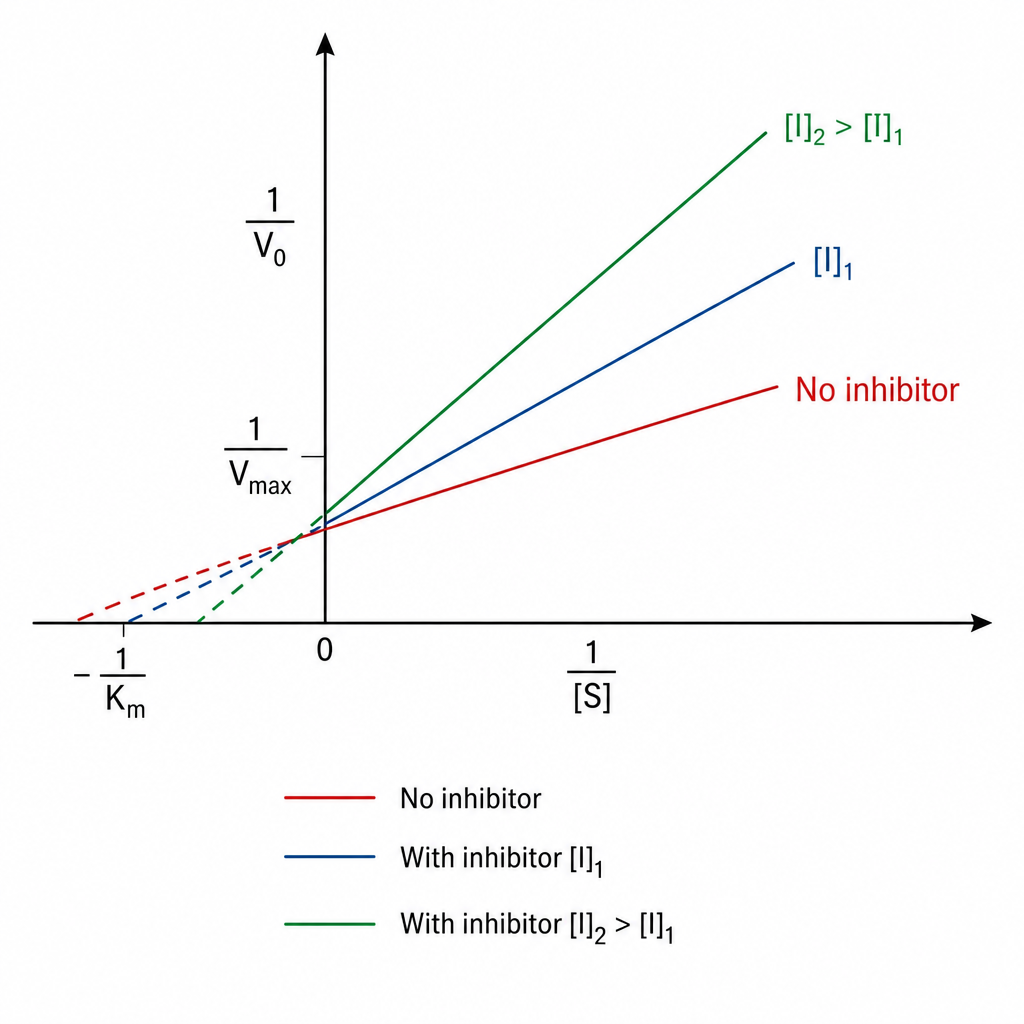
Which of the following statements is correct regarding the given graph?
Km of an enzyme is
Which of the following statements best describes the mechanism of action of insulin on target cells?
Kcat/Km is a measure of which of the following?
Km increases, but Vmax remains same. This is which type of inhibition?
Which of the following statements about isozymes is true?
What is the specific activity of an enzyme?
Which kinetic parameter is primarily associated with enzyme specificity?
Which enzyme has the highest turnover number in biochemical reactions?
Explanation: ***Isocitrate to Alpha-ketoglutarate (Isocitrate dehydrogenase)*** - **Isocitrate dehydrogenase** is the **rate-limiting enzyme** and the **most significant regulatory control point** of the TCA cycle - It catalyzes the first **irreversible NADH-generating step** after citrate formation, making it the key determinant of cycle flux - Strongly **activated by ADP** (indicating low energy status) and **Ca²⁺** (in mitochondria) - Strongly **inhibited by NADH and ATP** (indicating high energy status), providing sensitive energy-status regulation - This is the primary control point recognized in standard biochemistry references *Alpha-ketoglutarate to Succinyl-CoA (Alpha-ketoglutarate dehydrogenase complex)* - The **alpha-ketoglutarate dehydrogenase complex** is an important regulatory enzyme with irreversible catalysis - Inhibited by its products **NADH** and **succinyl-CoA**, as well as by **ATP** - While it is one of the three main control points, it is considered a **secondary regulatory site** compared to isocitrate dehydrogenase *Acetyl-CoA + Oxaloacetate to Citrate (Citrate synthase)* - **Citrate synthase** catalyzes the first committed step of the TCA cycle and is the entry point for acetyl-CoA - Subject to **product inhibition by citrate** and allosteric inhibition by **ATP, NADH, and succinyl-CoA** - Although highly regulated and crucial for initiating the cycle, it is not the rate-limiting step *Succinyl-CoA to Succinate (Succinyl-CoA synthetase)* - This reaction involves **substrate-level phosphorylation** to produce **GTP (or ATP)** - It is a **reversible reaction** and generally not a primary regulatory step - Regulation depends mainly on substrate availability rather than complex allosteric control mechanisms
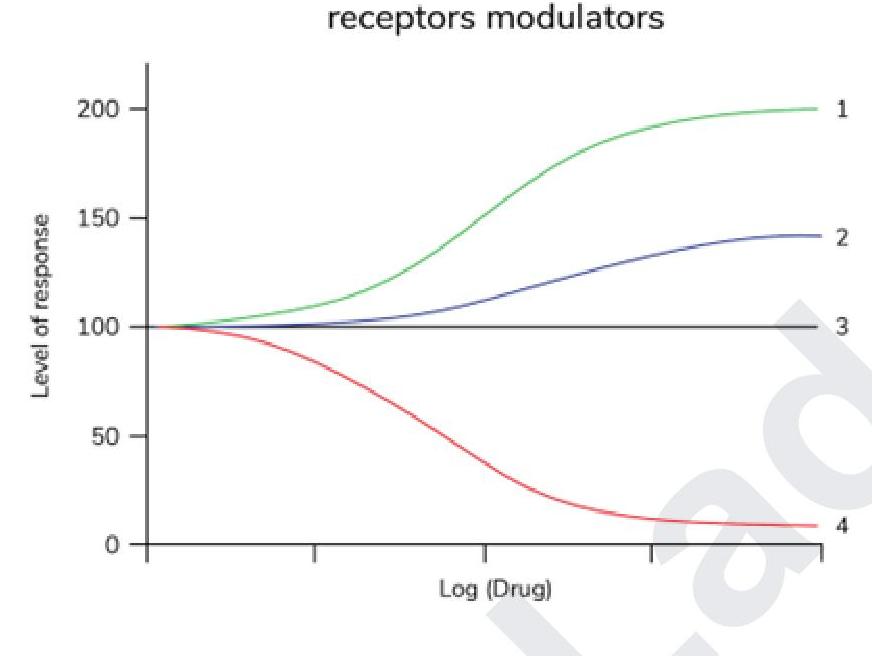
Explanation: ***Drug 1 represents agonist and drug 4 represent inverse agonist*** - **Drug 1** demonstrates maximal efficacy, producing a **supraphysiologic response** above the baseline (100%), characteristic of an **agonist**. - **Drug 4** produces a response **below the baseline** (100%), indicating inhibition of constitutive receptor activity, which is the definition of an **inverse agonist**. *Drug 1 represents agonist and drug 2 represents inverse agonist* - While **Drug 1** is correctly identified as an **agonist** due to its maximal effect above baseline, **Drug 2** is a **partial agonist**, as it produces a submaximal effect above baseline but does not reach the full agonist's efficacy. - **Drug 2** does not reduce the baseline response, so it cannot be an inverse agonist. *Drug 3 represents agonist and drug 4 represents inverse agonist* - **Drug 3** maintains the **baseline response** (at 100%) regardless of concentration, indicating it is a **neutral antagonist** or has no effect, not an agonist. - **Drug 4** is correctly identified as an **inverse agonist** because it reduces the baseline receptor activity. *Drug 2 represents partial agonist and drug 3 represents inverse agonist* - **Drug 2** is correctly identified as a **partial agonist** as it produces an effect above baseline but less than a full agonist. - **Drug 3** is incorrect; it shows no change from baseline (100%), reflecting a **neutral antagonist** or inactive substance, not an inverse agonist which would decrease the baseline response.
Explanation: ***The substrate concentration at half maximum velocity*** - **Km** (Michaelis constant) represents the **substrate concentration** at which the reaction velocity is **half of the maximum velocity (Vmax)**. - A **low Km** indicates a **high affinity** of the enzyme for its substrate, meaning it achieves half-maximal velocity at a lower substrate concentration. *Numerically identical for all isozymes that catalyses a given reaction* - **Isozymes** are different forms of an enzyme that catalyze the same reaction but may have **different Km values**, reflecting varying affinities for their substrate and different regulatory properties. - For example, **hexokinase** and **glucokinase** are isozymes with different Kms for glucose, reflecting their different physiological roles. *The normal physiological substrate concentration* - While Km is often in the range of **physiological substrate concentrations**, it is not defined as the normal physiological concentration itself. - It is a **kinetic parameter** determined experimentally and describes the enzyme's affinity, not the in vivo substrate availability. *Dissociation constant* - **Km** is technically an **apparent dissociation constant** but is not strictly equivalent to the true dissociation constant (Kd) of the enzyme-substrate complex. - It approximates Kd only under specific conditions where the **rate of ES breakdown to product is much slower than the dissociation of ES back to E + S**.
Explanation: ***Insulin binds to a transmembrane receptor on the outer surface of the plasma membrane, activating the tyrosine kinase in the cytosolic domain of the receptor.*** - **Insulin** is a **peptide hormone** and cannot freely pass through the lipid bilayer, thus it binds to a **transmembrane receptor** on the cell surface. - This binding leads to the activation of the receptor's intrinsic **tyrosine kinase activity** in the intracellular domain, initiating a signaling cascade. *Insulin binds to a cytoplasmic receptor and is transferred as a hormone receptor complex to the nucleus to modulate gene expression.* - This mechanism describes the action of **steroid hormones**, which are lipid-soluble and can cross the cell membrane, binding to **intracellular receptors**. - **Insulin** acts via a **cell surface receptor** and its downstream effects are mediated through signal transduction pathways, not direct nuclear translocation. *Insulin binds to a receptor on the outer surface of the plasma membrane, activating adenylate cyclase through the Gs protein.* - This mechanism is characteristic of **G-protein coupled receptors (GPCRs)**, which activate or inhibit enzymes like adenylate cyclase via G-proteins to produce second messengers like cyclic AMP. - The **insulin receptor** is a **receptor tyrosine kinase**, not a GPCR, and does not directly activate adenylate cyclase via Gs protein. *Insulin enters the cell and causes the release of calcium ions from intracellular stores.* - While some hormones and neurotransmitters can trigger the release of intracellular **calcium ions**, this is typically mediated by specific pathways (e.g., GPCRs linked to phospholipase C). - **Insulin** does not directly enter target cells to cause calcium release; its actions are primarily mediated through receptor tyrosine kinase signaling pathways.
Explanation: **Correct: Enzyme efficiency** - The ratio **kcat/Km** is the definitive measure of an enzyme's **catalytic efficiency** or **specificity constant** - It reflects how effectively an enzyme converts substrate to product at low substrate concentrations - A higher **kcat/Km** value indicates greater efficiency, combining high catalytic rate (kcat) with strong substrate affinity (low Km) - This is the most important parameter for comparing different enzymes or different substrates for the same enzyme *Incorrect: Speed of enzymatic reaction* - **kcat** (turnover number) alone measures the maximum speed when enzyme is saturated with substrate - **kcat/Km** is a more comprehensive measure that includes substrate binding affinity, not just reaction speed - Speed also depends on enzyme and substrate concentrations, which kcat/Km doesn't directly represent *Incorrect: Concentration of substrate* - **Km** (Michaelis constant) represents the substrate concentration at which reaction velocity is half of Vmax - **kcat/Km** is a ratio that describes enzyme performance across substrate concentrations, not the concentration itself - It's particularly useful for predicting enzyme behavior at physiological (low) substrate concentrations *Incorrect: Enzyme turnover* - **kcat** specifically measures enzyme turnover: the number of substrate molecules converted per enzyme molecule per unit time at saturation - **kcat/Km** incorporates both kcat and Km, providing overall efficiency rather than just turnover rate - Turnover is only one component of the efficiency measure
Explanation: ***Competitive*** - In **competitive inhibition**, the inhibitor **reversibly binds** to the **active site** of the enzyme, competing with the substrate. - This competition means that a higher substrate concentration is required to achieve half-maximal velocity, thus **increasing the Km**, while the maximum velocity (**Vmax**) remains unchanged if sufficient substrate is present. *Uncompetitive* - **Uncompetitive inhibition** involves the inhibitor binding only to the **enzyme-substrate complex**. - This type of inhibition typically leads to a **decrease in both Km and Vmax**. *Non-competitive* - In **non-competitive inhibition**, the inhibitor binds to a site other than the active site (allosteric site) on either the free enzyme or the enzyme-substrate complex. - This binding usually **decreases the Vmax** (due to reduced enzyme efficiency) but does not affect the Km (as substrate binding is not directly hindered). *Irreversible* - **Irreversible inhibition** involves the formation of a strong, often covalent, bond between the inhibitor and the enzyme, permanently inactivating it. - This type of inhibition effectively **reduces the concentration of active enzyme**, leading to a **decrease in Vmax** (as fewer enzyme molecules are available to catalyze the reaction) with varying effects on Km depending on the mechanism.
Explanation: ***They catalyze the same reaction but may differ in structure.*** - Isozymes are **different forms of an enzyme** that catalyze the **same biochemical reaction** but have distinct amino acid sequences. - Due to their different amino acid sequences, isozymes can exhibit variations in their **molecular structure**, kinetic properties, and regulatory mechanisms. *They have the same quaternary structure.* - While some isozymes might have a similar quaternary structure (e.g., both being tetramers), it is not a defining characteristic; they often have **different subunit compositions** or arrangements. - Their structural differences, including quaternary structure, contribute to their distinct properties and often reflect their expression in **different tissues or developmental stages**. *They have the same enzyme classification but differ in number and name.* - Isozymes belong to the **same enzyme classification** (e.g., EC number) because they catalyze the identical reaction, but they are **not necessarily numbered differently** as distinct enzymes. - Their differing names typically reflect the tissue they are found in or their specific subunits (e.g., lactate dehydrogenase isozymes **LDH-1 to LDH-5**). *They are distributed uniformly across different organs.* - Isozymes typically exhibit a **tissue-specific distribution**, meaning their presence and relative abundance vary significantly between different organs and tissues. - This differential distribution allows for **fine-tuning metabolic pathways** to meet the specific physiological demands of each tissue.
Explanation: ***Enzyme units per mg of protein*** - **Specific activity** is defined as the number of **enzyme units** (representing catalytic activity) per milligram of total protein in the sample. - It is a measure of **purity**, indicating the amount of active enzyme relative to other proteins in a preparation. - Formula: Specific activity = Units of enzyme activity / mg of total protein - Used to track enzyme purification progress during isolation procedures. *Concentration of substrate transformed per minute* - This describes the **reaction velocity** or rate of catalysis, but not the specific activity of the enzyme. - While related to enzyme activity, it does not normalize the activity to the amount of **total protein**. - This would be expressed as reaction rate or velocity (V), not specific activity. *Enzyme units per mg of substrate* - This is an incorrect formulation that confuses substrate with protein. - **Specific activity** is normalized to the amount of **protein** in the enzyme preparation, not the substrate. - This option represents a common misconception in enzyme kinetics terminology. *Limit of enzyme per gram of substrate* - This phrase does not correspond to any standard biochemical measure of enzyme activity or concentration. - It does not provide information about the **catalytic efficiency** or **purity** of the enzyme preparation. - The term "limit" is not used in the context of specific activity measurements.
Explanation: ***None of the options*** - **Enzyme specificity** is primarily determined by the unique three-dimensional **active site structure** of the enzyme, which allows it to bind only to specific substrates through complementary shape and chemical interactions. - This structural complementarity involves steric fit and specific non-covalent interactions (hydrogen bonds, van der Waals forces, electrostatic interactions) between the enzyme and its substrate. - **Neither Km nor Vmax are determinants of enzyme specificity**—they are kinetic parameters that describe enzyme behavior, not structural selectivity. *Km (Michaelis constant)* - Represents the substrate concentration at which the reaction rate is half of Vmax. - Indicates the **affinity** of an enzyme for its substrate (lower Km = higher affinity). - While enzymes may show different Km values for different substrates, **Km reflects binding affinity, not the structural basis of specificity**. *Vmax (Maximum velocity)* - The maximum rate of reaction when the enzyme is saturated with substrate. - Reflects **catalytic efficiency** and the amount of active enzyme present. - Does not relate to the enzyme's ability to discriminate between different substrate molecules. *Both* - Incorrect because neither Km nor Vmax determines which substrates an enzyme can recognize and bind. - Enzyme specificity is a **structural property** of the active site, while Km and Vmax are **kinetic properties** that describe reaction rates.
Explanation: ***Catalase*** - **Catalase** exhibits an exceptionally high turnover number, converting millions of molecules of hydrogen peroxide to water and oxygen per second. - Its high catalytic efficiency is crucial for protecting cells from **oxidative damage**, as hydrogen peroxide is a toxic byproduct of metabolism. *LDH* - **Lactate dehydrogenase (LDH)** catalyzes the interconversion of pyruvate and lactate, an important step in anaerobic metabolism. - While an efficient enzyme, its turnover number is significantly lower than that of catalase due to different metabolic requirements and substrate specificities. *Trypsin* - **Trypsin** is a protease involved in protein digestion, cleaving peptide bonds at specific sites. - Its catalytic rate is high for its function as a digestive enzyme, but it does not reach the extraordinary turnover numbers of enzymes like catalase, which handle highly reactive and abundant substrates. *None of the options* - This option is incorrect because **catalase** is a known enzyme with one of the highest turnover numbers reported in biochemistry. - Identifying the enzyme with the highest turnover among the given choices is a direct knowledge recall question in enzymology.
Get full access to all questions, explanations, and performance tracking.
Start For Free