Contraindication to neuraxial block is ?
In an accident case, after the arrival of medical team, all should be done in early management except;
Child with aspiration risk needs emergency surgery. Best induction sequence is:
True about anesthesia cylinders is all EXCEPT:
Which of the following is not done in the primary survey of trauma?
A 50 year old male is posted for elective laparoscopic cholecystectomy. No history of comorbidities. His surgery is scheduled at 2 PM on the day of surgery. Which of the following is against the ASA guidelines for preoperative fasting
Depth of Anesthesia is best measured by:
All are absolute contraindication of neuraxial anaesthesia except:
A moribund patient unlikely to survive 24 hours without surgery is classified as
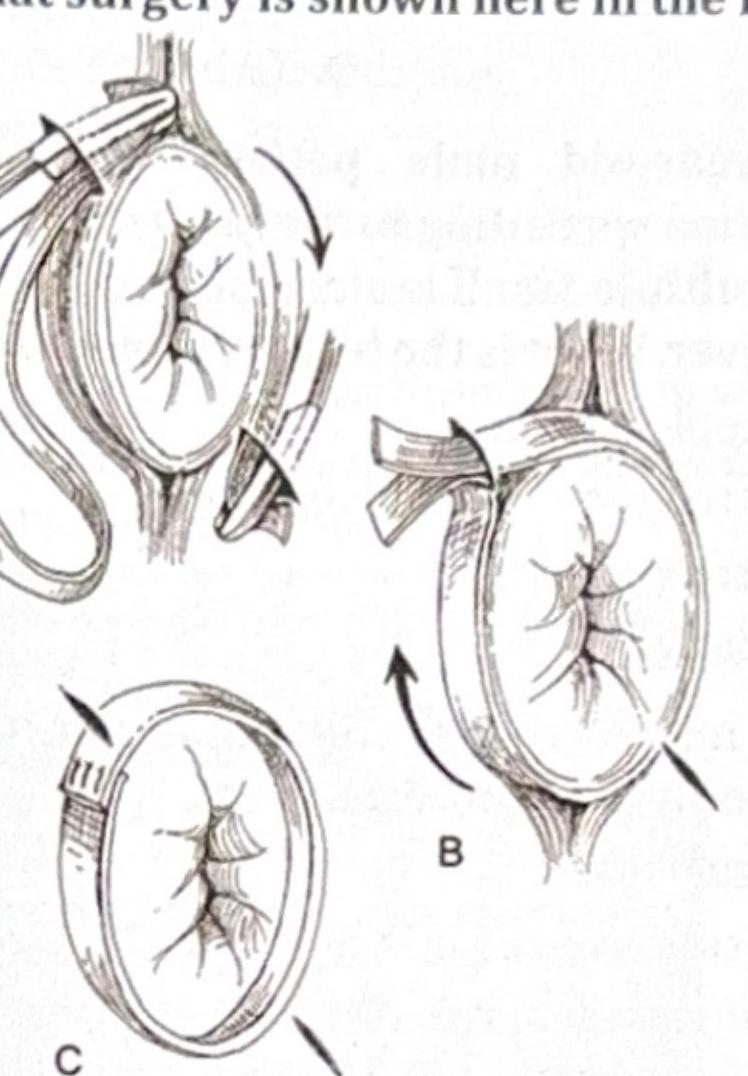
What surgery is shown here in the image?
Explanation: ***Clotting disorders*** - **Coagulopathy** is a major contraindication to neuraxial block due to the risk of **spinal hematoma**, which can lead to neurological deficits. - This includes patients on **anticoagulants** or with conditions like **thrombocytopenia** or hemophilia. *Hypertension* - While uncontrolled **severe hypertension** may be a relative contraindication, mild to moderate hypertension is generally not. - Neuraxial blocks can sometimes even help manage hypertension by causing **vasodilation**. *Renal disease* - **Chronic renal disease** itself is not a contraindication to neuraxial blocks. - However, complications of renal disease, such as **uremic coagulopathy**, would be a contraindication. *Diabetes* - **Diabetes mellitus** is not a contraindication to neuraxial blockade. - In fact, it may be beneficial by improving **glucose control** compared to general anesthesia in surgical patients.
Explanation: ***Check BP*** - In the **immediate/early management** of trauma (primary survey), while circulation assessment is crucial, the **initial assessment of circulation** focuses on: - **Pulse rate and quality** (radial, carotid) - **Capillary refill time** - **Skin color and temperature** - **Active hemorrhage control** - **Formal blood pressure measurement** with a cuff, while important, is typically recorded during or after these rapid initial assessments, as it takes more time to obtain an accurate reading. - In the context of this question, among the four options listed, BP measurement is relatively less immediate compared to the other life-saving priorities (airway protection, breathing assessment, C-spine stabilization, and GCS). - **Note:** This is a nuanced distinction - BP is assessed during primary survey, but the other three options have more immediate life-threatening implications if not addressed. *Glasgow coma scale* - **GCS assessment** is part of the **"D" (Disability)** step in the ATLS primary survey. - It is performed early to assess neurological status and level of consciousness. - GCS <8 indicates need for **definitive airway protection** (intubation). - This is a critical early assessment that guides immediate management decisions. *Stabilization of cervical vertebrae* - **C-spine immobilization** is part of the **"A" (Airway)** step - "Airway with cervical spine protection." - It is performed **simultaneously** with airway assessment using a **rigid cervical collar**. - This is the **first priority** in trauma management to prevent secondary spinal cord injury. - All trauma patients should be assumed to have C-spine injury until proven otherwise. *Check Respiration* - **Respiratory assessment** is part of the **"B" (Breathing)** step in the ATLS primary survey. - This involves checking: - **Respiratory rate and pattern** - **Chest wall movement** - **Air entry bilaterally** - **Signs of tension pneumothorax or flail chest** - This is an immediate life-saving priority and must be assessed early.
Explanation: ***Preoxygenation-propofol-succinylcholine*** - This sequence describes a **rapid sequence intubation (RSI)**, which is the preferred method for patients at high risk of aspiration, including children needing emergency surgery with an unknown fasting status. - **Preoxygenation** provides an oxygen reserve during the apneic period, **propofol** offers rapid induction with good hemodynamic stability, and **succinylcholine** provides fast-onset, short-acting neuromuscular blockade, crucial for preventing aspiration. *Preoxygenation-ketamine-succinylcholine* - While preoxygenation and succinylcholine are appropriate for RSI, **ketamine** may not be the optimal choice for a child with aspiration risk due to its potential to increase secretions and maintain laryngeal reflexes, which could complicate intubation. - Ketamine can also cause **emergence delirium** in some children, making it less favorable for a smooth anesthetic course compared to propofol. *Sevoflurane-propofol-succinylcholine* - **Sevoflurane** is an inhaled anesthetic often used for mask induction in children due to its non-pungent odor and rapid onset. However, it is generally **not suitable for RSI** in patients with aspiration risk as it has a slower induction time compared to intravenous agents and can cause coughing or laryngospasm. - Using both sevoflurane and propofol for induction in an RSI scenario is redundant and prolongs the induction phase, increasing aspiration risk. *Midazolam-propofol-rocuronium* - **Midazolam** is a benzodiazepine used for anxiolysis and sedation but has a **slower onset** and longer duration of action compared to propofol for rapid induction. - **Rocuronium** is a non-depolarizing neuromuscular blocker with a slower onset of action than succinylcholine, making it less ideal for RSI where immediate paralysis for intubation is critical to prevent aspiration.
Explanation: *DISS is the safety mechanism to prevent wrong fitting of cylinder to machine.* - **DISS (Diameter Index Safety System)** is a safety system used on pipelines and some cylinder connections, but not on the primary connection of a cylinder to an anesthesia machine which uses the **PISS (Pin Index Safety System)**. - The **PISS** is specifically designed to prevent the wrong gas cylinder from being fitted to the wrong yoke on the anesthesia machine. ***Most commonly used cylinder is type E.*** - **Type E cylinders** are indeed the most commonly used size for anesthetic gases attached directly to the anesthesia machine. - Their compact size makes them suitable for use as **reserve gas supplies** on the machine or for transport. *Cylinders are part of high pressure system.* - Gas cylinders contain gases at very high pressures (e.g., oxygen up to **2200 psi**), making them part of the **high-pressure system** of the anesthesia machine. - This high pressure needs to be reduced by a **pressure regulator** before the gas can be delivered to the patient. *Air is stored in cylinder with grey body with black and white shoulder.* - The correct color coding for **medical air cylinders** is a **grey body** with **black and white shoulders**. - This standardized color coding helps healthcare professionals quickly identify the cylinder's contents.
Explanation: ***NCCT head*** - A **Non-Contrast CT (NCCT) head** is typically performed during the **secondary survey** once the patient is hemodynamically stable and life-threatening conditions have been addressed. - The primary survey focuses on immediate **life-saving interventions** for airway, breathing, circulation, disability, and exposure. *Intubation* - **Intubation** is a critical intervention during the primary survey, specifically under the **'A' (Airway)** component, to establish and secure a patent airway in a compromised patient. - Failure to establish an airway can rapidly lead to **hypoxia** and death. *ICD drainage* - **Intercostal drain (ICD) drainage** is an urgent intervention in the primary survey, falling under **'B' (Breathing)**, to manage conditions like **tension pneumothorax** or massive hemothorax. - These conditions can severely compromise ventilation and circulation, requiring immediate relief. *CXR* - A **Chest X-ray (CXR)** is a rapid and essential diagnostic tool in the primary survey, also under **'B' (Breathing)**, to identify life-threatening thoracic injuries such as pneumothorax, hemothorax, or mediastinal shift. - It provides quick information crucial for immediate management decisions.
Explanation: **Pancakes at 10:00 AM** - According to ASA guidelines, the fasting period for solid food is typically **6-8 hours** before surgery. Eating pancakes, which are solid food, at 10:00 AM for a 2:00 PM surgery (4-hour interval) violates this guideline. - This short fasting period for solids increases the risk of **pulmonary aspiration** during induction of anesthesia. *Water at 12:00 PM* - Water is considered a clear liquid, and ASA guidelines typically allow clear liquids until **2 hours** before surgery. Drinking water at 12:00 PM for a 2:00 PM surgery is within these guidelines. - Rapid gastric emptying of clear liquids minimizes the risk of aspiration. *Black coffee at 5:30 AM* - Black coffee is considered a clear liquid, and it is consumed well within the **2-hour** fasting window for clear liquids before a 2:00 PM surgery. - The absence of milk or cream ensures it is treated as a clear liquid, which empties quickly from the stomach. *A non-clear liquid (e.g., orange juice) at 7:30 AM* - Non-clear liquids, such as orange juice, are treated similarly to light meals and generally require a fasting period of **6 hours** before surgery. Drinking orange juice at 7:30 AM for a 2:00 PM surgery (6.5-hour interval) is compliant with these guidelines. - The protein and pulp in non-clear liquids delay gastric emptying compared to clear liquids.
Explanation: ***BIS*** - The **BIS (Bispectral Index)** is an EEG-derived parameter that provides a quantitative measure of the patient's level of consciousness or depth of anesthesia. - A typical range for adequate surgical anesthesia is a BIS score between **40 and 60**, indicating a low probability of consciousness and recall. *TOF* - **TOF (Train-of-Four)** monitoring is used to assess the level of neuromuscular blockade, measuring the response of a muscle to a series of four electrical stimuli. - While important for managing **muscle relaxants**, it does not directly measure the depth of anesthesia or consciousness. *MAC* - **MAC (Minimum Alveolar Concentration)** is a measure of the potency of an inhaled anesthetic, defined as the concentration at which 50% of patients do not respond to a surgical stimulus. - It reflects the **ED50 of the anesthetic agent** itself rather than the patient's individual depth of anesthesia at a given moment. *Post Tetanic Potentiation* - **Post Tetanic Potentiation (PTP)** is a phenomenon observed during neuromuscular monitoring where a single twitch response is enhanced following a brief tetanus (rapid series of high-frequency stimuli). - PTP is used to assess **deep neuromuscular blockade** and recovery from paralytics, not the depth of anesthesia.
Explanation: ***Spinal deformity*** - While a **spinal deformity** can make neuraxial anesthesia technically challenging, it is generally considered a **relative contraindication**, not an absolute one. - The procedure can still be performed by an experienced anesthetist, potentially with imaging guidance, if the benefits outweigh the risks. *Local infection of site* - A **local infection** at the needle insertion site is an **absolute contraindication** due to the high risk of spreading infection into the central nervous system, leading to potentially life-threatening conditions such as **meningitis** or **epidural abscess**. - Introducing bacteria into the cerebrospinal fluid or epidural space is a severe complication to avoid. *Raised Intracranial pressure* - **Raised intracranial pressure (ICP)** is an **absolute contraindication** because puncturing the dura mater can lead to a rapid decrease in cerebrospinal fluid (CSF) pressure, resulting in brain herniation. - This sudden pressure gradient can cause devastating neurological injury or death. *Coagulopathy* - **Coagulopathy**, whether intrinsic (e.g., hemophilia) or iatrogenic (e.g., anticoagulation), is an **absolute contraindication** to neuraxial anesthesia. - The primary concern is the formation of an **epidural or spinal hematoma**, which can compress the spinal cord and lead to permanent neurological damage, including paralysis.
Explanation: ***ASA V*** - An **ASA V** patient is defined as a **moribund patient** who is not expected to survive without the operation. - This classification applies to patients with a high risk of death, often within **24 hours**, even with surgical intervention. *ASA III* - An **ASA III** patient has **severe systemic disease** that functional limitations, but is not incapacitating. - While serious, their condition is not immediately life-threatening to the extent of a moribund patient. *ASA VI* - An **ASA VI** patient is declared **brain-dead** and is undergoing surgery for **organ donation**. - This classification describes a patient who is already deceased from a neurological perspective, rather than one on the verge of death. *ASA I* - An **ASA I** patient is a **normal healthy** individual with no systemic disease. - This is the lowest risk category and contrasts sharply with the critical condition described in the question.
Explanation: ***Thiersch wiring*** - The image clearly depicts a **suture or wire** placed circumferentially around the anus to reduce its caliber, which is the hallmark of a **Thiersch procedure**. - This technique is used to treat **anal incontinence** by constricting the anal opening and improving sphincter function. *Hemorrhoidectomy* - This procedure involves the **surgical removal of hemorrhoids** and the images do not show any identifiable hemorrhoidal tissue being excised. - While bleeding and prolapse can be associated with hemorrhoids, the depicted technique with circumferential wiring is not used for their removal. *Altemeier operation* - The Altemeier operation is a type of **perineal rectosigmoidectomy** for rectal prolapse that involves resecting the prolapsed segment of the rectum. - The image does not illustrate resection of rectal tissue; instead, it shows a constricting device around the anus. *Wells procedure* - The Wells procedure, or **rectopexy**, involves anchoring the rectum to the sacrum to correct rectal prolapse. - This procedure typically involves an abdominal approach and fixation techniques, which are not represented in the illustration.
Get full access to all questions, explanations, and performance tracking.
Start For Free