Best imaging modality for acute pulmonary embolism
Which of the following segments is present in the middle lobe of the right lung?
Which of the following statements regarding axillary lymph nodes is incorrect?
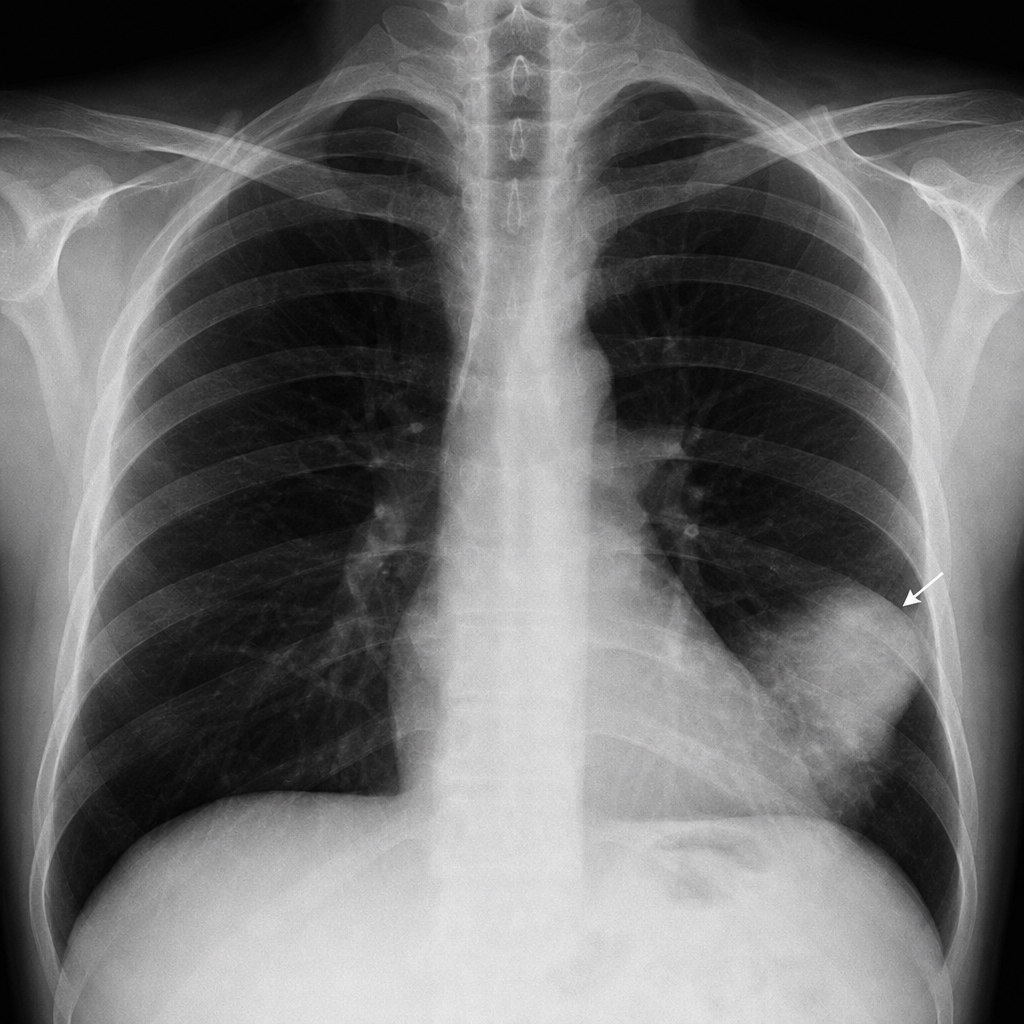
A chest X-ray shows a 'silhouette sign' with opacity obscuring the right heart border. Which lobe of the lung is most likely affected?
The thoracic duct crosses from the right to the left at the level of
The incidence of a foreign body being aspirated into the right lung is higher than into the left lung. All of the following statements support this, EXCEPT?
Carina is situated at which level?
Which of the following statements about the atrioventricular groove is true?
The aortic hiatus is formed by the right and left crura of the diaphragm. Which of the following structures does NOT pass through the aortic hiatus?
Left superior intercostal vein drains into?
Explanation: ***CT pulmonary angiogram*** - This is the **gold standard** imaging modality for diagnosing acute pulmonary embolism due to its high sensitivity and specificity in visualizing pulmonary arteries. - It rapidly provides detailed images of the pulmonary vasculature, allowing for direct visualization of **thrombi**. *V/Q scan* - A **V/Q scan** measures ventilation and perfusion of the lungs and is less definitive than CTPA, especially in patients with pre-existing lung disease. - It is often considered when **CTPA is contraindicated**, such as in cases of severe renal impairment or contrast allergy. *Chest X-ray* - A **chest X-ray** is generally used to rule out other causes of chest pain and shortness of breath, such as pneumonia or pneumothorax, rather than to diagnose PE directly. - It has **low sensitivity and specificity** for pulmonary embolism, as findings are often non-specific or normal even in the presence of PE. *MRI* - **Magnetic resonance angiography (MRA)** can be used, but it is typically reserved for patients who cannot undergo CTPA or V/Q scan due to contraindications like **pregnancy** or **renal failure**. - It often takes longer to perform and has lower spatial resolution compared to CTPA for pulmonary artery visualization.
Explanation: ***Medial*** - The **right middle lobe** of the lung consists of two bronchopulmonary segments: the **medial segment (S4)** and the lateral segment (S5) [1]. - The **medial segment** is located closer to the mediastinum and is supplied by the medial segmental bronchus. - These segments are defined by the branching pattern of the **bronchial tree** and pulmonary arteries, supplying specific areas of lung tissue [1]. *Anterior* - The **anterior segment** is part of the **right upper lobe**, not the middle lobe [1]. - The right upper lobe contains three segments: apical, posterior, and anterior segments [1]. - The middle lobe is separated from the upper lobe by the **horizontal (transverse) fissure**. *Upper* - "Upper" is not a specific bronchopulmonary segment name but rather refers to the **upper lobe** itself. - The **right upper lobe** is a distinct anatomical region from the middle lobe and contains apical, posterior, and anterior segments [1]. *Lower* - "Lower" is not a specific segment of the middle lobe but refers to the **lower lobe**. - The **right lower lobe** contains five segments: superior, medial basal, anterior basal, lateral basal, and posterior basal [1]. - The lower lobe is separated from the middle lobe by the **oblique fissure**.
Explanation: ***Lateral group lies along lateral thoracic vessels*** - The **lateral group** of axillary lymph nodes is located along the **axillary vein**, receiving lymph primarily from the upper limb [1]. - The **lateral thoracic vessels** are associated with the central and posterior groups of axillary lymph nodes, not the lateral group. *Posterior group lies along subscapular vessels* - The **posterior (subscapular) group** of axillary lymph nodes is indeed located along the **subscapular vessels**. - This group receives lymph from the posterior wall of the trunk and the posterior shoulder region. *Apical group is terminal lymph nodes* - The **apical group** (also known as the subclavian group) is considered the **terminal lymph nodes** of the axilla. - Lymph from all other axillary nodes eventually drains into the apical group before continuing to the supraclavicular nodes and then into the subclavian lymphatic trunk [2]. *Apical group lies along axillary vessels* - The **apical group** of axillary lymph nodes is situated in the apex of the axilla, superior to the pectoralis minor muscle, and lies in close proximity to the **axillary vessels** [1]. - This location allows it to receive lymph from other axillary groups and drain into the supraclavicular lymph nodes.
Explanation: ***Right middle lobe*** - The **silhouette sign** occurs when two objects of similar radiographic density are in direct contact, obscuring their common border. - The **right middle lobe** is adjacent to the right heart border, so an opacity in this lobe will typically obscure the border. *Right upper lobe* - The right upper lobe is positioned superiorly and medially, meaning opacification would more likely obscure the **right paratracheal stripe** or the superior mediastinal borders. - It does not directly border the right heart, thus it would not produce a silhouette sign with the cardiac outline. *Right lower lobe* - The right lower lobe is primarily associated with obscuring the **right hemidiaphragm** when it collapses or becomes consolidated. - Although it is somewhat posterior to the heart, it usually does not directly obscure the anterior right heart border. *Left lower lobe* - The left lower lobe is on the opposite side of the chest and opacification would not affect the **right heart border**. - Consolidation here would more likely obscure the **left hemidiaphragm** or the medial part of the left cardiac silhouette in certain views.
Explanation: ***T4-T5 vertebra*** - The **thoracic duct** crosses from the right to the left side of the vertebral column at the level of the **T4-T5 vertebrae**, specifically just above the root of the left lung. - This crossover is an important anatomical landmark as it signifies the duct's ascent towards the neck to drain into the left subclavian vein. *T12 vertebra* - The **thoracic duct** originates from the **cisterna chyli** at the level of the L1 or L2 vertebra and ascends into the thorax at or below the T12 vertebra, it does not cross over at this level. - This level primarily marks its entry into the thoracic cavity, not its main crossover point. *T6 vertebra* - While the **thoracic duct** is present in the thorax at this level, it does not undergo its characteristic crossover from right to left at the T6 vertebra. - The duct continues its ascent along the right side of the vertebral column before moving across. *T2 vertebra* - By the level of the T2 vertebra, the **thoracic duct** has already crossed to the left side of the vertebral column and is ascending towards its termination in the neck. - The crossover event occurs more inferiorly, at the T4-T5 level.
Explanation: ***Right lung is shorter and wider than left lung*** - This statement, while anatomically true, does **NOT directly explain** why foreign bodies preferentially enter the right lung - The dimensions of the **lung parenchyma itself** (shorter due to the diaphragm being pushed up by the liver, and wider) are unrelated to aspiration patterns - What determines aspiration is the **bronchial tree geometry** (angle, diameter, verticality), not the overall lung size - This is the EXCEPTION - it's a true anatomical fact but doesn't support the aspiration phenomenon *Incorrect - Tracheal bifurcation directs the foreign body to the right lung* - This statement DOES support higher right aspiration, so it cannot be the answer - The **carina angle** and bifurcation geometry favor the right side, directing foreign bodies preferentially to the right main bronchus - This is a key anatomical reason for the higher incidence *Incorrect - Right inferior lobar bronchus is in continuation with the right principal bronchus* - This statement DOES support higher right aspiration - After the right superior lobar bronchus branches off, the **intermediate bronchus** continues more directly toward the inferior lobe - This creates a straighter pathway from trachea → right main bronchus → intermediate bronchus → inferior lobar bronchus - Foreign bodies follow this direct path, often lodging in the right inferior lobe *Incorrect - Right principal bronchus is more vertical than the left bronchus* - This statement DOES support higher right aspiration - The right main bronchus diverges at approximately **25 degrees** from vertical, while the left diverges at **45 degrees** - This more vertical orientation makes the right bronchus a more direct continuation of the trachea - Gravity and airflow naturally direct aspirated material down this straighter path
Explanation: ***T4*** - The **carina**, the point where the trachea bifurcates into the left and right main bronchi, is most commonly located at the level of the **T4-T5 intervertebral disc** or approximately the **T4-T5 vertebral level**. - Among the given options, **T4** is the most accurate answer as it represents the closest anatomical landmark. - The carina corresponds to the **sternal angle (angle of Louis)** anteriorly, which is at the level of the second costal cartilage. - This anatomical landmark is crucial in clinical procedures like **bronchoscopy**, **endotracheal tube placement**, and radiologic imaging. - Note: The exact level varies slightly with respiration and individual anatomy. *T3* - The **T3 vertebral level** is **superior to the carina** and corresponds to structures in the upper mediastinum. - This level is too high for the tracheal bifurcation. *T9* - The **T9 vertebral level** is significantly **inferior to the carina**, located in the lower thoracic region. - This level corresponds to the **xiphisternal junction** anteriorly. - Important structures at this level include the inferior vena cava passing through the diaphragm (at T8). *T6* - The **T6 vertebral level** is **inferior to the carina**. - While the carina may descend to approximately this level during deep inspiration, the anatomical resting position is higher. - This level is associated with the **xiphoid process** anteriorly.
Explanation: ***Also called coronary sulcus*** - The **atrioventricular groove** is a critical anatomical landmark that separates the atria from the ventricles on the external surface of the heart. - This anatomical division is consistently referred to as the **coronary sulcus**, which encircles the entire heart. *Contains left anterior descending coronary artery* - The **left anterior descending (LAD) coronary artery**, also known as the anterior interventricular artery, lies within the **interventricular groove** (or sulcus), not the atrioventricular groove. - The interventricular groove separates the left and right ventricles, distinct from the atrioventricular separation. *Contains left coronary artery* - The **left coronary artery (LCA)** is a short main trunk that almost immediately divides into the **left anterior descending** (LAD) and **circumflex arteries** [1]. - While the **circumflex artery** (a branch of the LCA) runs in the left part of the atrioventricular groove, the main left coronary artery itself is too short to be considered within the groove [1]. *Contains posterior descending artery* - The **posterior descending artery (PDA)**, also known as the posterior interventricular artery, lies within the **posterior interventricular groove**, separating the ventricles posteriorly. - The PDA is a branch of either the right coronary artery (in most people) or the circumflex artery, but it follows the interventricular septum, not the atrioventricular border.
Explanation: ***Left gastric vein*** - The **left gastric vein** is part of the **portal venous system** and drains into the portal vein. - It **does NOT pass through the diaphragm** via the aortic hiatus or any other diaphragmatic opening. - It has **no anatomical relationship** with the aortic hiatus, making it the best answer to this question. *Thoracic duct* - The **thoracic duct** is the largest lymphatic vessel in the body and **passes through the aortic hiatus** along with the aorta. - It ascends through the aortic hiatus at the **T12 vertebral level** to eventually drain into the left subclavian vein. - It lies posterior to the aorta as it traverses the hiatus. *Left vagus nerve* - The **left vagus nerve** does NOT pass through the aortic hiatus, but it **does pass through the esophageal hiatus** at the T10 level. - It contributes to the **anterior vagal trunk** as it enters the abdomen with the esophagus. - While this structure doesn't pass through the aortic hiatus, it does traverse the diaphragm through a different opening, making it a less definitive answer than the left gastric vein. *Azygos vein* - The **azygos vein** typically **passes through the aortic hiatus** alongside the aorta and thoracic duct. - It may occasionally pass through a separate opening in the right crus of the diaphragm. - It collects deoxygenated blood from the posterior walls of the thorax and abdomen before draining into the superior vena cava.
Explanation: ***Brachiocephalic vein*** - The **left superior intercostal vein** is formed by the confluence of the **2nd and 3rd** left posterior intercostal veins. - It typically drains into the **left brachiocephalic vein**, which then contributes to the superior vena cava. *Hemiazygos vein* - The **hemiazygos vein** is on the left side of the vertebral column and primarily drains the lower left posterior intercostal veins (9th-11th). - It usually joins the **azygos vein** around the T8-T9 vertebral level, rather than directly receiving the left superior intercostal vein. *Internal thoracic vein* - The **internal thoracic veins** drain the anterior sensory chest wall and typically run alongside the sternum. - While they eventually drain into the brachiocephalic veins, they do not directly receive the posterior intercostal veins like the left superior intercostal vein. *Azygos vein* - The **azygos vein** is primarily on the right side of the vertebral column, draining the right posterior intercostal veins. - It usually receives the **hemiazygos** and **accessory hemiazygos veins** but not the left superior intercostal vein directly.
Get full access to all questions, explanations, and performance tracking.
Start For Free