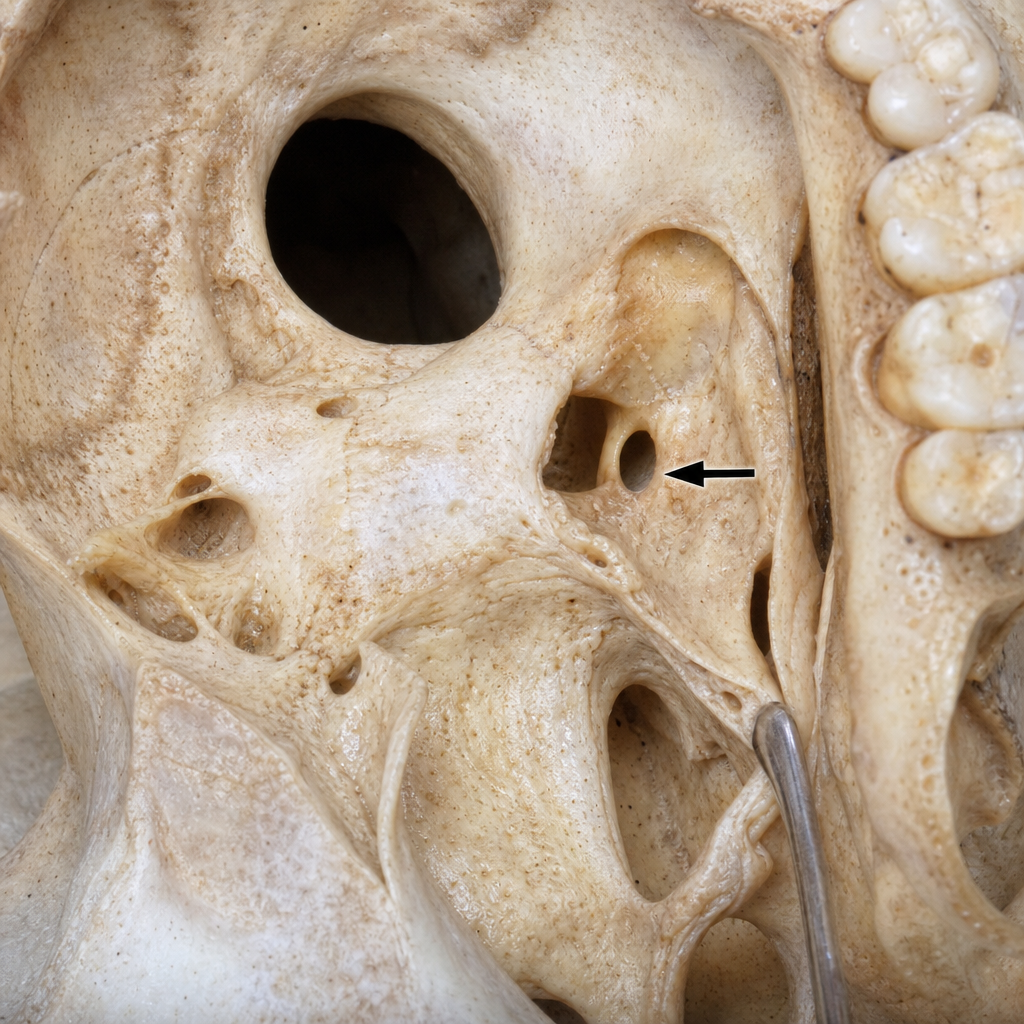
What are the cells of the cochlea called?
What is the sensory supply of the tongue, excluding which nerve?
Which extraocular muscle facilitates downward rotation, medial rotation, and extorsion of the eyeball?
What is the term for the osseocartilaginous junction on the dorsum of the nose?
Which of the following statements about the parotid gland is FALSE?
What is the action of the ciliary muscle?
A 14-year-old female presents with quinsy in the right side of her oropharynx. During surgical removal of the pathologic tissue or incision and drainage of the area, which of the following arteries is at greatest risk?
The Eustachian tube opens into which part of the middle ear cavity?
All of the following cranial nerves traverse through the cavernous sinus, EXCEPT?
Which is the first permanent tooth to erupt?
Explanation: **Explanation:** The **Organ of Corti**, located within the scala media of the cochlea, is the sensory organ of hearing [1]. It contains specialized mechanoreceptors known as **hair cells**, which are categorized into two types [1]: 1. **Inner Hair Cells (IHCs):** Arranged in a single row (approx. 3,500), these are the primary sensory receptors that convert mechanical sound vibrations into neural signals sent to the auditory nerve [1]. 2. **Outer Hair Cells (OHCs):** Arranged in three to four rows (approx. 12,000), these act as "cochlear amplifiers," physically elongating and contracting to enhance the sensitivity and frequency selectivity of the cochlea [2]. **Analysis of Options:** * **Option A (Epitheliocytipilon):** This is a non-existent medical term. While the Organ of Corti is derived from the otic vesicle epithelium, this specific term is incorrect. * **Option C (Transitional apical hair cells):** While the cochlea has an "apex" (helicotrema), "transitional apical hair cells" is not a standard anatomical classification for the functional cells of the cochlea. * **Option D:** Incorrect, as Option B is the standard anatomical fact. **High-Yield NEET-PG Pearls:** * **Innervation:** 90-95% of the auditory nerve fibers (Type I spiral ganglion neurons) innervate the **Inner Hair Cells**, despite them being fewer in number. * **Otoacoustic Emissions (OAEs):** These are generated by the spontaneous or evoked movements of the **Outer Hair Cells**. * **Stereocilia:** These are the "hairs" atop the cells; they are bathed in **endolymph** (high $K^+$), while the cell bodies are bathed in **perilymph** [3]. * **Damage:** Aminoglycoside toxicity and loud noise exposure typically damage the **Outer Hair Cells** first.
Explanation: The sensory innervation of the tongue is a high-yield topic in NEET-PG, involving multiple cranial nerves based on embryological origins. [1] **Why Option C is Correct:** The **8th Cranial Nerve (Vestibulocochlear nerve)** is purely responsible for hearing and equilibrium (balance). It has no anatomical course or functional role related to the oral cavity or the tongue. Therefore, it is the only nerve among the options that does not contribute to tongue sensation. [1] **Analysis of Incorrect Options:** * **5th Cranial Nerve (Trigeminal):** The **Lingual nerve** (a branch of the Mandibular division, V3) provides **general sensation** (touch, pain, temperature) to the **anterior 2/3rd** of the tongue. * **7th Cranial Nerve (Facial):** The **Chorda tympani** branch joins the lingual nerve to provide **special sensation (taste)** to the **anterior 2/3rd** of the tongue. [1] * **9th Cranial Nerve (Glossopharyngeal):** This nerve provides **both general and special sensation** to the **posterior 1/3rd** of the tongue, including the vallate papillae. [1] **High-Yield Clinical Pearls for NEET-PG:** * **Posterior-most part (Vallecula):** Supplied by the **Internal Laryngeal nerve** (branch of the 10th Cranial Nerve/Vagus). [1] * **Motor Supply:** All muscles of the tongue (intrinsic and extrinsic) are supplied by the **12th Cranial Nerve (Hypoglossal)**, *except* for the **Palatoglossus**, which is supplied by the Pharyngeal plexus (Cranial part of Accessory nerve via Vagus). * **Developmental Tip:** The anterior 2/3rd develops from the lingual swellings (Ectoderm), while the posterior 1/3rd develops from the hypobranchial eminence (Endoderm).
Explanation: The movements of the eyeball are determined by the orientation of the extraocular muscles relative to the visual axis. The **Inferior Rectus (IR)** originates from the common tendinous ring and inserts into the inferior aspect of the sclera. Because its insertion is lateral to its origin (forming an angle of 23° with the visual axis), it exerts a complex pull [1]. 1. **Why Inferior Rectus is correct:** * **Depression (Downward rotation):** Its primary action when the eye is abducted [1]. * **Extorsion (Lateral rotation):** Its secondary action; it pulls the lower pole of the eye medially, causing the 12 o'clock position of the cornea to rotate outward. * **Adduction (Medial rotation):** Its tertiary action; due to its medial approach from the apex of the orbit [1]. 2. **Why the other options are incorrect:** * **Superior Rectus:** This is the "opposite" muscle; it causes elevation, intorsion, and adduction [1]. * **Levator Palpebrae Superioris:** This muscle acts on the upper eyelid (elevation) rather than the eyeball itself. * **Medial Rectus:** This is a pure adductor; it does not contribute to vertical rotation or torsion [1]. **High-Yield Clinical Pearls for NEET-PG:** * **RAD Rule:** **R**ecti are **AD**ductors (except Lateral Rectus). Therefore, Superior and Inferior Recti both cause medial rotation. * **SIN Rule:** **S**uperior muscles are **IN**torsionists (Superior Oblique and Superior Rectus). Conversely, Inferior muscles are **Extorsionists**. * **Testing Position:** To isolate the action of the Inferior Rectus for clinical testing (pure depression), the patient is asked to look **outward (abduction)** and then down.
Explanation: The correct answer is **Rhinion**. The **Rhinion** is a critical anthropometric landmark representing the soft tissue and bony junction on the dorsum of the nose. Anatomically, it corresponds to the most distal (inferior) point of the internasal suture, where the nasal bones meet the upper lateral cartilages. This area is clinically significant as the skin is thinnest over the rhinion, making any underlying dorsal hump or irregularity highly visible. **Analysis of Incorrect Options:** * **Nasion (A):** This is the midline point where the internasal suture meets the nasofrontal suture. It represents the "root" of the nose or the depression between the eyes. * **Columella (B):** This refers to the fleshy external bridge of tissue that separates the nostrils at the base of the nose, formed primarily by the medial crura of the lower lateral cartilages. * **Glabella (D):** This is the most forward-projecting point in the midline of the forehead, located between the eyebrows on the frontal bone, superior to the nasion. **High-Yield Clinical Pearls for NEET-PG:** * **Surgical Significance:** In rhinoplasty, the rhinion is often the site of a "dorsal hump" (composed of both bone and cartilage). * **Skin Thickness:** The skin of the nose is thickest at the nasion, thins out at the **rhinion**, and becomes thick and sebaceous again at the tip (supratip area). * **Radix:** The most depressed part of the nasal dorsum, usually located at the level of the nasion.
Explanation: ### Explanation **1. Why Option B is the Correct (False) Statement:** The parotid gland contains approximately 20–30 lymph nodes. Crucially, the **superficial lobe** (located lateral to the facial nerve) contains the vast majority of these nodes. These nodes are divided into pre-auricular and infra-auricular groups. The deep lobe contains very few, if any, lymph nodes. This is clinically significant because most parotid lymphadenopathy or primary parotid tumors originate in the superficial lobe. **2. Analysis of Other Options:** * **Option A:** The parotid gland is anatomically divided into a superficial and deep lobe by the **facial nerve** and its branches (the "Patey’s plane"). This is a surgical landmark used during parotidectomy to avoid nerve injury. * **Option C:** Stensen’s duct (parotid duct) emerges from the anterior border of the gland, pierces the buccinator muscle, and opens into the vestibule of the mouth opposite the **crown of the upper second molar**. * **Option D:** The **lesser petrosal nerve** (a branch of the glossopharyngeal nerve, CN IX) carries preganglionic parasympathetic fibers to the **otiс ganglion**. Postganglionic fibers then travel via the auriculotemporal nerve to provide secretomotor innervation to the gland. **3. NEET-PG High-Yield Clinical Pearls:** * **Structures passing through the gland (Superficial to Deep):** Facial nerve → Retromandibular vein → External carotid artery (**Mnemonic: F-V-A**). * **Frey’s Syndrome:** Occurs due to aberrant regeneration of the auriculotemporal nerve, where parasympathetic fibers meant for the parotid gland instead innervate sweat glands, leading to "gustatory sweating." * **Mumps:** Viral infection causing parotid swelling; pain is exacerbated by eating because the parotid fascia (derived from the investing layer of deep cervical fascia) is dense and unyielding.
Explanation: The **ciliary muscle** is a smooth muscle located within the ciliary body of the eye. Its primary function is **accommodation**, which is the process of adjusting the eye's focal length to maintain a clear image of near objects. ### Why Option C is Correct: The ciliary muscle is connected to the lens via suspensory ligaments called **zonules**. * **Contraction:** When the ciliary muscle contracts, it moves inward (towards the lens). This reduces the tension on the zonular fibers. * **Result:** The lens, being elastic, becomes more **spherical (convex)**. This increases its refractive power, allowing the eye to focus on near objects. * **Relaxation:** When the muscle relaxes, zonular tension increases, flattening the lens for distant vision. ### Why Other Options are Incorrect: * **Option A (Constriction of the pupil):** This is the function of the **Sphincter Pupillae** muscle, located in the iris. While both the ciliary muscle and sphincter pupillae are supplied by parasympathetic fibers from the Edinger-Westphal nucleus (CN III), they perform distinct roles [1]. * **Option B (Dilatation of the pupil):** This is the function of the **Dilator Pupillae** muscle, which is under sympathetic control. ### High-Yield Clinical Pearls for NEET-PG: 1. **Nerve Supply:** The ciliary muscle receives **parasympathetic** innervation via the **short ciliary nerves** (postganglionic fibers from the **ciliary ganglion**) [1]. 2. **Presbyopia:** With age, the lens loses its elasticity. Even if the ciliary muscle contracts, the lens cannot become spherical, leading to difficulty in near vision. 3. **Cycloplegia:** Drugs like **Atropine** paralyze the ciliary muscle (cycloplegia), resulting in a loss of accommodation and blurred near vision. 4. **Glaucoma Connection:** Contraction of the ciliary muscle also opens the trabecular meshwork, facilitating the drainage of aqueous humor [2].
Explanation: **Explanation:** The clinical scenario describes **Quinsy (Peritonsillar Abscess)**, which occurs in the peritonsillar space between the palatine tonsil capsule and the superior constrictor muscle. **Why the correct answer is right:** The **tonsillar artery**, which is a branch of the **Facial artery**, is the main arterial supply to the palatine tonsil. It pierces the superior constrictor muscle to enter the lower pole of the tonsil. During incision and drainage or tonsillectomy, this artery (or its parent facial artery, which lies just lateral to the constrictor) is at the highest risk of injury, leading to significant hemorrhage. Additionally, the **external palatine vein** (paratonsillar vein) is a common source of bleeding in this region. **Why the incorrect options are wrong:** * **Lingual artery:** While it supplies the tongue and gives off dorsal lingual branches to the tonsil, it lies deeper and more inferiorly, making it less vulnerable during a superficial drainage of a peritonsillar abscess. * **Superior laryngeal artery:** This is a branch of the superior thyroid artery. It pierces the thyrohyoid membrane to supply the larynx; it is anatomically distant from the oropharyngeal tonsillar fossa. * **Ascending pharyngeal artery:** Although it contributes to the tonsillar blood supply via its pharyngeal branches, it is located more medially on the pharyngeal wall and is not the primary vessel at risk compared to the facial artery branches. **NEET-PG High-Yield Pearls:** * **Tonsillar Bed:** Formed mainly by the **Superior Constrictor** and Styloglossus muscles. * **Nerve at Risk:** The **Glossopharyngeal nerve (CN IX)** lies in the tonsillar bed and can be injured, leading to loss of taste/sensation in the posterior 1/3 of the tongue. * **Most common vessel for primary hemorrhage:** Tonsillar artery (branch of Facial). * **Most common vessel for venous hemorrhage:** External palatine vein.
Explanation: The Eustachian tube (auditory tube) connects the nasopharynx to the **anterior wall** of the tympanic cavity [1]. This connection is vital for equalizing pressure between the middle ear and the atmosphere [1]. ### Why the Anterior Wall is Correct: The anterior wall (carotid wall) of the middle ear is narrow because of the proximity of the internal carotid artery. It contains two major openings: the upper canal for the **tensor tympani muscle** and the lower, larger opening for the **Eustachian tube**. ### Why Other Options are Incorrect: * **Medial Wall (Labyrinthine wall):** This wall separates the middle ear from the inner ear. Key structures here include the **promontory** (basal turn of the cochlea), the **oval window** (fenestra vestibuli), and the **round window** (fenestra cochleae). * **Lateral Wall (Membranous wall):** Formed primarily by the **tympanic membrane** and the bony epitympanic recess [1]. It does not house the Eustachian tube. * **Posterior Wall (Mastoid wall):** Features the **aditus to the mastoid antrum**, the pyramid (housing the stapedius muscle), and the vertical segment of the facial nerve. ### High-Yield Clinical Pearls for NEET-PG: * **Structure:** The Eustachian tube is approximately 36mm long; the lateral 1/3 is bony, while the medial 2/3 is fibrocartilaginous. * **Muscles:** The **Tensor Veli Palatini** is the primary muscle responsible for opening the tube during swallowing or yawning (the "safety valve" of the middle ear) [1]. * **Pediatric Anatomy:** In children, the tube is shorter, wider, and more horizontal, which explains the higher incidence of ascending infections leading to **Otitis Media**. * **Relations:** The internal carotid artery lies immediately anterior to the anterior wall, separated only by a thin plate of bone.
Explanation: The **cavernous sinus** is a large venous plexus located on either side of the body of the sphenoid bone. Understanding the specific arrangement of structures within its walls versus its lumen is a high-yield topic for NEET-PG. ### **Explanation of the Correct Answer** The **Maxillary nerve (V2)** is often a point of anatomical debate, but for standard PG entrance exams, it is classically described as traversing the **lateral wall** of the cavernous sinus only in its posterior part before exiting through the **foramen rotundum**. However, in the context of this specific question, the **Abducens (VI)**, **Oculomotor (III)**, and **Trochlear (IV)** are more "intimate" residents. More importantly, the **Mandibular nerve (V3)** never enters the sinus, and the Maxillary nerve is frequently the "exception" in questions where the others are more definitively associated with the sinus throughout their course. *Note: In some advanced anatomical texts, V2 is considered to be outside the sinus entirely, making it the most appropriate "Except" choice among the options provided.* ### **Analysis of Incorrect Options** * **A. Oculomotor (III):** Located in the **lateral wall** (superior-most nerve). * **B. Trochlear (IV):** Located in the **lateral wall**, immediately below the III nerve. * **D. Abducens (VI):** This is the only nerve that travels **through the center (lumen)** of the sinus, medial to the internal carotid artery. It is the first nerve affected in cavernous sinus thrombosis. ### **High-Yield Clinical Pearls** 1. **Contents of the Lateral Wall (Superior to Inferior):** Oculomotor (III) → Trochlear (IV) → Ophthalmic (V1) → Maxillary (V2). 2. **Contents of the Center (Lumen):** Internal Carotid Artery (ICA) and Abducens Nerve (VI). 3. **Cavernous Sinus Thrombosis:** Typically presents with **ophthalmoplegia** and "pulsating exophthalmos." The Abducens nerve is usually the first to be paralyzed because it lies unprotected within the sinus lumen. 4. **Communications:** It communicates with the facial vein via the **superior ophthalmic vein** and **pterygoid plexus**, providing a route for infections from the "dangerous area of the face."
Explanation: **Explanation:** The eruption of permanent teeth is a critical milestone in dental anatomy and pediatric development. The **First Molar** (specifically the mandibular first molar) is the first permanent tooth to erupt, typically appearing at **6 years of age**. Because it erupts behind the second deciduous molar without replacing any primary tooth, it is often mistaken by parents for a primary tooth. This clinical significance has earned it the nickname the **"6-year molar."** It serves as the "cornerstone" of the dental arch, establishing the vertical dimension of the bite and the permanent occlusion. **Analysis of Incorrect Options:** * **First and Second Premolars (Options A & B):** These are "succedaneous" teeth, meaning they replace the primary molars. They typically erupt much later, between the ages of **10 and 12 years**. * **Second Molar (Option D):** This tooth erupts behind the first permanent molar, usually around **12 to 13 years** of age (often called the "12-year molar"). **High-Yield Clinical Pearls for NEET-PG:** * **Sequence of Eruption:** The general rule for permanent teeth is **M1-I1-I2-P1-P2-C-M2-M3** (Molar 1, Incisor 1, Incisor 2, Premolar 1, Premolar 2, Canine, Molar 2, Molar 3). *Note: In the mandible, the Canine often erupts before the Premolars.* * **First Primary Tooth:** The **Mandibular Central Incisor** is the first deciduous tooth to erupt (6–8 months). * **Calcification:** The first permanent tooth to begin calcification is the First Molar, which starts at **birth**. * **Mixed Dentition Period:** This period begins with the eruption of the first permanent molar (age 6) and ends with the shedding of the last primary tooth (age 12).
Skull and Facial Bones
Practice Questions
Scalp and Facial Muscles
Practice Questions
Dural Venous Sinuses
Practice Questions
Cranial Cavity
Practice Questions
Orbit and Contents
Practice Questions
Temporal and Infratemporal Regions
Practice Questions
Pterygopalatine Fossa
Practice Questions
Oral Cavity
Practice Questions
Paranasal Sinuses
Practice Questions
Applied Anatomy and Clinical Correlations
Practice Questions
Get full access to all questions, explanations, and performance tracking.
Start For Free