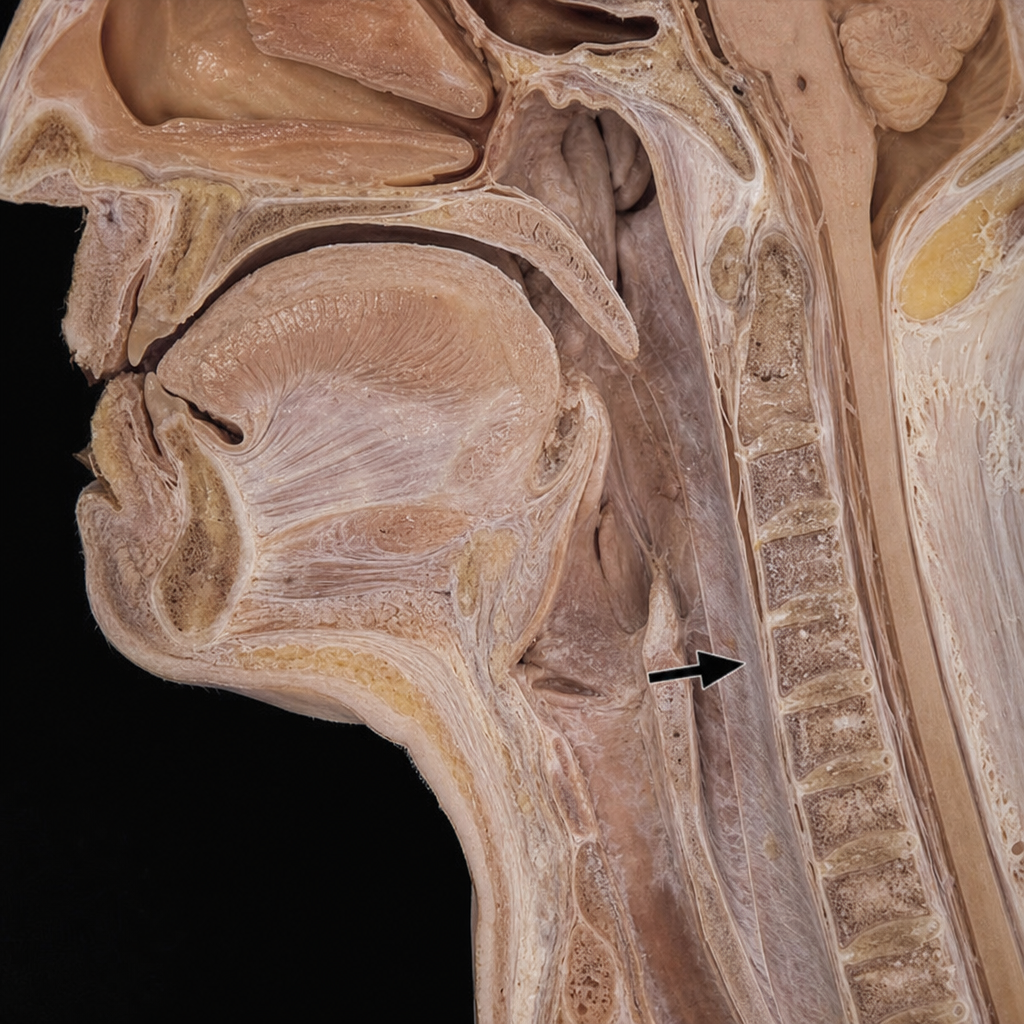
What is the primary lymphatic drainage site for the maxillary sinus?
All of the following are true about the middle ear cavity except?
What is the connecting vein between the facial vein and the cavernous sinus?
Fracture of the base of the skull may cause injury to the various cranial nerves, except:
Which of the following muscles of mastication has an opposite and independent function?
Which of the following cranial nerves does not contain parasympathetic motor (GVE) fibers?
Which nerve supplies the Muller muscle?
Which nerve supplies the muscle indicated by the second arrow?

What does the Greek letter lambda represent?
All of the following structures pierce the buccinator muscle, except:
Explanation: ### Explanation The lymphatic drainage of the paranasal sinuses follows a specific anatomical pattern based on their location and proximity to deep neck structures. **Why Retropharyngeal nodes are correct:** The **maxillary sinus** primarily drains its lymph into the **retropharyngeal lymph nodes**, particularly from its posterior aspect and floor. From there, the lymph eventually reaches the upper deep cervical nodes. In the context of NEET-PG, while some textbooks mention submandibular drainage for the anterior part of the sinus, the **primary and most characteristic** drainage site tested is the retropharyngeal group. **Analysis of Incorrect Options:** * **Submental nodes:** These drain the tip of the tongue, the floor of the mouth, and the central part of the lower lip. They do not receive drainage from the maxillary sinus. * **Submandibular nodes:** These primarily drain the frontal and ethmoidal sinuses, the anterior part of the nasal cavity, the upper lip, and the lateral parts of the lower lip. * **Upper deep cervical lymph nodes:** While these are the "final common pathway" for most head and neck structures (including the maxillary sinus), they are considered secondary nodes in this context. The retropharyngeal nodes act as the primary relay station. **Clinical Pearls for NEET-PG:** * **Frontal and Anterior Ethmoidal Sinuses:** Drain into the **Submandibular nodes**. * **Posterior Ethmoidal and Sphenoid Sinuses:** Drain into the **Retropharyngeal nodes**. * **Maxillary sinus Ostium:** Located in the **middle meatus** (hiatus semilunaris). Its high position makes natural drainage difficult, leading to frequent sinusitis. * **Cancer Spread:** Carcinoma of the maxillary sinus often presents with referred pain to the teeth (via the superior alveolar nerves) and can metastasize early to the retropharyngeal and deep cervical chains.
Explanation: The middle ear (tympanic cavity) is a six-sided, air-filled space within the petrous part of the temporal bone [1]. **Why Option C is the Correct (False) Statement:** The **tympanic membrane** forms the **lateral wall** (membranous wall) of the middle ear [1], not the medial wall. The **medial wall** (labyrinthine wall) separates the middle ear from the inner ear and features the promontory (basal turn of the cochlea), the oval window (fenestra vestibuli), and the round window (fenestra cochleae). **Analysis of Other Options:** * **Option A (Roof):** Formed by the **tegmen tympani**, a thin plate of the petrous temporal bone that separates the middle ear from the middle cranial fossa and temporal lobe of the brain. * **Option B (Anterior Wall):** Known as the carotid wall. It contains the openings for two canals: the **Eustachian tube** (auditory tube) [1] and the canal for the **tensor tympani muscle**. * **Option D (Floor):** Formed by a thin layer of bone separating the cavity from the **superior bulb of the internal jugular vein**. **High-Yield Clinical Pearls for NEET-PG:** * **Aditus ad antrum:** Located in the **posterior wall**, it connects the middle ear to the mastoid antrum. * **Facial Nerve:** The facial nerve canal runs along the medial and posterior walls; it is the most common site for nerve injury during mastoid surgery. * **Chorda Tympani:** A branch of the facial nerve that crosses the lateral wall (medial surface of the tympanic membrane) between the incus and malleus. * **Clinical Correlation:** Erosion of the tegmen tympani (roof) by a cholesteatoma can lead to temporal lobe abscesses or meningitis.
Explanation: ### Explanation The **facial vein** is a valveless vein that drains the superficial structures of the face. Its connection to the **cavernous sinus** (a dural venous sinus) is of immense clinical importance due to the potential for retrograde spread of infection. **1. Why Option A is Correct:** The facial vein communicates with the cavernous sinus primarily through the **superior ophthalmic vein**. The facial vein joins the angular vein at the medial canthus of the eye; the angular vein then continues as the superior ophthalmic vein, which passes through the **superior orbital fissure** to drain directly into the cavernous sinus. Because these veins lack valves, blood can flow in either direction depending on pressure gradients. **2. Analysis of Incorrect Options:** * **Option B (Inferior ophthalmic vein):** While it also drains into the cavernous sinus (or the superior ophthalmic vein), its primary connection is with the pterygoid venous plexus through the inferior orbital fissure, rather than being the direct main conduit from the facial vein. * **Option C (Pterygoid plexus):** The facial vein connects to the pterygoid plexus via the **deep facial vein**. While the pterygoid plexus eventually communicates with the cavernous sinus via emissary veins, the superior ophthalmic vein is the most direct and classic anatomical connection described for the facial vein. **3. Clinical Pearls for NEET-PG:** * **Danger Triangle of the Face:** This area (bounded by the upper lip, columella, and lateral angles of the mouth) is drained by the facial vein. * **Cavernous Sinus Thrombosis:** Infections from the "danger triangle" (e.g., a squeezed boil) can track retrogradely via the superior ophthalmic vein to the cavernous sinus, leading to life-threatening thrombosis. * **Key Nerves in Cavernous Sinus:** Remember that CN III, IV, V1, and V2 are in the lateral wall, while **CN VI** and the **Internal Carotid Artery** pass through the center.
Explanation: The base of the skull (skull base) is divided into the anterior, middle, and posterior cranial fossae. Fractures in these regions typically involve the various foramina through which cranial nerves exit. **Why Option C is the correct answer:** While the question asks which nerves are *excepted*, it is technically a "least likely" scenario based on anatomical protection. * **Cranial Nerve II (Optic Nerve):** It is encased within the **optic canal** in the sphenoid bone. While it can be injured in severe anterior/middle fossa fractures, it is often spared in general basal fractures compared to more superficial or exposed nerves. * **Cranial Nerve XII (Hypoglossal Nerve):** It exits via the **hypoglossal canal** in the occipital bone. This canal is located in a very thick, dense part of the skull base (the occipital condyles) and is deeply protected. Isolated injury to CN XII in a basal skull fracture is extremely rare compared to nerves in the petrous temporal bone or cribriform plate. **Analysis of Incorrect Options:** * **Option A (CN I and VII):** These are the **most commonly injured** nerves in skull base fractures. CN I (Olfactory) is easily torn at the fragile **cribriform plate** (Anterior Fossa) [1]. CN VII (Facial) is frequently injured in fractures of the **petrous part of the temporal bone** (Middle Fossa). * **Option B (CN II and V):** CN V (Trigeminal) branches exit through the superior orbital fissure, foramen rotundum, and foramen ovale. These areas are highly susceptible to middle cranial fossa fractures. **NEET-PG High-Yield Pearls:** 1. **Most common CN injured in skull base fracture:** CN I (Olfactory), leading to anosmia. 2. **Most common CN injured in temporal bone fractures:** CN VII (Facial). 3. **Battle’s Sign:** Post-auricular ecchymosis indicating a fracture of the posterior cranial fossa (mastoid part of temporal bone). 4. **Raccoon Eyes:** Periorbital ecchymosis indicating an anterior cranial fossa fracture. 5. **CSF Rhinorrhoea:** Occurs due to fracture of the cribriform plate (CN I area).
Explanation: The **Lateral Pterygoid** is unique among the muscles of mastication because it performs functions that are diametrically opposed to the others, earning it the reputation of having an "opposite and independent" role. ### Why Lateral Pterygoid is Correct: 1. **Depression (Opening) vs. Elevation (Closing):** While the Temporalis, Masseter, and Medial Pterygoid are primary **elevators** of the mandible (closing the mouth), the Lateral Pterygoid is the only muscle of mastication that **depresses** the mandible (opening the mouth) by pulling the condyle forward. 2. **Protrusion:** It is the chief muscle responsible for protrusion. 3. **Independent Action:** During side-to-side grinding movements, the lateral pterygoids can act independently or unilaterally to move the jaw to the opposite side. ### Why Other Options are Incorrect: * **Medial Pterygoid:** This muscle acts as a "mirror image" to the Masseter. Its primary function is to **elevate** the mandible. While it assists in protrusion and side-to-side movements, its main action (closing the jaw) aligns with the Masseter and Temporalis, not opposite to them. * **Both Lateral and Medial Pterygoid:** This is incorrect because their primary vertical functions are antagonistic (Lateral opens; Medial closes). They only act together during protrusion. ### High-Yield Clinical Pearls for NEET-PG: * **Insertion Tip:** The Lateral Pterygoid is the only muscle of mastication that inserts into the **neck of the mandibular condyle** and the **articular disc** of the TMJ. * **Nerve Supply:** All muscles of mastication are supplied by the **Mandibular Nerve (V3)**. * **TMJ Dynamics:** The superior head of the lateral pterygoid stabilizes the disc during jaw closure, while the inferior head is the primary opener. * **The "Opener":** Remember the mnemonic: **L**ateral **L**owers (Opens) the jaw; **M**edial **M**oves (Closes) it up.
Explanation: **Explanation:** The parasympathetic nervous system (craniosacral outflow) involves four specific cranial nerves that carry **General Visceral Efferent (GVE)** fibers to various ganglia in the head and neck [1]. These are **CN III, VII, IX, and X**. **1. Why VI is the correct answer:** The **Abducens nerve (CN VI)** is a purely somatic motor nerve. Its only function is to provide General Somatic Efferent (GSE) innervation to the **Lateral Rectus** muscle of the eye. It does not possess any autonomic (parasympathetic) nuclei or fibers. **2. Why the other options are incorrect:** * **CN III (Oculomotor):** Carries preganglionic parasympathetic fibers from the **Edinger-Westphal nucleus** to the ciliary ganglion. These fibers control the sphincter pupillae (miosis) and ciliary muscles (accommodation). * **CN IX (Glossopharyngeal):** Carries fibers from the **Inferior Salivatory nucleus** via the lesser petrosal nerve to the otic ganglion, providing secretomotor supply to the **parotid gland**. * **CN X (Vagus):** Carries fibers from the **Dorsal Nucleus of Vagus** to provide extensive parasympathetic innervation to the thoracic and abdominal viscera (up to the splenic flexure). **High-Yield NEET-PG Pearls:** * **Mnemonic for Parasympathetic CNs:** "3, 7, 9, 10" (or 1973). * **CN VII (Facial):** Often tested; it carries fibers from the **Superior Salivatory nucleus** to the submandibular and pterygopalatine ganglia (supplying lacrimal, submandibular, and sublingual glands). * **Purely Motor Nerves:** CN IV, VI, XI, and XII carry only motor fibers (GSE/SVE) and no parasympathetic components.
Explanation: The Muller muscle (superior tarsal muscle) is a smooth muscle located in the upper eyelid. Unlike the skeletal muscles of the eye, smooth muscles are under the control of the autonomic nervous system. 1. **Why Sympathetic nerve is correct:** The Muller muscle is innervated by **postganglionic sympathetic fibers** originating from the superior cervical ganglion [1]. These fibers travel along the internal carotid artery and eventually reach the muscle via the ophthalmic division of the trigeminal nerve. Its primary function is to maintain the "tone" of the upper eyelid, providing an additional 2 mm of eyelid elevation. 2. **Why other options are incorrect:** * **Facial nerve (CN VII):** Supplies the *Orbicularis oculi*, which is responsible for closing the eyelids (palpebral fissure). * **Trigeminal nerve (CN V):** Provides sensory innervation to the face and eye. While sympathetic fibers "hitchhike" on its branches, the nerve itself is not the motor source. * **Vagus nerve (CN X):** Primarily provides parasympathetic supply to thoracic and abdominal viscera; it has no role in eyelid elevation. **Clinical Pearls for NEET-PG:** * **Horner’s Syndrome:** Damage to the sympathetic pathway leads to **partial ptosis** (due to paralysis of Muller’s muscle), miosis, and anhidrosis [1]. * **Complete Ptosis:** Occurs with **Oculomotor nerve (CN III)** palsy because it supplies the *Levator palpebrae superioris* (the primary skeletal muscle elevator of the lid). * **Muller’s Muscle vs. LPS:** LPS is for voluntary/active elevation (CN III); Muller’s is for involuntary/tonic elevation (Sympathetic).
Explanation: ***Facial nerve*** - The **facial nerve (CN VII)** provides motor innervation to all **muscles of facial expression**, including those around the eyes, mouth, and cheeks. - It controls **voluntary facial movements** like smiling, frowning, and eye closure, making it responsible for the muscle indicated by the second arrow. *Maxillary nerve* - The **maxillary nerve (CN V2)** is purely **sensory**, providing sensation to the middle third of the face, upper lip, and maxillary teeth. - It has **no motor function** and does not innervate any muscles of facial expression. *Auditory nerve* - The **auditory/vestibulocochlear nerve (CN VIII)** is responsible for **hearing and balance** functions only. - It has **no motor component** to facial muscles and does not supply any muscles of facial expression. *Mandibular nerve* - The **mandibular nerve (CN V3)** primarily supplies the **muscles of mastication** (masseter, temporalis, pterygoid muscles) for chewing. - While it has motor function, it does **not innervate muscles of facial expression**, only muscles involved in jaw movement.
Explanation: **Explanation:** In human anatomy, **Lambda** refers to the craniometric point located at the junction of the **sagittal suture** and the **lambdoid suture** [1]. It marks the site of the **posterior fontanelle** in a newborn's skull [1]. The name is derived from the Greek letter 'λ' (lambda) because the intersection of these sutures resembles the shape of the lowercase letter. **Analysis of Options:** * **Option C (Lambda):** This is the correct anatomical term for the posterior junction of the skull sutures. It typically closes by 2–3 months of age, becoming the bony landmark known as lambda. * **Options A & B (Alpha and Beta):** These are Greek letters but do not represent specific craniometric landmarks on the skull. In medical science, Alpha and Beta are more commonly used to describe receptor types (e.g., adrenergic receptors) or brain wave patterns, rather than osteological points. **NEET-PG High-Yield Pearls:** 1. **Bregma:** The counterpart to Lambda, located anteriorly at the junction of the sagittal and coronal sutures (site of the anterior fontanelle) [1]. 2. **Closure Times:** The posterior fontanelle (Lambda) closes early (2–3 months), while the anterior fontanelle (Bregma) closes later (18–24 months). 3. **Pterion:** A H-shaped junction of four bones (Frontal, Parietal, Temporal, Sphenoid). It is a critical clinical landmark as the **middle meningeal artery** lies deep to it; trauma here can lead to an extradural hematoma. 4. **Asterion:** The junction of the parietomastoid, occipitomastoid, and lambdoid sutures.
Explanation: Explanation: The **buccinator muscle** forms the muscular substance of the cheek. Understanding the structures that pierce it is a high-yield topic for NEET-PG, as it differentiates between motor and sensory nerve supply to the face. **Why Option D is correct:** The **Buccal branch of the Mandibular nerve (Long Buccal Nerve)** provides sensory innervation to the skin over the buccinator and the mucous membrane of the cheek. Crucially, it **does not pierce** the muscle to reach its destination; instead, it passes between the two heads of the lateral pterygoid and then runs on the superficial surface of the buccinator before distributing to the skin and mucosa. **Analysis of Incorrect Options:** * **A. Parotid duct (Stensen’s duct):** This is the most famous structure piercing the buccinator. It enters the muscle opposite the upper second molar tooth to open into the oral cavity. * **B. Molar glands of the cheek:** These are small mucous glands situated between the buccinator and the mucous membrane; their ducts pierce the muscle to open into the vestibule of the mouth. * **C. Buccal branch of the Facial nerve:** This provides **motor** supply to the buccinator. To reach the deep surface of the muscle and provide innervation, these branches must pierce the overlying fascia and the muscle fibers. **High-Yield Clinical Pearls for NEET-PG:** * **Structures piercing the buccinator:** 1. Parotid duct, 2. Buccal branch of the facial nerve, 3. Ducts of the molar glands. * **Dual Nerve Supply Confusion:** Remember that the *Facial nerve* (CN VII) provides motor supply (pierces), while the *Mandibular nerve* (CN V3) provides sensory supply (does not pierce). * **Function:** The buccinator is known as the "accessory muscle of mastication" or the "whistling muscle." It prevents food from accumulating in the vestibule of the mouth.
Skull and Facial Bones
Practice Questions
Scalp and Facial Muscles
Practice Questions
Dural Venous Sinuses
Practice Questions
Cranial Cavity
Practice Questions
Orbit and Contents
Practice Questions
Temporal and Infratemporal Regions
Practice Questions
Pterygopalatine Fossa
Practice Questions
Oral Cavity
Practice Questions
Paranasal Sinuses
Practice Questions
Applied Anatomy and Clinical Correlations
Practice Questions
Get full access to all questions, explanations, and performance tracking.
Start For Free