A 40-year-old patient presents with dry eyes and reduced nasal secretions. On routine examination, the central nervous system was normal. In which of the following locations might a lesion be present?
Which of the following statements regarding the temporomandibular joint are true and false?
A patient is asked to protrude their tongue, and salt is placed on the anterior two-thirds of the tongue. This procedure is used for testing which nerve?
Which muscle is primarily responsible for the opening of the jaw?
All of the following are related to the facial nerve except?
Which of the following structures is located in the oropharynx?
At what age does the closure of the spheno-occipital suture typically occur?
Which artery is usually torn in a temporal bone fracture?
All except one are true regarding the cavernous sinus?
All of the following muscles are supplied by the pharyngeal plexus except?
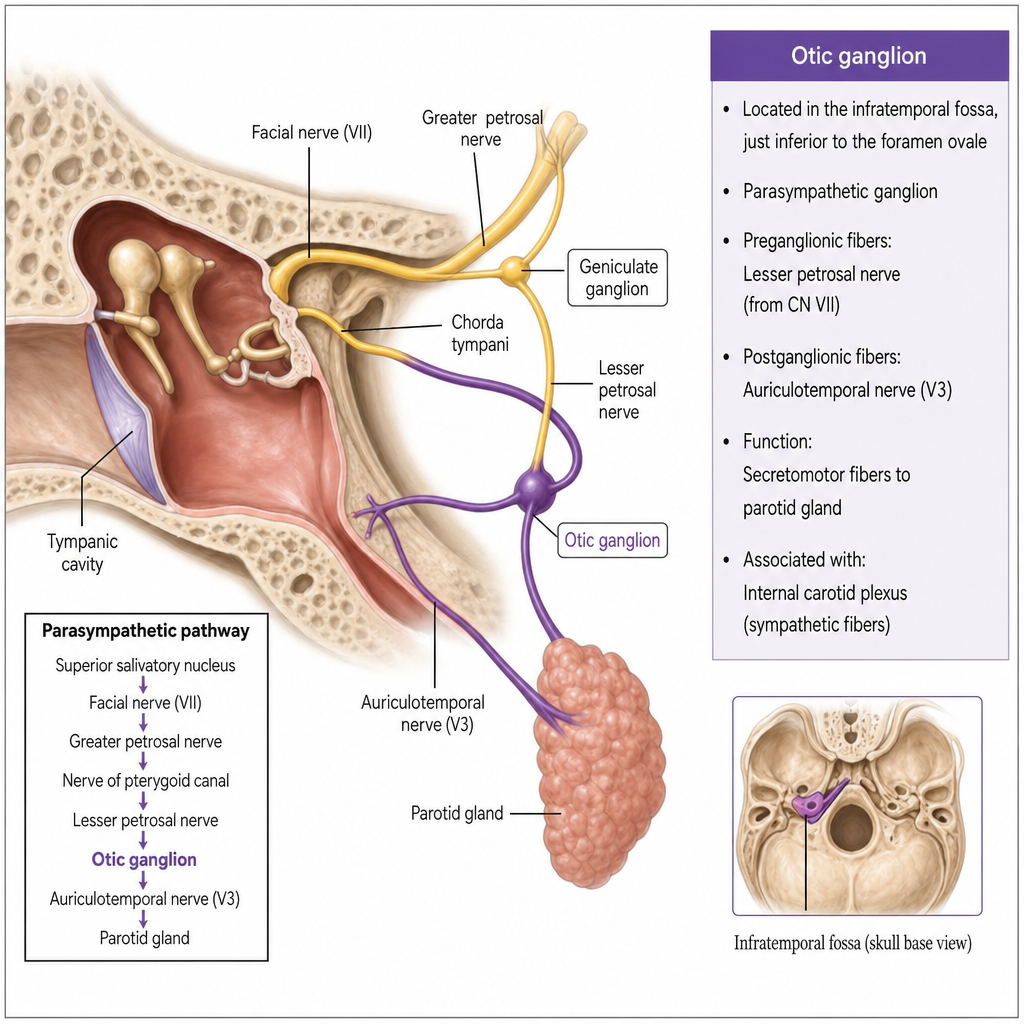
Explanation: The patient presents with **dry eyes (xerophthalmia)** and **reduced nasal secretions**, indicating a deficit in the parasympathetic innervation to the lacrimal gland and the mucosal glands of the nasal cavity. The **Sphenopalatine (Pterygopalatine) ganglion** is the "ganglion of hay fever." It receives preganglionic parasympathetic fibers from the **Greater Petrosal Nerve** (a branch of the Facial Nerve, CN VII). Postganglionic fibers from this ganglion provide secretomotor supply to: 1. **The Lacrimal Gland:** Via the maxillary nerve (zygomatic branch) and then the lacrimal nerve. 2. **Nasal and Palatine Glands:** Via the nasal and palatine nerves. Therefore, a lesion here explains both symptoms. **Analysis of Incorrect Options:** * **A. Otic Ganglion:** Provides secretomotor supply to the **parotid gland** via the auriculotemporal nerve. A lesion here would cause dry mouth (xerostomia), not dry eyes. * **C. Ciliary Ganglion:** Involved in the pupillary light reflex and accommodation [2]. A lesion would cause a dilated pupil (mydriasis) and loss of near vision, but does not affect lacrimation [2]. * **D. Superior Cervical Ganglion:** Provides **sympathetic** innervation to the head and neck. A lesion here results in **Horner’s Syndrome** (ptosis, miosis, anhidrosis), not a loss of parasympathetic secretions [1]. **High-Yield Clinical Pearls for NEET-PG:** * **Pathway of Lacrimation:** Lacrimatory nucleus (Pons) → Nervus intermedius → Geniculate ganglion → Greater petrosal nerve → Nerve of pterygoid canal (Vidian nerve) → **Sphenopalatine ganglion** → Maxillary nerve → Zygomaticotemporal nerve → Lacrimal nerve → Lacrimal gland. * The **Vidian Nerve** is formed by the union of the Greater Petrosal (parasympathetic) and Deep Petrosal (sympathetic) nerves. * **Sluder’s Neuralgia:** Also known as sphenopalatine ganglion neuralgia, often presents with referred pain to the maxilla and orbit associated with nasal congestion.
Explanation: The **Temporomandibular Joint (TMJ)** is a complex synovial joint of the **condylar variety**. Understanding its unique anatomy is crucial for NEET-PG. ### **Analysis of Statements** * **a - True:** The TMJ is a **bicondylar joint** where the head of the mandible articulates with the mandibular fossa and articular tubercle of the temporal bone. * **b - False:** The articular surfaces are covered by **fibrocartilage**, not hyaline cartilage. This is a high-yield distinction, as most synovial joints are hyaline-covered. * **c - False:** The joint cavity is divided into two distinct compartments (upper and lower) by an **intra-articular disc**, not a meniscus. * **d - True:** The **upper compartment** (meniscotemporal) allows for **gliding/translational movements** (protrusion and retraction), while the lower compartment (meniscomandibular) facilitates rotatory movements (hinge action). * **e - False:** The main nerve supply is the **auriculotemporal nerve** (a branch of the mandibular nerve), supplemented by the masseteric nerve. ### **Why Option C is Correct** Option C correctly identifies the histological nature of the articular surface (fibrocartilage) and the specific functional division of the joint compartments. ### **High-Yield Clinical Pearls** * **Muscles of Mastication:** Lateral pterygoid is the only muscle that **opens** the mouth (depresses the mandible) and is responsible for protrusion. * **Dislocation:** Occurs anteriorly into the infratemporal fossa, usually during a wide yawn or trauma. * **Derivation:** The mandible and muscles of mastication develop from the **1st Pharyngeal Arch**.
Explanation: ### Explanation The correct answer is **Facial nerve (VII)**. **1. Why the Facial Nerve is Correct:** The tongue has dual innervation for general sensation and special sensation (taste). The **anterior two-thirds** of the tongue receives taste fibers via the **chorda tympani**, which is a branch of the **Facial nerve (VII)** [1]. These fibers travel initially with the lingual nerve (a branch of V3) but originate from the nervus intermedius of the facial nerve [1]. Placing salt on this area specifically tests the integrity of the gustatory pathway of CN VII. **2. Why Other Options are Incorrect:** * **Trigeminal nerve (V):** The lingual nerve (V3) provides **general sensation** (touch, pain, temperature) to the anterior two-thirds of the tongue, not taste. * **Glossopharyngeal nerve (IX):** This nerve carries **both** general sensation and taste from the **posterior one-third** of the tongue (including the circumvallate papillae) [1]. * **Vagus nerve (X):** The internal laryngeal branch of the vagus nerve carries taste and general sensation from the extreme posterior part of the tongue (epiglottic region) [1]. **3. Clinical Pearls & High-Yield Facts for NEET-PG:** * **Motor Supply:** All muscles of the tongue (intrinsic and extrinsic) are supplied by the **Hypoglossal nerve (XII)**, *except* for the Palatoglossus, which is supplied by the **Cranial root of the Accessory nerve (XI)** via the pharyngeal plexus. * **Chorda Tympani Lesion:** A lesion proximal to the branching of the chorda tympani (as seen in Bell’s Palsy) results in **ageusia** (loss of taste) on the ipsilateral anterior two-thirds of the tongue and reduced salivation (submandibular/sublingual glands). * **Developmental Origin:** The anterior 2/3 develops from the lingual swellings (Ectoderm/Endoderm), while the posterior 1/3 develops from the cranial part of the hypobranchial eminence (Third pharyngeal arch).
Explanation: The muscles of mastication are a high-yield topic in NEET-PG Anatomy. To understand their function, one must distinguish between the muscles that close the jaw (elevators) and the one that opens it (depressor). ### **Explanation** **B. Lateral Pterygoid (Correct):** The lateral pterygoid is the **only** muscle of mastication primarily responsible for **opening the jaw** (depression of the mandible). It has two heads; the inferior head pulls the condyle of the mandible forward (protrusion) and downward along the articular eminence of the temporal bone, which results in the opening of the mouth. ### **Why the other options are incorrect:** * **A. Temporalis:** This is a powerful **elevator** of the mandible (closes the jaw). Its posterior fibers are also responsible for the **retraction** of the mandible. * **C. Medial Pterygoid:** This muscle acts as an **elevator** of the mandible, working synergistically with the masseter to close the jaw. * **D. Masseter:** This is the strongest muscle of mastication. Its primary function is the **elevation** of the mandible to provide the force required for crushing food. ### **High-Yield Clinical Pearls for NEET-PG:** * **Nerve Supply:** All four muscles of mastication are supplied by the **Mandibular nerve (V3)**, specifically the anterior division (except the medial pterygoid, which is supplied by the main trunk). * **The "Rule of L":** **L**ateral pterygoid **L**owers the jaw (and **L**ateralizes it). * **Trismus (Lockjaw):** Spasm of the elevator muscles (Masseter, Temporalis, Medial Pterygoid) prevents the mouth from opening. * **Jaw Deviation:** In a lower motor neuron lesion of the Mandibular nerve, the jaw deviates **towards the side of the lesion** upon opening because the healthy contralateral lateral pterygoid pushes the mandible toward the paralyzed side.
Explanation: The facial nerve (CN VII) is the nerve of the **second pharyngeal arch**. Understanding its anatomical course and derivatives is crucial for NEET-PG. ### Why "Maxillary Processes" is the Correct Answer The **maxillary process** is a derivative of the **first pharyngeal arch** (Mandibular arch). It is supplied by the **Maxillary nerve (V2)**, which is a branch of the Trigeminal nerve (the nerve of the first arch). Therefore, it has no embryological or functional relation to the facial nerve. ### Explanation of Other Options * **Posterior belly of the digastric:** This muscle is derived from the second pharyngeal arch. The facial nerve supplies it just after exiting the stylomastoid foramen. * **Stylomastoid foramen:** This is the anatomical exit point where the main trunk of the facial nerve leaves the skull (petrous temporal bone) to enter the parotid region. * **Parotid gland:** While the facial nerve does *not* provide secretomotor supply to the parotid, it passes **through** the substance of the gland, dividing it into superficial and deep lobes and branching into its five terminal motor branches. Note that the facial nerve does carry sensory fibers for taste from the anterior two-thirds of the tongue via the chorda tympani branch [1]. ### High-Yield Clinical Pearls * **Nerve of 2nd Arch:** Facial nerve. * **Intracranial Course:** Enters via Internal Acoustic Meatus $\rightarrow$ Facial canal $\rightarrow$ Exits via Stylomastoid foramen. * **The "Ze-By-Ma-C-Ce" Mnemonic:** Terminal branches in the parotid: **Te**mporal, **Zy**gomatic, **Bu**ccal, **Ma**rginal mandibular, and **Ce**rvical. * **Clinical Sign:** Damage at the stylomastoid foramen leads to **Bell’s Palsy** (LMN lesion), characterized by the inability to close the eye, loss of nasolabial fold, and drooping of the corner of the mouth.
Explanation: **Explanation:** The pharynx is divided into three parts: the nasopharynx, oropharynx, and laryngopharynx. The **oropharynx** extends from the soft palate above to the upper border of the epiglottis below. **Correct Answer: C. Palatine tonsil** The palatine tonsils are located in the lateral wall of the oropharynx, specifically within the **tonsillar fossa** between the palatoglossal arch (anteriorly) and the palatopharyngeal arch (posteriorly). This is a key landmark for both anatomy and clinical practice (tonsillectomy). **Analysis of Incorrect Options:** * **A. Pharyngotympanic (Eustachian) tube:** This structure opens into the lateral wall of the **nasopharynx**, posterior to the inferior nasal concha. It functions to equalize pressure in the middle ear. * **B. Fossa of Rosenmuller (Pharyngeal recess):** This is a deep slit-like depression located behind the tubal elevation in the **nasopharynx**. It is the most common site for the origin of Nasopharyngeal Carcinoma. * **D. Pyriform fossa:** This is a pear-shaped recess located on either side of the laryngeal inlet within the **laryngopharynx** (hypopharynx). It is a common site for the lodgment of foreign bodies (e.g., fish bones). **High-Yield Clinical Pearls for NEET-PG:** * **Waldeyer’s Ring:** A ring of lymphoid tissue at the pharyngeal entrance consisting of the Pharyngeal (adenoid), Tubal, Palatine, and Lingual tonsils. * **Nerve Supply:** The sensory supply to the oropharynx (including the gag reflex afferent) is the **Glossopharyngeal nerve (CN IX)**. * **Killian’s Dehiscence:** A potential weak spot between the thyropharyngeus and cricopharyngeus muscles in the laryngopharynx, leading to **Zenker’s diverticulum**.
Explanation: The spheno-occipital synchondrosis (often referred to as the spheno-occipital suture) is a primary cartilaginous joint located between the body of the sphenoid bone and the basilar part of the occipital bone. It is a critical growth center for the cranial base [1]. **Why Option B is correct:** In anatomical and forensic terms, the fusion of the spheno-occipital synchondrosis typically begins around puberty and is **completely closed by 18–25 years of age**. For the purpose of NEET-PG and standard medical textbooks (like Gray’s Anatomy), **18 years** is the accepted average age for complete ossification. Its closure marks the end of the longitudinal growth of the skull base [2]. **Analysis of Incorrect Options:** * **Option A (16 years):** While fusion may begin earlier in females (around 13–15 years), it is usually not complete across the entire population by 16 [2]. * **Option C (25 years):** Although some sources suggest fusion can continue until 25, 18 is the standard milestone used in most competitive examinations for "typical" closure. * **Option D (30 years):** This is far too late; the cranial base has long finished its growth by this age. **High-Yield Clinical Pearls for NEET-PG:** * **Forensic Significance:** The state of this suture is a reliable indicator for age estimation in skeletal remains (late adolescence vs. adulthood). * **Growth Direction:** Growth at this synchondrosis increases the length of the skull base in an anteroposterior direction. * **Clinical Correlation:** Premature closure (craniosynostosis) of this joint can lead to **midface hypoplasia**, commonly seen in conditions like Achondroplasia. * **Sequence:** It is one of the last sutures of the cranium to fuse, following the closure of the vault sutures.
Explanation: **Explanation:** The **middle meningeal artery (MMA)** is the correct answer because of its unique anatomical relationship with the **pterion**. The pterion is the H-shaped junction of the frontal, parietal, temporal, and sphenoid bones. It is the thinnest part of the skull and lies directly over the anterior branch of the MMA. A fracture of the temporal bone, particularly at the pterion, often lacerates this artery, leading to an **extradural (epidural) hemorrhage**. **Analysis of Incorrect Options:** * **Posterior auricular artery:** A branch of the external carotid artery that supplies the scalp behind the ear and the auricle; it is superficial and not typically involved in intracranial fractures. * **Transverse facial artery:** A branch of the superficial temporal artery that runs across the face below the zygomatic arch; it is involved in facial soft tissue injuries, not temporal bone fractures. * **Deep temporal artery:** These are branches of the maxillary artery that supply the temporalis muscle. While they are near the temporal bone, they are located deep to the muscle and outside the cranium, thus not associated with intracranial bleeding from a fracture. **Clinical Pearls for NEET-PG:** * **Source:** The MMA is a branch of the **first part of the maxillary artery** and enters the skull through the **foramen spinosum**. * **Classic Presentation:** Epidural hematoma often presents with a **"Lucid Interval"**—a temporary period of consciousness between the initial trauma and subsequent neurological deterioration. * **Radiology:** On a CT scan, an MMA bleed appears as a **biconvex (lenticular)**, hyperdense collection that does not cross cranial sutures.
Explanation: **Explanation** The cavernous sinus is a critical dural venous sinus located on either side of the sella turcica. Understanding its anatomy is high-yield for NEET-PG. **Why Option B is the Correct Answer (The False Statement):** The cavernous sinus is a **paired** structure. There are two cavernous sinuses, one on the left and one on the right of the body of the sphenoid bone. They are connected to each other by the anterior and posterior intercavernous sinuses, forming a "circular sinus" around the pituitary gland. **Analysis of Other Options:** * **Option A:** This is **true**. Like most dural sinuses, it is formed by the separation of the two layers of the dura mater. * **Option C:** This is **true**. The Oculomotor (III), Trochlear (IV), and the Internal Carotid Artery (ICA) enter the sinus by piercing its roof. * **Option D:** This is **true**. The Abducens nerve (VI) travels **through** the center of the sinus, lateral to the ICA. This makes it the most vulnerable nerve in cases of cavernous sinus thrombosis or ICA aneurysms. **High-Yield NEET-PG Pearls:** 1. **Contents of the Lateral Wall (Top to Bottom):** CN III, CN IV, Ophthalmic nerve (V1), and Maxillary nerve (V2). 2. **Contents passing THROUGH the sinus:** Internal Carotid Artery (with sympathetic plexus) and CN VI. 3. **Clinical Correlation:** Infections from the "Danger Area of the Face" can spread to the cavernous sinus via the superior ophthalmic vein or deep facial vein (through the pterygoid plexus), leading to **Cavernous Sinus Thrombosis** [1]. 4. **Communication:** It communicates with the transverse sinus via the superior petrosal sinus and with the internal jugular vein via the inferior petrosal sinus [1].
Explanation: The **pharyngeal plexus** is the primary nerve supply to the muscles of the pharynx and soft palate. It is formed by the pharyngeal branches of the Vagus nerve (CN X - motor), Glossopharyngeal nerve (CN IX - sensory), and sympathetic fibers from the superior cervical ganglion. ### Why Stylopharyngeus is the Correct Answer: The **Stylopharyngeus** is the only muscle of the pharynx derived from the **third pharyngeal arch**. Consequently, it is supplied solely by the nerve of that arch, the **Glossopharyngeal nerve (CN IX)**. It is the "lone exception" to the rule that all pharyngeal muscles are supplied by the Vagus nerve via the pharyngeal plexus. ### Analysis of Incorrect Options: * **Palatoglossus:** Although it is a muscle of the tongue, it is embryologically a muscle of the soft palate (4th arch). It is supplied by the pharyngeal plexus (CN X), unlike all other tongue muscles which are supplied by the Hypoglossal nerve (CN XII). * **Salpingopharyngeus:** This is a longitudinal muscle of the pharynx derived from the 4th arch and is supplied by the pharyngeal plexus (CN X). * **Cricopharyngeus:** This is the lower part of the inferior constrictor muscle. Like all constrictors, it is supplied by the pharyngeal plexus (CN X). It also receives additional innervation from the external laryngeal and recurrent laryngeal nerves. ### NEET-PG High-Yield Pearls: * **The "Rule of Exceptions":** * All muscles of the **Pharynx** are supplied by CN X (via plexus) *except* Stylopharyngeus (CN IX). * All muscles of the **Palate** are supplied by CN X (via plexus) *except* Tensor Veli Palatini (CN V3). * All muscles of the **Tongue** are supplied by CN XII *except* Palatoglossus (CN X). * All muscles of the **Larynx** are supplied by the Recurrent Laryngeal Nerve *except* Cricothyroid (External Laryngeal Nerve).
Skull and Facial Bones
Practice Questions
Scalp and Facial Muscles
Practice Questions
Dural Venous Sinuses
Practice Questions
Cranial Cavity
Practice Questions
Orbit and Contents
Practice Questions
Temporal and Infratemporal Regions
Practice Questions
Pterygopalatine Fossa
Practice Questions
Oral Cavity
Practice Questions
Paranasal Sinuses
Practice Questions
Applied Anatomy and Clinical Correlations
Practice Questions
Get full access to all questions, explanations, and performance tracking.
Start For Free