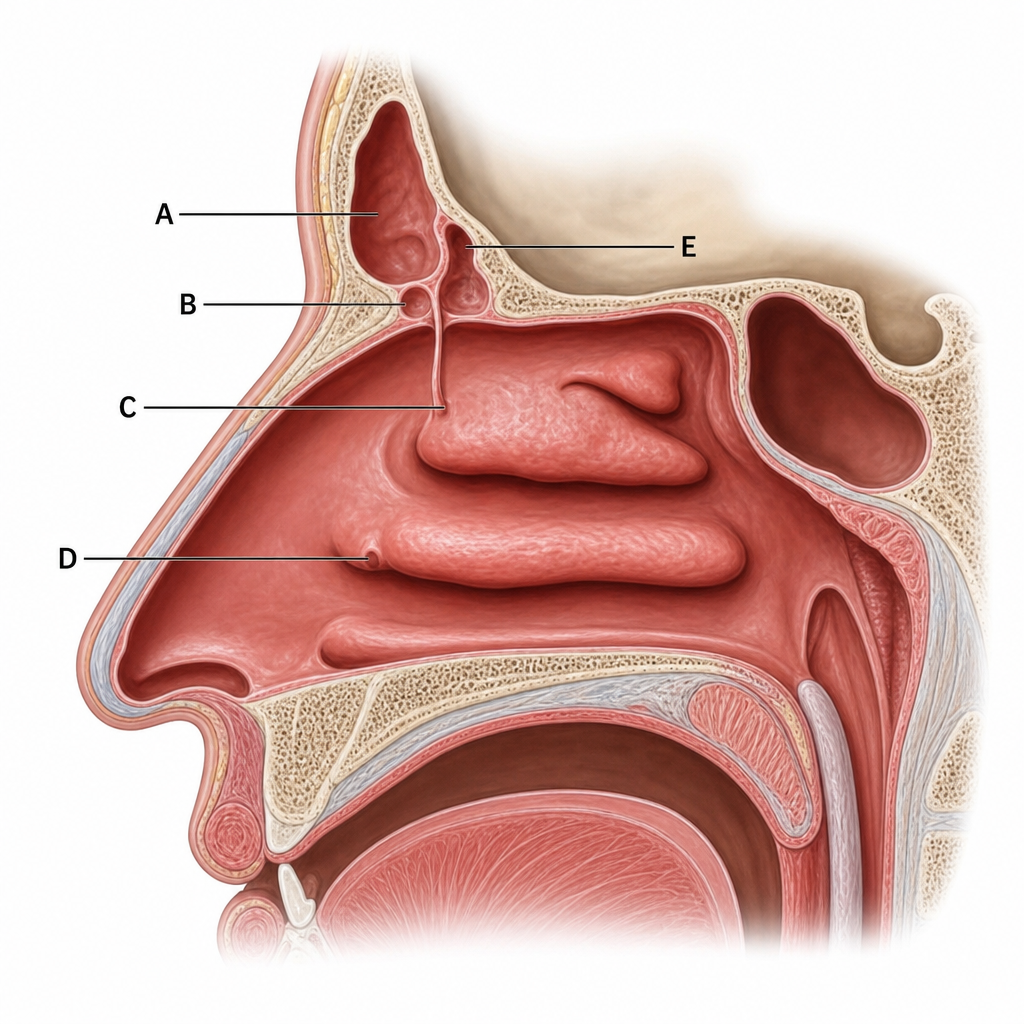
Hyperacusis is due to damage to which of the following muscles?
What forms the medial wall of the orbit?
The submandibular gland receives its blood supply from which artery?
Which of the following is NOT a branch of the facial nerve?
Paroxysmal lacrimation during mastication occurs due to damage to which nerve?
A patient presents with deviation of the tongue on protrusion. Which nerve is responsible?
A 30-year-old man presented with sudden onset double vision. On examination, his right eye, when at rest, was noted to be deviated medially. Which anatomical structures are most likely involved?
Which of the following muscles is pierced by the needle while giving an inferior alveolar nerve block?
Which of the following structures pass through the superior orbital fissure?
The duct of Von Ebner's salivary gland opens into which papilla?
Explanation: **Explanation:** **Hyperacusis** is a clinical condition characterized by an over-sensitivity to normal environmental sounds, which are perceived as abnormally loud or painful. **Why Stapedius is the correct answer:** The **Stapedius** is the smallest skeletal muscle in the human body, located in the middle ear [1]. It is innervated by the **nerve to stapedius**, a branch of the **Facial Nerve (CN VII)**. Its primary physiological role is the **acoustic reflex**: upon exposure to loud noises, the stapedius contracts to pull the stapes bone away from the oval window. This dampens the vibrations of the ossicular chain, protecting the inner ear. If the stapedius is paralyzed (commonly seen in **Bell’s Palsy**), this protective dampening mechanism is lost, leading to uninhibited vibrations and the perception of sounds as excessively loud (Hyperacusis). **Why other options are incorrect:** * **Orbicularis oris:** Innervated by the facial nerve, but it is a muscle of facial expression (closes the lips). Damage leads to drooping of the mouth or inability to whistle, not hearing issues. * **Styloglossus:** Innervated by the **Hypoglossal nerve (CN XII)**; it acts to retract and elevate the tongue. * **Stylopharyngeus:** The only muscle innervated by the **Glossopharyngeal nerve (CN IX)**; it elevates the pharynx and larynx during swallowing. **High-Yield Clinical Pearls for NEET-PG:** * **Tensor Tympani:** Another middle ear muscle (innervated by **CN V3**) that dampens sound by tensing the tympanic membrane. However, clinical hyperacusis is most classically associated with **Stapedius** palsy. * **Bell’s Palsy:** If a patient presents with facial deviation AND hyperacusis, the lesion is **proximal** to the branching of the nerve to stapedius in the facial canal. * **Origin:** Stapedius is derived from the **2nd Pharyngeal Arch**, while Tensor Tympani is from the **1st Pharyngeal Arch**.
Explanation: The medial wall of the orbit is the thinnest wall and is composed of four bones. From anterior to posterior, these are: **Frontal process of maxilla, Lacrimal bone, Ethmoid (orbital plate), and the Body of sphenoid.** ### Why Option A is Correct: The **Body of sphenoid** forms the most posterior part of the medial wall. It contains the optic canal, which transmits the optic nerve and ophthalmic artery. ### Analysis of Incorrect Options: * **B. Lesser wing of sphenoid:** This forms the posterior part of the **Roof** of the orbit (along with the orbital plate of the frontal bone). * **C. Greater wing of sphenoid:** This forms the posterior part of the **Lateral wall** of the orbit (along with the zygomatic bone). * **D. Frontal process of maxilla:** While this *does* contribute to the medial wall, it forms the **anterior-most** part. In multiple-choice questions where multiple components are listed, the Body of Sphenoid is often the high-yield anatomical landmark tested as the posterior boundary. ### High-Yield Clinical Pearls for NEET-PG: * **Lamina Papyracea:** This is the paper-thin orbital plate of the **ethmoid bone** on the medial wall. It is the most common site of fracture in orbital trauma and a frequent route for the spread of infection from the ethmoid sinuses to the orbit (causing orbital cellulitis). * **Blow-out Fracture:** Usually involves the **Floor** of the orbit (maxillary bone), leading to herniation of orbital contents into the maxillary sinus and entrapment of the inferior rectus muscle. * **Mnemonics for Walls:** * **Roof:** Frontal + Lesser wing of Sphenoid. * **Lateral Wall:** Zygomatic + Greater wing of Sphenoid. * **Medial Wall:** Maxilla + Lacrimal + Ethmoid + Sphenoid (Body).
Explanation: **Explanation:** The **submandibular gland** is primarily supplied by the **facial artery**, which is a branch of the external carotid artery. As the facial artery courses through the submandibular region, it loops over the gland (often embedded within a groove on its posterior surface) and gives off several **glandular branches** that provide the main arterial supply. **Analysis of Options:** * **Facial Artery (Correct):** It is the principal arterial supply. Venous drainage follows a similar pattern into the facial vein. * **Lingual Artery:** While it passes deep to the submandibular gland (separated by the hyoglossus muscle), its primary distribution is to the tongue and floor of the mouth. It may provide minor collateral supply via the sublingual artery, but it is not the primary source. * **Submandibular Artery:** This is a distractor; there is no major vessel by this specific name in standard anatomical nomenclature. * **Inferior Alveolar Artery:** This is a branch of the first part of the maxillary artery. It supplies the mandible and lower teeth, passing through the mandibular canal, and does not supply the submandibular gland. **High-Yield Clinical Pearls for NEET-PG:** * **Nerve Supply:** The secretomotor (parasympathetic) supply is via the **chorda tympani** (branch of CN VII), which hitches a ride with the **lingual nerve** to synapse at the **submandibular ganglion**. * **Wharton’s Duct:** The submandibular duct opens at the sublingual papilla. It is the most common site for **sialolithiasis** (salivary stones) due to its long, upward course and alkaline, calcium-rich secretions. * **Sialolithiasis (Clinical Pearls):** During submandibular gland excision, the **marginal mandibular branch of the facial nerve** is at risk and must be protected.
Explanation: The **Facial Nerve (CN VII)** is a complex mixed nerve containing motor, sensory, and parasympathetic fibers. Understanding its branching pattern is crucial for NEET-PG. ### **Why Lingual Nerve is the Correct Answer** The **Lingual nerve** is a branch of the **Mandibular division of the Trigeminal nerve (CN V3)**, not the facial nerve. It provides general somatic sensation (touch, pain, temperature) to the anterior two-thirds of the tongue. While the facial nerve (via the chorda tympani) eventually joins the lingual nerve to hitchhike to the tongue, the lingual nerve itself originates from CN V3. ### **Analysis of Incorrect Options** * **Branch to stylohyoid:** This is an **extracranial motor branch** of the facial nerve. It arises just after the nerve exits the stylomastoid foramen to supply the stylohyoid and the posterior belly of the digastric muscle. * **Chorda tympani:** This is a **pre-trematic branch** arising within the facial canal. It carries special visceral afferent (taste) fibers from the anterior 2/3 of the tongue and preganglionic parasympathetic fibers to the submandibular and sublingual glands. * **Greater petrosal nerve:** This is the **first branch** of the facial nerve, arising from the geniculate ganglion. It carries parasympathetic fibers to the lacrimal gland and mucous glands of the nose and palate. ### **High-Yield Clinical Pearls** * **The "Face-Off":** Remember that CN VII provides **Taste** (via Chorda Tympani), while CN V3 provides **Sensation** (via Lingual Nerve) to the anterior 2/3 of the tongue. * **Intracranial Branches:** Greater petrosal, Nerve to stapedius, and Chorda tympani. * **Extracranial Branches:** Posterior auricular, branch to stylohyoid/posterior digastric, and the five terminal branches (Temporal, Zygomatic, Buccal, Marginal Mandibular, Cervical). * **Clinical Sign:** Loss of the **stapedial reflex** (hyperacusis) indicates a lesion proximal to the nerve to the stapedius in the facial canal.
Explanation: **Explanation:** The clinical phenomenon described is known as **"Crocodile Tears Syndrome"** (Bogorad’s Syndrome). It is a sequela of **Facial nerve (CN VII)** injury, typically occurring during the recovery phase of Bell’s Palsy or after trauma to the nerve proximal to the geniculate ganglion. **Mechanism:** Under normal conditions, the facial nerve carries secretomotor fibers to the lacrimal gland (via the greater petrosal nerve) and the submandibular/sublingual glands (via the chorda tympani). During the regeneration of damaged nerve fibers, axons intended for the salivary glands are misdirected and grow along the pathway of the greater petrosal nerve to the lacrimal gland [1]. Consequently, a gustatory stimulus (mastication or smelling food) that should trigger salivation instead results in inappropriate lacrimation. **Analysis of Incorrect Options:** * **B. Auriculotemporal nerve:** Damage to this nerve (a branch of the mandibular nerve) leads to **Frey’s Syndrome**, where misdirected fibers cause gustatory sweating and flushing of the cheek rather than lacrimation. * **C. Oculomotor nerve:** This nerve controls extraocular muscles and pupillary constriction; it has no role in the secretomotor pathway for salivation or gustatory lacrimation [2]. * **D. Mandibular nerve:** While it provides motor supply to the muscles of mastication, it does not carry the preganglionic parasympathetic fibers responsible for this specific misdirection syndrome. **High-Yield Clinical Pearls for NEET-PG:** * **Site of Lesion:** Proximal to or at the **Geniculate Ganglion**. * **Frey’s Syndrome vs. Crocodile Tears:** Frey’s involves the Auriculotemporal nerve (sweating); Crocodile Tears involves the Facial nerve (tearing). * **Treatment:** Injection of **Botulinum toxin** into the lacrimal gland is a common management strategy.
Explanation: **Explanation:** The **Hypoglossal nerve (CN XII)** is the motor nerve for all intrinsic and extrinsic muscles of the tongue, except for the Palatoglossus (supplied by the Vagus nerve). The primary muscle responsible for tongue protrusion is the **Genioglossus**. In a healthy individual, the bilateral action of the Genioglossus muscles pulls the tongue forward and keeps it midline. In the event of a lower motor neuron (LMN) lesion of the Hypoglossal nerve, the Genioglossus on the affected side becomes paralyzed. Consequently, the intact Genioglossus on the healthy side acts unopposed, pushing the tongue toward the **paralyzed side**. **Analysis of Incorrect Options:** * **Facial nerve (CN VII):** Supplies the muscles of facial expression and taste to the anterior 2/3rd of the tongue (via chorda tympani), but has no motor control over tongue movement. * **Glossopharyngeal nerve (CN IX):** Provides general and special sensation (taste) to the posterior 1/3rd of the tongue and supplies the Stylopharyngeus muscle. * **Inferior alveolar nerve:** A branch of the Mandibular nerve (V3) that provides sensory innervation to the lower teeth and chin; it does not supply tongue muscles. **NEET-PG High-Yield Pearls:** * **Rule of Deviation:** The tongue deviates **toward** the side of the lesion in CN XII palsy ("The tongue licks the wound"). * **LMN vs. UMN:** LMN lesions (Hypoglossal nucleus/nerve) cause ipsilateral deviation, atrophy, and fasciculations. UMN lesions (Motor cortex/Internal capsule) cause contralateral deviation without atrophy. * **Safety Muscle:** The Genioglossus is known as the "safety muscle" of the tongue because it prevents the tongue from falling back and obstructing the oropharynx.
Explanation: ### Explanation **1. Why Option C is Correct:** The patient presents with **medial deviation (esotropia)** of the right eye at rest. This indicates a paralysis of the **Lateral Rectus (LR)** muscle [1]. Under normal conditions, the extraocular muscles exist in a state of balanced tension. When the lateral rectus—the primary **abductor** of the eye—is paralyzed, the action of the medial rectus (the antagonist) goes unopposed, pulling the eyeball medially [1]. The lateral rectus is uniquely supplied by the **Abducent Nerve (CN VI)**. Therefore, a CN VI palsy results in the inability to abduct the eye and a medial squint at rest. **2. Why Other Options are Incorrect:** * **Option A:** The **Medial Rectus** adducts the eye. Paralysis would result in **lateral deviation** (exotropia), not medial [1]. * **Option B:** The **Inferior Oblique** primarily elevates the eye in adduction. Its paralysis would not cause a primary medial deviation [1]. * **Option D:** The **Superior Rectus** (CN III) elevates the eye, and the **Trochlear Nerve (CN IV)** supplies the Superior Oblique (which depresses the eye in adduction) [1]. Neither is responsible for abduction; thus, their injury wouldn't cause a medial squint. **3. Clinical Pearls for NEET-PG:** * **Mnemonic (LR6SO4)3:** **L**ateral **R**ectus is supplied by CN **6**; **S**uperior **O**blique by CN **4**; all others by CN **3**. * **Longest Intracranial Course:** The Abducent nerve has the longest intracranial course, making it highly susceptible to injury in cases of **increased intracranial pressure (ICP)** (False localizing sign). * **Diplopia:** CN VI palsy causes **horizontal diplopia**, which worsens when the patient attempts to look towards the affected side [1]. * **Cavernous Sinus:** CN VI is the only nerve that runs *through* the center of the cavernous sinus (alongside the internal carotid artery), while CN III, IV, V1, and V2 are in the lateral wall.
Explanation: The **Inferior Alveolar Nerve Block (IANB)** is the most common local anesthetic technique used in dentistry to anesthetize the mandibular teeth. ### **Explanation of the Correct Answer** To reach the mandibular foramen (where the inferior alveolar nerve enters the mandible), the needle must pass through the **buccinator muscle**. * **Anatomical Pathway:** The needle is inserted lateral to the pterygomandibular raphe. The buccinator muscle originates partly from this raphe and forms the muscular substance of the cheek. Therefore, any needle directed toward the pterygomandibular space from the oral cavity must pierce the buccinator to reach the underlying loose connective tissue where the nerve resides. ### **Analysis of Incorrect Options** * **A. Medial Pterygoid:** This muscle forms the **medial boundary** of the pterygomandibular space. If the needle pierces this muscle, it is inserted too far medially, often resulting in "trismus" (muscle soreness) rather than successful anesthesia. * **B. Superior Constrictor:** This muscle forms the posterior attachment of the pterygomandibular raphe. The needle is inserted **anterior** to this muscle; piercing it would mean the needle is too far posterior, risking entry into the parotid gland. * **C. Temporalis:** The tendon of the insertion of the temporalis muscle lies **lateral** to the injection site (along the anterior border of the ramus). It is not in the direct path of a correctly placed IANB needle. ### **High-Yield Clinical Pearls for NEET-PG** * **Pterygomandibular Space:** The target site for IANB. It contains the inferior alveolar nerve, artery, vein, and the lingual nerve. * **Boundaries:** Lateral (Ramus of mandible), Medial (Medial pterygoid muscle), Anterior (Buccinator). * **Complication:** If the needle is advanced too far posteriorly, it may enter the **Parotid Gland**, potentially anesthetizing the **Facial Nerve (CN VII)** and causing transient facial paralysis. * **Landmark:** The **Pterygomandibular Raphe** (junction of buccinator and superior constrictor) serves as the key clinical landmark for needle insertion.
Explanation: The **superior orbital fissure (SOF)** is a critical communication between the middle cranial fossa and the orbit. It is located between the greater and lesser wings of the sphenoid bone. **Why the Correct Answer is Right:** The **Ophthalmic nerve (CN V1)**, the first division of the Trigeminal nerve, enters the orbit through the SOF. Specifically, its three main branches—the **Lacrimal, Frontal, and Nasociliary nerves**—pass through this fissure to provide sensory innervation to the eye and forehead. **Analysis of Incorrect Options:** * **Cranial Nerve I (Olfactory):** Passes through the **cribriform plate** of the ethmoid bone to reach the nasal cavity. * **Cranial Nerve II (Optic):** Passes through the **optic canal** along with the ophthalmic artery. * **Cranial Nerve VI (Abducens):** While CN VI *does* pass through the SOF (specifically within the common tendinous ring), the question asks for the best fit among the options provided. In many standard anatomical classifications and NEET-PG contexts, the Ophthalmic nerve (V1) is the classic representative of the SOF. *(Note: If this were a "multiple correct" style, CN VI would also be true, but V1 is the primary sensory nerve associated with this fissure). **High-Yield Facts for NEET-PG:** * **Structures passing through the SOF:** * **Above the Common Tendinous Ring:** Lacrimal, Frontal, and Trochlear (CN IV) nerves; Superior ophthalmic vein. * **Within the Ring (Oculomotor Foramen):** Superior and Inferior divisions of CN III, Nasociliary nerve, and CN VI. * **Clinical Pearl:** **Superior Orbital Fissure Syndrome** involves paralysis of extraocular muscles (CN III, IV, VI) and anesthesia of the forehead (CN V1) due to compression at the fissure. If the optic nerve is also involved, it is termed **Orbital Apex Syndrome**.
Explanation: Explanation: **Von Ebner’s glands** are minor serous salivary glands located in the tongue [1]. They are specifically associated with the **circumvallate (vallate) papillae**, which are large, circular structures arranged in a V-shape just anterior to the sulcus terminalis [1]. 1. **Why Circumvallate is correct:** The ducts of Von Ebner’s glands open into the deep **circular trenches (moats)** surrounding the circumvallate papillae [1]. Their primary function is to secrete a watery (serous) fluid that flushes out food particles and dissolved substances from the trenches. This "cleansing" action allows the taste buds located on the sides of the papillae to respond rapidly to new gustatory stimuli [1]. They also secrete lingual lipase, initiating lipid hydrolysis. 2. **Why other options are incorrect:** * **Filiform:** These are the most numerous papillae but are purely mechanical and **lack taste buds**. They do not have associated salivary glands. * **Fungiform:** These mushroom-shaped papillae are scattered on the dorsal surface (mainly the tip and sides) and contain taste buds, but they are not associated with Von Ebner’s glands [1]. * **Foliate:** These are leaf-like folds on the lateral margins of the tongue. While they contain taste buds and are associated with some serous glands in other mammals, in humans, Von Ebner’s glands are classically defined by their relationship with the circumvallate papillae [1]. **High-Yield NEET-PG Pearls:** * **Secretion Type:** Von Ebner’s glands are **purely serous**, unlike most other minor salivary glands which are mucous or mixed [1]. * **Enzyme:** They are the source of **lingual lipase**, which is active at an acidic pH and important for neonatal fat digestion. * **Nerve Supply:** The circumvallate papillae (and their taste buds) are supplied by the **Glossopharyngeal nerve (CN IX)**, despite being located on the "anatomical" anterior 2/3rd of the tongue.
Skull and Facial Bones
Practice Questions
Scalp and Facial Muscles
Practice Questions
Dural Venous Sinuses
Practice Questions
Cranial Cavity
Practice Questions
Orbit and Contents
Practice Questions
Temporal and Infratemporal Regions
Practice Questions
Pterygopalatine Fossa
Practice Questions
Oral Cavity
Practice Questions
Paranasal Sinuses
Practice Questions
Applied Anatomy and Clinical Correlations
Practice Questions
Get full access to all questions, explanations, and performance tracking.
Start For Free