Which of the following is NOT a branch of the maxillary nerve in the pterygopalatine fossa?
Which part is drained by the jugulodigastric lymph node?
At what age is the number of permanent teeth typically 16?
A fractured mandibular condyle is displaced forward and medially by the action of which of the following muscles?
Which nerve pierces the sphenomandibular ligament?
In which of the following parts does the VIIth nerve take the narrowest path during its entire course?
Jacobson's nerve is a branch of which cranial nerve?
Injury to one of the following arteries results in extradural hematoma?
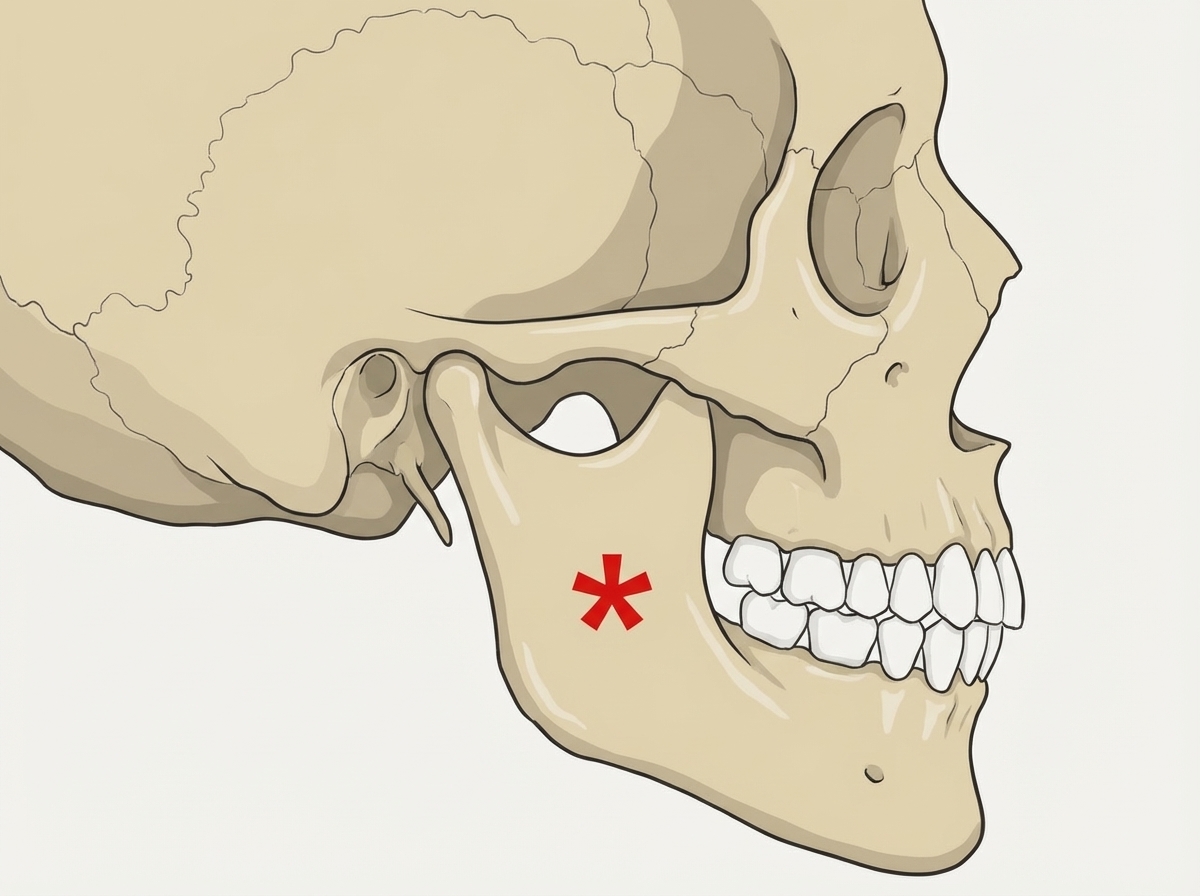
At birth, where does the mental foramen open?
Arterial communications between the carotid and vertebrobasilar systems include all EXCEPT?
Explanation: The **Maxillary Nerve (V2)** enters the **pterygopalatine fossa** via the foramen rotundum. Within this fossa, it gives off several branches before exiting through the inferior orbital fissure to become the infraorbital nerve. ### **Why "Infraorbital Nerve" is the Correct Answer** The **Infraorbital nerve** is technically considered the **terminal continuation** of the maxillary nerve, rather than a branch given off *within* the fossa. It only acquires this name once the maxillary nerve leaves the pterygopalatine fossa and enters the orbit through the **inferior orbital fissure**. Therefore, it is located in the infraorbital canal/groove, not the fossa itself. ### **Analysis of Other Options** * **Zygomatic nerve (A):** Arises within the pterygopalatine fossa and enters the orbit to divide into zygomaticotemporal and zygomaticofacial branches. * **Pterygopalatine nerve (C):** These are two short trunks that suspend the pterygopalatine ganglion within the fossa. They carry sensory fibers to the nose, palate, and pharynx. * **Posterior superior alveolar nerve (D):** Arises in the fossa just before the maxillary nerve enters the orbit. It descends on the posterior surface of the maxilla to supply the molar teeth. ### **High-Yield Clinical Pearls for NEET-PG** * **Foramen Rotundum:** The "gateway" for V2 to enter the pterygopalatine fossa. * **Ganglion of Hay Fever:** The pterygopalatine ganglion (located in this fossa) is often called this because it manages lacrimation and nasal secretion. * **Nerve of Pterygoid Canal (Vidian Nerve):** Formed by Great Petrosal (Parasympathetic) and Deep Petrosal (Sympathetic) nerves; it joins the ganglion in this fossa. * **Sensation:** V2 is purely sensory; any motor fibers (to the lacrimal gland) are hitchhiking from the Facial nerve (CN VII).
Explanation: The **jugulodigastric lymph node** (also known as the "principal node of the tongue" or the "tonsillar node") is a large, prominent member of the deep cervical chain. It is located in the carotid triangle, specifically where the posterior belly of the digastric muscle crosses the internal jugular vein. ### Why the Correct Answer is Right: * **Tonsil:** The jugulodigastric node is the primary lymphatic station for the **palatine tonsils**. Because it is the first node to receive drainage from this area, it frequently becomes enlarged and palpable during cases of acute tonsillitis or peritonsillar abscess. ### Why Other Options are Wrong: * **Palate:** The lymphatic drainage of the palate (hard and soft) primarily goes to the **retropharyngeal** and **upper deep cervical nodes**, though some drainage may eventually reach the jugulodigastric node, it is not the primary site. * **Tongue:** While the jugulodigastric node does receive drainage from the tongue (specifically the posterior third and lateral margins), the **submental** and **submandibular** nodes are the primary first-order stations for the tip and body of the tongue, respectively. * **Teeth:** Lymph from the teeth and gingivae primarily drains into the **submandibular nodes**. ### Clinical Pearls for NEET-PG: * **Jugulo-omohyoid Node:** Known as the "lymph node of the tongue," it primarily drains the tip of the tongue and is located where the omohyoid muscle crosses the internal jugular vein. * **Sentinel Node:** The jugulodigastric node is often the first site of metastasis for squamous cell carcinomas of the oropharynx. * **Palpation:** In a healthy individual, these nodes are usually not palpable; however, in "Tonsillar Lymphadenopathy," they become tender and firm just below the angle of the mandible.
Explanation: **Explanation:** The number of teeth present in a child’s mouth during the mixed dentition period is a high-yield topic for NEET-PG. The correct answer is **9 years** based on the sequence of permanent tooth eruption. **Why 9 years is correct:** By age 9, a child typically has **12 deciduous teeth** and **12 permanent teeth**. However, the question asks when the *total* number of permanent teeth reaches 16. * **Ages 6–7:** 4 first molars + 4 central incisors = 8 permanent teeth. * **Ages 8–9:** 4 lateral incisors erupt, bringing the total to 12. * **Ages 9–10:** The first premolars (4) begin to erupt. By the end of the 9th year/start of the 10th year, the addition of these 4 premolars brings the total count of permanent teeth to **16**. **Analysis of Incorrect Options:** * **8 years:** At this stage, only the first molars and central incisors are fully erupted (8 teeth); lateral incisors are just beginning to appear. * **12 years:** By this age, the second molars erupt. Most children have 28 permanent teeth (all except the third molars). * **15 years:** The dentition is complete with 28 teeth; only the 4 third molars (wisdom teeth) remain unerupted until ages 17–25. **Clinical Pearls for NEET-PG:** 1. **First Permanent Tooth:** The 1st Molar (6-year molar). It erupts *behind* the deciduous molars, not replacing any milk teeth. 2. **Eruption Sequence:** Mnemonic **"Mama Is In Pain, Papa Can Make Medicine"** (Molar 1, Incisor 1, Incisor 2, Premolar 1, Canine, Molar 2, Molar 3). 3. **Mixed Dentition Period:** Typically occurs between ages 6 and 12. 4. **Calcification:** The first permanent tooth to begin calcification is the 1st Molar (at birth).
Explanation: The **External Pterygoid (Lateral Pterygoid)** is the correct answer due to its specific anatomical insertion. It consists of two heads; the inferior head inserts into the **pterygoid fovea on the neck of the mandibular condyle**, while the superior head inserts into the articular disc and capsule of the temporomandibular joint (TMJ). When a fracture occurs at the neck of the mandible, the condylar process becomes a free fragment. The lateral pterygoid muscle, which originates medially (from the lateral pterygoid plate and sphenoid bone) and pulls anteriorly to protrude the jaw, exerts a traction force on this fragment. This results in the characteristic **anteromedial displacement** of the fractured condyle. **Analysis of Incorrect Options:** * **Temporalis:** Inserts into the coronoid process and the anterior border of the ramus. It acts to elevate and retract the mandible, not move the condyle medially. * **Internal Pterygoid (Medial Pterygoid):** Inserts on the medial surface of the angle of the mandible. While it is a medial muscle, it does not attach to the condylar process. * **Masseter:** Inserts on the lateral aspect of the ramus and angle of the mandible. It is a powerful elevator of the jaw but has no attachment to the condyle. **High-Yield Clinical Pearls for NEET-PG:** * **Lateral Pterygoid** is the only muscle of mastication that helps in **opening** the mouth (depressing the mandible). * In a unilateral condylar fracture, the jaw deviates **towards the side of the lesion** upon protrusion because the contralateral lateral pterygoid is unopposed. * The **Auriculotemporal nerve** and **Maxillary artery** are the most vulnerable structures related to the posterior aspect of the condylar neck.
Explanation: **Explanation:** The **sphenomandibular ligament** is an accessory ligament of the temporomandibular joint (TMJ), extending from the spine of the sphenoid bone to the lingula of the mandible. It serves as a key landmark in the infratemporal fossa. **Why the Nerve to Mylohyoid is correct:** The nerve to mylohyoid is a branch of the inferior alveolar nerve (given off just before it enters the mandibular foramen). To reach the mylohyoid groove on the medial aspect of the mandible, the nerve must **pierce the sphenomandibular ligament**. It then descends to supply the mylohyoid muscle and the anterior belly of the digastric. **Analysis of Incorrect Options:** * **Inferior Alveolar Nerve (IAN):** This nerve descends lateral to the sphenomandibular ligament and enters the mandibular foramen. It does not pierce the ligament. * **Lingual Nerve:** This nerve lies anterior and lateral to the sphenomandibular ligament as it travels toward the floor of the mouth. * **Superior Alveolar Nerve:** This is a branch of the maxillary nerve (V2) and is located in the pterygopalatine fossa and maxilla, far superior to the sphenomandibular ligament. **NEET-PG High-Yield Pearls:** 1. **Structures passing between the neck of the mandible and the sphenomandibular ligament:** Maxillary artery and auriculotemporal nerve. 2. **Relation to Local Anesthesia:** During an Inferior Alveolar Nerve Block (IANB), the sphenomandibular ligament can act as a physical barrier if the needle is placed too medially, leading to failed anesthesia. 3. **Embryology:** The sphenomandibular ligament is a remnant of **Meckel’s cartilage** (1st Pharyngeal Arch).
Explanation: The facial nerve (VIIth cranial nerve) has the longest and most tortuous course within a bony canal (the fallopian canal) of any nerve in the body. **Explanation of the Correct Answer:** The **labyrinthine segment** is the shortest (3-5 mm) but **narrowest part** of the fallopian canal. In this segment, the diameter of the bony canal is less than 0.7 mm. This is clinically significant because the nerve occupies nearly 83% of the available space here. Any inflammation or edema of the nerve in this narrowest portion leads to rapid compression and ischemia, which is the primary pathophysiological mechanism behind **Bell’s Palsy**. **Analysis of Incorrect Options:** * **Pons:** This is the site of the facial nerve nucleus (origin). While the nerve fibers are compact here, they are not encased in a rigid bony canal, allowing for more physiological "give." * **Superior Colliculus:** This is a landmark in the midbrain related to the visual system. The facial nerve fibers loop around the abducens nucleus in the pons, forming the **facial colliculus** on the floor of the 4th ventricle, not the superior colliculus. * **Stylomastoid Region:** This is where the nerve exits the skull through the stylomastoid foramen. At this point, the nerve is relatively thicker and transitioning into the parotid gland; it is not the narrowest point of the bony course. **High-Yield Clinical Pearls for NEET-PG:** * **First Genu:** Located at the labyrinthine segment where the **Greater Petrosal Nerve** arises and the **Geniculate Ganglion** is situated. * **Bell’s Palsy:** Most commonly involves the labyrinthine segment due to its extreme narrowness. * **Hyperacusis:** Occurs if the nerve to the stapedius (arising in the mastoid segment) is involved. * **Schirmer’s Test:** Used to evaluate the greater petrosal nerve function (lacrimation) to localize the lesion level.
Explanation: ### Explanation **Jacobson’s nerve**, also known as the **tympanic nerve**, is the first branch of the **Glossopharyngeal nerve (CN IX)**. It arises from the inferior ganglion of CN IX as it exits the skull through the jugular foramen. **Why the Correct Answer is Right:** Jacobson’s nerve enters the middle ear through the tympanic canaliculus to form the **tympanic plexus** on the promontory. It provides sensory innervation to the middle ear, Eustachian tube, and mastoid air cells. Most importantly, it carries **preganglionic parasympathetic fibers** that eventually leave the plexus as the **lesser petrosal nerve**, synapse in the **otic ganglion**, and provide secretomotor supply to the **parotid gland**. **Why the Other Options are Wrong:** * **Vagus nerve (CN X):** Its equivalent branch is **Arnold’s nerve** (auricular branch), which supplies the external auditory canal and can trigger a cough reflex when stimulated. * **Hypoglossal nerve (CN XII):** This is a purely motor nerve supplying the muscles of the tongue; it has no sensory or parasympathetic branches like Jacobson's nerve. * **Trigeminal nerve (CN V):** While it provides general sensation to the face and anterior tongue, it does not give rise to the tympanic nerve. However, its mandibular division (V3) is closely related to the otic ganglion. **High-Yield Facts for NEET-PG:** * **Pathway:** CN IX → Jacobson’s Nerve → Tympanic Plexus → Lesser Petrosal Nerve → Otic Ganglion → Auriculotemporal Nerve (V3) → Parotid Gland. * **Clinical Correlation:** Referred ear pain (otalgia) during tonsillitis or post-tonsillectomy occurs because CN IX supplies both the oropharynx and the middle ear (via Jacobson's nerve). * **Frey’s Syndrome:** Results from injury to the auriculotemporal nerve, where regenerating parasympathetic fibers (originally from CN IX) mistakenly innervate sweat glands.
Explanation: **Explanation:** The **Middle Meningeal Artery (MMA)** is the most common source of bleeding in an **Extradural Hematoma (EDH)** [1]. The MMA is a branch of the maxillary artery that enters the skull through the foramen spinosum and runs between the internal table of the skull and the dura mater [1]. It lies directly beneath the **pterion**, the thinnest part of the skull where the frontal, parietal, temporal, and sphenoid bones meet. A blow to the temple often fractures the pterion, lacerating the MMA and causing arterial blood to collect in the potential space between the bone and the dura [1]. **Analysis of Incorrect Options:** * **Facial Artery:** A branch of the external carotid artery that supplies the superficial face; it is extracranial and not involved in intracranial bleeds. * **Temporal Artery:** Specifically the Superficial Temporal Artery, it supplies the scalp. While it can be involved in scalp hematomas or giant cell arteritis, it does not cause intracranial bleeding. * **Anterior Cerebral Artery:** An intracranial vessel located within the subarachnoid space. Rupture (often via aneurysm) leads to a **Subarachnoid Hemorrhage (SAH)**, not an EDH. **High-Yield Clinical Pearls for NEET-PG:** * **Radiology:** EDH typically appears as a **biconvex (lens-shaped)**, hyperdense collection on CT that does not cross suture lines (as the dura is firmly attached at sutures) [1]. * **Clinical Presentation:** Classically features a **"Lucid Interval"**—a temporary period of consciousness after the initial trauma before the hematoma expands enough to cause increased intracranial pressure. * **Nerve Involvement:** An expanding EDH can lead to uncal herniation, often resulting in an **ipsilateral dilated pupil** due to compression of the 3rd cranial nerve (Oculomotor).
Explanation: **Explanation:** The position of the **mental foramen** changes significantly throughout life due to the growth of the mandible and the eruption/loss of teeth. This is a high-yield concept in osteology. **1. Why Option C is Correct:** At birth, the mandible is merely a shell containing the tooth germs of deciduous teeth. The mental foramen is located **below the sockets of the deciduous molars**. At this stage, the mandibular canal runs near the lower border of the mandible, and the foramen opens downwards and forwards because the alveolar process is more developed than the base. **2. Analysis of Incorrect Options:** * **Options A & B:** The mental foramen is situated more posteriorly than the canine region. Even at birth, it aligns with the molar tooth germs. * **Option D:** Positioning behind the deciduous molars would place the foramen near the ramus, which does not occur at any stage of normal development. **3. High-Yield Clinical Pearls for NEET-PG:** To master this topic, remember the "Rule of Three" for the mental foramen's position: * **At Birth:** Below the sockets of deciduous molars (near the lower border). * **In Adults:** Midway between the upper and lower borders, typically vertically aligned with the **interval between the two premolars** (or below the second premolar). * **In Old Age (Edentulous):** Due to the resorption of the alveolar process, the foramen appears closer to the **upper border** (alveolar margin). This is clinically significant as dentures can compress the mental nerve, causing pain. **Key takeaway:** The mental foramen "migrates" upward relative to the bone height as one ages from birth to senescence.
Explanation: The question tests knowledge of the **embryological and anatomical anastomoses** between the anterior circulation (Internal Carotid Artery - ICA) and the posterior circulation (Vertebrobasilar system). ### **Explanation** The **Spinal artery** (both anterior and posterior) arises from the **Vertebral arteries** (branches of the subclavian artery). While they supply the spinal cord, they do not form a direct communication or shunt between the carotid and vertebrobasilar systems. Therefore, it is the correct "except" option. ### **Analysis of Other Options** * **Posterior Communicating Artery (PCOM):** This is the most significant **permanent** anatomical communication in adults, forming part of the Circle of Willis by connecting the ICA to the Posterior Cerebral Artery (PCA). * **Trigeminal Artery:** This is the most common **persistent fetal anastomosis**. In early embryonic life, several pre-segmental arteries connect the primitive ICA to the longitudinal neural arteries (future basilar artery). These usually involute but may persist. * **Superior Hypophyseal Artery:** Arising from the ophthalmic segment of the ICA, it supplies the pituitary stalk and forms a capillary plexus (portal system) that can communicate with branches of the posterior circulation supplying the hypothalamus/pituitary region. ### **High-Yield NEET-PG Pearls** 1. **Persistent Fetal Communications:** In order of frequency (highest to lowest): **Trigeminal** > Fenestrated Basilar > Otic > Hypoglossal > Proatlantal intersegmental arteries. 2. **Saltzman Classification:** Used to categorize persistent trigeminal arteries based on their relationship with the superior cerebellar artery. 3. **Circle of Willis:** The primary site of collateral flow; the **Anterior Communicating Artery** is the most common site for Berry aneurysms.
Skull and Facial Bones
Practice Questions
Scalp and Facial Muscles
Practice Questions
Dural Venous Sinuses
Practice Questions
Cranial Cavity
Practice Questions
Orbit and Contents
Practice Questions
Temporal and Infratemporal Regions
Practice Questions
Pterygopalatine Fossa
Practice Questions
Oral Cavity
Practice Questions
Paranasal Sinuses
Practice Questions
Applied Anatomy and Clinical Correlations
Practice Questions
Get full access to all questions, explanations, and performance tracking.
Start For Free