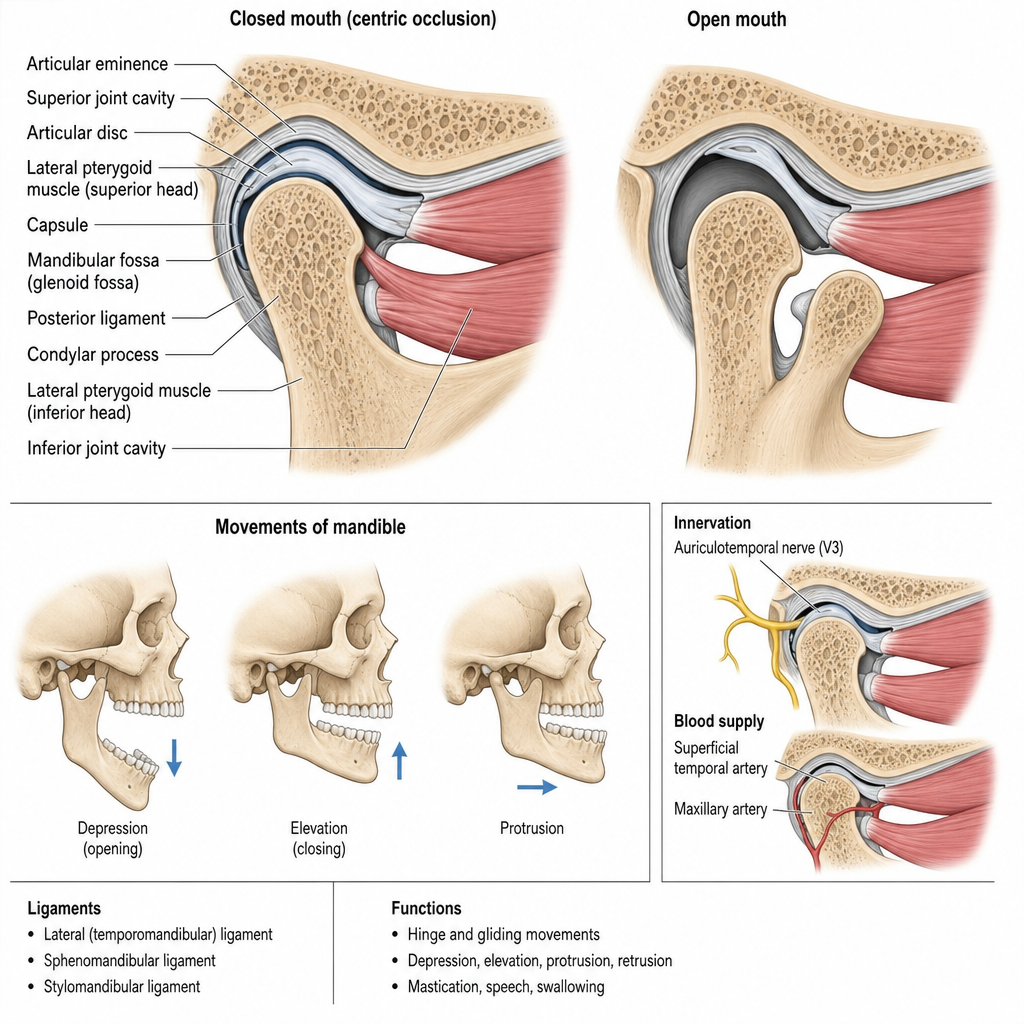
All muscles of the palate are supplied by the pharyngeal plexus, EXCEPT?
Which of the following statements is NOT true regarding the lacrimal gland?
What is the deepest layer of the scalp?
In a five-year-old child, which of the following foramina is located in the posterior cranial fossa?
Failure of descent of the thyroid primordium can lead to ectopic thyroid tissue in which of the following locations?
The anterior ethmoidal artery is closely related to which structure?
Which nerve supplies the inferior oblique muscle of the eye?
The external laryngeal nerve is most commonly injured during which surgical procedure?
Where are the lacrimal puncta of the upper and lower eyelids located relative to each other?
What is the lymphatic drainage of the anterior part of the nose?
Explanation: ### Explanation The muscles of the soft palate are primarily innervated by the **pharyngeal plexus**, which is formed by the pharyngeal branches of the Vagus nerve (CN X), Glossopharyngeal nerve (CN IX), and sympathetic fibers. **1. Why Tensor Veli Palatini is the Correct Answer:** The **Tensor veli palatini** is the only muscle of the palate derived from the **1st pharyngeal arch**. Consequently, it is supplied by the **nerve of the 1st arch**, which is the **Mandibular nerve (V3)**, specifically via the nerve to the medial pterygoid. Its primary function is to tense the soft palate and open the auditory tube during swallowing. **2. Why the Other Options are Incorrect:** * **Palatoglossus:** Despite its name ending in "-glossus," it is a muscle of the palate, not the tongue. It is derived from the 4th arch and supplied by the pharyngeal plexus (CN X). * **Palatopharyngeus:** This muscle forms the posterior pillar of the fauces. Like the Musculus uvulae and Levator veli palatini, it is supplied by the pharyngeal plexus (CN X). **3. High-Yield Clinical Pearls for NEET-PG:** * **The "Rule of L":** All muscles with "Tensor" in their name (Tensor veli palatini, Tensor tympani) are supplied by **V3**. * **Palate vs. Tongue:** All muscles of the palate are supplied by the Vagus (via pharyngeal plexus) except Tensor veli palatini (V3). All muscles of the tongue are supplied by the Hypoglossal nerve (CN XII) except Palatoglossus (CN X). * **Clinical Sign:** In a lesion of the Vagus nerve (CN X), the uvula deviates to the **opposite (normal) side** because the functional Levator veli palatini pulls it toward its side.
Explanation: The lacrimal gland is a frequent high-yield topic in head and neck anatomy. Here is the breakdown of the question: ### **Why Option C is the Correct Answer (The False Statement)** The orbital and palpebral parts of the lacrimal gland are continuous with each other around the lateral edge of the **levator palpebrae superioris (LPS)** muscle. Crucially, **all ducts** (approximately 10–12 in total) from both the orbital and palpebral parts must pass through the **palpebral part** to open into the superior conjunctival fornix. Therefore, the statement that 1–2 ducts from the orbital part open directly into the fornix is anatomically incorrect. ### **Analysis of Other Options** * **Option A:** True. The lacrimal gland is J-shaped; the **orbital part** is the larger, almond-shaped portion situated in the lacrimal fossa of the frontal bone. * **Option B:** True. The orbital part sits superior to the LPS muscle, while the palpebral part lies inferior to it. Thus, the inferior surface of the orbital part rests on the expansion of the levator muscle. * **Option C:** True. The **Glands of Krause** (located in the conjunctival fornices) and **Glands of Wolfring** (near the tarsal plates) are accessory lacrimal glands responsible for basal tear secretion. ### **NEET-PG High-Yield Pearls** * **Surgical Importance:** Because all ducts pass through the palpebral part, surgical removal or biopsy of the palpebral part can stop all secretions from the entire gland. * **Nerve Supply:** Secretomotor (parasympathetic) fibers originate in the **lacrimatory nucleus** (CN VII), travel via the greater petrosal nerve, synapse at the **pterygopalatine ganglion**, and reach the gland via the **zygomaticotemporal** and **lacrimal nerves**. * **Blood Supply:** Lacrimal artery (branch of the ophthalmic artery).
Explanation: The scalp consists of five distinct layers, which can be easily remembered using the mnemonic **SCALP**. From superficial to deep, these layers are: 1. **S**kin: Thick and hair-bearing. 2. **C**onnective tissue (Dense): Contains nerves and blood vessels. 3. **A**poneurosis (Galea aponeurotica): The tendon linking the occipital and frontal bellies of the occipitofrontalis muscle. 4. **L**oose areolar tissue: The "danger zone" of the scalp. 5. **P**ericranium: The deepest layer. **Why Pericranium is correct:** The **Pericranium** is the periosteum of the external surface of the skull bones. It is firmly attached to the sutures but can be stripped from the bone surfaces. As the innermost layer, it lies directly against the calvaria (skull cap). **Analysis of Incorrect Options:** * **Superficial fascia (Connective tissue):** This is the second layer. It is dense and fibrofatty, anchoring the skin to the underlying aponeurosis. * **Galea aponeurotica:** This is the third layer. It provides the structural framework for the scalp but is separated from the bone by two deeper layers. * **Occipitofrontalis muscle:** This muscle is part of the third layer (the musculoaponeurotic layer). It is not the deepest structure. **High-Yield Clinical Pearls for NEET-PG:** * **Danger Area of Scalp:** The **Loose Areolar Tissue** (4th layer) is called the "danger area" because pus or blood can easily spread within it and reach the intracranial venous sinuses via **emissary veins**, potentially causing meningitis or sinus thrombosis. * **Cephalhematoma:** A subperiosteal hemorrhage (below the pericranium) that is limited by suture lines. This distinguishes it from **Caput Succedaneum**, which occurs in the superficial tissues and crosses suture lines. * **Scalp Wounds:** Wounds gape widely if the Galea Aponeurotica is lacerated coronally, because the frontal and occipital bellies of the muscle pull in opposite directions.
Explanation: The cranial fossa is divided into anterior, middle, and posterior compartments, each housing specific neurovascular structures. This anatomical arrangement remains consistent from childhood through adulthood. ### **Why Jugular Foramen is Correct** The **Jugular Foramen** is located in the **posterior cranial fossa**, situated between the petrous part of the temporal bone and the occipital bone. It is a critical exit point for: * **Cranial Nerves:** IX (Glossopharyngeal), X (Vagus), and XI (Accessory). * **Vascular Structures:** The sigmoid sinus (continuing as the internal jugular vein) and the inferior petrosal sinus. ### **Why Other Options are Incorrect** The remaining options are all located in the **Middle Cranial Fossa**: * **Foramen Rotundum:** Located in the greater wing of the sphenoid; it transmits the Maxillary nerve (V2). * **Foramen Spinosum:** Located in the greater wing of the sphenoid; it transmits the middle meningeal artery and the nervous spinosus. * **Foramen Lacerum:** Located at the junction of the sphenoid, temporal, and occipital bones. In life, it is filled with cartilage, and only small emissary veins and the greater petrosal nerve pass through it. ### **High-Yield Clinical Pearls for NEET-PG** * **Vernet’s Syndrome (Jugular Foramen Syndrome):** Results from a lesion (like a glomus tumor) at this foramen, leading to paralysis of CN IX, X, and XI. * **Mnemonic for Middle Cranial Fossa:** Remember **ROS** (Rotundum, Ovale, Spinosum) from medial to lateral in the greater wing of the sphenoid. * **Internal Acoustic Meatus:** Another key opening in the posterior fossa (petrous temporal bone) transmitting CN VII and VIII.
Explanation: The thyroid gland originates as an endodermal proliferation at the floor of the pharynx, specifically at a point called the **foramen cecum**. During normal development, it descends through the neck via the **thyroglossal duct** to reach its final position anterior to the trachea [1], [2]. **Why Option C is correct:** If the thyroid primordium fails to descend, it remains at its site of origin [1]. This results in a **Lingual Thyroid**, the most common form of ectopic thyroid tissue [1]. It is located at the base of the tongue, just posterior to the circumvallate papillae, near the foramen cecum. **Analysis of Incorrect Options:** * **Options A & B:** While the thyroid originates between the anterior two-thirds and posterior one-third of the tongue, it specifically arises from the midline at the junction (foramen cecum). "Dorsal aspect" is too broad; the specific site is the base/midline. * **Option D:** The thyroid primordium develops from the pharyngeal floor (dorsum of the tongue), not the inferior surface. **High-Yield NEET-PG Clinical Pearls:** * **Lingual Thyroid:** In 70% of cases, this is the *only* functioning thyroid tissue in the body [1]. Surgical removal without checking for a normal thyroid in the neck can lead to permanent hypothyroidism. * **Thyroglossal Duct Cyst:** If the duct fails to disappear, a cyst may form [1], [2]. It is always in the **midline** and characteristically **moves upward on protrusion of the tongue** (due to its attachment to the hyoid bone). * **Pyramidal Lobe:** A common anatomical variant representing a persistent distal end of the thyroglossal duct [2].
Explanation: ### Explanation **1. Why the Correct Answer is Right:** The **anterior ethmoidal artery** is a branch of the ophthalmic artery. It leaves the orbit through the anterior ethmoidal canal. It is accompanied by the **nasociliary nerve** (specifically its branch, the **anterior ethmoidal nerve**). Together, they enter the anterior ethmoidal air cells and then pass into the cranial cavity (above the cribriform plate) before descending into the nasal cavity. This close anatomical relationship is a classic high-yield point in head and neck anatomy. **2. Why the Incorrect Options are Wrong:** * **A. Recurrent laryngeal nerve:** This nerve is located in the neck, specifically in the tracheoesophageal groove. It has no anatomical proximity to the ethmoidal region. * **C. Optic nerve:** While the ophthalmic artery (the parent vessel) originates near the optic nerve, the anterior ethmoidal artery branches off much further forward in the orbit, away from the optic canal. * **D. Posterior ethmoidal artery:** While both are branches of the ophthalmic artery, they run in separate canals (posterior vs. anterior ethmoidal canals). The anterior ethmoidal artery is specifically paired with the anterior ethmoidal nerve (a branch of the nasociliary). **3. Clinical Pearls & High-Yield Facts for NEET-PG:** * **Source:** The anterior ethmoidal artery is a branch of the **ophthalmic artery**, which is a branch of the **Internal Carotid Artery (ICA)**. * **Epistaxis:** The anterior ethmoidal artery contributes to **Kiesselbach’s plexus** (Little’s area) on the nasal septum, a common site for nosebleeds. * **Nerve Pathway:** The nasociliary nerve is a branch of the **Ophthalmic division (V1)** of the Trigeminal nerve. * **Surgical Landmark:** In Functional Endoscopic Sinus Surgery (FESS), the anterior ethmoidal artery is a critical landmark located just posterior to the frontal sinus opening.
Explanation: The extraocular muscles are primarily innervated by three cranial nerves: the **Oculomotor (CN III)**, **Trochlear (CN IV)**, and **Abducent (CN VI)**. The **Oculomotor nerve [2]** is the correct answer because it supplies the majority of these muscles, including the **inferior oblique**, superior rectus, inferior rectus, and medial rectus, as well as the levator palpebrae superioris. Specifically, the inferior oblique is supplied by the **inferior division** of the Oculomotor nerve. **Analysis of Incorrect Options:** * **Abducent nerve (CN VI):** This nerve exclusively supplies the **Lateral Rectus** muscle (responsible for abduction). * **Trochlear nerve (CN IV):** This nerve exclusively supplies the **Superior Oblique** muscle. * **Facial nerve (CN VII):** This nerve supplies the muscles of facial expression (e.g., orbicularis oculi) but does not innervate any extraocular muscles responsible for eye movement. **High-Yield Clinical Pearls for NEET-PG:** * **Mnemonic:** Remember **LR6SO4R3** (Lateral Rectus by CN VI, Superior Oblique by CN IV, and the Rest by CN III). * **Inferior Oblique Action:** It is the only extraocular muscle that originates from the anterior part of the orbital floor (maxilla). Its primary action is **extorsion**, with secondary actions of **elevation** and **abduction** [1]. * **Nerve Injury:** A CN III palsy presents with "Down and Out" eye position, ptosis, and a dilated pupil (mydriasis) [2].
Explanation: **Explanation:** The **external laryngeal nerve (ELN)** is a branch of the superior laryngeal nerve. It descends on the larynx, deep to the superior thyroid artery, and eventually pierces the inferior constrictor muscle to supply the **cricothyroid muscle** (the only intrinsic laryngeal muscle not supplied by the recurrent laryngeal nerve). [1] **Why Option A is Correct:** The external laryngeal nerve runs in close proximity to the **superior thyroid artery**. During a thyroidectomy, the nerve is at high risk of injury when the superior thyroid artery is being ligated [1]. To avoid damaging the nerve, the artery should be ligated **as close to the superior pole of the thyroid gland as possible**, where the nerve and artery tend to diverge [1]. Injury to this nerve results in the inability to tense the vocal cords, leading to a loss of high-pitched voice and easy vocal fatigue. **Why Other Options are Incorrect:** * **Option B:** The **recurrent laryngeal nerve** is closely related to the **inferior thyroid artery**. It is typically injured during ligation of this artery if not ligated well away from the gland [1]. * **Option C:** The subclavian artery is located in the root of the neck. While the recurrent laryngeal nerves loop around the subclavian (right) and aorta (left), they are not the primary concern during simple ligation of this vessel. * **Option D:** The facial artery is located in the submandibular region and face; it has no anatomical relationship with the laryngeal nerves. **NEET-PG High-Yield Pearls:** * **Cricothyroid Muscle:** Known as the "singer’s muscle" because it tenses the vocal cords. * **Nerve-Artery Relationships:** * **External Laryngeal Nerve:** Superior Thyroid Artery (Ligate *near* the pole). * **Recurrent Laryngeal Nerve:** Inferior Thyroid Artery (Ligate *away* from the pole). * **Clinical Presentation:** ELN injury causes a "monotone" voice; Recurrent Laryngeal Nerve injury causes hoarseness (unilateral) or airway obstruction (bilateral).
Explanation: The **lacrimal puncta** are small, circular openings located on the summits of the lacrimal papillae at the medial margins of the upper and lower eyelids. **1. Why "Opposed" is Correct:** When the eyes are closed, the upper and lower lacrimal puncta are perfectly **opposed** (aligned against each other). This anatomical arrangement is crucial for the lacrimal pump mechanism. During blinking, the compression of the lacrimal sac and the opposition of the puncta create a negative pressure system that draws tears from the *lacus lacrimalis* into the lacrimal canaliculi, ensuring efficient drainage. **2. Analysis of Incorrect Options:** * **The upper punctum is medial/lateral:** These are incorrect because, in a normal anatomical state, the puncta lie in the same vertical plane. If one were significantly more medial or lateral than the other, they would not meet during eyelid closure, leading to inefficient tear drainage and potential epiphora (overflow of tears). * **No relation:** This is incorrect as the puncta are functionally and anatomically synchronized components of the lacrimal apparatus. **High-Yield NEET-PG Pearls:** * **Location:** The puncta are situated about 6 mm from the medial canthus. * **Direction:** The puncta are directed backward into the *lacus lacrimalis*; if they are everted (as in ectropion), it leads to constant tearing. * **Lacrimal Pump:** The **Horner’s muscle** (a part of the orbicularis oculi) is responsible for dilating the lacrimal sac, creating the suction required for drainage. * **Pathology:** Obstruction of the puncta or canaliculi is a common cause of **epiphora**.
Explanation: The lymphatic drainage of the nose is a high-yield topic for NEET-PG, as it follows a distinct anatomical division between the external/anterior structures and the internal/posterior structures. ### **Explanation of the Correct Answer** The **anterior part of the nasal cavity** (including the vestibule) and the **external nose** (skin) drain primarily into the **submandibular lymph nodes**. This occurs because the lymphatics from the anterior face and the floor of the mouth follow the course of the facial artery and vein, eventually terminating in the submandibular group located in the submandibular triangle. ### **Analysis of Incorrect Options** * **B. Parotid lymph nodes:** These primarily drain the root of the nose, the eyelids, the frontotemporal region of the scalp, and the external auditory meatus. * **C. Pretracheal lymph nodes:** These are located in the neck, anterior to the trachea, and drain the lower part of the larynx, the thyroid gland, and the upper trachea. * **D. Retropharyngeal lymph nodes:** These drain the **posterior part** of the nasal cavity, the nasopharynx, and the auditory tube. This is a common distractor in exams. ### **Clinical Pearls & High-Yield Facts** * **The "Divide":** Remember that the anterior nose drains to **Submandibular nodes**, while the posterior nose and paranasal sinuses drain to **Retropharyngeal** and **Upper Deep Cervical (Jugulodigastric) nodes**. * **The Vestibule:** Since the nasal vestibule is lined by skin (not mucosa), its lymphatic drainage mimics that of the facial skin. * **Danger Area of the Face:** Infections from the external nose can spread via the facial vein to the cavernous sinus (via ophthalmic veins) because these veins are valveless.
Skull and Facial Bones
Practice Questions
Scalp and Facial Muscles
Practice Questions
Dural Venous Sinuses
Practice Questions
Cranial Cavity
Practice Questions
Orbit and Contents
Practice Questions
Temporal and Infratemporal Regions
Practice Questions
Pterygopalatine Fossa
Practice Questions
Oral Cavity
Practice Questions
Paranasal Sinuses
Practice Questions
Applied Anatomy and Clinical Correlations
Practice Questions
Get full access to all questions, explanations, and performance tracking.
Start For Free