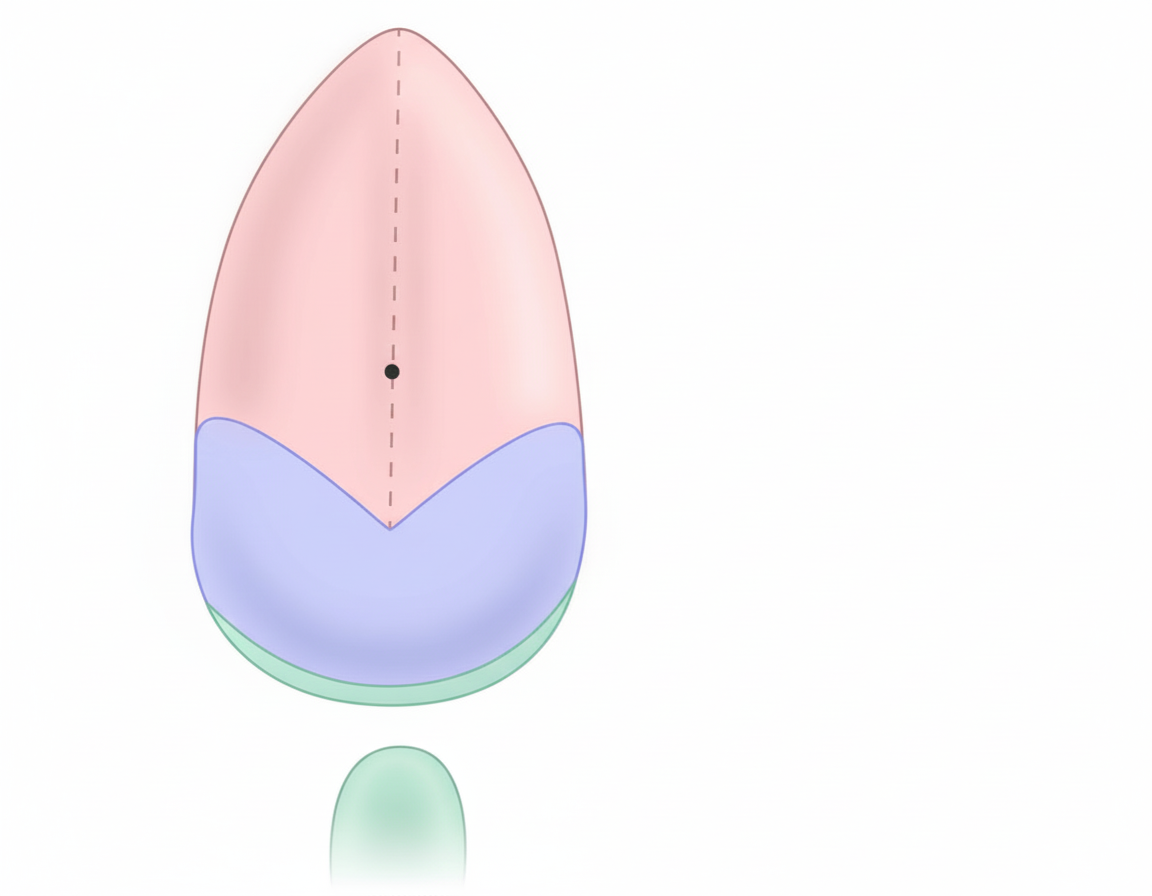
Which muscles make up the pterygomandibular raphe?
Which nerve provides motor innervation to the buccinator muscle?
The anterior ethmoidal nerve is a branch of the nasociliary nerve. Which of the following areas is NOT supplied by the anterior ethmoidal nerve?
Regarding the parotid gland, all are true except?
Which of the following foramina transmits a nerve branch to the meninges?
Dorello's canal transmits what structure in the tip of the temporal bone?
The adult maxillary air sinus always lies directly above which of the following teeth?
Which is the last skull suture to close?
Which extra-ocular muscle is supplied by the nucleus of the opposite side?
A 32-year-old man is admitted to the emergency department with visual problems. Radiographic examination reveals a tumor of the adenohypophysis (anterior pituitary gland). Physical examination reveals a loss of the lateral halves of the fields of vision of both eyes (bitemporal hemianopia or "tunnel vision"). Which of the following structures was most likely compressed by the tumor?
Explanation: The **pterygomandibular raphe** (also known as the pterygomandibular ligament) is a crucial tendinous band of the buccopharyngeal fascia. It serves as a common point of origin and insertion for two major muscles of the oral and pharyngeal regions. ### **Explanation of the Correct Answer** The raphe extends from the **pterygoid hamulus** of the medial pterygoid plate above to the posterior end of the **mylohyoid line** of the mandible below. * **Anteriorly:** It gives origin to the fibers of the **buccinator** muscle. * **Posteriorly:** It gives origin to the fibers of the **superior constrictor** muscle of the pharynx. This structural arrangement allows the cheek (buccinator) and the pharynx (superior constrictor) to function as a continuous muscular wall during swallowing and speech. ### **Why Other Options are Incorrect** * **Options A & B:** The **masseter** is a muscle of mastication located on the lateral surface of the mandibular ramus. It does not attach to the raphe, which is located medially. * **Option D:** The **middle constrictor** originates from the hyoid bone and the stylohyoid ligament, significantly lower than the level of the pterygomandibular raphe. ### **NEET-PG High-Yield Clinical Pearls** * **Clinical Landmark:** The pterygomandibular raphe is a key landmark for the **Inferior Alveolar Nerve Block**. The needle is typically inserted lateral to the raphe. * **Separation:** The **lingual nerve** lies medial to the raphe, while the **long buccal nerve** passes lateral to it. * **Space:** The raphe separates the **buccal space** (anteriorly) from the **pterygomandibular space** (posteriorly).
Explanation: The **Facial nerve (CN VII)** provides motor innervation to the **buccinator muscle**. Although the buccinator is located in the cheek, it is embryologically derived from the **second pharyngeal arch**; therefore, it is classified as a muscle of facial expression rather than a muscle of mastication. Specifically, it is supplied by the **buccal branch** of the facial nerve. Its primary functions include compressing the cheeks against the teeth to prevent food accumulation in the vestibule and assisting in whistling or blowing. **Analysis of Incorrect Options:** * **Hypoglossal nerve (CN XII):** This is the motor nerve for all intrinsic and extrinsic muscles of the tongue (except the palatoglossus). * **Glossopharyngeal nerve (CN IX):** This nerve provides sensory innervation to the posterior third of the tongue and oropharynx, and motor supply only to the stylopharyngeus muscle. * **Trigeminal nerve (CN V):** Specifically, the mandibular division ($V_3$) supplies the muscles of mastication (derived from the first arch). While the **long buccal nerve** (a branch of $V_3$) provides *sensory* innervation to the skin and mucous membrane overlying the buccinator, it does not provide motor supply. **High-Yield Clinical Pearls:** * **The "Buccal" Confusion:** Students often confuse the *buccal branch of the Facial nerve* (Motor to buccinator) with the *buccal nerve of the Mandibular nerve* (Sensory to the cheek). * **Paralysis:** In **Bell’s Palsy** (CN VII palsy), paralysis of the buccinator leads to the accumulation of food in the vestibule of the mouth during chewing. * **Stensen’s Duct:** The parotid duct pierces the buccinator muscle opposite the upper second molar tooth.
Explanation: The **Nasociliary nerve** (a branch of the Ophthalmic division of the Trigeminal nerve, CN V1) gives off the **Anterior Ethmoidal nerve**. This nerve follows a complex course, passing through the anterior ethmoidal canal to enter the anterior cranial fossa before descending into the nasal cavity. ### Why Maxillary Sinus is the Correct Answer: The **Maxillary sinus** is primarily supplied by the **Superior Alveolar nerves** (Anterior, Middle, and Posterior) and the **Infraorbital nerve**, all of which are branches of the **Maxillary nerve (CN V2)**. The anterior ethmoidal nerve (CN V1) does not contribute to its sensory innervation. ### Analysis of Other Options: * **Interior of nasal cavity:** After passing through the nasal slit, the nerve divides into internal nasal branches that supply the anterior part of the nasal septum and the lateral nasal wall. * **Dural sheath of the anterior cranial fossa:** As the nerve passes over the cribriform plate, it gives off meningeal branches to the dura mater of the anterior cranial fossa. * **Ethmoidal air cells:** The nerve provides sensory innervation to the **anterior and middle ethmoidal air cells** via small twigs during its course through the ethmoidal canal. ### NEET-PG High-Yield Pearls: * **External Nasal Nerve:** The anterior ethmoidal nerve terminates as the external nasal nerve, supplying the skin of the **bridge and tip of the nose**. * **Sneeze Reflex:** The anterior ethmoidal nerve is the afferent limb for the sneeze reflex triggered by nasal irritants. * **Hilton’s Law Application:** Remember that CN V1 supplies the forehead and bridge of the nose, while CN V2 supplies the mid-face, including the maxillary sinus and upper teeth.
Explanation: ### Explanation The parotid gland is the largest salivary gland, and understanding its anatomical relations is high-yield for NEET-PG. **Why Option A is the Correct Answer (The False Statement):** While the parotid is indeed a **purely serous gland**, it is **not** in direct contact with the internal carotid artery (ICA). The ICA lies deep to the gland, separated from it by the **styloid process** and the muscles attached to it (stylohyoid, styloglossus, and stylopharyngeus). These structures form a protective barrier between the parotid bed and the carotid sheath. **Analysis of Other Options:** * **Option B:** The gland is wedge-shaped. Its **superior surface** (deep lobe) is in close proximity to the cartilaginous part of the **external acoustic meatus** and the temporomandibular joint. * **Option C:** The **facial nerve (CN VII)** enters the posteromedial surface of the gland and divides into its five terminal branches within the substance of the gland (Patey’s facio-venous plane), effectively being enveloped by parotid tissue. * **Option D:** The gland is enclosed in a tough capsule derived from the **investing layer of deep cervical fascia**. The superficial layer is thick and attached to the zygomatic arch, while the deep layer is thin. **High-Yield Clinical Pearls:** 1. **Structures piercing the gland (Superficial to Deep):** Facial nerve → Retromandibular vein → External carotid artery (**F-V-A**). 2. **Frey’s Syndrome:** Results from injury to the **auriculotemporal nerve**; regenerating secretomotor fibers mistakenly join the sweat glands, leading to gustatory sweating. 3. **Stensen’s Duct:** Opens into the vestibule of the mouth opposite the **crown of the upper second molar**. 4. **Mumps:** Viral infection causing swelling; pain is severe because the parotid capsule (deep fascia) is unyielding.
Explanation: The **Foramen spinosum**, located in the greater wing of the sphenoid bone, is a high-yield anatomical landmark. It transmits the **Middle Meningeal Artery** (the primary blood supply to the dura mater) and the **Nervus Spinosus** (meningeal branch of the mandibular nerve, V3). The Nervus spinosus re-enters the cranium through this foramen to provide sensory innervation to the dura of the middle cranial fossa. **Analysis of Options:** * **Mastoid Foramen:** Transmits an emissary vein (connecting sigmoid sinus to posterior auricular/occipital veins) and a small branch of the occipital artery to the dura, but not a significant nerve branch to the meninges. * **Jugular Foramen:** Transmits Cranial Nerves IX, X, and XI, the internal jugular vein, and the inferior petrosal sinus. While the Vagus nerve has a meningeal branch, it typically arises within or just below the foramen rather than being the primary "nerve branch transmitted" by the foramen in standard anatomical descriptions. * **Foramen Magnum:** Transmits the medulla oblongata, spinal accessory nerves (ascending), vertebral arteries, and spinal arteries. **Clinical Pearls for NEET-PG:** 1. **Middle Meningeal Artery (MMA):** Rupture of the MMA (often due to a fracture at the **Pterion**) leads to an **Extradural Hemorrhage (EDH)**, characterized by a "lucid interval" and a biconvex/lens-shaped opacity on CT. 2. **Mnemonic for Sphenoid Foramina (Medial to Lateral):** **ROS** – Foramen **R**otundum (V2), Foramen **O**vale (MALE: Mandibular nerve, Accessory meningeal artery, Lesser petrosalnerve, Emissary vein), and Foramen **S**pinosum. 3. The Nervus spinosus is unique as it arises in the infratemporal fossa and "turns back" to enter the skull.
Explanation: ### Explanation **Dorello’s canal** is a small osteofibrous tunnel located at the tip of the petrous part of the temporal bone. It is formed between the petrous tip and the **petrosphenoidal ligament (Gruber’s ligament)**. **Why the Abducent Nerve is Correct:** The **Abducent nerve (CN VI)** enters the cavernous sinus by passing through Dorello’s canal. This is a critical anatomical landmark because the nerve makes a sharp bend as it enters the canal, making it highly susceptible to injury during base-of-skull fractures or increased intracranial pressure (ICP). **Analysis of Incorrect Options:** * **Middle meningeal artery:** Enters the skull through the **foramen spinosum** in the greater wing of the sphenoid bone. * **Mandibular nerve (V3):** Exits the skull through the **foramen ovale**. * **Superior alveolar branch of maxillary nerve:** These branches arise from the maxillary nerve (V2) within the pterygopalatine fossa and infraorbital canal, not the petrous temporal bone. **Clinical Pearls for NEET-PG:** 1. **Gradenigo’s Syndrome:** This is a classic triad resulting from **petrous apicitis** (inflammation of the petrous temporal bone). It involves: * Suppurative otitis media. * Pain in the distribution of the Trigeminal nerve (due to involvement of the trigeminal ganglion). * **Abducent nerve palsy** (due to involvement of CN VI in Dorello’s canal), leading to diplopia and medial squint. 2. **Longest Intracranial Course:** The Abducent nerve has the longest intradural course among cranial nerves, which, combined with its tethering at Dorello's canal, makes it a "false localizing sign" in cases of raised ICP.
Explanation: **Explanation:** The **maxillary sinus (Antrum of Highmore)** is the largest of the paranasal sinuses. Its floor is formed by the alveolar process of the maxilla and is classically described as being in close proximity to the roots of the posterior teeth. **Why Molars are correct:** The floor of the maxillary sinus is lowest in the region of the **first and second molars**. In adults, the roots of these teeth (especially the first molar) are separated from the sinus cavity by only a thin plate of bone, and sometimes only by the mucous membrane (Schneiderian membrane). This anatomical relationship is why dental infections can lead to maxillary sinusitis and why tooth extractions in this region carry a risk of creating an oro-antral fistula. **Why other options are incorrect:** * **Incisors and Canines (Options A & B):** These are anterior teeth. The maxillary sinus typically extends anteriorly only as far as the second premolar. The area above the incisors and canines is occupied by the floor of the nasal cavity, not the maxillary sinus. * **Premolars (Option C):** While the sinus floor can extend to the second premolar, it does not *always* lie directly above them in every individual, and it is never as consistently or closely related as it is to the molars. **High-Yield Clinical Pearls for NEET-PG:** * **Drainage:** The maxillary sinus drains into the **middle meatus** via the hiatus semilunaris. Because the ostium is located high on its medial wall, it drains poorly in the upright position. * **Nerve Supply:** The superior alveolar nerves (branches of the maxillary nerve) supply both the sinus lining and the molar teeth, leading to **referred pain** (a toothache during sinusitis). * **First to Develop:** The maxillary sinus is the first paranasal sinus to appear (around the 3rd-4th month of fetal life).
Explanation: ### Explanation The timing of suture closure is a high-yield topic in neuroanatomy, as it dictates skull growth and clinical conditions like craniosynostosis [1]. **Why Occipital Sutures are Correct:** The sutures surrounding the occipital bone, specifically the **petro-occipital** and **spheno-occipital synchondroses**, are the last to undergo complete bony fusion. While most vault sutures (like the sagittal or coronal) begin closing in the 20s and finish by the 30s or 40s, the **spheno-occipital synchondrosis** (the junction between the body of the sphenoid and the basilar part of the occipital bone) typically fuses between **18 to 25 years of age**. However, in the context of forensic anatomy and skull development, the sutures of the posterior cranial base and the complex junctions around the occipital bone are considered the final markers of skeletal maturity. **Analysis of Incorrect Options:** * **Frontal (Metopic) Suture:** This is the **first** to close, typically obliterating between **3 to 9 months** of age (completely gone by year 2). Persistent frontal suture is called a metopic suture. * **Sagittal Suture:** This usually begins closing around age 22 and is often the first of the major vault sutures to show signs of fusion. * **Coronal Suture:** This follows the sagittal suture, typically beginning closure around age 24. **Clinical Pearls for NEET-PG:** 1. **Metopic Suture:** The earliest to close (9 months). If it fails to close, it's seen in 3-8% of adults. 2. **Craniosynostosis:** Premature closure of sutures [1]. * **Scaphocephaly:** Premature closure of the **Sagittal** suture (Most common). * **Plagiocephaly:** Unilateral closure of **Coronal** or Lambdoid sutures. * **Trigonocephaly:** Premature closure of the **Frontal** suture. 3. **Fontanelles:** The **Anterior fontanelle** (Bregma) closes last among fontanelles (18–24 months), whereas the **Posterior fontanelle** (Lambda) closes earliest (2–3 months). Do not confuse fontanelle closure with suture fusion.
Explanation: **Explanation:** The correct answer is **Superior Rectus**. This question tests your knowledge of the unique organization of the Oculomotor (III) nerve nucleus located in the midbrain. **Why Superior Rectus is correct:** The Oculomotor nucleus is a complex of sub-nuclei. While most extra-ocular muscles are supplied by the ipsilateral (same side) sub-nuclei, the **Superior Rectus (SR)** is the only muscle supplied by the **contralateral (opposite side)** sub-nucleus [2]. The fibers for the SR decussate (cross over) within the midbrain before exiting as part of the oculomotor nerve. **Why the other options are incorrect:** * **Lateral Rectus:** Supplied by the Abducens (VI) nerve. Its nucleus supplies the muscle on the **ipsilateral** side [2]. * **Medial Rectus & Inferior Rectus:** These are supplied by the Oculomotor (III) nerve [2], but unlike the SR, their fibers originate from **ipsilateral** sub-nuclei. * **Superior Oblique (Note):** While not an option here, it is important to remember that the Trochlear (IV) nerve nucleus supplies the contralateral Superior Oblique, but the nerve itself decussates *after* exiting the brainstem (the only cranial nerve to exit posteriorly and decussate). **High-Yield NEET-PG Pearls:** 1. **Levator Palpebrae Superioris (LPS):** Supplied by a single **central caudal nucleus** that provides bilateral innervation. 2. **Edinger-Westphal Nucleus:** Provides parasympathetic supply to the ciliary muscle and sphincter pupillae [1]. 3. **Rule of Thumb:** All extra-ocular muscles are supplied by ipsilateral nuclei EXCEPT the **Superior Rectus** (contralateral nucleus) and the **Superior Oblique** (contralateral nucleus). Note: References [2] and [3] describe the functional actions and innervation of these muscles [2], [3].
Explanation: **Explanation:** The patient presents with **bitemporal hemianopia**, a classic visual field defect characterized by the loss of the lateral (temporal) halves of the visual field in both eyes. **Why the Optic Chiasm is correct:** The pituitary gland (adenohypophysis) lies in the sella turcica, directly inferior to the **optic chiasm**. In the chiasm, nerve fibers from the **nasal retina** of both eyes cross to the opposite side [1]. Since the nasal retina is responsible for perceiving the **temporal visual field**, a midline compression (such as an upward-growing pituitary adenoma) specifically damages these decussating fibers [2]. This results in the inability to see the outer halves of the visual world, often described as "tunnel vision." **Why other options are incorrect:** * **Optic Nerve (A):** Compression here would result in ipsilateral monocular vision loss (blindness in one eye), not a bilateral field defect. * **Optic Tract (C):** Lesions of the optic tract lead to **contralateral homonymous hemianopia** (loss of the same side of the visual field in both eyes, e.g., loss of the left half of the field in both eyes). * **Oculomotor Nerve (D):** While a large tumor could involve CN III in the cavernous sinus, it would cause ptosis, mydriasis, and ophthalmoplegia, not a specific visual field defect like bitemporal hemianopia [3]. **NEET-PG High-Yield Pearls:** * **Pituitary Adenoma:** Most common cause of bitemporal hemianopia. * **Craniopharyngioma:** Another common cause, often seen in children; it compresses the chiasm from *above* (superior aspect). * **Meyer’s Loop:** Fibers in the temporal lobe; damage causes "pie in the sky" (superior quadrantanopia). * **Baum’s Loop:** Fibers in the parietal lobe; damage causes "pie on the floor" (inferior quadrantanopia).
Skull and Facial Bones
Practice Questions
Scalp and Facial Muscles
Practice Questions
Dural Venous Sinuses
Practice Questions
Cranial Cavity
Practice Questions
Orbit and Contents
Practice Questions
Temporal and Infratemporal Regions
Practice Questions
Pterygopalatine Fossa
Practice Questions
Oral Cavity
Practice Questions
Paranasal Sinuses
Practice Questions
Applied Anatomy and Clinical Correlations
Practice Questions
Get full access to all questions, explanations, and performance tracking.
Start For Free