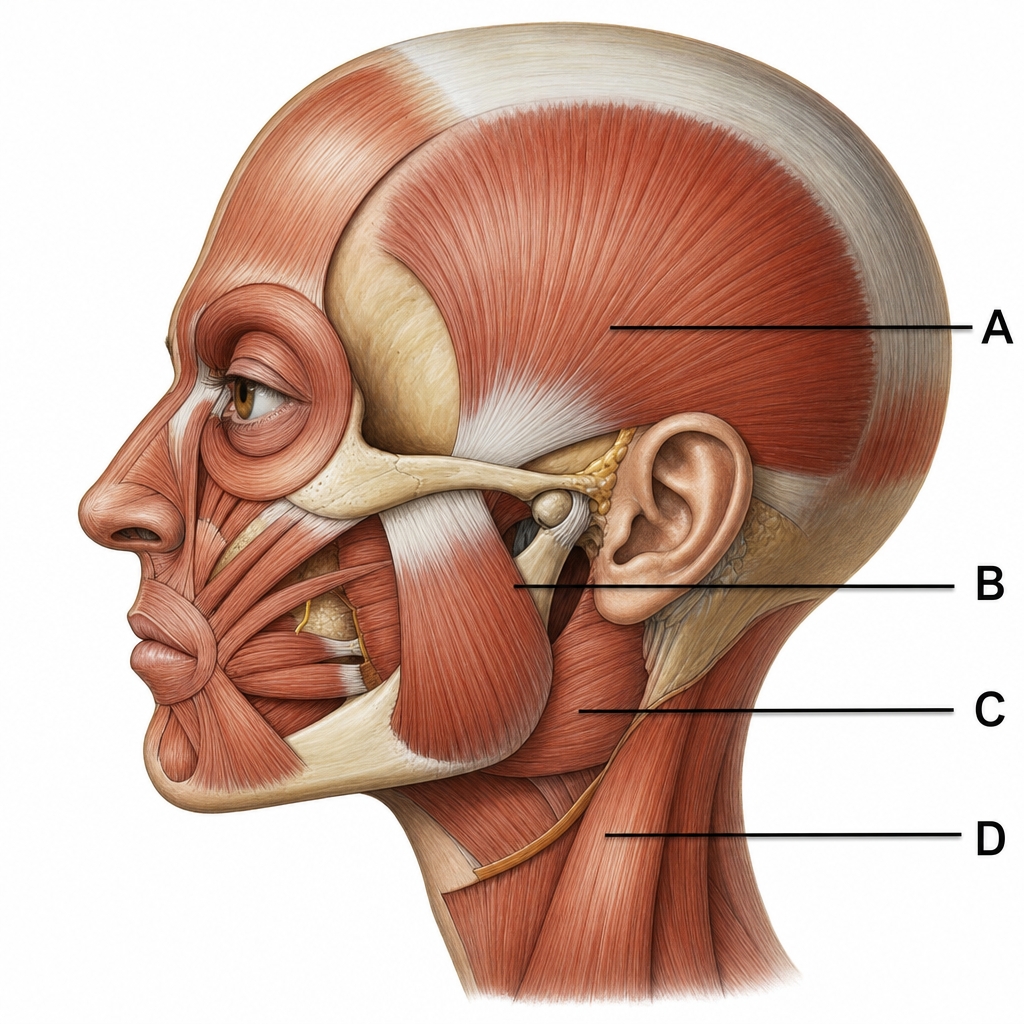
Which of the following supplies the lobule of the ear pinna?
Which of the following structures does not form part of the roof of the orbit?
Which of the following structures is NOT present on the medial surface of the submandibular gland?
The Sylvian point is related to which anatomical structure?
The lambda is the junction between which two cranial bones?
Which one of the following statements is false about the Pituitary gland?
What is the upper covering layer of the cochlear duct?
Which of the following nerves does NOT supply the dura mater of the posterior cranial fossa?
What is the relationship of the artery, vein, and nerve within the parotid gland from lateral to medial?
Which branch of the angular vein causes cavernous sinus thrombosis?
Explanation: The sensory innervation of the auricle (pinna) is a high-yield topic in NEET-PG Anatomy, often tested through its complex segmental distribution. ### **Explanation** The **Great Auricular Nerve (C2, C3)**, a branch of the cervical plexus, provides sensory innervation to the lower part of the auricle, specifically the **lobule**, the tail of the parotid gland, and the skin over the angle of the mandible. It is the primary nerve supplying the cranial (medial) surface and the posterior half of the lateral surface of the pinna. ### **Analysis of Incorrect Options** * **A. Auriculotemporal nerve:** A branch of the mandibular nerve (V3), it supplies the **tragus**, the upper part of the lateral surface of the pinna, and the external auditory meatus. It does not reach the lobule. * **C. Lesser occipital nerve:** Also from the cervical plexus (C2), it supplies the skin of the scalp behind the ear and the **superior portion** of the cranial surface of the pinna. * **D. Great petrosal nerve:** This is a branch of the facial nerve (CN VII) carrying parasympathetic fibers to the lacrimal gland and taste fibers from the palate; it has no role in the cutaneous sensation of the ear. ### **Clinical Pearls for NEET-PG** * **The "V-shape" Rule:** Remember that the **Auriculotemporal nerve** (Anterior-Superior) and **Great Auricular nerve** (Posterior-Inferior) divide the lateral surface of the pinna. * **Arnold’s Nerve:** The **Auricular branch of the Vagus (CN X)** supplies the concha and the external acoustic meatus. Stimulation of this nerve (e.g., by a speculum or syringing) can cause the **"Ear-Cough Reflex"** or even fainting (vasovagal syncope). * **Ramsay Hunt Syndrome:** Herpes Zoster involving the geniculate ganglion often presents with vesicles in the area supplied by the facial nerve's sensory component (concha and retroauricular groove).
Explanation: The orbit is a pyramid-shaped bony cavity formed by seven bones. Understanding its boundaries is a high-yield topic for NEET-PG. ### **Explanation of the Correct Answer** The **Greater wing of the sphenoid bone** does not form the roof; instead, it forms the majority of the **lateral wall** of the orbit and a small portion of the floor. The roof (superior wall) is formed primarily by two bones: the orbital plate of the frontal bone anteriorly and the lesser wing of the sphenoid bone posteriorly. ### **Analysis of Incorrect Options** * **A & B (Frontal Bone / Orbital Plate):** The orbital plate of the frontal bone forms the vast majority (anterior 90%) of the roof. It separates the orbit from the anterior cranial fossa. * **D (Lesser wing of the sphenoid):** This bone forms the posterior-most apex of the roof and contains the optic canal, which transmits the optic nerve and ophthalmic artery. ### **Clinical Pearls & High-Yield Facts** * **The "Z-M-L" Rule for Lateral Wall:** Remember **Z**ygomatic bone and **M**axilla (partially) and **L**esser/Greater wings. Specifically, the lateral wall is formed by the Zygomatic bone and the **Greater wing** of the sphenoid. * **Weakest Wall:** The **floor** (Maxilla) is the most common site for "blow-out fractures," often leading to herniation of orbital contents into the maxillary sinus. * **Thinnest Wall:** The **medial wall** (specifically the *lamina papyracea* of the ethmoid bone) is the thinnest, making it a common route for the spread of ethmoid sinusitis into the orbit (orbital cellulitis). * **Structures at the Apex:** The Superior Orbital Fissure lies between the greater and lesser wings of the sphenoid.
Explanation: The submandibular gland is a large salivary gland located in the submandibular triangle. It is divided into superficial and deep lobes by the posterior border of the mylohyoid muscle. Understanding its relations is high-yield for NEET-PG. **Explanation of the Correct Answer:** The **Facial artery** is **NOT** present on the medial surface. Instead, it is a key relation of the **lateral (inferolateral) surface** of the gland. The artery grooves the posterosuperior part of the gland, loops over the base of the mandible, and then ascends onto the face. **Analysis of Incorrect Options (Medial Relations):** The medial surface of the submandibular gland is related to three muscles and several neurovascular structures: * **A. Mylohyoid:** Forms the anterior part of the medial relation. * **C. Hyoglossus:** Forms the posterior part of the medial relation. * **D. Styloglossus:** Also relates to the posterior part of the medial surface. * *Other medial relations include:* The submandibular ganglion, lingual nerve, hypoglossal nerve, and the deep lobe of the gland itself. **NEET-PG High-Yield Pearls:** 1. **Facial Artery vs. Vein:** The facial **artery** is related to the gland (lateral surface), but the facial **vein** and the cervical branch of the facial nerve lie superficial to the gland (on the investing layer of deep cervical fascia). 2. **Wharton’s Duct:** The submandibular duct emerges from the medial surface and is crossed laterally by the lingual nerve ("Triple relation" or "Looping" of the nerve). 3. **Nerve Supply:** Secretomotor fibers arise from the **superior salivatory nucleus** (CN VII), travel via the chorda tympani, and synapse in the **submandibular ganglion**.
Explanation: **Explanation:** The **Sylvian point** is a crucial surface landmark on the skull that corresponds to the site where the lateral sulcus (Sylvian fissure) of the brain divides into its three rami (anterior, ascending, and posterior). **Why the correct answer is right:** The Sylvian point is located approximately **3 cm behind the zygomatic process of the frontal bone**, directly underlying the **squamous part of the temporal bone**. Specifically, it lies near the **pterion** (the H-shaped junction of the frontal, parietal, temporal, and sphenoid bones). Because the squamous part of the temporal bone forms the lateral wall of the middle cranial fossa, it serves as the primary bony relation to this neuroanatomical landmark. **Why the incorrect options are wrong:** * **Petrous part:** This is located deep within the skull base, housing the inner ear structures. It is not related to the lateral surface landmarks of the cerebrum. * **Tympanic part:** This is a small curved plate forming the wall of the external auditory meatus, situated far below the Sylvian fissure. * **Mastoid part:** This is located posteriorly and inferiorly to the squamous part. It relates to the sigmoid sinus and cerebellum rather than the Sylvian point. **High-Yield NEET-PG Pearls:** * **Pterion:** The Sylvian point lies deep to the pterion. A fracture here can rupture the **middle meningeal artery**, leading to an **extradural hematoma (EDH)**. * **Sylvian Fissure:** It separates the frontal and parietal lobes from the temporal lobe. * **Chassaignac’s Tubercle:** Do not confuse the Sylvian point with other surface landmarks; remember that the **carotid tubercle** (C6) is another high-yield landmark often tested in head and neck anatomy.
Explanation: ### Explanation The **lambda** is a craniometric landmark located at the posterior aspect of the skull. It represents the point where the **sagittal suture** (between the two parietal bones) meets the **lambdoid suture** (between the parietal bones and the occipital bone) [1]. **1. Why the correct answer is right:** * **Parietal and occipital bones:** The lambda marks the junction of these two bones [1]. In the fetal skull, this area is a membrane-filled space known as the **posterior fontanelle**, which typically closes by 2–3 months of age to become the bony landmark "lambda." **2. Why the incorrect options are wrong:** * **Occipital and frontal bones:** These bones do not articulate directly; they are separated by the parietal and sphenoid bones. * **Frontal and temporal bones:** These meet at the lateral aspect of the skull (near the pterion), not at the lambda. * **Frontal and parietal bones:** The junction between these bones is the **bregma** (the site of the anterior fontanelle), where the coronal and sagittal sutures meet [1]. **3. Clinical Pearls & High-Yield Facts for NEET-PG:** * **Bregma:** Junction of sagittal and coronal sutures (Anterior fontanelle) [1]. It is the largest fontanelle and closes by 18–24 months. * **Pterion:** An H-shaped junction of the frontal, parietal, temporal, and greater wing of the sphenoid. It is clinically significant because the **middle meningeal artery** lies deep to it; trauma here can lead to an extradural hematoma (EDH). * **Asterion:** Junction of the parietal, temporal, and occipital bones (Star-shaped). * **Vertex:** The most superior point of the skull in the midline.
Explanation: **Explanation:** The pituitary gland (hypophysis cerebri) is a master endocrine gland situated in the sella turcica of the sphenoid bone. **Why Option D is the correct (False) statement:** The pituitary gland is connected to the **hypothalamus**, not the thalamus, via the infundibulum (pituitary stalk). The hypothalamus regulates the pituitary through the hypothalamo-hypophyseal portal system (anterior lobe) and direct axonal projections (posterior lobe) [2]. **Analysis of other options:** * **Option A (True):** The acidophil cells of the anterior pituitary (adenohypophysis) secrete **Somatotropic hormone** (Growth Hormone), which is essential for physical growth [3]. * **Option B (True):** The gland receives its blood supply from the **superior and inferior hypophyseal arteries**, which are branches of the internal carotid artery, forming a vital part of the vascular network associated with the **Circle of Willis**. * **Option C (True):** The entire gland is of **ectodermal origin**, but from two different sources: the anterior lobe develops from **Rathke’s pouch** (oral ectoderm), while the posterior lobe develops from the **infundibulum** (neuroectoderm). **High-Yield Clinical Pearls for NEET-PG:** * **Relations:** Superiorly, it is related to the **Optic Chiasma**; tumors (like prolactinomas) can cause **bitemporal hemianopia**. * **Surgical Access:** The preferred surgical route for pituitary tumors is the **trans-sphenoidal approach**. * **Empty Sella Syndrome:** A condition where the subarachnoid space herniates into the sella turcica, flattening the gland [1]. * **Pharyngeal Pituitary:** A remnant of Rathke’s pouch may persist in the roof of the nasopharynx.
Explanation: ### Explanation The **cochlear duct (scala media)** is a triangular, endolymph-filled space within the bony cochlea. To understand its boundaries, one must visualize its cross-section: 1. **Vestibular membrane (Reissner’s membrane):** This forms the **roof (upper covering)** of the cochlear duct, separating it from the scala vestibuli [1], [2]. It is a thin, two-layered epithelial structure that maintains the ionic gradient between the perilymph and endolymph. 2. **Basilar membrane:** This forms the **floor (lower boundary)** of the cochlear duct, separating it from the scala tympani [2]. It supports the Organ of Corti. 3. **Stria vascularis:** This forms the **lateral wall**. It is highly vascularized and is responsible for the production of endolymph and maintaining its high potassium concentration. **Analysis of Incorrect Options:** * **Basilar membrane:** Incorrect, as it forms the floor, not the roof. * **Tectorial membrane:** Incorrect. This is a gelatinous structure overlying the hair cells *within* the cochlear duct; it is not a boundary layer of the duct itself [1]. * **Stria vascularis:** Incorrect, as it forms the lateral boundary. **High-Yield Clinical Pearls for NEET-PG:** * **Endolymph vs. Perilymph:** The cochlear duct contains **endolymph** (high $K^+$, like intracellular fluid), while the scala vestibuli and tympani contain **perilymph** (high $Na^+$, like ECF/CSF) [2]. * **Organ of Corti:** Located on the basilar membrane; it is the actual peripheral organ of hearing [2]. * **Helicotrema:** The small opening at the apex of the cochlea where the scala vestibuli and scala tympani communicate. * **Modiolus:** The central conical bony pillar of the cochlea around which the canal turns.
Explanation: The nerve supply of the dura mater is a high-yield topic for NEET-PG. The dura mater is supplied primarily by the **Trigeminal nerve (CN V)** in the anterior and middle cranial fossae, while the **upper cervical nerves (C1–C3)** and branches of the **Vagus (CN X)** and **Hypoglossal (CN XII)** nerves supply the posterior cranial fossa. ### Why the Spinal Accessory Nerve (CN XI) is correct: The **Spinal Accessory Nerve** is purely motor in function. It supplies the sternocleidomastoid and trapezius muscles. It does not carry any sensory fibers and does not contribute to the innervation of the dura mater. ### Analysis of other options: * **Hypoglossal Nerve (CN XII):** While CN XII is primarily motor to the tongue, it carries **recurrent meningeal branches** derived from the **C1 and C2 spinal nerves**. These fibers hitchhike along the nerve to supply the dura of the posterior fossa. * **Vagus Nerve (CN X):** The vagus nerve provides direct sensory innervation to the posterior fossa dura via its **meningeal branch**, which arises from the superior ganglion and enters the cranium through the jugular foramen. * **Facial Nerve (CN VII):** Though less commonly tested, the facial nerve does provide minor sensory contributions to the dura of the internal acoustic meatus and parts of the posterior fossa. ### High-Yield Clinical Pearls: 1. **Supratentorial Dura:** Supplied by CN V (V1, V2, V3). Pain is referred to the face/forehead. 2. **Infratentorial Dura:** Supplied by CN X and C1–C3. Pain is referred to the back of the head and neck. 3. **The
Explanation: ### Explanation The parotid gland contains several vital structures that traverse its substance. The correct anatomical relationship of these structures from **lateral (superficial) to medial (deep)** is the **Facial Nerve, Retromandibular Vein, and External Carotid Artery.** #### 1. Why "Nerve, Vein, Artery" is Correct The structures are arranged in layers based on their developmental and anatomical positions: * **Most Superficial (Lateral): Facial Nerve (CN VII).** After exiting the stylomastoid foramen, it enters the gland and divides into its five terminal branches (Temporal, Zygomatic, Buccal, Marginal Mandibular, and Cervical). * **Intermediate: Retromandibular Vein.** Formed by the union of the maxillary and superficial temporal veins. * **Deepest (Medial): External Carotid Artery.** It enters the lower part of the gland and divides into the maxillary and superficial temporal arteries at the level of the neck of the mandible. #### 2. Why Other Options are Incorrect * **Options A, C, and D** are incorrect because they misplace the depth of the structures. In the human body, major arteries are generally protected deep to veins and nerves to prevent life-threatening hemorrhage from superficial trauma. In the parotid, the facial nerve is the most vulnerable structure because it is the most lateral. #### 3. High-Yield NEET-PG Pearls * **Mnemonic:** Remember **"N-V-A"** (Nerve, Vein, Artery) from lateral to medial. * **Patey’s Facio-venous Plane:** This is a surgical cleavage plane used during parotidectomy. The facial nerve and its branches serve as the landmark to separate the "superficial" and "deep" lobes of the gland. * **Clinical Correlation:** In parotid tumors (like Pleomorphic Adenoma), the facial nerve is at risk during surgery. A "conservative parotidectomy" involves removing the gland while carefully preserving the facial nerve. * **Frey’s Syndrome:** A post-surgical complication where auriculotemporal nerve fibers regrow to sweat glands, causing gustatory sweating.
Explanation: The **cavernous sinus** is a critical venous channel that lacks valves, allowing blood to flow in both directions. This anatomical feature facilitates the spread of infection from the face to the intracranial dural sinuses. ### **Explanation of the Correct Answer** The **angular vein** is formed by the union of the **supraorbital** and **supratrochlear** veins at the medial angle of the eye. The supraorbital vein communicates directly with the **superior ophthalmic vein** through the supraorbital notch. Since the superior ophthalmic vein drains directly into the cavernous sinus, an infection originating in the "danger area of the face" (nasolabial region) can track through the angular vein and its supraorbital branch into the cavernous sinus, leading to **Cavernous Sinus Thrombosis (CST)**. ### **Analysis of Incorrect Options** * **Maxillary vein:** This vein is located deeper in the infratemporal fossa and joins the superficial temporal vein to form the retromandibular vein. It does not directly contribute to the formation of the angular vein. * **Infraorbital vein:** While it drains the lower eyelid and cheek and communicates with the pterygoid plexus, it is not the primary branch of the angular vein responsible for the direct superior pathway to the cavernous sinus. * **Supratrochlear vein:** Although it helps form the angular vein, the supraorbital vein is the more clinically significant conduit in this specific pathway due to its direct communication with the ophthalmic venous system. ### **High-Yield Clinical Pearls for NEET-PG** * **Danger Area of the Face:** Bound by the bridge of the nose and the corners of the mouth. * **Valve-less Veins:** The facial vein and ophthalmic veins are valve-less, which is the primary reason for retrograde infection spread. * **Alternative Pathway:** Infection can also reach the cavernous sinus via the **deep facial vein** connecting to the **pterygoid venous plexus**, which then communicates with the sinus via emissary veins. * **Clinical Sign:** The first cranial nerve usually affected in CST is the **Abducens nerve (CN VI)** because it runs through the center of the sinus.
Skull and Facial Bones
Practice Questions
Scalp and Facial Muscles
Practice Questions
Dural Venous Sinuses
Practice Questions
Cranial Cavity
Practice Questions
Orbit and Contents
Practice Questions
Temporal and Infratemporal Regions
Practice Questions
Pterygopalatine Fossa
Practice Questions
Oral Cavity
Practice Questions
Paranasal Sinuses
Practice Questions
Applied Anatomy and Clinical Correlations
Practice Questions
Get full access to all questions, explanations, and performance tracking.
Start For Free