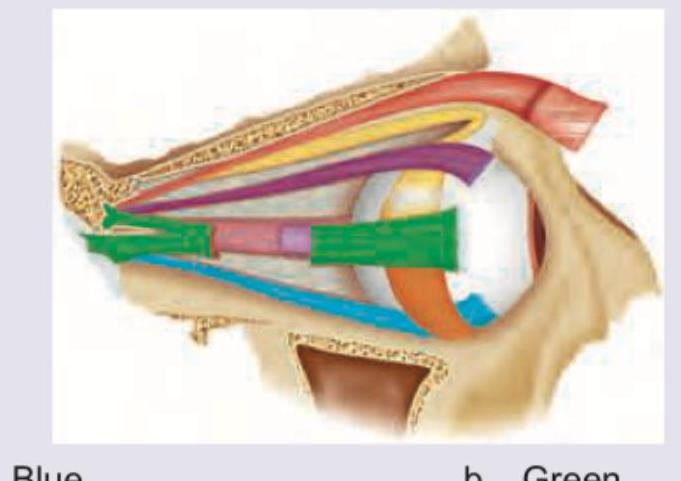
Which of the color-marked muscles shown below is the antagonist muscle to superior rectus?
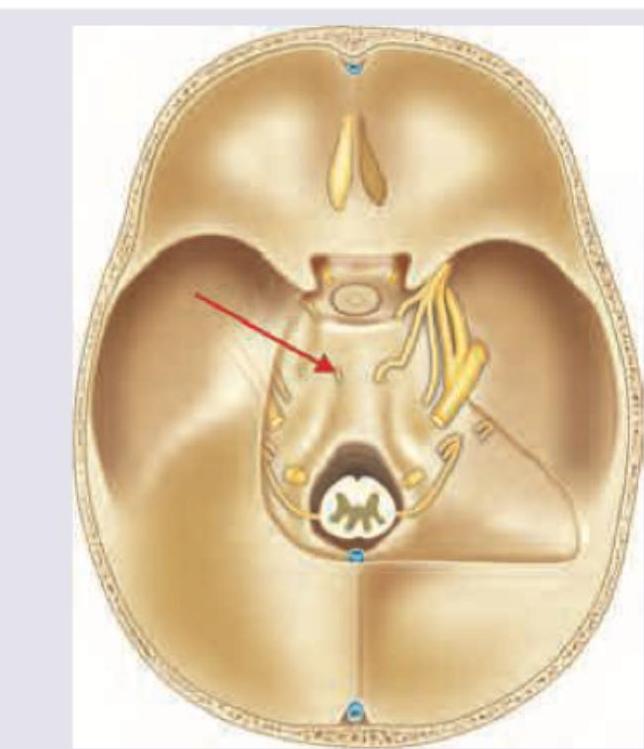
Identify the structure marked by the arrow in this skull base image:
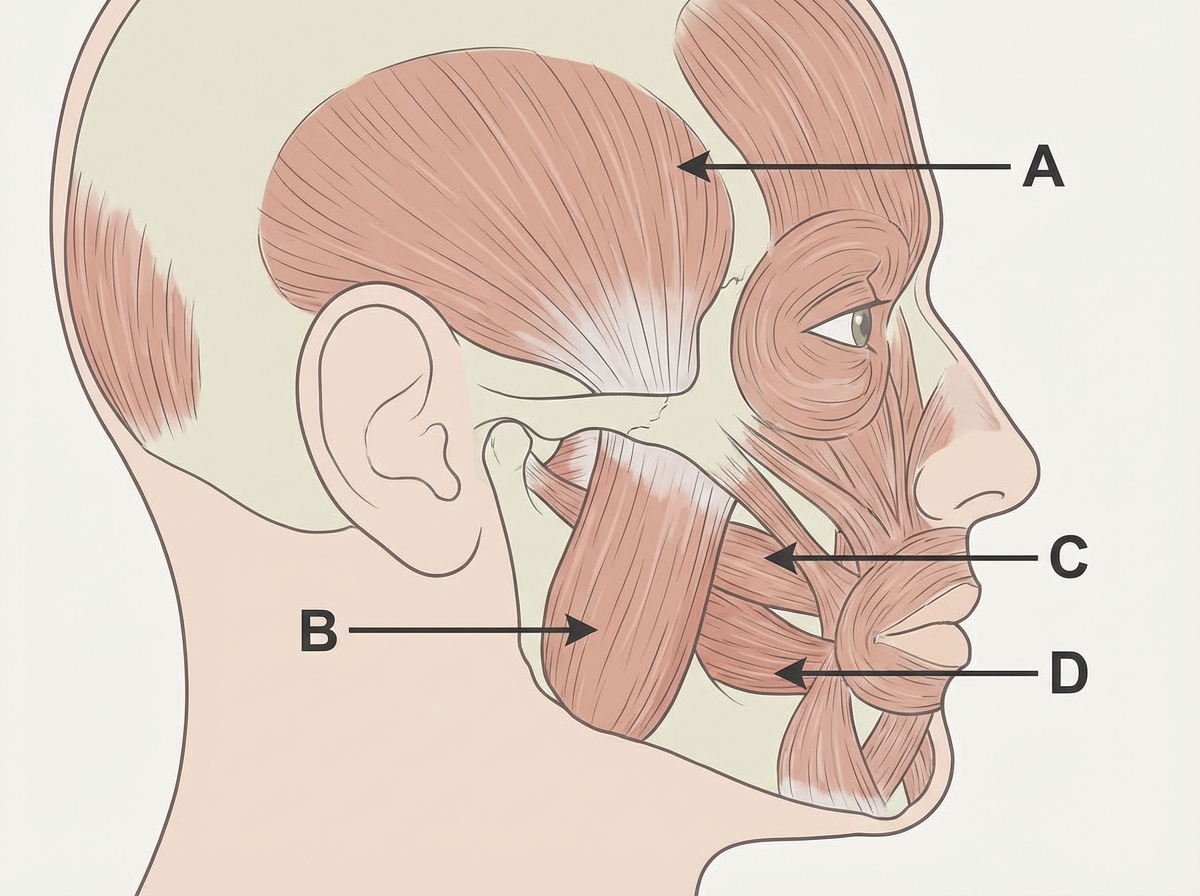
Which of the following structures will help in opening of jaw?
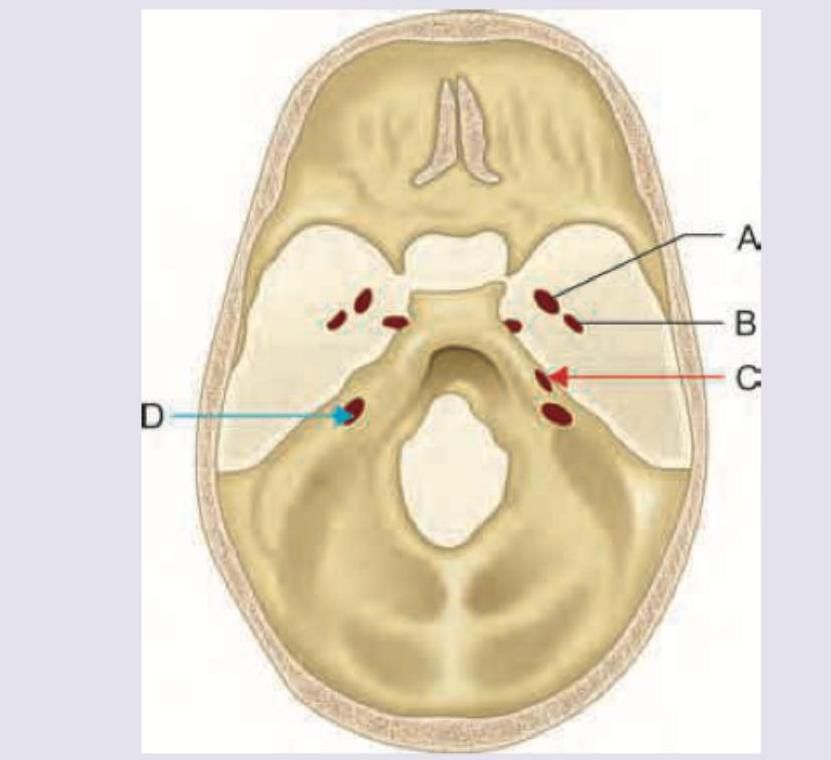
Mandibular division of trigeminal nerve passes through which of the following? (AIIMS May 2018)
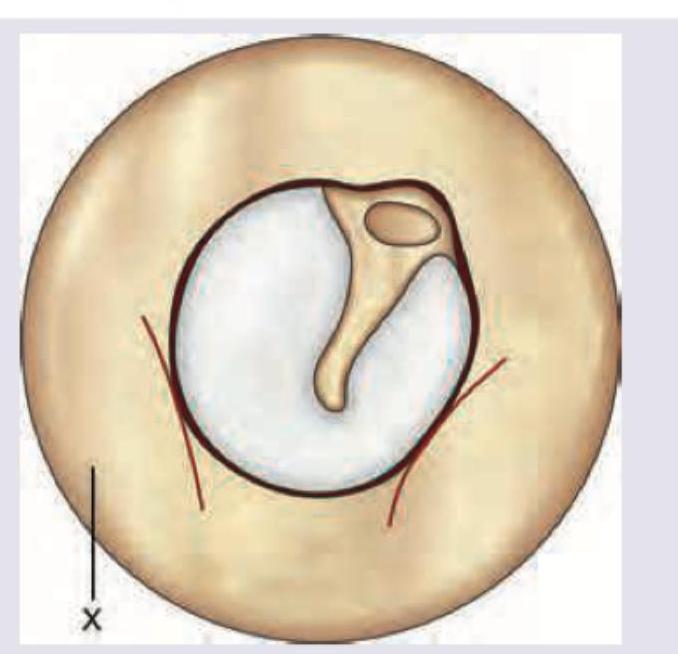
The area of external auditory canal marked as ' $X$ ' is innervated by which nerve?
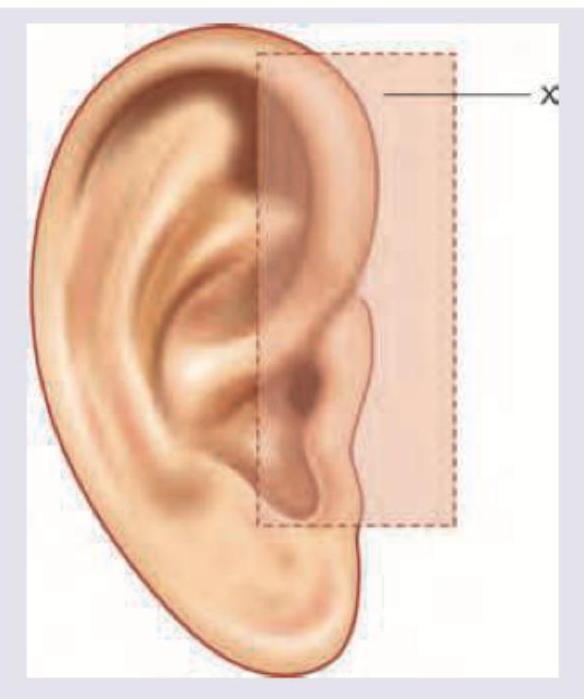
Which of the following nerve supplies the area of pinna marked as X?
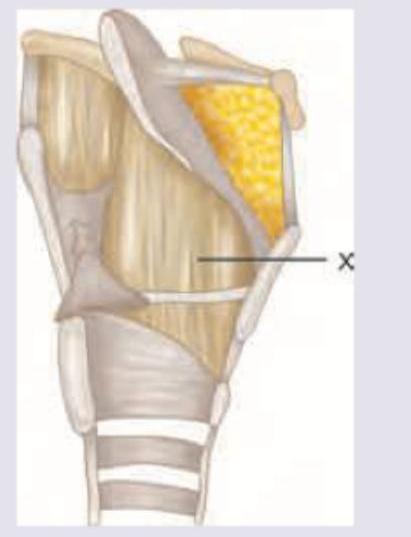
What does the marking X represent? (DNB Pattern 2018)
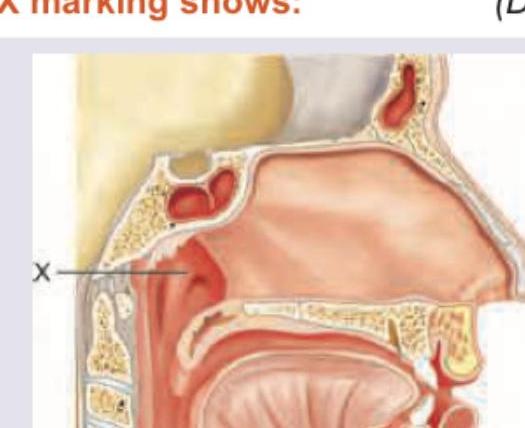
The X marking shows:
In a patient of carcinoma tongue, the infiltration of which muscle causes ankyloglossia ?
All of the following cranial nerves pass through the jugular foramen except :
Explanation: ***Blue*** - The blue structure represents the **inferior rectus muscle**, which is responsible for **depression** and some adduction/extorsion of the eye. - As the superior rectus primarily performs **elevation** of the eye, the inferior rectus acts as its direct antagonist. *Green* - The green structure represents the **medial rectus muscle**, which primarily causes **adduction** (moving the eye inward). - Its antagonist is the lateral rectus, not the superior rectus. *Purple* - The purple structure represents the **levator palpebrae superioris**, a muscle responsible for **elevating the upper eyelid**. - It does not directly move the eyeball, so it cannot be an antagonist to the superior rectus, which moves the eye. *Yellow* - The yellow structure is likely the **lacrimal gland**, an exocrine gland responsible for producing **tears**. - It is not a muscle and therefore cannot act as an antagonist to any extraocular muscle.
Explanation: ***Vertebral artery*** - The arrow indicates the **vertebral artery** as it ascends through the **foramen magnum** into the posterior fossa, appearing as a prominent paired vascular structure lateral to the **medulla oblongata**. - In skull base imaging, vertebral arteries appear as **cylindrical structures** running alongside the brainstem, distinguishable from nerves by their **larger caliber** and **bilateral symmetry** at the craniovertebral junction. *Spinal accessory nerve* - The **spinal accessory nerve (CN XI)** has a much **smaller diameter** than the indicated structure and would appear as a thin nerve bundle coursing toward the **jugular foramen**. - It enters the skull through the foramen magnum but quickly turns laterally toward the **jugular foramen**, not maintaining the vertical course shown by the arrow. *Labyrinthine artery* - The **labyrinthine artery** is a **small branch** of the AICA that enters the **internal acoustic meatus** to supply the inner ear, too small to be clearly visible at this magnification. - It would be located more **anterolaterally** near the cerebellopontine angle, not in the **midline posterior fossa** location indicated by the arrow. *Abducens nerve* - The **abducens nerve (CN VI)** emerges from the **pontomedullary junction** and travels anteriorly through the **cavernous sinus**, located much more **superiorly and anteriorly** than the marked structure. - It would appear as a **thin nerve** rather than the **robust vascular structure** indicated, and would not be visible at the **foramen magnum level**.
Explanation: ***C*** - Structure C represents the **lateral pterygoid muscle**, which is the primary muscle responsible for **opening the jaw (depression of the mandible)**, as well as protrusion and contralateral excursion. - It is the only muscle of mastication that actively participates in jaw opening. *A* - Structure A appears to be the **medial pterygoid muscle**, which is primarily involved in **elevation of the mandible** (jaw closing) and side-to-side movements. - Its action is antagonistic to jaw opening. *B* - Structure B likely represents the **masseter muscle**, a powerful muscle of mastication that primarily functions to **elevate the mandible** and close the jaw. - It is a strong jaw closer, not an opener. *D* - Structure D points to the **temporalis muscle**, another major muscle of mastication that is responsible for **elevating and retracting the mandible** (closing the jaw). - Its primary actions are in jaw closing, not opening.
Explanation: ***D*** - The label 'D' points to the **foramen ovale**, which is the opening through which the **mandibular division of the trigeminal nerve (V3)** exits the middle cranial fossa. - The foramen ovale also transmits the **accessory meningeal artery**, **lesser petrosal nerve**, and the **emissary veins**. *A* - The label 'A' points to the **foramen rotundum**, which is primarily for the passage of the **maxillary division of the trigeminal nerve (V2)**. - The foramen rotundum is distinct from the foramen ovale and is located more anterior and medial. *B* - The label 'B' points to the **foramen spinosum**, which allows the passage of the **middle meningeal artery** and the **nervus spinosus (meningeal branch of V3)**. - While it transmits a branch of V3, it is not the main exit point for the entire mandibular division. *C* - The label 'C' points to the **foramen lacerum**, which is occupied by **cartilage** in vivo and primarily traversed by the **internal carotid artery** and its accompanying sympathetic plexus passing superiorly to it. - No major cranial nerves pass completely through it; instead, some nerves (like the greater petrosal nerve) pass over its superior surface or exit through associated canals.
Explanation: ***Arnold nerve*** - The **Arnold's nerve**, also known as the **auricular branch of the vagus nerve (CN X)**, innervates the posterior inferior part of the external auditory canal and a portion of the concha. - Stimulation of this nerve can elicit the "ear-cough reflex" (Aristotle's reflex) or cause syncope in susceptible individuals. *Facial nerve* - The facial nerve (CN VII) primarily provides **motor innervation** to the muscles of facial expression. - While it has a small sensory component (nervus intermedius) that supplies taste to the anterior two-thirds of the tongue and a small area of the pinna, it does not significantly innervate the external auditory canal. *Auriculotemporal nerve* - The **auriculotemporal nerve** is a branch of the **mandibular nerve (V3)**, which is part of the trigeminal nerve (CN V). - It primarily innervates the skin of the temporal region, the external auditory meatus (anterior and superior aspects), and the temporomandibular joint, but it is not the primary innervation for the area marked 'X' which is typically posteroinferior. *Lesser occipital nerve* - The lesser occipital nerve is a branch of the **cervical plexus**. - It provides **cutaneous sensation** to the skin over the mastoid process and the upper part of the auricle, not the external auditory canal.
Explanation: ***Lesser occipital nerve*** - The **lesser occipital nerve** (C2, C3) primarily supplies the skin of the **cranial surface of the auricle's upper half** and the adjacent scalp, which corresponds to the area marked as X. - This nerve is a branch of the **cervical plexus** and provides sensory innervation to this posterior-superior part of the pinna. *Arnold's nerve* - **Arnold's nerve** (auricular branch of the vagus nerve) supplies the skin of the **concha**, tragus, and external auditory meatus. - Stimulation of this nerve can cause the **cough reflex** or **syncopal episodes** (vasovagal syncope). *Auriculotemporal nerve* - The **auriculotemporal nerve** (a branch of the mandibular nerve, V3) innervates the **anterior and superior parts of the external ear**, including the tragus and helix. - It also provides sensory innervation to the skin of the temple and secretomotor fibers to the **parotid gland**. *Greater occipital nerve* - The **greater occipital nerve** (C2) primarily supplies the skin of the **posterior scalp** up to the vertex. - It does not significantly contribute to the sensory innervation of the pinna itself, though it is located in the nearby posterior neck region.
Explanation: ***Crico-vocal membrane*** - The marking X points to the **conus elasticus**, also known as the crico-vocal membrane. This membrane forms the main supporting ligament of the larynx. - Its superior free edge forms the **vocal ligament**, which is the core of the true vocal folds. *Quadrangular membrane* - The quadrangular membrane is located **superior** to the vocal folds, extending between the arytenoid and epiglottic cartilages. - Its lower free border forms the **vestibular ligament** (false vocal cord), which is superior to the position marked by X. *Thyro-hyoid membrane* - The thyro-hyoid membrane connects the **thyroid cartilage** to the **hyoid bone**. - It lies significantly superior to the structures shown in the region marked by X, which is within the larynx itself. *Hyo-epiglottic ligament* - The hyo-epiglottic ligament connects the **hyoid bone** to the **anterior surface of the epiglottis**. - This ligament is situated much higher in the neck and anterior to the structures depicted by the mark X.
Explanation: ***Torus tubarius*** - The X marking points to a prominent mucosal elevation in the nasopharynx formed by the **cartilaginous end of the Eustachian tube**. - This structure is known as the **torus tubarius** and is a key landmark in the lateral wall of the nasopharynx. *Rathke's pouch* - **Rathke's pouch** is an embryonic invagination of the stomodeum that gives rise to the anterior pituitary gland. - It is located superior to the nasopharynx, not within its lateral wall as shown by the X marking. *Digastric ridge* - The **digastric ridge** is a term not typically used in anatomical descriptions of the nasopharynx or its immediate vicinity. - The digastric muscle is located in the neck, inferior to the structures depicted. *Tegmen plate* - The **tegmen tympani** is a thin plate of bone forming the roof of the tympanic cavity (middle ear). - This structure is part of the temporal bone and is located superior to the nasopharynx, not directly within its lumen as indicated.
Explanation: ***Genioglossus muscle*** - Infiltration of the **genioglossus muscle** by carcinoma of the tongue restricts tongue protrusion and movement, functionally mimicking **ankyloglossia** [1]. - The genioglossus is the **primary protrusor** of the tongue, originating from the mental spine of the mandible and inserting into the entire length of the tongue. - When infiltrated by tumor, it causes **inability to protrude the tongue** beyond the lower incisor teeth and deviation toward the affected side [1]. - Though true ankyloglossia is a congenital condition involving the lingual frenulum, this term is used clinically to describe **acquired restriction of tongue mobility**. *Palatoglossus muscle* - The palatoglossus muscle primarily **elevates the posterior tongue** and assists in closing the oropharyngeal isthmus. - Its infiltration would affect **swallowing and palatine arch function** rather than tongue protrusion. - Not the primary cause of restricted tongue protrusion seen in this clinical scenario. *Styloglossus muscle* - The styloglossus muscle **retracts and elevates the sides of the tongue**. - Its involvement would impair retraction and lateral movements but would **not restrict protrusion**, which is the hallmark of ankyloglossia. *Mylohyoid muscle* - The mylohyoid forms the **muscular floor of the mouth** and elevates the hyoid bone and tongue during swallowing. - It is not an intrinsic tongue muscle; infiltration would cause **floor of mouth issues** and dysphagia rather than specific restriction of tongue protrusion.
Explanation: ***Hypoglossal*** - The **hypoglossal nerve (CN XII)** exits the skull through the **hypoglossal canal**, not the jugular foramen. - Its primary function is to innervate the intrinsic and extrinsic muscles of the **tongue**. *Vagus* - The **vagus nerve (CN X)** is one of the three cranial nerves that traverse the **jugular foramen**. - It has extensive innervation, including parasympathetic supply to the **heart, lungs, and most of the gastrointestinal tract**. *Glossopharyngeal* - The **glossopharyngeal nerve (CN IX)** exits the skull via the **jugular foramen**. - It is responsible for **taste sensation** from the posterior one-third of the tongue and motor innervation to the **stylopharyngeus muscle**. *Spinal accessory* - The **spinal accessory nerve (CN XI)** passes through the **jugular foramen** after entering the cranial cavity through the foramen magnum. - It innervate the **sternocleidomastoid** and **trapezius muscles**, responsible for head and shoulder movements.
Skull and Facial Bones
Practice Questions
Scalp and Facial Muscles
Practice Questions
Dural Venous Sinuses
Practice Questions
Cranial Cavity
Practice Questions
Orbit and Contents
Practice Questions
Temporal and Infratemporal Regions
Practice Questions
Pterygopalatine Fossa
Practice Questions
Oral Cavity
Practice Questions
Paranasal Sinuses
Practice Questions
Applied Anatomy and Clinical Correlations
Practice Questions
Get full access to all questions, explanations, and performance tracking.
Start For Free