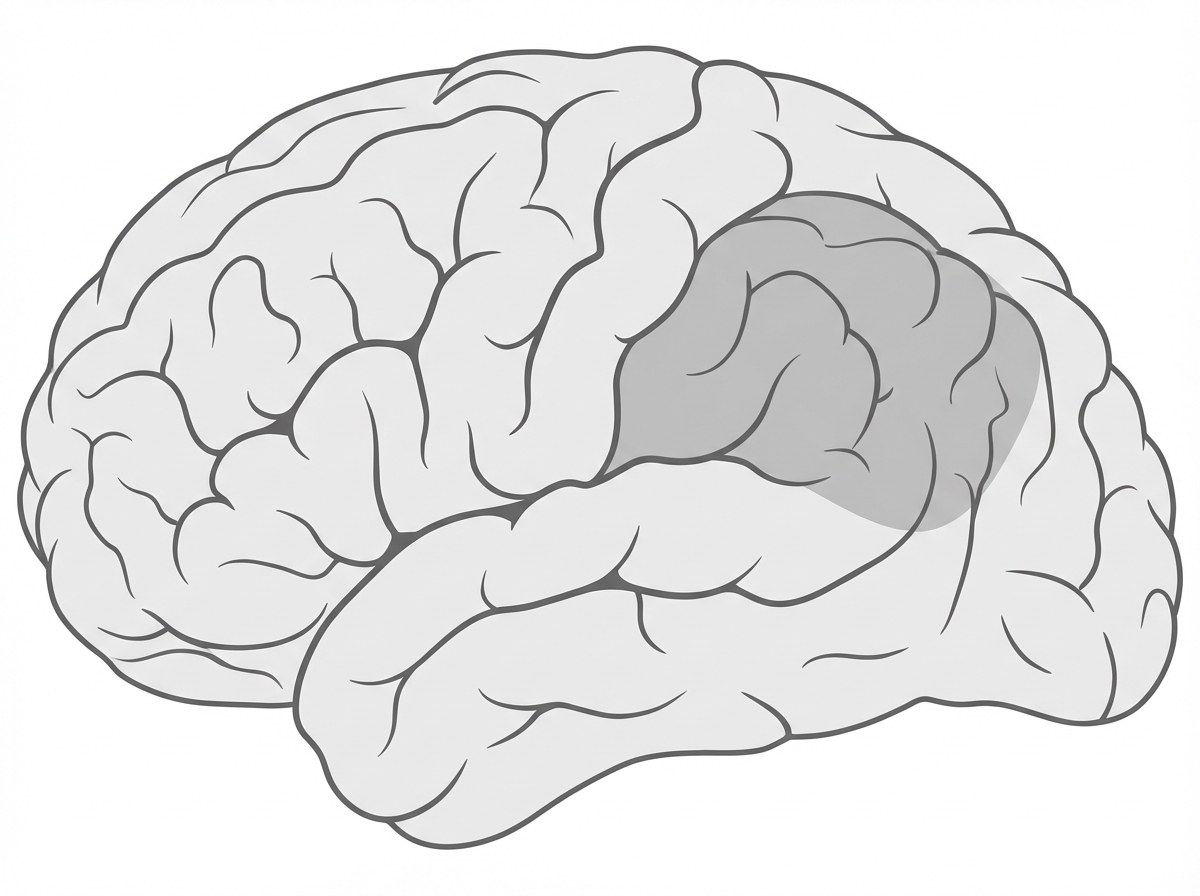
Which artery supplies the lateral surface of the cerebral hemisphere?
Which statement is not true regarding the cranial dura mater?
The floor of the third ventricle is formed by all of the following except?
Which of the following cranial structures are insensitive to pain?
Which nerves do not arise from the medulla?
The primary motor area of the brain is supplied by which artery?
Which of the following is NOT true about Weber's syndrome?
Which nerve emerges through the trapezoid body of the pons?
The limbic system is also known as which of the following?
Which of the following functions is NOT typically associated with damage to the cerebellum?
Explanation: ### Explanation The **Middle Cerebral Artery (MCA)** is the largest branch of the internal carotid artery and is the primary blood supply to the **lateral (superolateral) surface** of the cerebral hemisphere [1]. It travels through the lateral sulcus (Sylvian fissure) to supply the majority of the frontal, parietal, and temporal lobes, including the primary motor and sensory areas for the face and upper limbs, as well as the Broca’s and Wernicke’s speech areas. **Analysis of Options:** * **Anterior Cerebral Artery (ACA):** Supplies the **medial surface** of the cerebral hemisphere (up to the parieto-occipital sulcus) and a thin strip of the superior border on the lateral surface [1]. It primarily serves the motor and sensory cortices for the lower limbs. * **Posterior Cerebral Artery (PCA):** Supplies the **inferior surface** of the temporal lobe and the **occipital lobe** (including the visual cortex). * **Posterior Inferior Cerebellar Artery (PICA):** A branch of the vertebral artery that supplies the postero-lateral part of the medulla and the inferior surface of the cerebellum; it does not supply the cerebral cortex. **High-Yield Clinical Pearls for NEET-PG:** 1. **Stroke Localization:** An MCA infarct typically presents with contralateral hemiplegia and hemianesthesia affecting the **face and arm** more than the leg. If the dominant hemisphere is involved, **aphasia** occurs. 2. **Lenticulostriate Arteries:** These are deep branches of the MCA (M1 segment) known as the "arteries of stroke" (Charcot’s artery), which supply the internal capsule and basal ganglia. 3. **Homunculus:** Remember that the MCA maps to the "upper body" (face/arms), while the ACA maps to the "lower body" (legs/perineum).
Explanation: ### Explanation **1. Why Option D is the Correct Answer (The False Statement):** The dural venous sinuses are not located external to the meningeal layer; rather, they are situated **between** the two layers of the dura mater (the outer endosteal layer and the inner meningeal layer) [1]. At specific locations, the meningeal layer reflects away from the endosteal layer to form dural folds (like the falx cerebri); the gaps created at the base or margins of these folds house the venous sinuses [1]. **2. Analysis of Other Options:** * **Option A:** This is **true**. Unlike the spinal dura (which has one layer), the cranial dura is composed of an outer **endosteal (periosteal) layer**, which adheres to the skull, and an inner **meningeal layer**, which is continuous with the spinal dura [1]. * **Option B:** This is **true**. The supratentorial dura is primarily supplied by the three branches of the **Trigeminal nerve (CN V)**. The infratentorial dura (posterior cranial fossa) is supplied by the upper cervical nerves (C1-C3) and the Vagus nerve (CN X). * **Option C:** This is **true**. The meninges consist of the Dura mater (outermost, tough), Arachnoid mater (middle), and Pia mater (innermost, delicate). **3. NEET-PG High-Yield Pearls:** * **Blood Supply:** The **Middle Meningeal Artery** (a branch of the maxillary artery) is the most important artery for the dura. It runs between the endosteal dura and the bone; its rupture leads to an **Extradural Hemorrhage (EDH)** [1]. * **Pain Sensitivity:** The brain parenchyma is insensitive to pain, but the dura is **highly sensitive**. Dural stretching or irritation is a primary cause of headaches. * **Dural Folds:** The largest fold is the **Falx Cerebri**, which contains the Superior and Inferior Sagittal Sinuses. The **Tentorium Cerebelli** separates the occipital lobes from the cerebellum.
Explanation: The **third ventricle** is a narrow, slit-like cavity located between the two thalami. Understanding its boundaries is high-yield for NEET-PG, as it involves several structures of the diencephalon and midbrain. ### Why "Anterior Pituitary" is the Correct Answer: The floor of the third ventricle is formed by structures that slope downward and backward. While the **infundibulum** (pituitary stalk) and the **posterior pituitary** (neurohypophysis) are developmentally and anatomically continuous with the hypothalamus (forming part of the floor) [1], the **anterior pituitary** (adenohypophysis) is an endocrine structure derived from **Rathke’s pouch** (oral ectoderm). It sits in the sella turcica and does not form the ventricular boundary. ### Explanation of Other Options (Boundaries of the Floor): The floor extends from the optic chiasma anteriorly to the cerebral aqueduct posteriorly. * **A. Tuber cinereum:** This is a hollow eminence of gray matter situated between the optic chiasma and the mammillary bodies; it forms a direct part of the floor. * **B. Posterior perforated substance:** Located in the interpeduncular fossa, this area allows the passage of central branches of the posterior cerebral artery and contributes to the posterior part of the floor. * **C. Tegmentum:** Specifically the tegmentum of the midbrain, it lies inferior to the posterior part of the third ventricle and forms the most posterior portion of its floor before it narrows into the aqueduct of Sylvius. * *Note: Other components include the Optic Chiasma and Mammillary bodies.* ### NEET-PG High-Yield Pearls: * **Anterior Wall:** Formed by the lamina terminalis, anterior commissure, and column of the fornix. * **Roof:** Formed by the ependyma, covered by the **tela choroidea** (which contains the choroid plexus). * **Clinical Correlation:** Obstruction of the third ventricle (e.g., by a colloid cyst) leads to **obstructive hydrocephalus**, typically presenting with paroxysmal headaches related to head posture.
Explanation: In neuroanatomy, the structures within the cranium are classified as either **pain-sensitive** or **pain-insensitive**. This distinction is crucial for understanding the pathophysiology of headaches. ### Why Choroid Plexus is the Correct Answer The **Choroid Plexus**, along with the brain parenchyma (gray and white matter), the ependymal lining of the ventricles, and the arachnoid mater, lacks nociceptors (pain receptors). Since there are no sensory nerve endings to detect noxious stimuli, these structures are completely **insensitive to pain**. ### Why the Other Options are Wrong The pain-sensitive structures of the head are primarily the dura mater, the proximal portions of large intracranial arteries, and the venous sinuses. * **A. Dural sheath surrounding vascular sinuses:** The dural envelopes of the major venous sinuses (like the Superior Sagittal Sinus) are richly innervated by branches of the Trigeminal nerve (CN V) and are highly sensitive to stretch and pressure. * **C. Falx cerebri:** This is a fold of the dura mater. The dura, especially where it forms the falx and tentorium, is highly pain-sensitive. * **D. Middle meningeal artery:** The walls of the large intracranial and meningeal arteries contain nociceptors. Traction or dilation of the middle meningeal artery is a classic cause of throbbing headache pain. ### NEET-PG High-Yield Pearls * **Innervation Rule:** Above the tentorium cerebelli, pain is mediated by the **Trigeminal nerve (CN V)** (referred to the forehead/face). Below the tentorium, pain is mediated by the **Vagus (CN X) and Glossopharyngeal (CN IX)** nerves and upper cervical nerves (referred to the back of the head/neck). * **Brain Parenchyma:** The brain itself does not feel pain; this is why patients can remain awake during "awake craniotomies." * **Most Sensitive:** The most pain-sensitive structures are the **proximal segments of the cerebral arteries** and the **dura at the base of the brain**.
Explanation: To master neuroanatomy for NEET-PG, it is essential to memorize the specific exit points of cranial nerves (CN) from the brainstem. ### **Explanation of the Correct Answer** **A. Facial Nerve (CN VII):** This is the correct answer because the facial nerve, along with the abducens (VI) and vestibulocochlear (VIII) nerves, arises from the **pontomedullary junction** (the groove between the pons and the medulla). Specifically, the facial nerve originates from the lateral aspect of this junction. It does not arise from the medulla oblongata itself. ### **Analysis of Incorrect Options** * **B. Glossopharyngeal (CN IX) & C. Vagus (CN X):** These are incorrect because they directly arise from the **medulla**. Along with the Accessory nerve (CN XI), they emerge from the post-olivary sulcus (retro-olivary groove) of the medulla. * **D. Dorsal horn of gray matter:** While this is a structural component of the spinal cord (and the spinal trigeminal nucleus extends into the medulla), it is not a cranial nerve. In the context of "nerves arising from the medulla," CN IX, X, and XII are the primary residents. ### **High-Yield NEET-PG Pearls** * **Rule of 4s for Brainstem:** * **Midbrain:** CN III, IV * **Pons:** CN V, VI, VII, VIII (VI-VIII are at the junction) * **Medulla:** CN IX, X, XI, XII * **Hypoglossal Nerve (CN XII):** Unique because it exits the medulla from the **pre-olivary sulcus** (between the pyramid and the olive), whereas IX, X, and XI exit from the **post-olivary sulcus**. * **Clinical Correlation:** Lateral Medullary Syndrome (Wallenberg Syndrome) typically affects CN IX and X, leading to dysphagia and dysarthria, but spares the facial nerve.
Explanation: The **primary motor area (Brodmann area 4)** is located in the precentral gyrus on the lateral surface of the frontal lobe and extends onto the medial surface of the hemisphere (within the paracentral lobule) [1]. Its blood supply is divided between two major arteries based on the **homunculus** (the functional map of the body): [1] 1. **Middle Cerebral Artery (MCA):** Supplies the **lateral surface** of the precentral gyrus. This area controls the motor functions of the face, upper limbs, and trunk. 2. **Anterior Cerebral Artery (ACA):** Supplies the **medial surface** of the precentral gyrus (part of the paracentral lobule). This area controls the motor functions of the lower limbs and perineum. Therefore, the entire primary motor area requires both the ACA and MCA for complete perfusion. **Explanation of Options:** * **Option A & B:** These are incomplete. While the ACA and MCA both supply parts of the motor cortex, neither supplies the *entire* area alone. * **Option D:** The Posterior Cerebral Artery (PCA) primarily supplies the occipital lobe (visual cortex) and the inferior surface of the temporal lobe; it does not contribute to the primary motor area. **NEET-PG High-Yield Pearls:** * **Stroke Localization:** An MCA stroke typically results in contralateral paralysis of the **face and arm** more than the leg. An ACA stroke results in contralateral paralysis of the **leg and foot** more than the arm. * **Paracentral Lobule:** This is the specific site on the medial surface where the ACA supplies the motor and sensory areas for the lower limb and micturition control. * **Homunculus:** Remember "Fat Man on the Side" (Face/Arm = Lateral/MCA) and "Legs in the Middle" (Legs = Medial/ACA) [1].
Explanation: **Weber’s Syndrome** (Superior Alternating Hemiplegia) is a midbrain stroke syndrome caused by an occlusion of the paramedian branches of the **posterior cerebral artery**. It specifically involves the **ventral midbrain**, affecting the fibers of the Oculomotor nerve (CN III) and the descending corticospinal/corticobulbar tracts in the crus cerebri. ### Why Option D is the Correct Answer: In Weber’s syndrome, there is **ipsilateral** (same side) paralysis of the muscles supplied by the Oculomotor nerve and **contralateral** (opposite side) hemiplegia. While the corticobulbar tract is involved, it typically results in a **contralateral lower facial palsy** (supranuclear/UMN type). The option "Contralateral facial nerve palsy" is often considered "not true" in the context of classic descriptions because the hallmark of Weber's is the combination of CN III palsy and limb hemiplegia. More importantly, in many exam contexts, facial nerve involvement is more characteristically associated with **Millard-Gubler syndrome** (Pons). ### Explanation of Incorrect Options: * **A & B (Diplopia & Ophthalmoplegia):** These are **true** features. Damage to the CN III fascicles leads to paralysis of the extraocular muscles (except lateral rectus and superior oblique), causing the eye to look "down and out" (Ophthalmoplegia) and resulting in double vision (Diplopia). * **C (Contralateral Hemiplegia):** This is a **true** feature. Damage to the **corticospinal tract** in the crus cerebri (above the decussation in the medulla) results in paralysis of the opposite side of the body. ### High-Yield Clinical Pearls for NEET-PG: * **Site of Lesion:** Ventral/Base of the Midbrain. * **Nerve Involved:** Ipsilateral CN III (Oculomotor). * **Classic Presentation:** Ipsilateral ptosis, dilated pupil, and "down and out" eye + Contralateral hemiplegia. * **Comparison:** * **Benedikt’s Syndrome:** Midbrain tegmentum (CN III + Red Nucleus = Tremors/Ataxia). * **Millard-Gubler Syndrome:** Base of Pons (CN VI + CN VII + Hemiplegia).
Explanation: ### Explanation The **Cochlear nerve** (a component of the Vestibulocochlear nerve, CN VIII) is the correct answer because of its specific functional and anatomical relationship with the auditory pathway in the pons [1]. **1. Why the Cochlear Nerve is Correct:** The **trapezoid body** is a bundle of transverse fibers located in the ventral part of the pontine tegmentum. It represents the site where second-order neurons from the **ventral cochlear nuclei** decussate (cross over) to the opposite side before ascending in the lateral lemniscus [1]. Because these fibers are the direct continuation of the auditory pathway, the cochlear nerve is anatomically and functionally associated with this structure as it enters the brainstem at the cerebellopontine angle. **2. Why the Other Options are Incorrect:** * **Trigeminal nerve (CN V):** Emerges from the **lateral aspect of the mid-pons** at the junction of the pons and the middle cerebellar peduncle. * **Abducens nerve (CN VI):** Emerges from the **pontomedullary junction**, specifically at the most medial aspect, near the pyramid of the medulla. * **Facial nerve (CN VII):** Emerges from the **pontomedullary junction** (cerebellopontine angle), lateral to the abducens nerve but medial to the vestibulocochlear nerve. **3. High-Yield Facts for NEET-PG:** * **Trapezoid Body:** It is a key landmark for the **auditory pathway** [1]. Lesions here can lead to bilateral hearing impairment (though usually more pronounced in the contralateral ear). * **Cerebellopontine Angle (CPA):** This is the clinical site where CN VII and CN VIII emerge. Acoustic neuromas (vestibular schwannomas) commonly occur here, affecting hearing and facial expression. * **Nuclei Location:** The cochlear nuclei are located on the surface of the inferior cerebellar peduncle.
Explanation: **Explanation:** The **Limbic System** is historically and functionally referred to as the **"Smell Brain"** (or **Rhinencephalon**). This terminology stems from evolutionary biology; in lower vertebrates, the structures that now comprise the limbic system were primarily dedicated to the processing of olfactory (smell) stimuli. In humans, while the limbic system has evolved to become the primary center for **emotion, behavior, motivation, and long-term memory**, it maintains a direct and unique anatomical connection to the olfactory system [1]. Unlike other senses, olfactory impulses reach the limbic cortex directly without first being relayed through the thalamus [1]. **Analysis of Incorrect Options:** * **A. Small brain:** This term refers to the **Cerebellum**, which is located in the posterior cranial fossa and is responsible for motor coordination and balance. * **C. Hind brain:** Also known as the **Rhombencephalon**, it consists of the pons, medulla oblongata, and cerebellum. * **D. Mid brain:** Also known as the **Mesencephalon**, it is the smallest region of the brainstem associated with vision, hearing, and motor control. **High-Yield NEET-PG Pearls:** * **Papez Circuit:** The classic pathway of the limbic system (Hippocampus → Mammillary body → Anterior thalamic nucleus → Cingulate gyrus → Hippocampus). * **Amygdala:** The "almond-shaped" nucleus responsible for fear conditioning and emotional responses. * **Klüver-Bucy Syndrome:** Results from bilateral destruction of the amygdala, characterized by hyperorality, hypersexuality, and docility. * **Hippocampus:** Crucial for converting short-term memory into long-term memory; it is one of the first areas affected in Alzheimer’s disease.
Explanation: The cerebellum acts as the "coordinator" of the motor system, ensuring smooth, precise, and balanced movements. It does not initiate muscle contraction but regulates it [1]. Why Asthenia is the Correct Answer: Asthenia (generalized muscle weakness) is primarily a feature of Lower Motor Neuron (LMN) lesions or neuromuscular junction disorders (like Myasthenia Gravis). While cerebellar lesions can cause hypotonia (decreased resistance to passive stretch), they do not typically cause true clinical weakness or paralysis [1]. A patient with cerebellar damage can still generate force, but they cannot coordinate that force effectively. Analysis of Incorrect Options: * Posture & Equilibrium: The vestibulocerebellum (flocculonodular lobe) is responsible for maintaining balance and upright posture [1]. Damage leads to truncal ataxia and a wide-based gait. * Tone: The spinocerebellum regulates muscle tone via its influence on the gamma motor neurons [1]. Cerebellar lesions characteristically lead to hypotonia and "pendular" deep tendon reflexes. NEET-PG High-Yield Clinical Pearls: * VANIST Mnemonic: Common signs of cerebellar lesions include Vertigo, Ataxia, Nystagmus (coarse), Intention tremor, Slurred speech (scanning speech), and Tremor/Hypotonia [1]. * Ipsilateral Presentation: Cerebellar lesions always manifest on the same side as the lesion because the fibers "double-cross" (decussation of superior cerebellar peduncle and the distal motor tracts). * Decomposition of Movement: Patients perform complex movements in stages rather than one smooth motion (dyssynergia) [1].
Cerebral Hemispheres
Practice Questions
Diencephalon
Practice Questions
Brainstem
Practice Questions
Cerebellum
Practice Questions
Basal Ganglia
Practice Questions
Limbic System
Practice Questions
Ventricular System and CSF
Practice Questions
Blood Supply of the Brain
Practice Questions
Cranial Nerves and Nuclei
Practice Questions
Functional Systems and Pathways
Practice Questions
Applied Neuroanatomy
Practice Questions
Neuroimaging Correlations
Practice Questions
Get full access to all questions, explanations, and performance tracking.
Start For Free