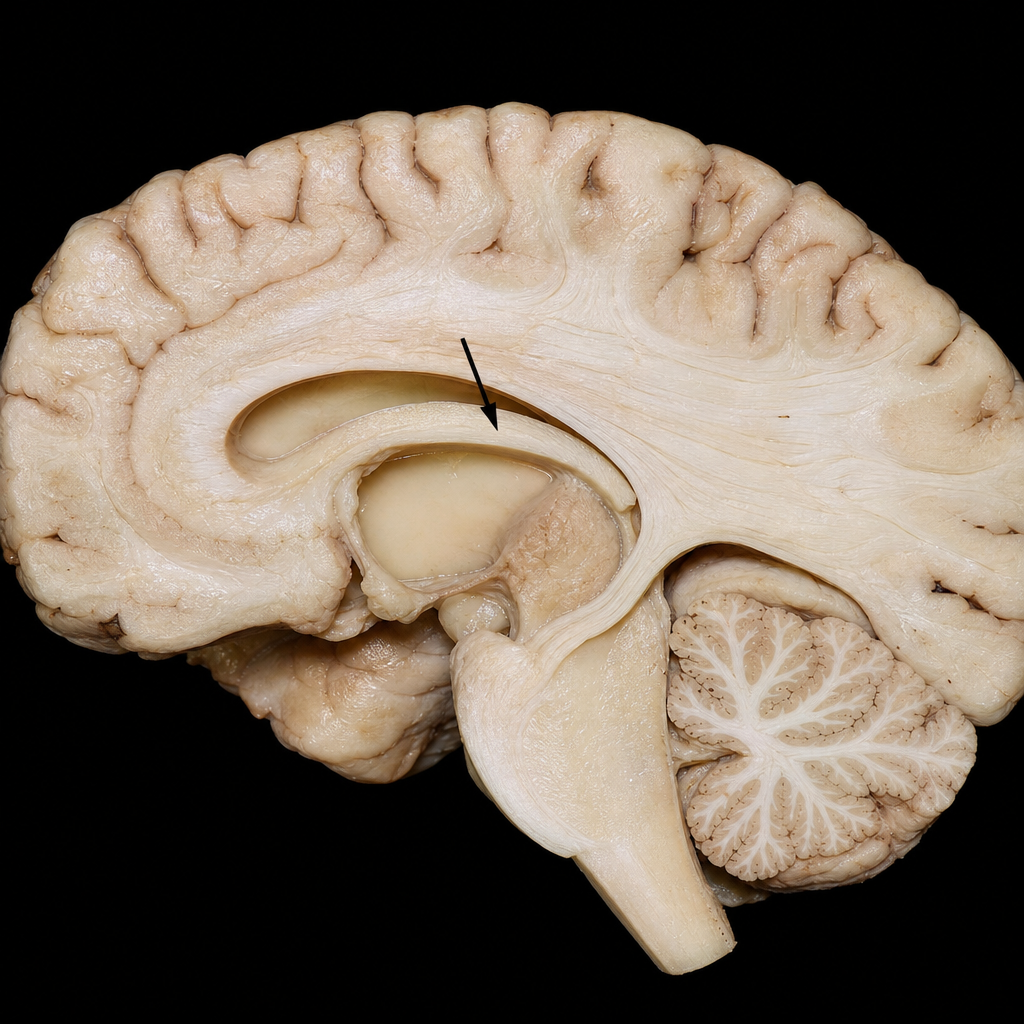
Involvement of the parietal branch of the middle meningeal artery, which is closely related to the cerebrum, results in which of the following?
Myelin sheath in the central nervous system is formed by which type of cell?
The nucleus ambiguus is related to all cranial nerves except which of the following?
What is the largest branch of the vertebral artery?
Glomus cells are found in which of the following locations or structures?
A 62-year-old male patient presented with signs and symptoms of stroke. MR angiography revealed a thrombus in the posterior cerebral artery. All of the following structures may be affected by the lesion, except?
Which artery supplies the major part of the superolateral surface of the brain?
Where do the arachnoid villi, responsible for cerebrospinal fluid absorption, primarily protrude?
What is the rate of formation of cerebrospinal fluid (CSF) per day?
The posterior limb of the internal capsule is supplied by all except which of the following arteries?
Explanation: ### Explanation The **middle meningeal artery (MMA)**, a branch of the maxillary artery, enters the skull through the foramen spinosum. It divides into anterior (frontal) and posterior (**parietal**) branches. The parietal branch courses over the squamous part of the temporal bone and the parietal bone, lying deep to the **superior temporal gyrus**. **1. Why "Contralateral Deafness" is correct:** The superior temporal gyrus contains the **Primary Auditory Cortex (Brodmann areas 41 and 42)**. An extradural hematoma (EDH) resulting from the rupture of the parietal branch of the MMA can compress this area [1]. While auditory input is bilateral, acute unilateral cortical lesions or compression can result in significant hearing deficits, traditionally characterized in neuroanatomical teaching as **contralateral deafness** or diminished hearing in the opposite ear due to the decussation of auditory fibers in the brainstem (lateral lemniscus). **2. Why other options are incorrect:** * **Hemiplegia (Option A):** This is typically associated with the **anterior (frontal) branch** of the MMA, which lies over the precentral gyrus (motor cortex). * **Ipsilateral deafness (Option B):** Cortical representation of hearing is primarily contralateral; ipsilateral deafness usually suggests a peripheral lesion (e.g., CN VIII or inner ear damage), not a cortical compression. **3. Clinical Pearls for NEET-PG:** * **Pterion:** The weakest point of the skull where the frontal branch of the MMA is most vulnerable; injury here leads to a "lucid interval." * **Source:** MMA is a branch of the **Maxillary artery** (1st part). * **Foramen:** It enters the skull via **Foramen Spinosum**. * **Imaging:** EDH appears as a **biconvex/lens-shaped** hyperdensity on CT that does not cross suture lines [1].
Explanation: ### Explanation **Correct Answer: C. Oligodendrocytes** **1. Why Oligodendrocytes are correct:** In the **Central Nervous System (CNS)**, which includes the brain and spinal cord, myelin is produced by **Oligodendrocytes** [2]. A single oligodendrocyte is capable of myelinating segments of multiple axons (up to 50) by extending its cytoplasmic processes to wrap around them [3]. This insulation is crucial for saltatory conduction, significantly increasing the speed of nerve impulse transmission. **2. Why the other options are incorrect:** * **A. Schwann cells:** These cells produce myelin in the **Peripheral Nervous System (PNS)** [3]. Unlike oligodendrocytes, one Schwann cell myelinates only a single segment of a single axon [3]. * **B. Microglia:** These are the resident macrophages of the CNS [1]. They are derived from the mesoderm (monocyte-macrophage lineage) and function in immune defense and phagocytosis, not myelination [1]. * **D. Protoplasmic astrocytes:** These are found primarily in the **gray matter**. They provide metabolic support to neurons and contribute to the blood-brain barrier (BBB). Fibrous astrocytes are their counterparts in white matter. **3. High-Yield Clinical Pearls for NEET-PG:** * **Origin:** All neuroglia (Oligodendrocytes, Astrocytes, Ependymal cells) are derived from the **Neuroectoderm**, *except* for Microglia, which are **Mesodermal** in origin [1]. * **Demyelinating Diseases:** **Multiple Sclerosis (MS):** Characterized by the destruction of oligodendrocytes (CNS demyelination) [2]. **Guillain-Barré Syndrome (GBS):** Characterized by the destruction of Schwann cells (PNS demyelination). * **Friedreich's Ataxia:** Involves both CNS and PNS demyelination. * **Acoustic Neuroma:** This tumor arises from Schwann cells (PNS) of the vestibular nerve, even though it is located within the cranial cavity.
Explanation: The **Nucleus Ambiguus** is a long column of motor neurons located in the reticular formation of the medulla oblongata. It provides the **Special Visceral Efferent (SVE)** fibers, which supply the muscles derived from the branchial (pharyngeal) arches. ### Why Option A is Correct: * **Cranial Nerve VIII (Vestibulocochlear):** This is a purely sensory nerve responsible for hearing and equilibrium [1]. It is associated with the vestibular and cochlear nuclei, not the nucleus ambiguus [2]. Therefore, it is the correct "except" choice. ### Why the Other Options are Incorrect: The Nucleus Ambiguus contributes motor fibers to the following nerves: * **Cranial Nerve IX (Glossopharyngeal):** Supplies the **Stylopharyngeus** muscle (3rd arch). * **Cranial Nerve X (Vagus):** Supplies the muscles of the **pharynx, soft palate, and larynx** (4th and 6th arches). * **Cranial Nerve XI (Cranial part of Accessory):** The cranial root of CN XI originates here, joins the Vagus nerve, and helps supply the laryngeal muscles. ### High-Yield Clinical Pearls for NEET-PG: * **Mnemonic:** Remember the "Ambiguous 9, 10, 11." * **Function:** It controls vital functions like swallowing and phonation. * **Lesion:** A lesion of the nucleus ambiguus (often seen in **Lateral Medullary Syndrome/Wallenberg Syndrome**) results in dysphagia (difficulty swallowing), dysarthria, and a nasal twang in the voice due to paralysis of the palatal and laryngeal muscles. * **Location:** It is situated in the **medulla**, dorsal to the inferior olivary nucleus.
Explanation: **Explanation:** The **Posterior Inferior Cerebellar Artery (PICA)** is the largest and most significant branch of the **vertebral artery**. It typically arises from the fourth (V4) segment of the vertebral artery, just before it joins its counterpart to form the basilar artery. PICA follows a tortuous course around the medulla oblongata to supply the posteroinferior aspect of the cerebellum and the choroid plexus of the fourth ventricle. **Analysis of Options:** * **Posterior Inferior Cerebellar Artery (PICA):** Correct. It is the largest branch and is clinically vital as it supplies the lateral part of the medulla. * **Anterior Spinal Artery (ASA):** Incorrect. This is a small branch formed by the union of two twigs from the vertebral arteries. It descends in the anterior median fissure of the spinal cord. * **Posterior Spinal Artery (PSA):** Incorrect. These are small branches that may arise from either the vertebral artery or the PICA itself. * **Anterior Inferior Cerebellar Artery (AICA):** Incorrect. While it is a major cerebellar artery, it is a branch of the **Basilar artery**, not the vertebral artery. **High-Yield Clinical Pearls for NEET-PG:** * **Wallenberg Syndrome (Lateral Medullary Syndrome):** This is the most common clinical correlation. It occurs due to occlusion of the PICA or the vertebral artery, leading to symptoms like ipsilateral Horner's syndrome, ataxia, and crossed sensory loss (ipsilateral face, contralateral body). * **Rule of 4s:** Remember that PICA supplies the **lateral medulla**, while the ASA supplies the **medial medulla** (occlusion of ASA leads to Dejerine Syndrome). * The vertebral artery enters the skull through the **foramen magnum** and is a derivative of the **first part of the subclavian artery**.
Explanation: **Explanation:** **Glomus cells** (Type I cells) are specialized peripheral chemoreceptors primarily located in the **Carotid Body** (at the bifurcation of the common carotid artery) and the **Aortic Bodies** (along the aortic arch) [1]. 1. **Why Chemoreceptors is correct:** Glomus cells act as sensory receptors that monitor changes in arterial blood. They are specifically sensitive to **hypoxia** (decreased $PaO_2$), **hypercapnia** (increased $PaCO_2$), and **acidosis** (decreased pH) [1], [2]. When triggered, they release neurotransmitters (like dopamine and acetylcholine) to stimulate the glossopharyngeal (CN IX) and vagus (CN X) nerves, which signal the brainstem to increase the respiratory rate. 2. **Why other options are incorrect:** * **Bladder:** The bladder contains transitional epithelium and detrusor muscle; it does not house glomus cells. * **Brain:** While the brain contains *central* chemoreceptors (in the medulla), these are sensitive to pH/CO2 changes in the CSF, not glomus cells. * **Kidney:** The kidney contains **Juxtaglomerular (JG) cells**, which secrete renin [3]. Though the names sound similar, their functions are entirely different. **High-Yield Clinical Pearls for NEET-PG:** * **Embryology:** Glomus cells are derived from the **Neural Crest**. * **Glomus Tumor (Paraganglioma):** A highly vascular tumor arising from these cells. A common site is the **Glomus Jugulare** (near the jugular bulb), often presenting with pulsatile tinnitus and cranial nerve palsies. * **Histology:** On H&E stain, they appear as clusters of cells called **"Zellballen"** surrounded by a rich vascular network and sustentacular (Type II) cells.
Explanation: The **Posterior Cerebral Artery (PCA)** is the terminal branch of the basilar artery. It primarily supplies the occipital lobe, the inferomedial temporal lobe, and various deep structures via its central and ventricular branches. [1] **Why Pons is the correct answer:** The **Pons** is supplied by the **Basilar Artery** through its paramedian and circumferential branches (short and long). Since the PCA originates at the terminal bifurcation of the basilar artery, a thrombus in the PCA occurs distal to the pontine supply. Therefore, the pons remains unaffected by a PCA lesion. **Analysis of other options:** * **Choroid plexus of the third ventricle:** Supplied by the **Posterior Choroidal arteries**, which are direct branches of the PCA (P2 segment). * **Midbrain:** The PCA provides numerous small perforating branches (thalamoperforating and thalamogeniculate) that supply the midbrain, particularly the cerebral peduncles and the tectum. * **Lentiform nucleus:** While the Middle Cerebral Artery (MCA) is the primary supply via lenticulostriate arteries, the **Posterior Communicating Artery** and branches of the **PCA** contribute to the supply of the posterior part of the lentiform nucleus and the thalamus. [1] **NEET-PG High-Yield Pearls:** 1. **Visual Deficits:** The most common clinical sign of a PCA stroke is **contralateral homonymous hemianopia with macular sparing** (due to collateral supply to the occipital pole from the MCA). 2. **Thalamic Syndrome:** Occlusion of PCA branches to the thalamus leads to Dejerine-Roussy syndrome (contralateral sensory loss followed by agonizing burning pain). [1] 3. **Weber’s Syndrome:** A midbrain infarct involving PCA branches affects CN III fibers and the corticospinal tract.
Explanation: ### Explanation **1. Why Middle Cerebral Artery (MCA) is Correct:** The Middle Cerebral Artery is the largest branch of the internal carotid artery and is often described as the "artery of the superolateral surface." It travels through the lateral sulcus (Sylvian fissure) and fans out to supply almost the entire **superolateral surface** of the cerebral hemisphere. Specifically, it supplies the motor and sensory areas for the whole body (except the lower limb and perineum), the Broca’s area, and Wernicke’s area. **2. Why the Other Options are Incorrect:** * **Anterior Cerebral Artery (ACA):** This artery primarily supplies the **medial surface** of the cerebral hemisphere (up to the parieto-occipital sulcus) and a thin strip (about 1 inch) of the superolateral surface along the superior border. * **Posterior Cerebral Artery (PCA):** This artery mainly supplies the **inferior surface** of the temporal lobe and the **medial surface** of the occipital lobe (including the visual cortex). * **Vertebral Artery:** This artery supplies the cerebellum and brainstem via its branches (like the PICA) and joins to form the basilar artery; it does not directly supply the cerebral cortex. **3. High-Yield Clinical Pearls for NEET-PG:** * **Stroke Correlation:** An MCA infarct typically presents with contralateral hemiplegia and hemianesthesia, sparing the leg and foot, often accompanied by **aphasia** if the dominant hemisphere is involved. * **Charcot’s Artery:** The lenticulostriate branches of the MCA are known as the "arteries of cerebral hemorrhage," frequently involved in hypertensive strokes [1]. * **Homunculus Map:** Remember: **ACA = Leg/Foot** (Medial); **MCA = Face/Arm** (Lateral). [2]
Explanation: ### Explanation **1. Why Option A is Correct:** Cerebrospinal fluid (CSF) is produced by the choroid plexuses and must be reabsorbed into the venous system to maintain intracranial pressure [1]. This absorption occurs through **arachnoid villi** (and their larger clusters, **arachnoid granulations**) [2]. These are microscopic finger-like projections of the arachnoid mater that pierce the dura mater to protrude into the **Superior Sagittal Sinus (SSS)** and its associated lateral lacunae [3]. The pressure gradient between the subarachnoid space and the venous sinus allows CSF to flow one-way into the blood [1]. **2. Why the Other Options are Incorrect:** * **B, C, and D:** While the inferior sagittal, straight, and transverse sinuses are integral parts of the dural venous system, they are not the primary sites for CSF absorption. The SSS is the largest and most superiorly located dural sinus, providing the extensive surface area and specialized lateral lacunae necessary for the bulk of arachnoid granulation protrusion [3]. **3. High-Yield Clinical Pearls for NEET-PG:** * **Pacchionian Bodies:** These are simply calcified or enlarged arachnoid granulations, often seen in older adults; they can cause small indentations on the inner table of the skull (granular foveolae). * **Hydrocephalus:** Any obstruction to the flow of CSF or a defect in absorption by the arachnoid villi (e.g., post-meningitis fibrosis) leads to **communicating hydrocephalus** [1][2]. * **Monro-Kellie Doctrine:** The cranial vault is a fixed volume; therefore, if CSF absorption via the SSS is impaired, intracranial pressure (ICP) rises rapidly [3]. * **Blood-CSF Barrier:** While the Blood-Brain Barrier is at the endothelial level, the Blood-CSF barrier is located at the **tight junctions of the choroid plexus epithelial cells**.
Explanation: The formation of Cerebrospinal Fluid (CSF) is a continuous process primarily occurring in the **choroid plexuses** of the lateral, third, and fourth ventricles [2]. 1. **Why 500 c.c. is correct:** The average rate of CSF production is approximately **0.3 to 0.4 ml/minute**, which translates to roughly **20–25 ml per hour** [3]. Over a 24-hour period, this totals approximately **500–600 ml (or c.c.)**. Since the total volume of CSF in the subarachnoid space and ventricles is only about **150 ml**, the entire CSF volume is replaced/turned over about 3 to 4 times a day [3]. 2. **Why other options are incorrect:** * **150 c.c.:** This represents the **total volume** of CSF present in the nervous system at any given time, not the daily production rate. * **1000 c.c. and above:** These values (1000, 2000, 8000 c.c.) are physiologically inaccurate. Production at these rates would overwhelm the arachnoid granulations' capacity for reabsorption, leading to a rapid and fatal increase in intracranial pressure. **High-Yield Clinical Pearls for NEET-PG:** * **Site of Production:** Mainly Choroid plexus (80%) [2]; the rest is formed by the interstitial fluid and ependymal lining. * **Site of Absorption:** **Arachnoid granulations** or villi (into the superior sagittal sinus) [1], [3]. * **Specific Gravity of CSF:** 1.005. * **Pressure:** 70–180 mm of $H_2O$ (in lateral recumbent position) [1]. * **Composition:** CSF is an ultrafiltrate of plasma but has **lower glucose**, **lower protein**, and **higher chloride** levels compared to plasma.
Explanation: The internal capsule is a compact bundle of white matter fibers that carries vital motor and sensory information. Its blood supply is a high-yield topic for NEET-PG, as different segments are supplied by distinct arterial branches. **Explanation of the Correct Answer:** * **Recurrent Artery of Heubner (Option B):** This is a branch of the **Anterior Cerebral Artery (ACA)**. It primarily supplies the **Anterior Limb** and the head of the caudate nucleus. It does not contribute to the blood supply of the posterior limb, making it the correct "except" choice. **Analysis of Incorrect Options (Arteries that DO supply the Posterior Limb):** * **Middle Cerebral Artery (Option A):** The **Lenticulostriate branches** of the MCA supply the superior half of the posterior limb. * **Anterior Choroidal Artery (Option C):** A branch of the Internal Carotid Artery (ICA), it supplies the inferior half of the posterior limb and the retrolentiform part. * **Posterior Cerebral Artery (Option D):** Small perforating branches of the PCA supply the most posterior and inferior aspects of the posterior limb. **High-Yield Clinical Pearls for NEET-PG:** 1. **Genu Supply:** The genu of the internal capsule is primarily supplied by direct branches of the **Internal Carotid Artery** or the MCA. 2. **Charcot’s Artery of Cerebral Hemorrhage:** This refers to the **Lenticulostriate branches of the MCA**, which are the most common site for hypertensive bleeds involving the posterior limb. 3. **Clinical Deficit:** Since the posterior limb contains the **corticospinal tract**, a stroke here (e.g., involving the Anterior Choroidal Artery) typically results in contralateral hemiplegia.
Cerebral Hemispheres
Practice Questions
Diencephalon
Practice Questions
Brainstem
Practice Questions
Cerebellum
Practice Questions
Basal Ganglia
Practice Questions
Limbic System
Practice Questions
Ventricular System and CSF
Practice Questions
Blood Supply of the Brain
Practice Questions
Cranial Nerves and Nuclei
Practice Questions
Functional Systems and Pathways
Practice Questions
Applied Neuroanatomy
Practice Questions
Neuroimaging Correlations
Practice Questions
Get full access to all questions, explanations, and performance tracking.
Start For Free