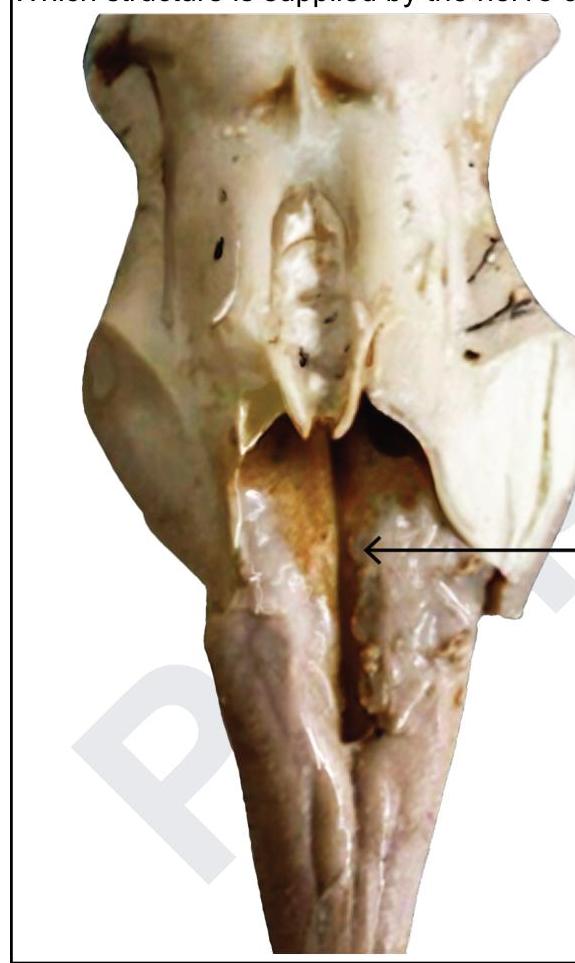
Which of the following statements about the dura mater is incorrect?
Which nerve is most commonly affected by intracranial aneurysms?
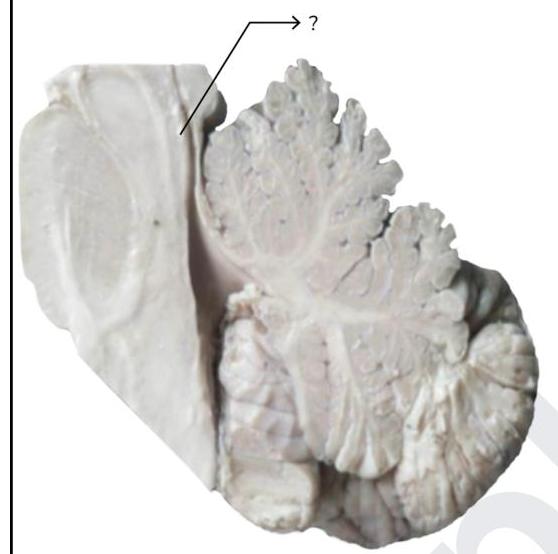
All cerebellar peduncle tracts pass through the superior cerebellar peduncles, except:
What is the site of lesion in Bitemporal hemianopia?
The anterior communicating artery in the circle of Willis is derived from which major artery?
A 35-year-old woman presents with a headache after accidentally hitting her head. An MRI confirmed the presence of a blood clot in the great cerebral vein of Galen. Which of the following venous structures is a direct tributary of the great cerebral vein of Galen?
Inability to suck on a straw may indicate a lesion of which cranial nerve?
A 43-year-old female patient, who sustained a head injury in a fall, has significant problems with memory. Her brain injury is most likely to which lobe?
The hippocampal formation includes all of the following except?
Cerebrospinal fluid (CSF) is partly absorbed by lymphatics around which cranial nerves?
Explanation: The **Dura Mater** is the thickest and toughest of the three meningeal layers. In the cranium, it is uniquely composed of two layers: an outer **periosteal layer** (attached to the skull) and an inner **meningeal layer** [1]. **Why Option C is the "Incorrect" Statement (The Correct Answer):** While it is a common misconception that dural venous sinuses are *always* between the two layers, the statement is technically incomplete or misleading in a comparative context. Most dural venous sinuses (like the Superior Sagittal Sinus) are indeed formed by the separation of the periosteal and meningeal layers [1]. However, some sinuses (like the **Inferior Sagittal Sinus** and the **Straight Sinus**) are located entirely within folds of the **meningeal layer alone**. Therefore, the absolute statement that they are located between the two layers is the least accurate among the options provided. **Analysis of Other Options:** * **Option A:** Correct. The dura mater is the "pachymeninx" (thick membrane) and is the most superficial layer, followed by the arachnoid and pia mater. * **Option B:** Correct. Unlike the spinal dura (which has only one layer), the cranial dura consists of periosteal and meningeal layers [1]. * **Option C:** Correct. The supratentorial dura is primarily innervated by branches of the **Trigeminal nerve (CN V)**, while the infratentorial dura is supplied by the upper cervical nerves (C1-C3) and the Vagus nerve. **NEET-PG High-Yield Pearls:** * **Blood Supply:** The **Middle Meningeal Artery** (branch of the maxillary artery) is the chief supply. It enters via the **foramen spinosum**. * **Clinical Correlation:** Rupture of the middle meningeal artery leads to an **Extradural Hemorrhage (EDH)**, characterized by a "lucid interval" and a biconvex/lens-shaped opacity on CT [1]. * **Dural Folds:** The meningeal layer reflects inwards to form the Falx Cerebri and Tentorium Cerebelli, which help stabilize the brain.
Explanation: **Explanation:** The **Oculomotor nerve (CN III)** is the most common cranial nerve affected by intracranial aneurysms due to its intimate anatomical relationship with the **Circle of Willis**. Specifically, it passes between the **Posterior Cerebral Artery (PCA)** and the **Superior Cerebellar Artery (SCA)**. However, the most frequent site for an aneurysm causing CN III palsy is the junction of the **Posterior Communicating Artery (PCoA)** and the Internal Carotid Artery. **Why the Oculomotor Nerve is the Correct Answer:** Aneurysms at the PCoA junction compress the nerve directly. Because the parasympathetic pupilloconstrictor fibers are located superficially (peripherally) in the nerve trunk, they are compressed first [3]. This leads to a **"surgical third nerve palsy,"** characterized by a dilated, non-reactive pupil ("blown pupil") along with ptosis and a "down and out" eye position. **Analysis of Incorrect Options:** * **Optic Nerve (CN II):** While it can be compressed by large ophthalmic artery aneurysms, this is statistically less common than CN III involvement. * **Trochlear Nerve (CN IV):** It has the longest intracranial course but is rarely affected by aneurysms due to its protected position under the tentorium. * **Abducent Nerve (CN VI):** Though it is the most common nerve affected by increased intracranial pressure (due to its long intradural course), it is less frequently involved in specific focal aneurysmal compressions compared to CN III [2]. **High-Yield Clinical Pearls for NEET-PG:** * **Rule of Pupil:** In CN III palsy, if the pupil is **spared** (normal), the cause is likely medical (e.g., Diabetes/Hypertension due to microvascular ischemia of central fibers). If the pupil is **involved** (dilated), the cause is likely surgical/structural (e.g., PCoA aneurysm) [3]. * **Most common site for intracranial aneurysm:** Anterior Communicating Artery (A-com) [1]. * **Most common aneurysm causing CN III palsy:** Posterior Communicating Artery (P-com).
Explanation: The **Superior Cerebellar Peduncle (SCP)**, also known as the brachium conjunctivum, is the primary efferent (outgoing) pathway of the cerebellum. Understanding the direction and origin of these tracts is crucial for NEET-PG. ### Why Olivocerebellar is the Correct Answer The **Olivocerebellar tract** is a major **afferent** (incoming) pathway that originates from the Inferior Olivary Nucleus of the medulla. These fibers cross the midline and enter the cerebellum exclusively through the **Inferior Cerebellar Peduncle (ICP)** as climbing fibers [1]. Since it enters via the ICP, it does not pass through the SCP. Climbing fiber activity is specifically associated with motor learning and long-term adjustments within the cerebellar cortex [1]. ### Analysis of Incorrect Options * **Tectocerebellar (A):** This is an afferent tract carrying visual and auditory impulses from the colliculi of the midbrain to the cerebellum. It enters via the **SCP**. * **Cerebellocerebellar (B):** These are fibers connecting the two cerebellar hemispheres, primarily traveling through the **SCP**. * **Cerebellorubral (D):** This is a major efferent tract originating from the dentate nucleus, passing through the **SCP** to reach the red nucleus of the midbrain. ### High-Yield NEET-PG Pearls * **SCP Rule of Thumb:** It is mostly **Efferent** (e.g., Dentatothalamic, Cerebellorubral). The major exception (Afferent) is the **Ventral Spinocerebellar Tract**. * **ICP Rule of Thumb:** It is mostly **Afferent** (e.g., Olivocerebellar, Vestibulocerebellar, Dorsal Spinocerebellar). * **MCP (Middle Cerebellar Peduncle):** It is the largest peduncle and contains only one tract: the **Pontocerebellar tract** (Afferent). * **Climbing Fibers:** All climbing fibers in the cerebellum originate from the **Inferior Olivary Nucleus** via the ICP [1].
Explanation: **Explanation:** **1. Why Optic Chiasma is Correct:** Bitemporal hemianopia is the classic visual field defect caused by a lesion at the **optic chiasma** [1]. At the chiasma, the nerve fibers from the **nasal retina** of both eyes decussate (cross over) to the opposite side [1]. Since the nasal retina is responsible for perceiving the **temporal (lateral) visual fields**, a midline compression of the chiasma interrupts these crossing fibers [1]. This results in the loss of the outer half of the vision in both eyes. **2. Why Other Options are Incorrect:** * **Optic Nerve:** A lesion here results in **ipsilateral monocular blindness** (total vision loss in one eye) because it carries all sensory input from that specific eye before any crossing occurs [1]. * **Optic Tract:** Lesions distal to the chiasma (optic tract or optic radiation) involve fibers from the ipsilateral temporal retina and contralateral nasal retina [2]. This leads to **contralateral homonymous hemianopia** (loss of the same side of the visual field in both eyes) [1]. * **Optic Radiation:** Similar to the optic tract, a complete lesion causes contralateral homonymous hemianopia. Partial lesions (e.g., in the temporal or parietal lobes) cause quadrantanopias. **3. NEET-PG Clinical Pearls:** * **Most Common Cause:** The most frequent cause of bitemporal hemianopia is a **Pituitary Adenoma** (compressing the chiasma from below). * **Craniopharyngioma:** This tumor compresses the chiasma from **above**, also leading to bitemporal defects, often starting in the lower quadrants. * **Meyer’s Loop:** Fibers of the optic radiation passing through the temporal lobe; a lesion here causes "Pie in the sky" (Superior homonymous quadrantanopia). * **Macular Sparing:** Often seen in occipital cortex lesions due to dual blood supply (Middle and Posterior Cerebral Arteries) [1].
Explanation: **Explanation:** The **Circle of Willis** (Circulus Arteriosus) is a vital polygonal anastomotic network at the base of the brain that provides collateral circulation [1]. **Why the correct answer is right:** The **Anterior Communicating Artery (AComA)** is a short, single midline vessel that connects the two **Anterior Cerebral Arteries (ACA)** [1]. The ACAs themselves are the smaller terminal branches of the Internal Carotid Arteries. Therefore, the AComA is anatomically derived as a bridge between the left and right ACAs, completing the anterior portion of the circle. **Why the incorrect options are wrong:** * **Basilar Artery:** This is formed by the union of the two vertebral arteries. It contributes to the posterior circulation by dividing into the Posterior Cerebral Arteries (PCA). * **Vertebral Artery:** These are branches of the subclavian arteries that enter the cranium to form the basilar artery; they do not directly give rise to the anterior communicating artery. * **Internal Carotid Artery (ICA):** While the ICA gives rise to the ACA, it does not directly form the AComA. The AComA specifically branches from the ACAs. **High-Yield Clinical Pearls for NEET-PG:** 1. **Aneurysm Site:** The Anterior Communicating Artery is the **most common site** for Berry (saccular) aneurysms in the Circle of Willis (approx. 30-35%) [1]. 2. **Visual Deficits:** An aneurysm at the AComA can compress the **optic chiasm**, leading to bitemporal hemianopia. 3. **Components of the Circle:** It is formed by the AComA, ACAs, ICAs, Posterior Communicating Arteries (PComA), and PCAs. Note: The Middle Cerebral Artery (MCA) is **not** part of the Circle of Willis [1].
Explanation: The **Great Cerebral Vein of Galen** is a short, thick venous trunk formed by the union of the two **Internal Cerebral Veins** and the two **Basal Veins (of Rosenthal)**. It is located in the quadrigeminal cistern. [1] **Why the correct answer is right:** The Great Cerebral Vein of Galen drains directly into the **Straight Sinus**, which is a **dural venous sinus**. In the context of venous hierarchy, the Great Cerebral Vein acts as the final common pathway for the deep venous system of the brain before emptying into the dural sinus system. Therefore, it is anatomically and functionally continuous with the dural venous sinuses. **Why the incorrect options are wrong:** * **A. Emissary veins:** These connect the extracranial veins of the scalp with the intracranial dural venous sinuses to help regulate intracranial pressure. They do not drain into the deep venous system. [1] * **B. Pterygoid venous plexus:** This is a venous network located in the infratemporal fossa. It communicates with the cavernous sinus via emissary veins but has no direct connection to the Vein of Galen. * **C. Diploic veins:** These are found within the cancellous bone (diploe) of the skull vault. They drain into dural sinuses or scalp veins, not the deep cerebral veins. **Clinical Pearls for NEET-PG:** * **Formation:** Internal Cerebral Veins + Basal Veins of Rosenthal = Great Cerebral Vein of Galen. * **Termination:** It joins the **Inferior Sagittal Sinus** to form the **Straight Sinus**. * **Location:** It passes posterosuperiorly behind the splenium of the corpus callosum. * **Vein of Galen Malformation (VOGM):** A high-yield clinical condition involving an arteriovenous shunt that can lead to high-output heart failure in neonates.
Explanation: **Explanation:** The ability to suck on a straw requires the coordinated action of the facial muscles to create a tight seal around the straw and generate negative pressure. The primary muscle involved in this action is the **Buccinator**, which flattens the cheeks against the teeth and prevents food or air from escaping into the vestibule of the mouth. * **Correct Answer (C):** The **Facial Nerve (CN VII)** provides motor innervation to all muscles of facial expression, including the **buccinator** and the **orbicularis oris** (which purses the lips). A lesion of CN VII (e.g., Bell’s Palsy) leads to paralysis of these muscles, making it impossible to maintain a seal or create the suction necessary to use a straw. **Analysis of Incorrect Options:** * **Option A (II):** The Optic Nerve is purely sensory, responsible for vision. It has no motor function. * **Option B (V):** The Trigeminal Nerve (Mandibular division) innervates the muscles of mastication (e.g., masseter, temporalis). While it controls jaw movement, it does not control the facial muscles required for suction. * **Option D (IX):** The Glossopharyngeal Nerve is primarily responsible for taste (posterior 1/3 of the tongue), sensation in the oropharynx, and the gag reflex. **High-Yield Clinical Pearls for NEET-PG:** * **Buccinator Paradox:** Although the buccinator is a muscle of the cheek, it is **not** a muscle of mastication; it is a muscle of facial expression (CN VII). * **Hyperacusis:** A lesion of CN VII proximal to the nerve to the stapedius causes sensitivity to loud sounds. * **Corneal Reflex:** CN V1 is the afferent limb (sensory), while **CN VII** is the efferent limb (motor/blink).
Explanation: The **Temporal lobe** is the primary anatomical site for memory processing and storage [1]. Specifically, the medial aspect of the temporal lobe houses the **hippocampus** and the **parahippocampal gyrus**, which are essential for the formation of new memories (encoding) and the consolidation of short-term memory into long-term memory [1]. Damage to these structures, often seen in head injuries or temporal lobe epilepsy, typically results in anterograde amnesia [1]. **Analysis of Incorrect Options:** * **Frontal Lobe:** Primarily responsible for executive functions, personality, motor control (Broca’s area), and social behavior. While it plays a role in "working memory," global memory deficits are more characteristic of temporal lesions [1]. * **Parietal Lobe:** Focuses on somatosensory perception, spatial awareness, and integration of sensory input. Lesions here lead to agnosia, apraxia, or hemispatial neglect. * **Occipital Lobe:** Dedicated almost exclusively to visual processing. Damage results in visual field defects (e.g., cortical blindness or homonymous hemianopia) rather than memory loss. **NEET-PG High-Yield Pearls:** * **Papez Circuit:** Remember that the hippocampus is a key component of this circuit, which mediates emotional experience and memory. * **Klüver-Bucy Syndrome:** Bilateral temporal lobe lesions (specifically the amygdala) lead to hyperorality, hypersexuality, and visual agnosia. * **Wernicke’s Area:** Located in the superior temporal gyrus (dominant hemisphere); damage leads to sensory/receptive aphasia. * **Meyer’s Loop:** Fibers of the optic radiation passing through the temporal lobe; damage causes "pie in the sky" (superior quadrantanopia) visual defects.
Explanation: The **hippocampal formation** is a functional unit of the limbic system located in the medial temporal lobe. It is primarily involved in memory consolidation and spatial navigation. Anatomically, it consists of three distinct structures: the **Hippocampus proper** (Cornu Ammonis), the **Dentate gyrus**, and the **Subiculum**. Some authorities also include the **Entorhinal cortex**, as it serves as the primary gateway for sensory information entering the hippocampus. * **Why Amygdaloid is the correct answer:** The **Amygdaloid body (Amygdala)** is a separate almond-shaped nucleus located anterior to the hippocampus. While it is a key component of the **Limbic System** (involved in emotional processing and fear), it is anatomically and functionally distinct from the hippocampal formation [1]. * **Why other options are incorrect:** * **Dentate gyrus:** A serrated strip of gray matter that is a core component of the hippocampal formation; it is one of the few areas in the adult brain where neurogenesis occurs [1]. * **Subiculum:** The transition zone between the hippocampus proper and the entorhinal cortex; it serves as the major output pathway. * **Entorhinal cortex:** Located in the parahippocampal gyrus, it provides the "perforant path" (the main input) to the hippocampal formation. **High-Yield Clinical Pearls for NEET-PG:** 1. **Papez Circuit:** Remember the flow: Hippocampus → Fornix → Mammillary body → Anterior thalamic nucleus → Cingulate gyrus → Entorhinal cortex → Hippocampus [1]. 2. **Sommer’s Sector:** The **CA1** area of the hippocampus is highly sensitive to hypoxia (ischemia). 3. **Klüver-Bucy Syndrome:** Results from bilateral destruction of the **Amygdala**, leading to hypersexuality, placidity, and hyperorality.
Explanation: The primary site of cerebrospinal fluid (CSF) absorption is the **arachnoid villi and granulations** into the dural venous sinuses. However, a significant "extracranial" pathway exists where CSF drains into the **lymphatic system**. This occurs via the subarachnoid space extending along the sheaths of specific cranial nerves, eventually reaching the cervical lymphatics. [1] **Why Option A is Correct:** CSF follows the subarachnoid space extensions along the following nerves: * **CN I (Olfactory):** CSF passes through the cribriform plate into the nasal submucosa lymphatics. [2] * **CN II (Optic):** The optic nerve is surrounded by all three meningeal layers; CSF drains into the orbital lymphatics. * **CN VII & VIII (Facial & Vestibulocochlear):** These nerves carry subarachnoid extensions into the internal acoustic meatus, leading to the lymphatics of the middle ear and nasopharynx. **Analysis of Incorrect Options:** * **Options B, C, and D:** These include **CN VI (Abducens)** or **CN III (Oculomotor)**. While these nerves pass through the subarachnoid space, they do not possess significant, clinically relevant extensions of the subarachnoid space that facilitate major lymphatic drainage compared to the nerves listed in Option A. **NEET-PG High-Yield Pearls:** 1. **Total CSF Volume:** ~150 ml (only 25-30 ml is in the ventricles; the rest is in the subarachnoid space). 2. **Daily Production:** ~500 ml/day (replaced roughly 3-4 times daily). 3. **Hydrocephalus:** Obstruction in this drainage pathway (e.g., post-meningitic fibrosis of arachnoid granulations) leads to **communicating hydrocephalus**. [1] 4. **Clinical Link:** The connection between CN I and nasal lymphatics explains why certain intranasal drugs can bypass the blood-brain barrier (nose-to-brain delivery). [2]
Cerebral Hemispheres
Practice Questions
Diencephalon
Practice Questions
Brainstem
Practice Questions
Cerebellum
Practice Questions
Basal Ganglia
Practice Questions
Limbic System
Practice Questions
Ventricular System and CSF
Practice Questions
Blood Supply of the Brain
Practice Questions
Cranial Nerves and Nuclei
Practice Questions
Functional Systems and Pathways
Practice Questions
Applied Neuroanatomy
Practice Questions
Neuroimaging Correlations
Practice Questions
Get full access to all questions, explanations, and performance tracking.
Start For Free