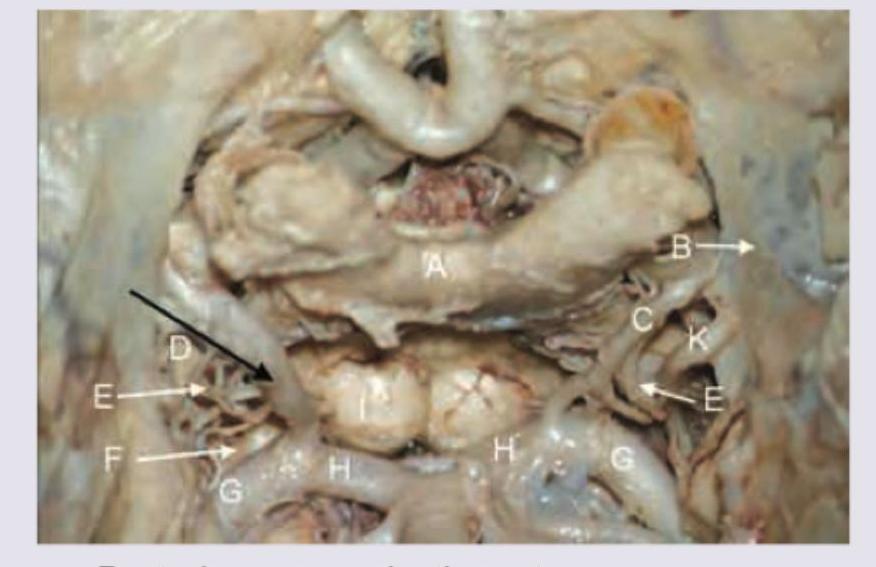
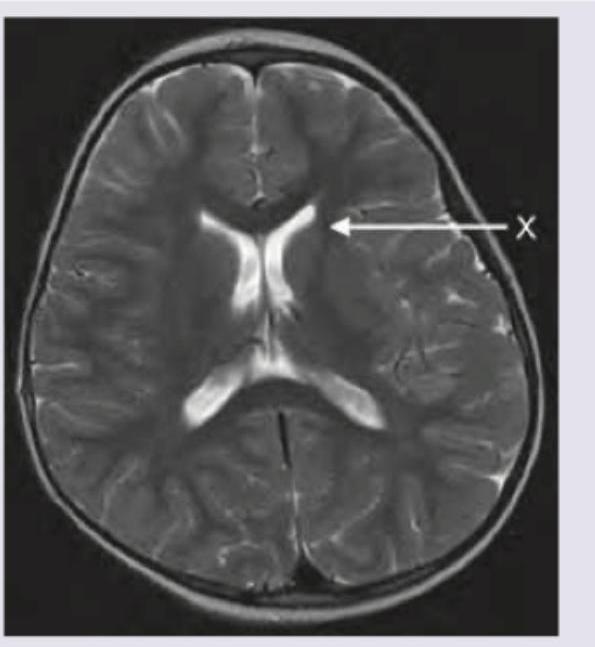
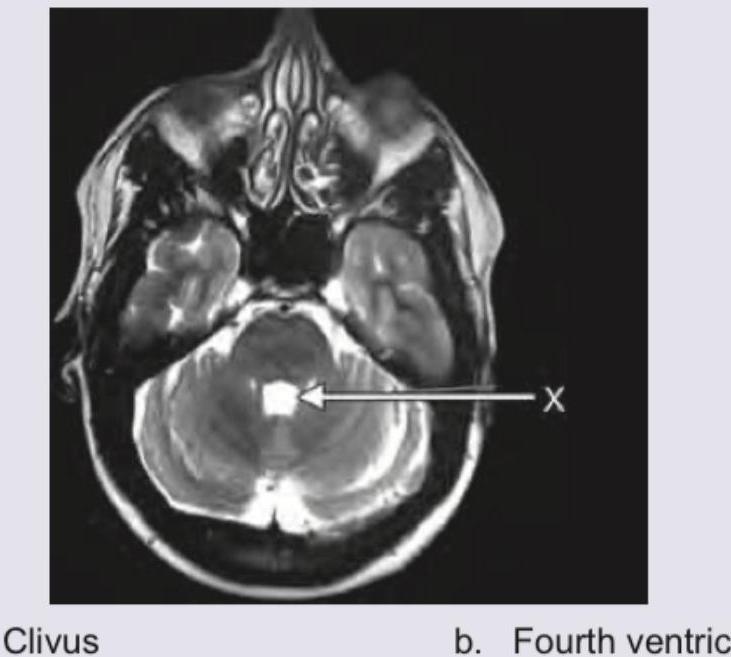
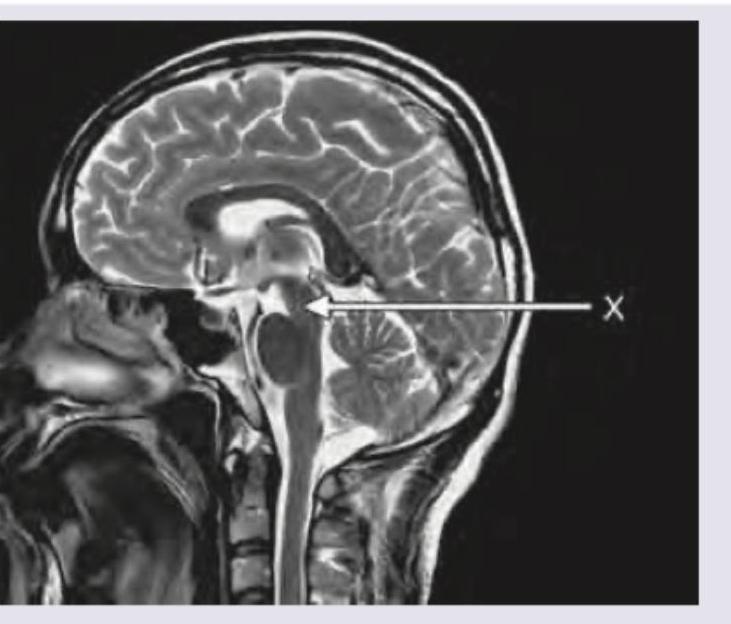
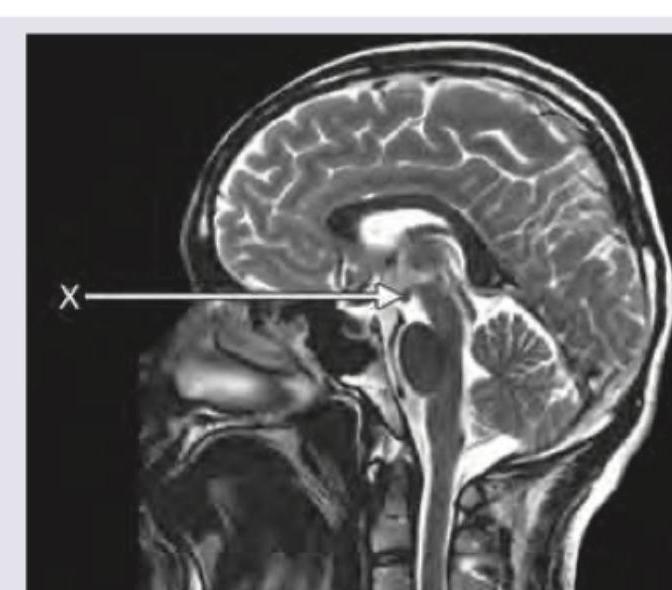
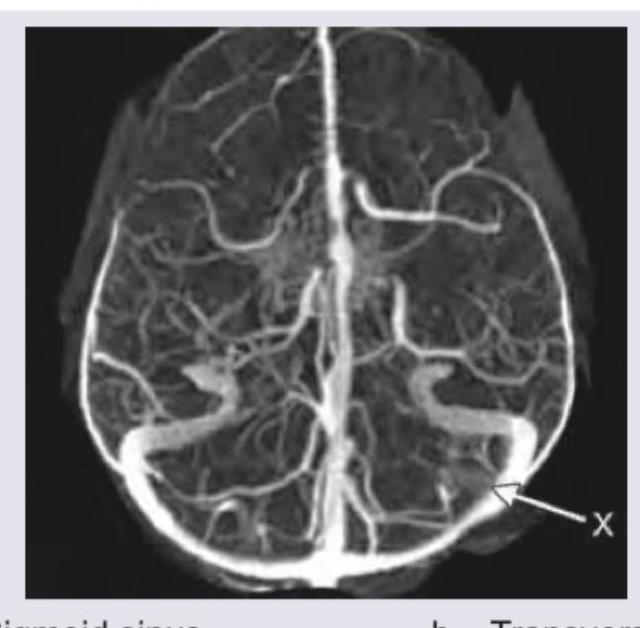
Which nerve is compressed by an aneurysm of the posterior communicating artery in the circle of Willis?
Which of the following is NOT a terminal branch of the internal carotid artery?
A lesion in the left optic tract typically manifests as which of the following visual field defects?
Which of the following is NOT associated with the temporal lobe?
Charcot's artery is:
Anomia is seen in lesions of which part of the temporal lobe?
The vertebral artery passes through the foramen of the transverse processes of which cervical vertebra?
The posterior communicating artery is a branch of which artery?
Which artery does not supply the medulla?
Corpus striatum includes all of the following except?
Explanation: ### Explanation **Correct Answer: C. Oculomotor nerve** The **Oculomotor nerve (CN III)** has a highly significant anatomical relationship with the **Posterior Communicating Artery (PCoA)**. As the nerve exits the midbrain and passes through the subarachnoid space, it runs laterally and parallel to the PCoA before entering the cavernous sinus [2]. Due to this proximity, an aneurysm at the junction of the Internal Carotid Artery and the PCoA is the most common cause of non-traumatic, isolated third-nerve palsy [1]. **Why the other options are incorrect:** * **Hypophysis cerebri (A):** This is the pituitary gland, not a nerve. While a pituitary macroadenoma can compress the optic chiasm, it is not typically affected by a PCoA aneurysm. * **Trochlear nerve (B):** CN IV exits the posterior aspect of the brainstem and has a long intracranial course, but it is located more laterally and inferiorly to the PCoA. It is more commonly associated with superior cerebellar artery pathologies. * **Optic nerve (D):** The optic nerve and chiasm are located anterior to the PCoA. They are more likely to be compressed by aneurysms of the Anterior Communicating Artery (ACoA) or the ophthalmic artery. **Clinical Pearls for NEET-PG:** * **Pupillary Involvement:** In PCoA aneurysms, the parasympathetic fibers (which lie superficially on CN III) are compressed first. This leads to a **"surgical third nerve palsy"** characterized by a **dilated, non-reactive pupil** (mydriasis) before the onset of extraocular muscle weakness [2]. * **Rule of Thumb:** If the pupil is spared, the cause is likely medical (e.g., Diabetes/Ischemia); if the pupil is involved, the cause is likely surgical (e.g., PCoA Aneurysm). * **Location:** The PCoA connects the Internal Carotid Artery to the Posterior Cerebral Artery.
Explanation: ### Explanation The **Internal Carotid Artery (ICA)** is a major vessel supplying the brain [1]. To answer this question, one must distinguish between the **branches** of the ICA and its final **terminal bifurcation**. **Why "Cavernous Artery" is the correct answer:** The ICA is divided into four segments: Cervical, Petrous, Cavernous, and Cerebral. The **Cavernous artery** (often referring to the *meningohypophyseal trunk* or *inferolateral trunk*) arises from the **cavernous (C3) segment** of the ICA while it is still within the cavernous sinus. It is a side branch, not a terminal branch. The ICA only terminates once it pierces the dura mater and reaches the base of the brain. **Analysis of Incorrect Options:** * **A & B (Anterior and Middle Cerebral Arteries):** These are the two **true terminal branches** of the ICA. The ICA ends at the level of the anterior perforated substance by bifurcating into the smaller ACA and the larger MCA. * **C (Posterior Communicating Artery):** While technically a branch of the **cerebral (C4) segment**, it arises just before the terminal bifurcation. In many clinical contexts and exam patterns, it is grouped with the distal branches of the ICA that contribute to the Circle of Willis [1]. However, compared to the cavernous artery (which is proximal and non-terminal), it is not the "least" terminal. **High-Yield Clinical Pearls for NEET-PG:** * **Mnemonic for ICA branches:** "**A P**oint **O**f **M**aximum **A**ccuracy" (**A**nterior Choroidal, **P**osterior Communicating, **O**phthalmic, **M**iddle Cerebral, **A**nterior Cerebral). * **Ophthalmic Artery:** The first branch of the cerebral (intracranial) part of the ICA. * **Charcot’s Artery:** The lenticulostriate branches of the **Middle Cerebral Artery** are the most common site of hypertensive hemorrhage. * **Circle of Willis:** The ICA connects to the Vertebrobasilar system via the Posterior Communicating Artery [1].
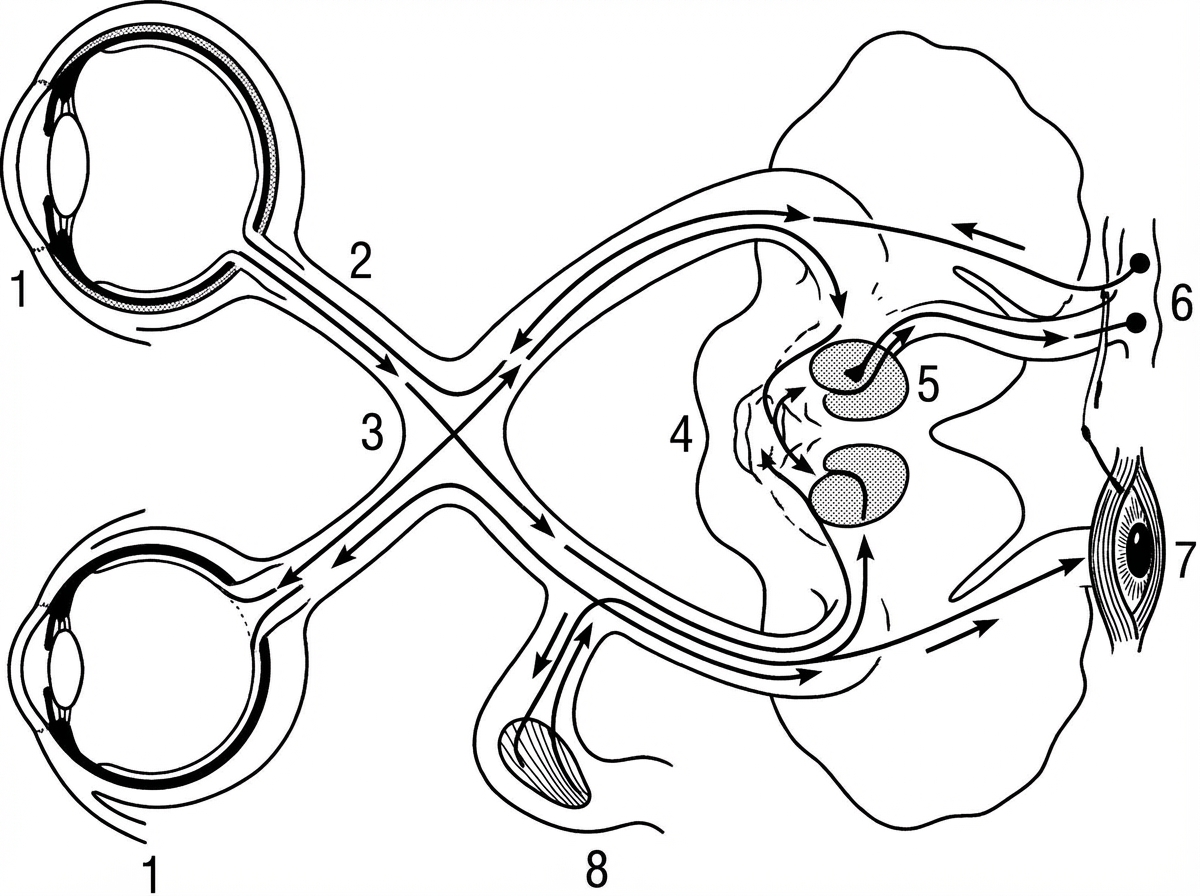
Explanation: ### Explanation **1. Why Option D is Correct:** The visual pathway is organized such that the **optic tract** carries fibers from the **ipsilateral temporal retina** and the **contralateral nasal retina** [1]. * The left optic tract contains fibers from the left temporal retina (which sees the right nasal visual field) and the right nasal retina (which sees the right temporal visual field). * Therefore, a lesion in the **left optic tract** results in a loss of the entire **right half of the visual field** in both eyes [1]. This is termed **Right Homonymous Hemianopia**. **2. Analysis of Incorrect Options:** * **A. Left unilateral blindness:** This occurs due to a lesion of the **left optic nerve**. It affects only one eye before the fibers reach the optic chiasm [1]. * **B. Left bilateral hemianopia:** This is a non-standard term. If referring to Bitemporal Hemianopia (loss of both outer fields), it is caused by a lesion at the **optic chiasm** (e.g., Pituitary adenoma) [1]. * **C. Left homonymous hemianopia:** This would be caused by a lesion in the **right optic tract** or right lateral geniculate nucleus [1]. **3. Clinical Pearls & High-Yield Facts for NEET-PG:** * **Rule of Thumb:** Any lesion **posterior to the optic chiasm** (tract, radiation, or cortex) produces a **homonymous** defect on the **contralateral** side [1]. * **Meyer’s Loop (Temporal lobe):** Lesion leads to "Pie in the sky" (Superior Quadrantanopia). * **Baum’s Loop (Parietal lobe):** Lesion leads to "Pie on the floor" (Inferior Quadrantanopia). * **Macular Sparing:** Characteristically seen in PCA (Posterior Cerebral Artery) infarcts affecting the visual cortex, as the macula has a dual blood supply (PCA + MCA) [1].
Explanation: The **temporal lobe** is primarily responsible for processing sensory input, language comprehension, and memory storage. The correct answer is **Spatial relationship**, as this function is primarily localized to the **Parietal lobe**. [2] ### Why "Spatial Relationship" is the Correct Answer: Spatial orientation, navigation, and the perception of three-dimensional relationships are functions of the **Parietal lobe** (specifically the non-dominant hemisphere). Damage to this area leads to conditions like **hemispatial neglect** or **constructional apraxia**, rather than temporal lobe deficits. ### Analysis of Incorrect Options: * **Audition:** The superior temporal gyrus contains the **Primary Auditory Cortex (Brodmann areas 41, 42)**. It is the primary site for receiving and processing sound. * **Memory:** The medial aspect of the temporal lobe houses the **Hippocampus** and **Entorhinal cortex**, which are critical for the formation of declarative (long-term) memory. [1] * **Behaviour:** The temporal lobe is a key component of the **Limbic System** (via the Amygdala). It regulates emotional responses, aggression, and social behavior. ### High-Yield Clinical Pearls for NEET-PG: * **Wernicke’s Area:** Located in the posterior part of the superior temporal gyrus (Area 22). Lesions cause **receptive aphasia** (fluent but nonsensical speech). [2] * **Meyer’s Loop:** Fibers of the optic radiation that pass through the temporal lobe. Lesions cause **Superior Quadrantanopia** ("Pie in the sky" defect). * **Klüver-Bucy Syndrome:** Results from bilateral amygdala/temporal lobe destruction, characterized by hyperorality, hypersexuality, and docility. * **Temporal Lobe Epilepsy:** Often presents with **Auras** (olfactory/auditory hallucinations) and automatisms. [1]
Explanation: **Explanation:** **Charcot’s Artery** (also known as the **Lenticulostriate artery**) is a branch of the **Middle Cerebral Artery (MCA)**. Specifically, it refers to the larger lateral striate branches that supply the internal capsule and basal ganglia [1]. 1. **Why Option B is Correct:** The lateral striate arteries arise from the M1 segment of the MCA. They supply the **posterior limb of the internal capsule**, the putamen, and the caudate nucleus. These vessels are thin-walled, high-pressure branches that are prone to rupture in patients with chronic hypertension, leading to intracerebral hemorrhage [1]. Because of its frequent involvement in strokes, it is famously termed the "Artery of Cerebral Hemorrhage." 2. **Why Other Options are Incorrect:** * **Option A:** The medial striate branch of the Anterior Cerebral Artery (ACA) is known as the **Recurrent Artery of Heubner**. It supplies the head of the caudate nucleus and the anterior limb of the internal capsule. * **Options C & D:** The Fronto-polar and Calloso-marginal arteries are cortical branches of the ACA. They supply the medial surface of the frontal and parietal lobes, not the deep subcortical structures associated with Charcot’s artery. **High-Yield Clinical Pearls for NEET-PG:** * **Common Site of Bleed:** Charcot’s artery rupture typically leads to hemorrhage in the **Putamen** (most common site for hypertensive bleed) [1]. * **Clinical Presentation:** Rupture causes contralateral hemiplegia due to involvement of the motor fibers in the posterior limb of the internal capsule. * **Microaneurysms:** Chronic hypertension leads to the formation of **Charcot-Bouchard aneurysms** in these small perforating vessels, which are distinct from Berry aneurysms (found in the Circle of Willis).
Explanation: **Explanation:** **Anomia** is a type of aphasia characterized by the inability to name objects, despite knowing what they are and how to use them. It is a hallmark feature of lesions involving the **posterior part of the temporal lobe**, specifically the **angular gyrus** and the **posterior portion of the middle and inferior temporal gyri** [1]. This region acts as a critical hub for lexical retrieval and integrating visual information with language [1]. **Analysis of Options:** * **A. Posterior part (Correct):** This area (including Brodmann area 37 and 39) is essential for naming. Damage here disrupts the connection between the visual recognition of an object and its linguistic label [1]. * **B. Uncus:** Located in the medial temporal lobe, the uncus is part of the olfactory cortex. Lesions here typically result in **uncinate fits** (olfactory hallucinations) or herniation syndromes, not language deficits. * **C. Inferior temporal lobe:** While involved in visual object recognition (the "what" pathway), isolated lesions here usually cause **visual agnosia** (inability to recognize objects) rather than a specific naming deficit (anomia) [2]. * **D. Meyer's loop:** These are the lower fibers of the geniculocalcarine tract that loop around the temporal horn of the lateral ventricle. Damage results in **superior quadrantanopia** ("pie in the sky" visual field defect). **NEET-PG High-Yield Pearls:** * **Wernicke’s Aphasia:** Located in the posterior part of the **Superior** Temporal Gyrus (Brodmann 22). Characterized by fluent but meaningless speech ("word salad") [1]. * **Gerstmann Syndrome:** Associated with the angular gyrus (dominant parietal/temporal junction); features include agraphia, acalculia, finger agnosia, and left-right disorientation. * **Prosopagnosia:** Inability to recognize faces, usually due to bilateral lesions of the **fusiform gyrus** (occipitotemporal lobe) [2].
Explanation: **Explanation:** The vertebral artery is a major branch of the first part of the subclavian artery. Its course is divided into four segments, and its relationship with the cervical vertebrae is a high-yield anatomical concept. **1. Why Option D is Correct:** The vertebral artery typically enters the **foramen transversarium** (transverse foramen) of the **6th cervical vertebra (C6)**. It then ascends vertically through the foramina of all subsequent vertebrae above it (C5 to C1). It **does not** pass through the foramen transversarium of the **7th cervical vertebra (C7)**. Although C7 does have a foramen transversarium, it is usually small and transmits only the accessory vertebral vein and sympathetic nerves, not the artery itself. **2. Analysis of Incorrect Options:** * **Option A:** Incorrect because the artery bypasses C7. * **Option B:** Incorrect because it also passes through C1 and C6. * **Option C:** Incorrect because the artery must pass through C1 (Atlas) to enter the foramen magnum and form the basilar artery. **3. Clinical Pearls & High-Yield Facts for NEET-PG:** * **Segments:** * **V1 (Pre-foraminal):** From origin to C6. * **V2 (Foraminal):** From C6 to C1 (the segment described in the question). * **V3 (Atlantic):** Lies in the groove on the superior aspect of the posterior arch of the atlas (within the suboccipital triangle). * **V4 (Intracranial):** Pierces the dura and arachnoid mater to enter the foramen magnum. * **Tortuosity:** The V3 segment is prone to compression during extreme neck rotation, which can lead to Bow Hunter’s Syndrome (vertebrobasilar insufficiency). * **Variation:** In about 5% of individuals, the artery may enter at C4 or C5 instead of C6, but it almost never enters at C7.
Explanation: **Explanation:** The **posterior communicating artery (PCoA)** is a vital component of the **Circle of Willis**, acting as a bridge between the anterior and posterior cerebral circulations. **1. Why the Correct Answer is Right:** The PCoA arises from the **Cerebral (C4) part of the Internal Carotid Artery (ICA)**. It originates just before the ICA bifurcates into its terminal branches (the anterior and middle cerebral arteries). Its primary function is to connect the ICA system with the Posterior Cerebral Artery (PCA), which is a branch of the basilar artery. **2. Why the Other Options are Incorrect:** * **External carotid artery:** This artery supplies the face and neck structures; it does not contribute to the Circle of Willis or the primary arterial supply of the brain. * **Middle cerebral artery (MCA):** The MCA is a terminal branch of the ICA, not the parent vessel of the PCoA. * **Posterior superior cerebellar artery (Superior Cerebellar Artery):** This is a branch of the basilar artery that supplies the cerebellum and midbrain, not the PCoA. **3. Clinical Pearls for NEET-PG:** * **Aneurysm Site:** The junction of the ICA and the PCoA is the **second most common site** for berry aneurysms in the Circle of Willis. * **CN III Palsy:** An aneurysm of the PCoA often presents with **ipsilateral Third Nerve (Oculomotor) Palsy**, characterized by "down and out" eye deviation and a dilated, non-reactive pupil (due to compression of superficial parasympathetic fibers). * **Circle of Willis Components:** Remember that the ICA gives rise to the Ophthalmic, Anterior Choroidal, and Posterior Communicating arteries before bifurcating.
Explanation: **Explanation:** The blood supply to the medulla oblongata is derived primarily from the **vertebral arteries** and their branches. The medulla is located in the lower part of the brainstem, while the **Superior Cerebellar Artery (SCA)** arises from the distal part of the basilar artery, just before it bifurcates into the posterior cerebral arteries. Therefore, the SCA supplies the superior surface of the cerebellum and the midbrain, not the medulla. **Analysis of Options:** * **Anterior Spinal Artery (ASA):** Formed by branches from both vertebral arteries, it supplies the paramedian region of the medulla, including the pyramids, medial lemniscus, and hypoglossal nucleus. * **Vertebral Artery:** Direct bulbar branches from the vertebral artery supply the lateral part of the medulla. * **Posterior Inferior Cerebellar Artery (PICA):** This is a major branch of the vertebral artery. It supplies the postero-lateral part of the medulla (containing the spinal trigeminal nucleus, nucleus ambiguus, and spinothalamic tract). **High-Yield Clinical Pearls:** * **Lateral Medullary Syndrome (Wallenberg Syndrome):** Most commonly caused by occlusion of the **PICA** or the vertebral artery. It presents with ipsilateral Horner’s syndrome, ataxia, and crossed sensory loss. * **Medial Medullary Syndrome (Dejerine Syndrome):** Caused by occlusion of the **Anterior Spinal Artery**. It presents with contralateral hemiplegia (pyramid involvement) and ipsilateral tongue deviation (CN XII involvement). * **Rule of Thumb:** The medulla is supplied by the Vertebral system; the Pons by the Basilar system; and the Midbrain by the Posterior Cerebral and Superior Cerebellar arteries.
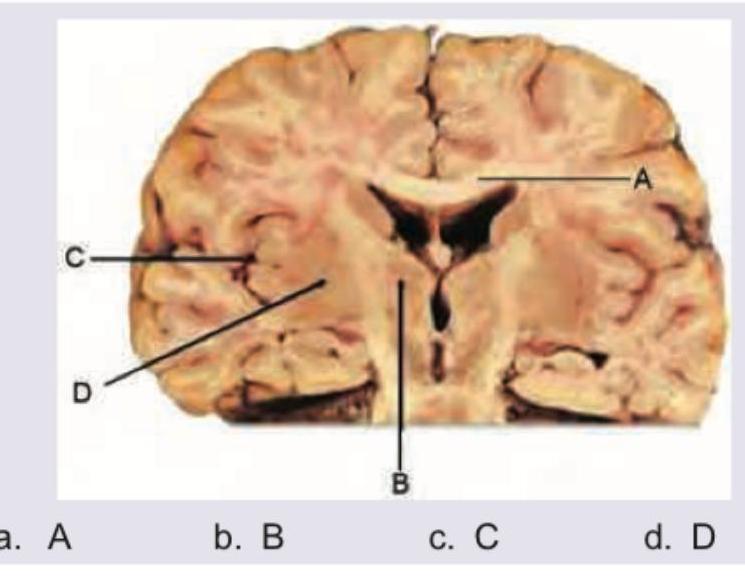
Explanation: The **Corpus Striatum** is a major component of the basal ganglia, located deep within the cerebral hemispheres [1]. It is functionally and anatomically divided based on its phylogenetic development and structural connections. ### **Explanation of the Correct Answer** **D. Amygdala:** While the amygdala is anatomically located in the temporal lobe near the tail of the caudate nucleus, it is functionally part of the **Limbic System**, not the corpus striatum. It is primarily involved in emotional processing and fear responses rather than the motor control functions associated with the striatum. ### **Analysis of Incorrect Options** * **A. Caudate Nucleus:** This is a C-shaped structure that forms the "Neostriatum" along with the putamen [1]. It is a core component of the corpus striatum. * **B. Putamen:** This is the larger, lateral part of the lentiform nucleus [1]. Together with the caudate, it forms the **Striatum (Neostriatum)**. * **C. Globus Pallidus:** This is the smaller, medial part of the lentiform nucleus [1]. It is referred to as the **Paleostriatum**. ### **High-Yield NEET-PG Pearls** 1. **Lentiform Nucleus:** Composed of the Putamen + Globus Pallidus [1]. 2. **Striatum (Neostriatum):** Composed of the Caudate Nucleus + Putamen [1]. 3. **Corpus Striatum:** Composed of the Caudate Nucleus + Lentiform Nucleus (Putamen + Globus Pallidus). 4. **Internal Capsule:** The white matter fibers of the internal capsule pass through the corpus striatum, giving it a "striated" or striped appearance, which is the origin of its name. 5. **Clinical Correlation:** Degeneration of the striatum (specifically GABAergic neurons) is the hallmark of **Huntington’s Disease**, whereas loss of dopaminergic input to the striatum leads to **Parkinson’s Disease** [1].
Cerebral Hemispheres
Practice Questions
Diencephalon
Practice Questions
Brainstem
Practice Questions
Cerebellum
Practice Questions
Basal Ganglia
Practice Questions
Limbic System
Practice Questions
Ventricular System and CSF
Practice Questions
Blood Supply of the Brain
Practice Questions
Cranial Nerves and Nuclei
Practice Questions
Functional Systems and Pathways
Practice Questions
Applied Neuroanatomy
Practice Questions
Neuroimaging Correlations
Practice Questions
Get full access to all questions, explanations, and performance tracking.
Start For Free