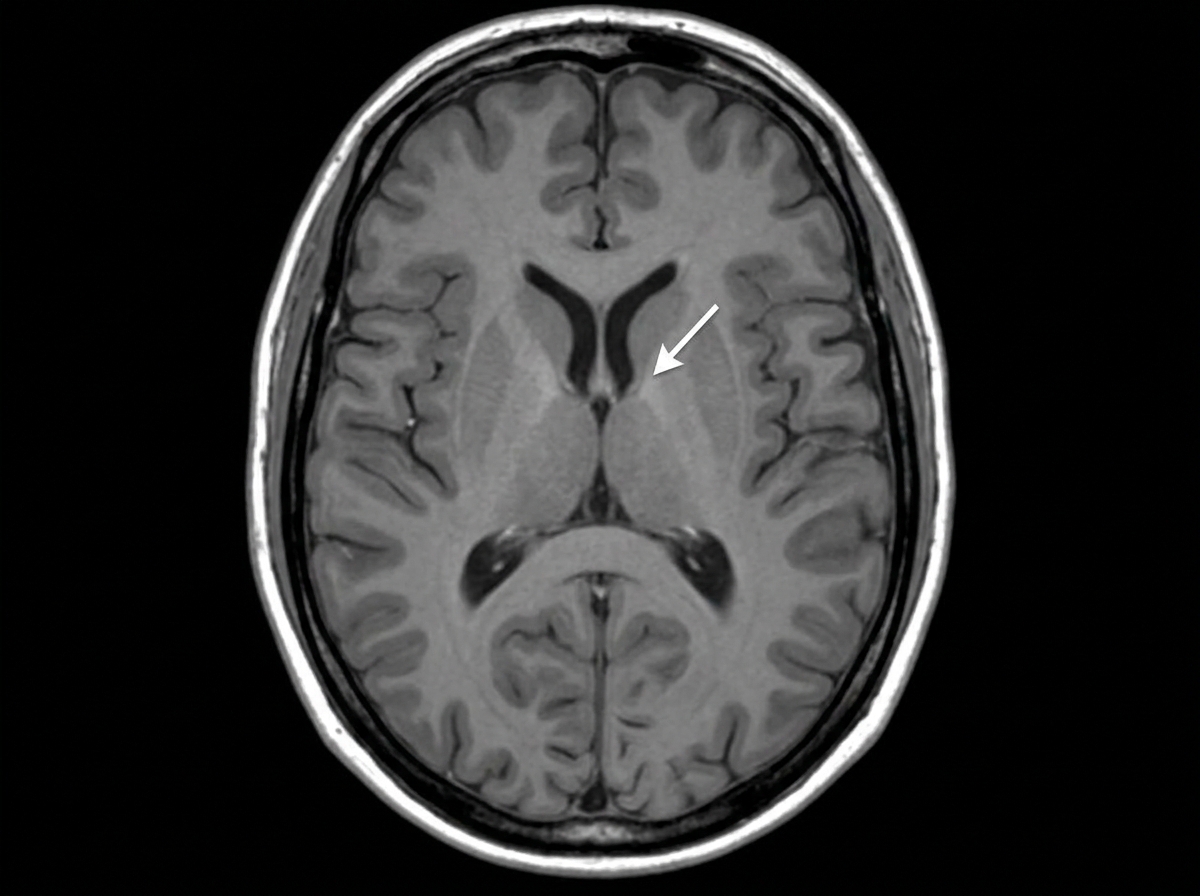
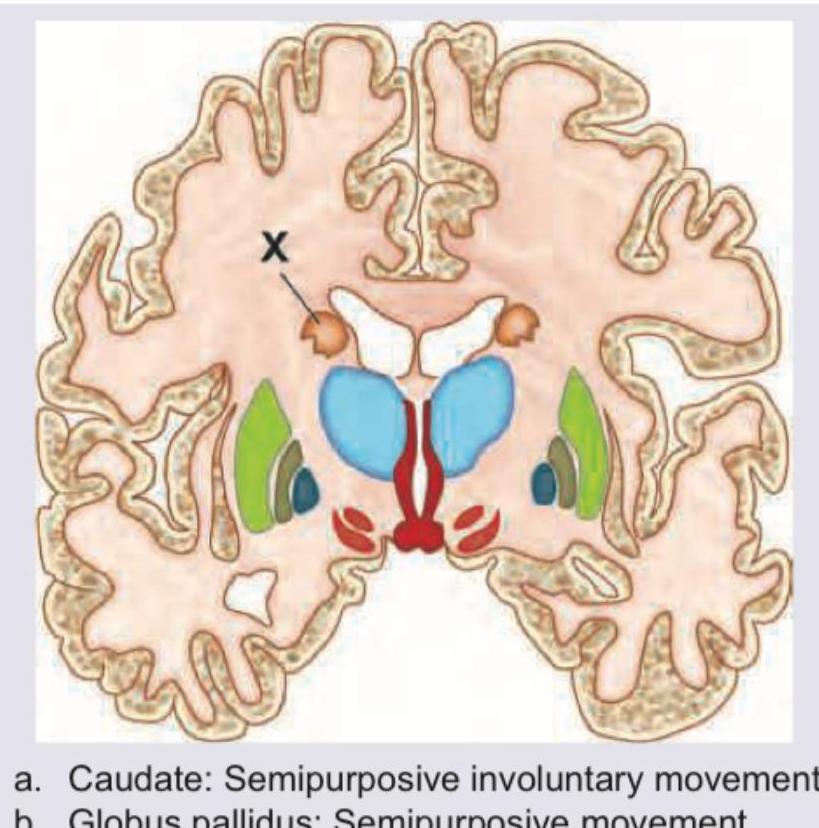
All of the following are true about the substantia nigra except:
A right-hand dominant person presents with Broca's Aphasia. This is likely to result from damage to which area?
Wallenberg's syndrome may involve which of the following structures?
Which is the most common cranial nerve involved in the pathology of an intracranial aneurysm?
The falx cerebri contains all of the following except?
A 25-year-old male involved in a road traffic accident presents to the emergency department. On examination, he is moaning and unable to speak, but he can understand spoken language. Which of the following areas of the brain is most likely involved?

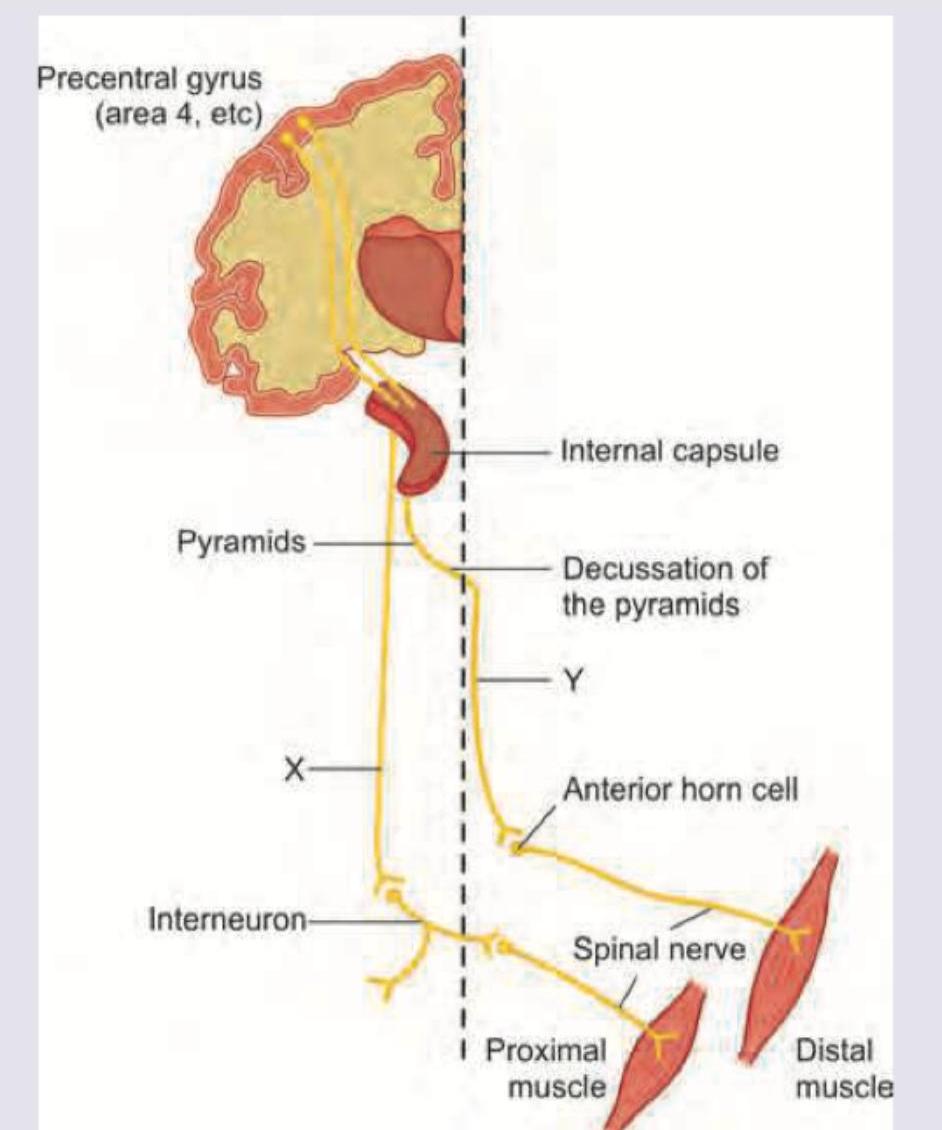
Motor area of Brodmann is area
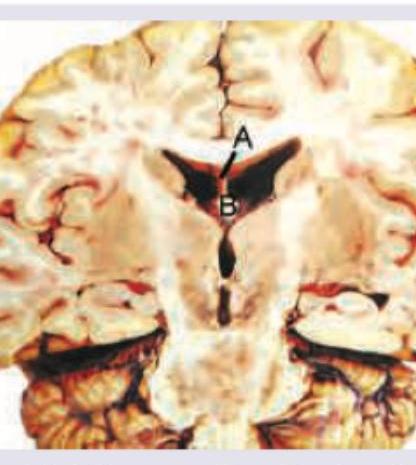
Which of the following statements regarding the corpus callosum is true?
All of the following arteries supply the medulla oblongata, except?
The medial geniculate body is an eminence on the inferior surface of the thalamus lateral to the midbrain. Which of the following functions is related to the medial geniculate body?
Explanation: ### Explanation The **substantia nigra (SN)** is a vital component of the basal ganglia located in the midbrain [1]. It is divided into two distinct parts: the **pars compacta (SNpc)** and the **pars reticulata (SNpr)**. **Why Option D is the Correct Answer (The False Statement):** The primary efferent fibers from the **pars compacta** are **dopaminergic**, not GABAergic [1]. These fibers form the **nigrostriatal pathway**, projecting to the striatum (caudate and putamen) to modulate motor activity. While the *pars reticulata* does contain GABAergic neurons that project to the thalamus, the hallmark neurotransmitter associated with the substantia nigra in the context of clinical anatomy and the nigrostriatal tract is **Dopamine** [1]. **Analysis of Other Options:** * **Option A:** The SNpc contains neurons rich in **neuromelanin** (a byproduct of dopamine synthesis), which gives the structure its characteristic dark appearance. * **Option B:** In **Parkinson’s disease**, there is a progressive loss of dopaminergic neurons in the SNpc [1]. Macroscopically, this results in the **depigmentation or pallor** of the substantia nigra, a classic post-mortem finding. * **Option C:** The substantia nigra receives significant inhibitory afferents from the **striatum** (caudate nucleus and putamen) via the **striatonigral pathway**. These fibers are GABAergic. ### Clinical Pearls for NEET-PG: * **MPTP Toxicity:** A neurotoxin that selectively destroys dopaminergic neurons in the SN, leading to permanent Parkinsonian symptoms [1]. * **Lewy Bodies:** Histopathological hallmark of Parkinson’s disease, found within the surviving neurons of the SNpc; they contain **alpha-synuclein**. * **Midbrain Level:** The substantia nigra is located at the level of the **superior colliculus** in the midbrain, situated between the tegmentum and the crus cerebri.
Explanation: **Explanation:** **1. Why Option A is Correct:** Broca’s area is the motor speech center responsible for the production of speech. In approximately 95% of right-handed individuals (and 70% of left-handed individuals), the **left hemisphere** is dominant for language [1]. Broca’s area is anatomically located in the **pars opercularis and pars triangularis** of the **inferior frontal gyrus** (Brodmann areas 44 and 45). Damage here results in Broca’s (expressive) aphasia, characterized by non-fluent, "telegraphic" speech with preserved comprehension [1]. **2. Why Other Options are Incorrect:** * **Option B:** In a right-dominant person, the right inferior frontal gyrus is the non-dominant counterpart. Damage here typically results in **dysprosody** (loss of emotional expression/inflection in speech) rather than aphasia. * **Option C:** The left superior temporal gyrus houses **Wernicke’s area** (Brodmann area 22). Damage here causes Wernicke’s (receptive) aphasia, where speech is fluent but nonsensical ("word salad") and comprehension is impaired [1]. * **Option D:** Damage to the right superior temporal gyrus affects the interpretation of emotional tone and rhythm in the speech of others [2]. **3. NEET-PG High-Yield Pearls:** * **Blood Supply:** Broca’s area is supplied by the **superior division** of the Left Middle Cerebral Artery (MCA). Wernicke’s area is supplied by the **inferior division** of the Left MCA. * **The Connection:** Broca’s and Wernicke’s areas are connected by a bundle of nerve fibers called the **arcuate fasciculus** [1]. Damage to this leads to **Conduction Aphasia** (impaired repetition). * **Clinical Sign:** Broca’s aphasia is often associated with contralateral hemiparesis (right side) because the area is adjacent to the motor cortex [1].
Explanation: **Explanation:** **Wallenberg’s Syndrome**, also known as **Lateral Medullary Syndrome**, typically results from an occlusion of the **Posterior Inferior Cerebellar Artery (PICA)** or the vertebral artery. Because the lateral medulla houses several vital nuclei and tracts in a compact area, an infarct here leads to a constellation of neurological deficits. **Why "All of the above" is correct:** The lesion involves the dorsolateral portion of the medulla, which contains all the structures listed: * **Vestibular Nucleus:** Involvement leads to vertigo, nausea, vomiting, and nystagmus (often towards the side of the lesion). * **Nucleus Ambiguus (CN IX, X, XI):** This is a high-yield feature. Damage causes paralysis of the ipsilateral soft palate, pharynx, and larynx, resulting in **dysphagia, dysarthria, and dysphonia** (loss of gag reflex). * **Nucleus and Tractus Solitarius:** Damage results in the loss of taste (ageusia) on the ipsilateral half of the tongue. **Other involved structures (Why individual options aren't the sole answer):** While each option is a component of the syndrome, the clinical presentation is a composite. Other classic features include: * **Lateral Spinothalamic Tract:** Contralateral loss of pain and temperature sensation from the body. * **Spinal Nucleus/Tract of Trigeminal Nerve:** Ipsilateral loss of pain and temperature from the face (Crossed Hemianesthesia). * **Descending Sympathetic Fibers:** Ipsilateral **Horner’s Syndrome** (ptosis, miosis, anhidrosis). * **Inferior Cerebellar Peduncle:** Ipsilateral ataxia and dysmetria. **NEET-PG Clinical Pearls:** * **Mnemonic:** "Don't pick a (PICA) horse (Horner's) that can't eat (Dysphagia - Nucleus Ambiguus)." * **Key Distinction:** Wallenberg’s syndrome **spares the Medial Lemniscus and Hypoglossal nerve** (these are involved in Medial Medullary Syndrome/Dejerine Syndrome). Therefore, tongue movements and vibration/proprioception remain intact.
Explanation: The **Abducens nerve (CN VI)** is the most common cranial nerve involved in intracranial pathology, particularly in the context of generalized increased intracranial pressure (ICP) and specific aneurysms. [1] ### Why Abducens Nerve (CN VI) is Correct The Abducens nerve has the **longest intracranial course** of all cranial nerves. [1] It emerges from the pontomedullary junction, travels upwards along the clivus, and makes a sharp turn over the petrous part of the temporal bone to enter the cavernous sinus. Because of this long, tortuous path and its tethering at the petrous apex, it is highly susceptible to stretching or compression whenever there is a shift in brain dynamics (e.g., an aneurysm causing mass effect or raised ICP). It is often referred to as a **"false localizing sign"** because its dysfunction may not indicate the exact site of the lesion. [1] ### Why Other Options are Incorrect * **Oculomotor nerve (CN III):** While CN III is classically associated with **Posterior Communicating Artery (PComA)** aneurysms (presenting as "down and out" eye with ptosis and pupil involvement), it is not the *most* common nerve involved across all intracranial pathologies. * **Trigeminal nerve (CN V):** This nerve is less commonly affected by aneurysms. It is more typically involved in pathologies like trigeminal neuralgia (vascular compression by the Superior Cerebellar Artery) or tumors of the Meckel’s cave. ### NEET-PG High-Yield Pearls * **PComA Aneurysm:** Classically causes **Oculomotor nerve palsy** with **pupillary dilation** (due to superficial parasympathetic fibers being compressed). * **Cavernous Sinus Aneurysm:** The Abducens nerve is the first nerve affected in cavernous sinus pathology because it sits centrally (medial) near the internal carotid artery, whereas CN III, IV, and V1/V2 are in the lateral wall. * **Gradenigo’s Syndrome:** Characterized by Abducens palsy, trigeminal pain, and otitis media (due to petrous apicitis).
Explanation: The **falx cerebri** is a large, sickle-shaped fold of dura mater located in the longitudinal fissure between the two cerebral hemispheres. It contains specific dural venous sinuses within its margins. **1. Why Transverse Sinus is the Correct Answer:** The **transverse sinus** is not contained within the falx cerebri. Instead, it is located along the attached posterior margin of the **tentorium cerebelli**, where it runs along the occipital bone. Therefore, it is anatomically associated with the tentorium, not the falx. **2. Analysis of Incorrect Options:** * **Superior Sagittal Sinus (SSS):** This is located in the **attached (convex) upper margin** of the falx cerebri, running from the crista galli to the internal occipital protuberance [1]. Bridging veins travel from the cerebral hemispheres to empty into this sinus [1]. * **Inferior Sagittal Sinus (ISS):** This is located in the **free (concave) lower margin** of the falx cerebri, running above the corpus callosum. * **Straight Sinus:** This is formed by the union of the Inferior Sagittal Sinus and the Great Vein of Galen. It is located at the **junction of the falx cerebri and the tentorium cerebelli**. **Clinical Pearls & High-Yield Facts:** * **Confluence of Sinuses (Torcular Herophili):** The point where the Superior Sagittal, Straight, and Occipital sinuses meet, usually draining into the transverse sinuses. * **Nerve Supply:** The falx cerebri is primarily supplied by the ophthalmic division of the **Trigeminal nerve (CN V1)**; irritation here can cause referred frontal headaches. * **Calcification:** The falx cerebri can normally calcify with age, which is a common incidental finding on CT scans.
Explanation: ***Area B*** - **Broca's area** (located in the **inferior frontal gyrus**, Brodmann areas 44/45) controls **motor speech production** and when damaged causes **expressive aphasia** with preserved comprehension. - The patient's ability to understand spoken language but inability to speak coherently is classic for **Broca's aphasia**, commonly seen in traumatic brain injuries affecting the dominant hemisphere. *Area A* - This area does not correspond to regions involved in **speech production** or **language comprehension**. - Damage here would not produce the specific pattern of **preserved comprehension** with **impaired speech output** seen in this case. *Area C* - Likely represents **Wernicke's area** in the **superior temporal gyrus**, which when damaged causes **receptive aphasia** with fluent but nonsensical speech. - Patients with **Wernicke's aphasia** have **impaired comprehension** but can produce fluent speech, opposite to this patient's presentation. *Area D* - This area does not correspond to primary **language centers** responsible for speech production or comprehension. - Damage here would not result in the characteristic **motor aphasia** pattern of intact understanding but inability to express speech.
Explanation: The correct answer is **B. Area 4**. **1. Why Area 4 is correct:** Brodmann Area 4 corresponds to the **Primary Motor Cortex**, located in the **precentral gyrus** of the frontal lobe [1]. It is responsible for the execution of voluntary motor movements on the contralateral side of the body. It contains the giant pyramidal cells of Betz, which give rise to the corticospinal (pyramidal) tract [1], [4]. **2. Why other options are incorrect:** * **Area 1:** This is part of the **Primary Somatosensory Cortex** (along with areas 2 and 3), located in the postcentral gyrus [4]. It is responsible for processing tactile and proprioceptive information. * **Area 5:** This is the **Somatosensory Association Cortex** located in the superior parietal lobule [5]. it helps in stereognosis (identifying objects by touch). * **Area 7:** Also part of the **Somatosensory Association Cortex**, it integrates sensory and visual information to assist in motor coordination and spatial awareness [5]. **3. High-Yield NEET-PG Clinical Pearls:** * **Motor Homunculus:** The body is represented upside down in Area 4 [1]. The **leg and foot** are represented on the medial surface (supplied by the **Anterior Cerebral Artery**), while the face and hands are on the lateral surface (supplied by the **Middle Cerebral Artery**). * **Lesion Effects:** A lesion in Area 4 results in contralateral **Upper Motor Neuron (UMN)** type paralysis [3]. * **Area 6:** Located just anterior to Area 4, this is the **Premotor and Supplementary Motor Area**, responsible for planning complex movements [2]. * **Area 44, 45:** Known as **Broca’s Area** (Motor Speech Area), located in the dominant hemisphere.
Explanation: The **corpus callosum** is the largest commissural pathway in the brain, consisting of approximately 200 million nerve fibers. Its primary anatomical and functional role is to facilitate interhemispheric communication by connecting corresponding neocortical areas of the two cerebral hemispheres. ### **Analysis of Options:** * **A (Correct):** It is the primary **commissural tract** connecting the left and right cerebral hemispheres, allowing for the integration of sensory, motor, and cognitive information. * **B (Incorrect):** The cerebellum is connected to the brainstem via the superior, middle, and inferior cerebellar peduncles, not the corpus callosum. * **C (Incorrect):** While it is predominantly composed of commissural fibers, it also contains **decussating fibers** and some collateral projections. In medical exams, "only" is often a distractor; the corpus callosum is defined by its function as a commissure, but it is structurally complex. * **D (Incorrect):** The corpus callosum forms the **roof of the lateral ventricles**. It is related to the **lateral ventricles**, while the 3rd ventricle lies inferiorly, bounded by the thalamus and hypothalamus. ### **High-Yield NEET-PG Pearls:** 1. **Parts (Anterior to Posterior):** Rostrum, Genu, Body (Trunk), and Splenium. 2. **Forceps Minor:** Fibers of the genu connecting the frontal lobes. 3. **Forceps Major:** Fibers of the splenium connecting the occipital lobes. 4. **Clinical Correlation:** **Split-brain syndrome** occurs after surgical callosotomy (used for intractable epilepsy), leading to a lack of coordination between hemispheres (e.g., inability to name an object held in the left hand). 5. **Blood Supply:** Mainly by the **anterior cerebral artery** (pericallosal and callosomarginal branches).
Explanation: ### Explanation The blood supply to the **medulla oblongata** is derived primarily from the branches of the **vertebral arteries** and the **basilar artery**. **Why C is the correct answer:** The **Anterior Inferior Cerebellar Artery (AICA)** is a branch of the lower part of the **Basilar artery**. It primarily supplies the **Pons** (specifically the inferolateral part) and the anterior part of the cerebellum. It does not contribute to the blood supply of the medulla. **Analysis of incorrect options:** * **Posterior Inferior Cerebellar Artery (PICA):** A major branch of the vertebral artery. It supplies the **postero-lateral part** of the medulla. Occlusion of PICA leads to Lateral Medullary Syndrome (Wallenberg Syndrome). * **Anterior Spinal Artery:** Formed by the union of branches from both vertebral arteries. It supplies the **paramedian (medial) region** of the medulla. Occlusion leads to Medial Medullary Syndrome (Dejerine Syndrome). * **Vertebral Artery:** Direct branches (bulbar branches) from the vertebral artery supply the **lateral part** of the medulla. **NEET-PG High-Yield Pearls:** 1. **Medial Medullary Syndrome:** Caused by occlusion of the **Anterior Spinal Artery**. Key features include contralateral hemiparesis (pyramid), contralateral loss of vibration/proprioception (medial lemniscus), and ipsilateral tongue deviation (hypoglossal nerve). 2. **Lateral Medullary (Wallenberg) Syndrome:** Caused by occlusion of **PICA** or the vertebral artery. Key features include ipsilateral Horner’s syndrome, ataxia, and crossed sensory loss (ipsilateral face, contralateral body). 3. **Rule of Thumb:** AICA is to the **Pons** what PICA is to the **Medulla**.
Explanation: The **Medial Geniculate Body (MGB)** is a specialized nucleus of the thalamus that serves as the **obligatory subcortical relay station for the auditory pathway** [1]. It receives auditory information from the inferior colliculus via the brachium of the inferior colliculus and projects it to the primary auditory cortex (Heschl’s gyri, Brodmann areas 41 and 42) in the temporal lobe. **Analysis of Options:** * **B. Hearing (Correct):** The MGB is the "thalamic relay" for hearing [1]. A common mnemonic to remember this is **"M is for Music"** (Medial = Music/Hearing). * **A. Vision:** Visual information is relayed through the **Lateral Geniculate Body (LGB)** [1]. Mnemonic: **"L is for Light"** (Lateral = Light/Vision). * **C. Balance:** Vestibular (balance) information primarily relays through the vestibular nuclei in the brainstem and the ventral posterior nucleus of the thalamus, not the MGB. * **D. Smell:** Olfaction is unique because it is the only sensory modality that reaches the cerebral cortex (olfactory cortex) without necessarily relaying through the thalamus first. **High-Yield NEET-PG Pearls:** 1. **The Auditory Pathway (E-COLI):** **E**ighth nerve → **C**ochlear nuclei → **O**livary complex (Superior) → **L**ateral lemniscus → **I**nferior colliculus → **MGB** → Auditory Cortex [1]. 2. **Metathalamus:** The MGB and LGB together constitute the metathalamus. 3. **Connections:** The MGB is connected to the **Inferior Colliculus**, while the LGB is connected to the **Superior Colliculus** [1].
Cerebral Hemispheres
Practice Questions
Diencephalon
Practice Questions
Brainstem
Practice Questions
Cerebellum
Practice Questions
Basal Ganglia
Practice Questions
Limbic System
Practice Questions
Ventricular System and CSF
Practice Questions
Blood Supply of the Brain
Practice Questions
Cranial Nerves and Nuclei
Practice Questions
Functional Systems and Pathways
Practice Questions
Applied Neuroanatomy
Practice Questions
Neuroimaging Correlations
Practice Questions
Get full access to all questions, explanations, and performance tracking.
Start For Free