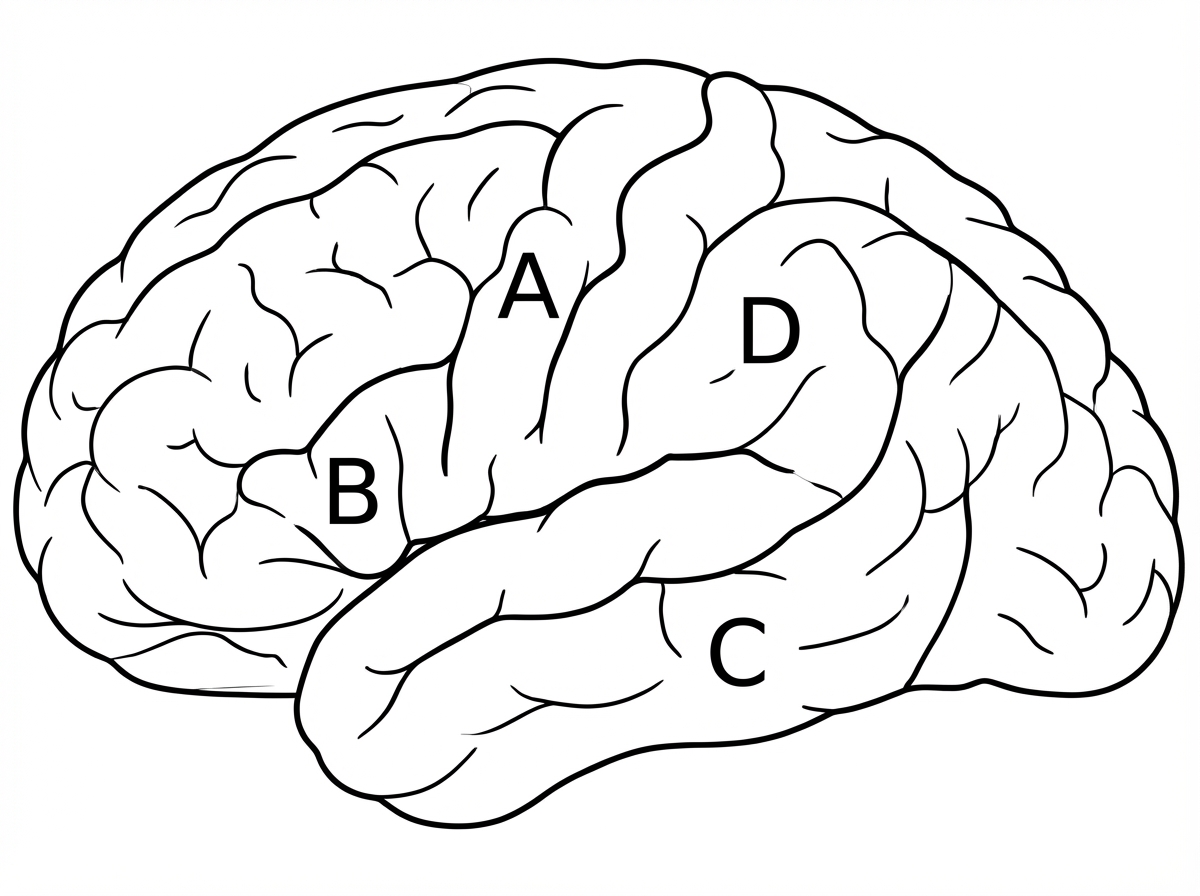
Components of the epithalamus include all of the following except?
Damage to the superior branch of the middle cerebral artery results in which of the following?
What is true about the great cerebral vein of Galen?
Which is the most common vessel affected in subdural hemorrhage?
Which area is outside the blood-brain barrier?
Globus pallidus and putamen are components of which brain structure?
Which of the following represents the largest commissural fibers in the brain?
Which of the following arteries does NOT give rise to arteries supplying the spinal cord?
Cerebrospinal fluid is obtained from the space between which meningeal layers?
A knife wound has severed the oculomotor nerve. Which of the following conditions will occur because of this injury?
Explanation: The **Epithalamus** is the most dorsal part of the diencephalon, forming the roof of the third ventricle [1]. It primarily serves as a connection between the limbic system and other parts of the brain. ### Why Striae Terminalis is the Correct Answer The **Stria terminalis** is a major output pathway of the **amygdala** (part of the limbic system) that runs in the groove between the caudate nucleus and the thalamus. It is **not** a component of the epithalamus. It is often confused with the *stria medullaris* due to the similarity in names. ### Analysis of Other Options * **Habenula (Habenular nuclei):** These are small nuclei located at the posterior end of the stria medullaris. They act as a relay station for signals from the limbic system to the midbrain. * **Striae medullaris (thalami):** This is a bundle of white matter fibers that carries afferent signals from the septal nuclei and hypothalamus to the habenular nuclei. It forms a ridge on the superomedial surface of the thalamus. * **Pineal gland (Epiphysis cerebri):** An endocrine gland attached to the diencephalon by the pineal stalk [1]. It secretes melatonin and is a hallmark structure of the epithalamus. ### High-Yield NEET-PG Pearls * **The "Rule of S":** Remember that **S**tria **M**edullaris is in the **M**edial part of the thalamus (Epithalamus), while **S**tria **T**erminalis is associated with the **T**halamostriate vein and the amygdala. * **Habenular Commissure:** Connects the habenular nuclei of both sides; it is located superior to the pineal stalk. * **Pineal Calcification:** Often visible on CT scans in adults; a shift in its midline position can indicate a space-occupying lesion (e.g., tumor or hematoma) [1].
Explanation: The **Middle Cerebral Artery (MCA)** is the most common site for ischemic strokes [1]. It divides into superior and inferior divisions at the insula. ### **Why Motor Aphasia is Correct** The **superior branch** of the MCA supplies the lateral aspect of the frontal lobe, including **Broca’s area** (Brodmann areas 44 and 45) and the primary motor cortex. Damage to Broca’s area results in **Motor (Expressive) Aphasia**, characterized by non-fluent speech, labored output, but preserved comprehension [1]. Additionally, superior branch strokes often cause contralateral hemiparesis affecting the face and arm more than the leg. ### **Explanation of Incorrect Options** * **A. Personality change:** This is typically associated with lesions in the **Prefrontal Cortex**, often supplied by the **Anterior Cerebral Artery (ACA)** or traumatic brain injury. * **C. Urinary incontinence:** This occurs due to damage to the **Paracentral Lobule** (medial surface of the frontal lobe), which is supplied by the **Anterior Cerebral Artery (ACA)**. * **D. Sensory aphasia:** Also known as **Wernicke’s aphasia**, this results from damage to the **inferior branch** of the MCA, which supplies the superior temporal gyrus [1]. ### **High-Yield Clinical Pearls for NEET-PG** * **MCA Superior Division:** Broca’s Aphasia + Contralateral motor deficit (Face/Arm > Leg). * **MCA Inferior Division:** Wernicke’s Aphasia + Superior Quadrantanopia ("Pie in the sky" due to Meyer’s loop involvement). * **ACA Stroke:** Contralateral motor/sensory loss specifically in the **Lower Limb** + Urinary incontinence. * **Global Aphasia:** Occurs with a proximal MCA occlusion (M1 segment) affecting both superior and inferior divisions.
Explanation: ### Explanation The **Great Cerebral Vein (of Galen)** is a short, thick trunk (approx. 2 cm long) that represents the most critical component of the **deep venous drainage** of the brain [1]. **Why Option D is Correct:** The Great Cerebral Vein is formed by the union of the two **Internal Cerebral Veins** (which are themselves formed by the union of the thalamostriate and choroidal veins). These internal cerebral veins unite just **behind and below the splenium of the corpus callosum** in the quadrigeminal cistern to form the Vein of Galen. It also receives the two **Basal veins (of Rosenthal)** before draining into the Straight Sinus. **Analysis of Incorrect Options:** * **Option A:** The thalamostriate and choroidal veins unite at the interventricular foramen (of Monro) to form the **Internal Cerebral Vein**, not the Great Cerebral Vein directly. * **Option B:** The Vein of Galen belongs to the **deep venous system** [1]. The superficial system consists of the superior, middle, and inferior cerebral veins (including the anastomotic veins of Trolard and Labbé). * **Option C:** The Great Cerebral Vein drains into the **Straight Sinus** (after joining the Inferior Sagittal Sinus). The sigmoid sinus is the continuation of the transverse sinus. **High-Yield Clinical Pearls for NEET-PG:** * **Course:** It passes backwards and upwards to join the Inferior Sagittal Sinus to form the **Straight Sinus**. * **Vein of Galen Malformation (VOGM):** A rare arteriovenous malformation in neonates that can lead to high-output heart failure and hydrocephalus. * **Location:** It is situated in the **quadrigeminal cistern** (cisterna ambiens). * **Drainage:** It drains the deep structures including the thalamus, basal ganglia, and internal capsule [1].
Explanation: ### Explanation **Correct Answer: C. Bridging veins** **Mechanism:** Subdural hemorrhage (SDH) occurs due to the tearing of **bridging veins** [1] as they traverse the subdural space to drain into the dural venous sinuses (most commonly the Superior Sagittal Sinus). These veins are thin-walled and vulnerable to shearing forces during sudden acceleration-deceleration injuries [1]. On imaging, SDH typically presents as a **crescent-shaped (concave)** hyperdensity that can cross cranial sutures but is limited by dural reflections (like the falx cerebri). **Analysis of Incorrect Options:** * **A. Middle meningeal artery:** This is the most common vessel involved in **Epidural Hemorrhage (EDH)**, usually following a fracture at the pterion [1]. EDH presents as a biconvex (lens-shaped) hematoma. * **B. Aneurysm of anterior cerebral artery:** Rupture of a berry aneurysm (most commonly at the Anterior Communicating Artery) leads to **Subarachnoid Hemorrhage (SAH)** [2], characterized by blood in the cisterns and sulci ("worst headache of life"). * **D. Basilar artery:** While critical for posterior circulation, its rupture or occlusion typically leads to brainstem strokes or SAH [2], not a subdural collection. **High-Yield Clinical Pearls for NEET-PG:** * **At-risk populations:** Elderly patients and chronic alcoholics are predisposed to SDH because **brain atrophy** stretches the bridging veins, making them more liable to tear even with minor trauma. * **Shaken Baby Syndrome:** SDH in infants is a classic marker of child abuse due to vigorous shaking. * **Chronic SDH:** May present weeks after trauma with fluctuating levels of consciousness or dementia-like symptoms. * **Imaging Rule:** SDH = **C**rescent (Concave); EDH = **L**ens (Convex).
Explanation: ### Explanation The **Blood-Brain Barrier (BBB)** is a highly selective semipermeable border of endothelial cells that prevents solutes in the circulating blood from non-selectively crossing into the extracellular fluid of the central nervous system [1]. However, certain specialized regions called **Circumventricular Organs (CVOs)** lack a BBB to allow for direct communication between the blood and the brain [1]. **Why Area Postrema is Correct:** The **Area Postrema**, located in the floor of the 4th ventricle at the level of the medulla (obex), is a sensory CVO. It lacks a BBB so it can detect toxins or emetic substances in the blood. It functions as the **Chemoreceptor Trigger Zone (CTZ)**, which initiates the vomiting reflex. **Analysis of Incorrect Options:** * **Thalamus & Cerebral Cortex:** These are major components of the forebrain. They possess a continuous capillary endothelium with tight junctions (the structural basis of the BBB) to maintain a stable microenvironment for neuronal signaling. * **4th Ventricle:** This is a space filled with Cerebrospinal Fluid (CSF). While the CSF is separated from the blood by the *Blood-CSF barrier* (at the choroid plexus), the ventricle itself is an anatomical space, not a neural tissue structure "outside" the BBB in the context of vascular permeability [3]. **High-Yield Clinical Pearls for NEET-PG:** * **Other CVOs lacking BBB:** Pineal gland, Posterior pituitary (Neurohypophysis), Median eminence, Organum vasculosum of the lamina terminalis (OVLT), and Subfornical organ [1], [2]. * **Function of OVLT:** Acts as an osmoreceptor to sense changes in plasma osmolarity. * **Structural components of BBB:** Tight junctions (Zonula occludens), Basement membrane, and Astrocyte end-feet (Podocytes). * **Clinical Correlation:** Dopamine agonists (like Apomorphine) act on the Area Postrema to induce vomiting because it is outside the BBB.
Explanation: The **Basal Ganglia** (or Basal Nuclei) is a collection of subcortical gray matter nuclei situated deep within the cerebral hemispheres, primarily involved in motor control and procedural learning [1]. Anatomically, the **Putamen** and the **Globus Pallidus** (internal and external segments) together form the **Lentiform Nucleus**, a lens-shaped structure [1]. When the Putamen is grouped with the Caudate Nucleus, they are collectively referred to as the **Striatum** [1]. Therefore, Option D is the correct anatomical classification. **Why other options are incorrect:** * **Pons:** This is a part of the brainstem located between the midbrain and medulla. It contains cranial nerve nuclei (V-VIII) and respiratory centers, but not the lentiform nucleus [1]. * **Thalamus:** While the thalamus is a deep gray matter structure adjacent to the basal ganglia, it serves as the primary sensory relay station of the brain [1]. It is separated from the lentiform nucleus by the internal capsule [1]. * **Cerebellum:** Located in the posterior cranial fossa, it coordinates voluntary movements and balance. Its internal nuclei include the Dentate, Emboliform, Globose, and Fastigial nuclei (mnemonic: "Don't Eat Greasy Food"). **High-Yield Clinical Pearls for NEET-PG:** * **Wilson’s Disease:** Characterized by copper deposition specifically in the **Putamen** (Lenticular degeneration). * **Blood Supply:** The basal ganglia are primarily supplied by the **Charcot’s artery** (Lenticulostriate branches of the Middle Cerebral Artery), which is a common site for hypertensive hemorrhage [1]. * **Parkinson’s Disease:** Involves the degeneration of dopaminergic neurons in the **Substantia Nigra** (pars compacta), which is functionally part of the basal ganglia circuit [1].
Explanation: **Explanation:** **Corpus Callosum (Correct Answer):** The corpus callosum is the **largest commissural fiber bundle** in the human brain, consisting of approximately 200–300 million axonal projections. Commissural fibers are defined as white matter tracts that connect functionally corresponding areas of the two cerebral hemispheres. The corpus callosum facilitates interhemispheric communication and is divided into four main parts: the rostrum, genu, body (trunk), and splenium. **Analysis of Incorrect Options:** * **Anterior Commissure:** A much smaller bundle located in the lamina terminalis. It primarily connects the temporal lobes and olfactory structures [2]. It is significant as a landmark in stereotactic surgery but is far smaller than the corpus callosum. * **Posterior Commissure:** Located in the upper part of the cerebral aqueduct (at the level of the pineal gland) [1]. It is involved in the bilateral pupillary light reflex but is a minor tract in terms of fiber count [1]. * **Habenular Commissure:** A tiny tract located superior to the pineal stalk, connecting the two habenular nuclei. It is part of the epithalamus and is functionally related to the limbic system. **High-Yield Clinical Pearls for NEET-PG:** * **Blood Supply:** The corpus callosum is primarily supplied by the **anterior cerebral artery (ACA)** via the pericallosal artery; however, the splenium receives supply from the **posterior cerebral artery (PCA)**. * **Clinical Correlation:** Surgical sectioning of the corpus callosum (commissurotomy) is used to treat intractable epilepsy, resulting in **"Split-brain syndrome."** * **Marchiafava-Bignami Disease:** A rare neurological condition characterized by primary demyelination and necrosis of the corpus callosum, often associated with chronic alcoholism.
Explanation: The spinal cord is supplied by a longitudinal system (one anterior and two posterior spinal arteries) and a segmental system (radicular and segmental medullary arteries). The segmental supply is crucial as the longitudinal arteries are often insufficient to supply the entire length of the cord. **Explanation of the Correct Answer:** **D. Thoracoacromial artery:** This is a branch of the second part of the **axillary artery**. It supplies the pectoral muscles, deltoid, acromion, and clavicular region. It is located too laterally and superficially in the thoracic wall to contribute to the spinal cord's blood supply. **Explanation of Incorrect Options:** * **A. Ascending cervical artery:** A branch of the thyrocervical trunk (subclavian artery), it provides segmental branches to the **cervical** spinal cord. * **B. Deep cervical artery:** Arising from the costocervical trunk (subclavian artery), it supplies the **lower cervical** and upper thoracic segments of the cord. * **C. Intercostal arteries:** Posterior intercostal arteries (branches of the thoracic aorta) give off spinal branches that enter the intervertebral foramina to supply the **thoracic** spinal cord [1]. **High-Yield NEET-PG Pearls:** 1. **Artery of Adamkiewicz (Arteria Radicularis Magna):** The largest segmental medullary artery, usually arising from a left-sided lower intercostal or upper lumbar artery (T9–L2). It is the major source of blood to the lower two-thirds of the spinal cord. 2. **Watershed Areas:** The mid-thoracic region (T4–T8) is a "watershed" area with relatively poor collateral circulation, making it highly susceptible to ischemic injury during aortic surgery or hypotension. 3. **Origin Summary:** Spinal supply originates from the **Vertebral, Ascending Cervical, Deep Cervical, Intercostal, Lumbar, and Lateral Sacral arteries.** [1]
Explanation: ### Explanation **1. Why Option C is Correct:** The brain and spinal cord are enveloped by three meningeal layers: the dura mater (outer), arachnoid mater (middle), and pia mater (inner). The **subarachnoid space** is the anatomical space located between the **arachnoid mater** and the **pia mater**. This space contains the **Cerebrospinal Fluid (CSF)**, as well as major blood vessels and the trabeculae (delicate connective tissue filaments). In clinical practice, such as during a lumbar puncture, the needle must penetrate the dura and arachnoid to reach this space to withdraw CSF [1]. **2. Why Other Options are Incorrect:** * **Option A (Dura and Arachnoid):** This defines the **subdural space** [2]. In healthy individuals, this is a "potential space" containing only a thin film of serous fluid. Clinical pathology here typically involves a subdural hematoma (usually due to tearing of bridging veins) [2]. * **Option B (Dura and Pia):** There is no direct anatomical space between these two layers, as the arachnoid mater is situated between them. * **Epidural Space (Bonus):** Though not listed, the space outside the dura mater is the epidural space, which contains fat and the internal vertebral venous plexus [2]. **3. Clinical Pearls & High-Yield Facts for NEET-PG:** * **Lumbar Puncture (LP) Site:** In adults, LP is performed at the **L3-L4 or L4-L5** level to avoid injuring the spinal cord (which ends at L1 in adults and L3 in infants) [3]. * **Subarachnoid Hemorrhage (SAH):** Often described as the "worst headache of life" (thunderclap headache), it is caused by bleeding into the subarachnoid space, most commonly from a ruptured **Berry aneurysm**. * **CSF Flow:** CSF is produced by the **choroid plexus** in the ventricles and is reabsorbed into the dural venous sinuses via **arachnoid granulations** [1].
Explanation: The **Oculomotor nerve (CN III)** carries both motor fibers to extraocular muscles and **parasympathetic (GVE) fibers** to the intraocular muscles [1]. ### **Why Option D is Correct** The preganglionic parasympathetic fibers of CN III synapse in the **ciliary ganglion**. The postganglionic fibers (short ciliary nerves) then supply the **ciliary muscle** and the **sphincter pupillae** [1]. Severing the nerve interrupts this pathway, leading to paralysis of the ciliary muscle (**cycloplegia**), which results in a loss of accommodation. ### **Analysis of Incorrect Options** * **A. Constricted pupil:** The sphincter pupillae is paralyzed, leaving the dilator pupillae (sympathetic) unopposed. This results in a **dilated (mydriatic)** pupil, not a constricted one [1]. * **B. Abduction of the eyeball:** While the eye deviates laterally ("Down and Out") due to the unopposed action of the Lateral Rectus (CN VI) and Superior Oblique (CN IV), the term "abduction" implies an active movement. The eye is *fixed* in an abducted position; it cannot perform active abduction/adduction normally. * **C. Complete ptosis:** While CN III supplies the Levator Palpebrae Superioris (LPS), a lesion usually causes **partial to severe ptosis**. However, in the context of NEET-PG questions, if a specific physiological function like "paralysis of the ciliary muscle" is an option, it is often the more precise anatomical consequence of the parasympathetic fiber loss. ### **NEET-PG High-Yield Pearls** * **"Down and Out" Eye:** The classic presentation of CN III palsy. * **Surgical vs. Medical Third Nerve Palsy:** Parasympathetic fibers are located **peripherally** in the nerve. They are compressed first by external masses (e.g., PCom artery aneurysm), leading to a **dilated pupil**. In medical causes like Diabetes (ischemia), the central motor fibers are affected first, often **sparing the pupil**. * **Muscles spared:** Only the Superior Oblique (SO4) and Lateral Rectus (LR6) remain functional.
Cerebral Hemispheres
Practice Questions
Diencephalon
Practice Questions
Brainstem
Practice Questions
Cerebellum
Practice Questions
Basal Ganglia
Practice Questions
Limbic System
Practice Questions
Ventricular System and CSF
Practice Questions
Blood Supply of the Brain
Practice Questions
Cranial Nerves and Nuclei
Practice Questions
Functional Systems and Pathways
Practice Questions
Applied Neuroanatomy
Practice Questions
Neuroimaging Correlations
Practice Questions
Get full access to all questions, explanations, and performance tracking.
Start For Free