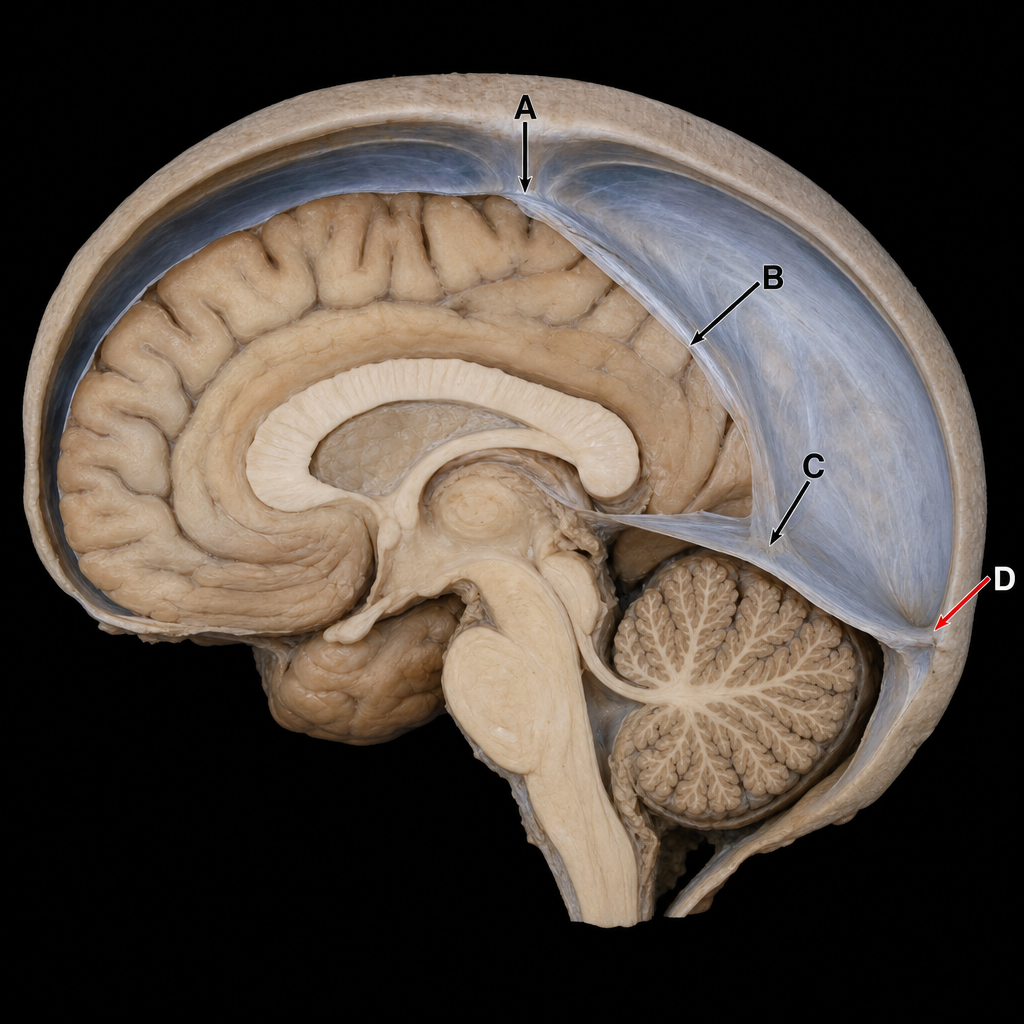
A 57-year-old woman presents with fever, nausea, vomiting, and the worst headache of her life. Investigations suggest hydrocephalus due to decreased absorption of cerebrospinal fluid (CSF). A decrease in CSF flow through which of the following structures would be responsible for these findings?
Damage to the paracentral lobule during neurosurgery can lead to which of the following clinical manifestations?
The rhombencephalon includes all except?
Through which part of the internal capsule does the auditory pathway pass?
Wernicke's area is located in which part of the brain?
Lateral medullary syndrome or Wallenberg syndrome involves all EXCEPT:
What is the efferent limb of the gag reflex?
The least common site for a berry aneurysm is?
Damage to the structure producing the elevation marked leads to paralysis of which of the following muscles?

All of the following are nuclei of the cerebellum, EXCEPT:
Explanation: ### Explanation The clinical presentation of the "worst headache of her life" combined with fever and vomiting suggests a subarachnoid hemorrhage or meningitis, both of which can lead to **communicating hydrocephalus** [1][3]. **Why Arachnoid Villi is Correct:** Cerebrospinal fluid (CSF) is produced in the choroid plexuses, circulates through the ventricular system, and enters the subarachnoid space [2]. The final step in the CSF life cycle is its **reabsorption into the dural venous sinuses** (primarily the superior sagittal sinus). This occurs through the **arachnoid villi** (or larger arachnoid granulations) [2]. If these structures are obstructed—often by blood products, inflammatory debris, or fibrosis—CSF cannot be absorbed, leading to increased intracranial pressure and hydrocephalus [1]. **Why the Other Options are Incorrect:** * **A. Choroid plexus:** This is the site of CSF **production**, not absorption [1][2]. Overactivity (e.g., choroid plexus papilloma) causes hydrocephalus through overproduction, not decreased flow/absorption [2]. * **B. Vertebral venous plexus:** While this plexus (Batson’s plexus) communicates with the cranial dural sinuses, it is not the primary site for CSF drainage. It is more clinically relevant for the metastatic spread of pelvic tumors to the brain. * **D. Internal jugular vein:** This is the ultimate venous exit for blood from the brain, but CSF must first pass through the arachnoid villi into the dural sinuses before reaching the jugular veins. **NEET-PG High-Yield Pearls:** * **Flow of CSF:** Lateral Ventricles → Foramen of Monro → 3rd Ventricle → Aqueduct of Sylvius → 4th Ventricle → Foramina of Luschka/Magendie → Subarachnoid Space → **Arachnoid Villi** [2]. * **Communicating vs. Non-communicating:** If CSF reaches the subarachnoid space but isn't absorbed, it is **communicating** hydrocephalus (e.g., post-meningitis) [3]. If there is a block within the ventricles, it is **non-communicating** (obstructive) [1][3]. * **Normal Pressure Hydrocephalus (NPH):** A specific type of communicating hydrocephalus characterized by the triad: *Urinary incontinence, Gait ataxia, and Dementia* ("Wet, Wobbly, and Wacky").
Explanation: The **paracentral lobule** is located on the medial surface of the cerebral hemisphere, surrounding the indentation of the central sulcus. It represents the continuation of the precentral and postcentral gyri and contains the motor and sensory representations for the **lower limb, foot, and perineum**. ### Why the Correct Answer is Right: According to the **motor and sensory homunculus**, the body is represented in an inverted fashion [2]. While the face and upper limbs are represented on the lateral surface of the brain (supplied by the Middle Cerebral Artery), the lower extremity and the sphincters (bladder and bowel) are represented on the **medial surface** (supplied by the **Anterior Cerebral Artery**). Therefore, damage to the paracentral lobule specifically affects the contralateral lower limb and the perineal region. ### Why Other Options are Wrong: * **A. Hemiplegia:** This refers to paralysis of one side of the body (face, arm, and leg). This typically occurs with lesions in the internal capsule [2] or extensive damage to the lateral motor cortex. * **B. Monoplegia:** While a small lesion could cause monoplegia of the leg, "Involvement of the perineum and lower limbs" is a more specific and accurate description of the paracentral lobule’s functional territory. * **D. Quadriplegia:** This involves all four limbs and usually results from high cervical spinal cord injuries or bilateral brainstem lesions, not a localized cortical injury. ### NEET-PG High-Yield Pearls: * **Blood Supply:** The paracentral lobule is supplied by the **Anterior Cerebral Artery (ACA)**. An ACA infarct typically presents with contralateral leg weakness and urinary incontinence. * **Functional Zones:** The anterior part of the lobule is motor (Brodmann area 4), and the posterior part is sensory (Brodmann areas 1, 2, 3) [1]. * **Clinical Sign:** A lesion here often results in **"spastic"** weakness of the lower limb and loss of voluntary control over the bladder and bowel sphincters.
Explanation: ### Explanation The brain develops from three primary vesicles during embryogenesis. Understanding this classification is fundamental for neuroanatomy questions in NEET-PG. **1. Why Midbrain is the Correct Answer:** The **Rhombencephalon** (Hindbrain) is the most caudal of the primary brain vesicles. It further divides into the **metencephalon** and **myelencephalon**. The **Midbrain**, however, develops from the **Mesencephalon**, which is a distinct primary vesicle located between the forebrain and hindbrain [2]. Therefore, the midbrain is not part of the rhombencephalon. **2. Analysis of Incorrect Options:** * **Pons & Cerebellum:** These structures are derived from the **Metencephalon**, which is the cranial part of the rhombencephalon [1], [2]. * **Medulla Oblongata:** This structure is derived from the **Myelencephalon**, the caudal part of the rhombencephalon [2]. **Summary Table of Brain Development:** | Primary Vesicle | Secondary Vesicle | Adult Derivatives | | :--- | :--- | :--- | | **Prosencephalon** (Forebrain) | Telencephalon & Diencephalon | Cerebral hemispheres, Thalamus, Hypothalamus | | **Mesencephalon** (Midbrain) | Mesencephalon | **Midbrain** | | **Rhombencephalon** (Hindbrain) | Metencephalon & Myelencephalon | **Pons, Cerebellum, Medulla** | **Clinical Pearls & High-Yield Facts:** * **The Isthmus Rhombencephali:** This is the constriction that separates the mesencephalon from the rhombencephalon. * **Cavity of the Rhombencephalon:** The central cavity of the hindbrain develops into the **Fourth Ventricle**. * **Pontine Flexure:** This flexure occurs in the middle of the rhombencephalon, causing the thin roof of the fourth ventricle to stretch. * **The "Rule of 4s":** In clinical neurology, the last four cranial nerves (IX-XII) are associated with the medulla, while the middle four (V-VIII) are associated with the pons [2].
Explanation: The **internal capsule** is a compact band of white matter fibers situated between the thalamus and caudate nucleus medially, and the lentiform nucleus laterally. It is divided into five distinct parts, each carrying specific fiber tracts. ### Why the Sublentiform Part is Correct The **sublentiform part** passes underneath the lentiform nucleus. It primarily contains the **auditory radiations**, which originate in the **medial geniculate body (MGB)** of the thalamus and project to the primary auditory cortex (Heschl’s gyri, areas 41 and 42) in the temporal lobe [1]. It also carries some visual fibers (temporopontine fibers). ### Why Other Options are Incorrect * **Anterior Limb:** Located between the head of the caudate and the lentiform nucleus. It carries frontopontine fibers and thalamocortical fibers (anterior thalamic radiation) to the prefrontal cortex. * **Posterior Limb:** Located between the thalamus and the lentiform nucleus. It is high-yield for carrying **corticospinal (motor) tracts** and the superior thalamic radiation (sensory fibers). * **Retrolentiform Part:** Located behind the lentiform nucleus. It carries the **optic radiations** (geniculocalcarine tract) from the **lateral geniculate body (LGB)** to the visual cortex. ### NEET-PG High-Yield Pearls * **Mnemonic for Geniculate Bodies:** **M**GB is for **M**usic (Auditory); **L**GB is for **L**ight (Visual) [1]. * **Blood Supply:** The most common site of hypertensive hemorrhage is the internal capsule, specifically involving the **Charcot’s artery of cerebral hemorrhage** (a branch of the Middle Cerebral Artery) [3]. * **Genu:** This part contains the **corticobulbar tracts**, which control the muscles of the head and neck [2].
Explanation: **Explanation:** **Wernicke’s area** is the primary sensory speech area responsible for the **comprehension of spoken and written language** [1], [3]. It is located in the posterior part of the **Superior Temporal Gyrus** (Brodmann area 22) of the dominant hemisphere (usually the left) [2]. It lies adjacent to the primary auditory cortex, allowing it to process and interpret auditory signals into meaningful language [2]. **Analysis of Incorrect Options:** * **A. Inferior frontal gyrus:** This is the location of **Broca’s area** (Brodmann areas 44 and 45). It is the motor speech area responsible for speech production, not comprehension [1]. * **C. Inferior temporal gyrus:** This area is primarily involved in high-level visual processing and object recognition (the "what" pathway), rather than language comprehension [4]. * **D. Cingulate gyrus:** Part of the limbic system, it is involved in emotional processing, learning, and memory. **Clinical Pearls for NEET-PG:** * **Wernicke’s Aphasia (Sensory/Receptive Aphasia):** Characterized by fluent but meaningless speech ("word salad"). Patients have poor comprehension and are often unaware of their deficit (anosognosia). * **Arcuate Fasciculus:** The white matter tract that connects Wernicke’s area to Broca’s area [1]. Damage here leads to **Conduction Aphasia** (impaired repetition with intact comprehension). * **Blood Supply:** Wernicke’s area is supplied by the **inferior division of the Middle Cerebral Artery (MCA)**.
Explanation: Explanation: Lateral Medullary Syndrome (Wallenberg Syndrome) results from an occlusion of the **Posterior Inferior Cerebellar Artery (PICA)** or the vertebral artery. The syndrome is characterized by damage to the lateral portion of the medulla, sparing the midline structures. **Why Option D is the Correct Answer:** The **12th cranial nerve (Hypoglossal nerve)** nucleus and its exiting fibers are located in the **medial medulla**. Therefore, they are affected in **Medial Medullary Syndrome** (Dejerine Syndrome), not Lateral Medullary Syndrome. Involvement of the 12th nerve would cause tongue deviation toward the side of the lesion, which is a hallmark of medial involvement. **Analysis of Incorrect Options:** * **A. 5th Cranial Nerve:** The **Spinal trigeminal nucleus and tract** are located laterally. Damage leads to loss of pain and temperature sensation on the ipsilateral side of the face. * **B & C. 9th and 10th Cranial Nerves:** The **Nucleus Ambiguus** (which gives motor fibers to CN IX and X) is located in the lateral medulla. Damage results in dysphagia, dysarthria, and loss of the gag reflex. **High-Yield Clinical Pearls for NEET-PG:** * **Mnemonic for Wallenberg:** "Don't **PICA** (PICA artery) a fight with a **Lateral** (Lateral Medulla) **Vest** (Vestibular nuclei)." * **Crossed Hemianesthesia:** This is the most characteristic finding—loss of pain/temp on the **ipsilateral face** (CN V) and **contralateral body** (Lateral Spinothalamic tract). * **Horner’s Syndrome:** Occurs due to damage to descending sympathetic fibers. * **Ataxia:** Occurs due to involvement of the Inferior Cerebellar Peduncle.
Explanation: The gag reflex (pharyngeal reflex) is a protective mechanism that prevents foreign objects from entering the airway. Understanding its reflex arc is high-yield for NEET-PG. ### **Mechanism of the Gag Reflex** * **Afferent Limb (Sensory):** The **Glossopharyngeal nerve (CN IX)** carries sensory impulses from the posterior one-third of the tongue, the soft palate, and the oropharynx to the sensory nucleus of the trigeminal nerve and the nucleus solitarius. * **Efferent Limb (Motor):** The **Vagus nerve (CN X)** carries motor impulses from the **nucleus ambiguus** to the muscles of the pharynx (specifically the constrictors) and the soft palate (levator veli palatini). This results in the contraction of the pharyngeal muscles and elevation of the soft palate. ### **Why the Other Options are Incorrect** * **A. Facial nerve (CN VII):** Primarily responsible for muscles of facial expression and the efferent limb of the corneal reflex. * **B. Glossopharyngeal nerve (CN IX):** This is the **afferent** (sensory) limb, not the efferent limb. A common exam trap is confusing the two. * **C. Trigeminal nerve (CN V):** The mandibular branch (V3) provides motor supply to the muscles of mastication and the efferent limb of the jaw jerk reflex. ### **Clinical Pearls for NEET-PG** 1. **Nucleus Ambiguus:** This is the common motor nucleus for CN IX, X, and XI. Lesions here will abolish the efferent limb of the gag reflex. 2. **Uvular Deviation:** In a unilateral Vagal nerve lesion, the uvula deviates **away** from the side of the lesion (towards the normal side) because the contralateral levator veli palatini is unopposed. 3. **Absent Reflex:** An absent gag reflex can indicate damage to CN IX, CN X, or brainstem death.
Explanation: Berry (saccular) aneurysms are thin-walled protrusions at arterial bifurcations, primarily occurring within the **Circle of Willis**. The distribution is highly asymmetrical, with approximately **85-90%** occurring in the **Anterior Circulation** and only **10-15%** in the **Posterior Circulation** [1]. **1. Why Vertebral Artery is the correct answer:** While berry aneurysms can occur anywhere in the Circle of Willis, the **Vertebral Artery** is statistically the least common site among the options provided [1]. Aneurysms in the posterior circulation are most frequently found at the basilar artery apex. The vertebral artery itself (before joining to form the basilar) is a rare site for saccular aneurysms compared to the major junctions of the circle. **2. Analysis of Incorrect Options:** * **Junction of ACA and ICA (Option C):** This is a very common site. The most frequent site overall is the **Anterior Communicating Artery (30-35%)**, followed by the junction of the Internal Carotid and Posterior Communicating arteries [3]. * **Basilar Artery (Option B):** This is the most common site within the **posterior circulation** (specifically the Basilar tip). * **Posterior Cerebral Artery (Option D):** While less common than anterior sites, it occurs more frequently than isolated vertebral artery aneurysms. **High-Yield Clinical Pearls for NEET-PG:** * **Most common site overall:** Anterior Communicating Artery (ACoA). * **Most common site in Posterior Circulation:** Basilar Artery tip. * **Clinical Presentation:** Rupture leads to **Subarachnoid Hemorrhage (SAH)**, characterized by a "thunderclap headache" (worst headache of life) [2]. * **Associated Conditions:** Polycystic Kidney Disease (ADPKD), Ehlers-Danlos syndrome, and Coarctation of the Aorta. * **Risk Factors:** Hypertension and smoking are the leading modifiable risk factors.
Explanation: ***Risorius*** - The marked elevation is the **facial colliculus** in the floor of the **4th ventricle** (rhomboid fossa), formed by **CN VII fibers** looping around the **abducens nucleus**. - Damage to this structure causes **CN VII palsy**, paralyzing facial muscles including the **risorius muscle** which is responsible for lateral retraction of the mouth angle. *Lateral rectus* - The **lateral rectus muscle** is innervated by the **abducens nerve (CN VI)**, not the facial nerve. - While the **abducens nucleus** lies beneath the facial colliculus, damage to the colliculus primarily affects the **facial nerve genu** rather than the abducens nucleus itself. *Levator palpebrae superioris* - This muscle is innervated by the **oculomotor nerve (CN III)**, which originates from the **midbrain** at the level of the **superior colliculus**. - The **facial colliculus** is located in the **pons** at the floor of the 4th ventricle, not related to CN III pathways. *Superior oblique* - The **superior oblique muscle** is innervated by the **trochlear nerve (CN IV)**, which decussates in the **superior medullary velum**. - CN IV has no anatomical relationship with the **facial colliculus** or the **facial nerve genu** pathway.
Explanation: ### Explanation The cerebellum contains four pairs of deep cerebellar nuclei embedded within its white matter. These nuclei are the primary output centers of the cerebellum. **1. Why "Nucleus Caudate" is the correct answer:** The **Caudate Nucleus** is not a cerebellar nucleus; it is a major component of the **Basal Ganglia** (along with the putamen and globus pallidus) located in the forebrain [1]. It plays a critical role in motor planning, executive function, and the reward system, rather than the direct coordination of movement handled by the cerebellum. **2. Analysis of Incorrect Options (Deep Cerebellar Nuclei):** The deep cerebellar nuclei can be remembered by the mnemonic **"Don't Eat Greasy Foods"** (Lateral to Medial): * **Nucleus Dentatus (Option B):** The largest and most lateral nucleus. It receives fibers from the cerebrocerebellum and is involved in planning and initiation of voluntary movements. * **Nucleus Globosus (Option C):** Part of the *nucleus interpositus*. It coordinates motor activity via the paleocerebellum. * **Nucleus Fastigii (Option D):** The most medial nucleus. It is associated with the vestibulocerebellum and regulates balance and eye movements [2]. *(Note: Nucleus Emboliformis is the fourth nucleus, also part of the nucleus interpositus).* [2] ### High-Yield Clinical Pearls for NEET-PG: * **Phylogenetic Classification:** * **Archicerebellum:** Flocculonodular lobe + Fastigial nucleus (Balance) [2]. * **Paleocerebellum:** Anterior lobe + Globosus/Emboliformis (Muscle tone). * **Neocerebellum:** Posterior lobe + Dentate nucleus (Coordination). * **Lesion Localization:** A lesion of the **Dentate nucleus** or the lateral cerebellar hemisphere results in **ipsilateral** limb ataxia and intentional tremors. * **Blood Supply:** The deep nuclei are primarily supplied by the **Superior Cerebellar Artery (SCA)** and the **Anterior Inferior Cerebellar Artery (AICA)**.
Cerebral Hemispheres
Practice Questions
Diencephalon
Practice Questions
Brainstem
Practice Questions
Cerebellum
Practice Questions
Basal Ganglia
Practice Questions
Limbic System
Practice Questions
Ventricular System and CSF
Practice Questions
Blood Supply of the Brain
Practice Questions
Cranial Nerves and Nuclei
Practice Questions
Functional Systems and Pathways
Practice Questions
Applied Neuroanatomy
Practice Questions
Neuroimaging Correlations
Practice Questions
Get full access to all questions, explanations, and performance tracking.
Start For Free