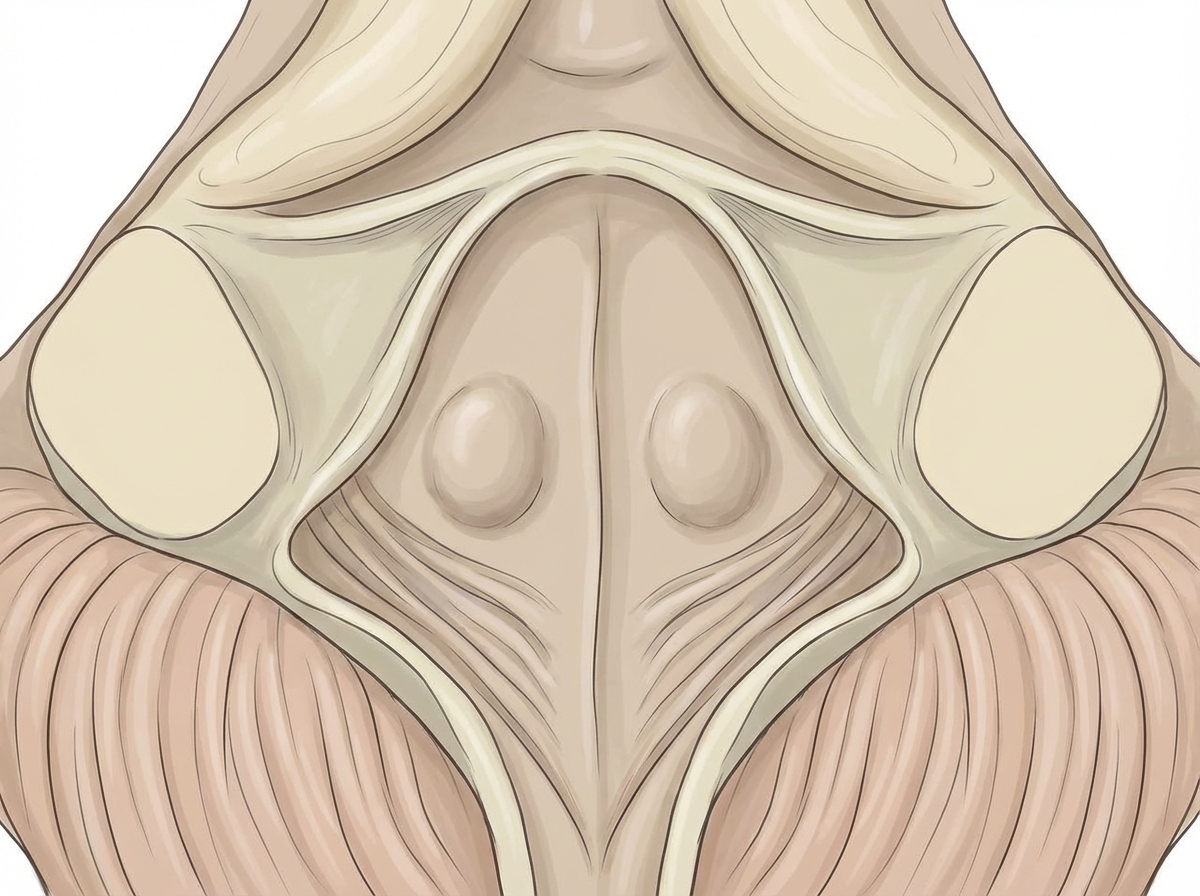
The gustatory nucleus is part of which structure?
Which of the following is included in the Upper Motor Neuron (UMN) pathway?
Which of the following is a branch of the basilar artery?
Which of the following is NOT part of the Ascending Reticular Activating System (ARAS)?
In the postnatal period, what is the greatest growth observed in the grey matter of the central nervous system?
The conus medullaris syndrome differs from the cauda equina syndrome in that the former shows which of the following?
Which nucleus innervates the muscles responsible for accommodation?
What is the cavity of the midbrain called?
Which of the following neuronal cell types is involved in the formation of the blood-brain barrier?
The anterior and posterior neuropores close during which week of embryonic development?
Explanation: The **Solitary Nucleus (Nucleus Tractus Solitarius - NTS)** is a vertical column of grey matter located in the medulla oblongata. It serves as the primary sensory relay station for visceral and taste information [1]. ### Why the Solitary Nucleus is Correct: The NTS is functionally divided into two parts: 1. **Rostral Part (Gustatory Nucleus):** Receives special visceral afferent (SVA) fibers for **taste** from the anterior 2/3 of the tongue (CN VII), posterior 1/3 of the tongue (CN IX), and the epiglottis (CN X) [1]. 2. **Caudal Part:** Receives general visceral afferent (GVA) fibers from the thoracic and abdominal viscera (CN IX and X). ### Why the Other Options are Incorrect: * **Hypoglossal Nucleus:** A motor nucleus (GSE) that supplies all intrinsic and extrinsic muscles of the tongue (except the palatoglossus). It is not involved in sensory or taste pathways. * **Nucleus Ambiguus:** A motor nucleus (SVE) that provides fibers to CN IX, X, and XI to supply the muscles of the pharynx, larynx, and soft palate. * **Dorsal Motor Nucleus:** A parasympathetic nucleus (GVE) of the Vagus nerve (CN X) that supplies the heart, lungs, and gastrointestinal tract. ### NEET-PG High-Yield Pearls: * **Mnemonic for NTS:** **S**olitary = **S**ensation (Taste + Visceral). * **Mnemonic for Ambiguus:** **A**mbiguus = **A**ction (Motor to pharynx/larynx). * The **Ventral Posteromedial (VPM) nucleus** of the thalamus is the next relay station for taste fibers after the gustatory nucleus [1]. * The primary gustatory cortex is located in the **Insula** and the frontal operculum.
Explanation: The **Upper Motor Neuron (UMN)** system consists of motor neurons that originate in the cerebral cortex or brainstem and carry motor information down to the spinal cord or cranial nerve nuclei [1]. **Why Option A is Correct:** The **Pyramidal cells** (specifically the giant cells of Betz) are located in the primary motor cortex (Brodmann area 4). Their axons form the **Corticospinal** and **Corticobulbar** tracts [1]. Since these neurons reside entirely within the Central Nervous System (CNS) and synapse onto lower motor neurons, they are the quintessential components of the UMN pathway. [1] **Why Other Options are Incorrect:** * **B. Peripheral nerves:** These are part of the Lower Motor Neuron (LMN) system. They carry impulses from the spinal cord/brainstem to the effector muscles [1]. * **C. Anterior horn cells (AHCs):** These are the cell bodies of the LMNs located in the grey matter of the spinal cord. Damage to AHCs (e.g., in Polio or SMA) results in LMN signs [1]. * **D. Glial cells:** These are non-neuronal supporting cells (like astrocytes or oligodendrocytes) that provide structural and metabolic support but do not transmit motor impulses. **High-Yield Clinical Pearls for NEET-PG:** * **UMN Lesion Signs:** Spasticity (Clasp-knife), Hyperreflexia, Upgoing plantars (Babinski sign), and absent superficial reflexes [1]. * **LMN Lesion Signs:** Flaccid paralysis, Fasciculations, Atrophy/Wasting, and Hyporeflexia [1]. * **Exception:** In the acute phase of a UMN lesion (Spinal Shock), limbs may initially be flaccid before developing spasticity. * **Location:** The UMN ends at the synapse with the Anterior Horn Cell; the AHC itself is the beginning of the LMN [1].
Explanation: **Explanation:** The **Basilar Artery** is formed by the union of the two vertebral arteries at the lower border of the pons. It travels upward in the pontine sulcus and terminates at the upper border of the pons by dividing into the two posterior cerebral arteries. **Why Option A is Correct:** The **Pontine arteries** are numerous small vessels that arise directly from the trunk of the basilar artery to supply the pons. These are considered direct branches of the basilar artery throughout its course. **Why Other Options are Incorrect:** * **Posterior Inferior Cerebellar Artery (PICA):** This is the largest branch of the **Vertebral artery**, not the basilar artery. It typically arises before the two vertebral arteries merge. * **Posterior Cerebral Artery (PCA):** While the basilar artery ends by dividing into the PCAs, in classical anatomical nomenclature, these are classified as **terminal branches** rather than collateral branches of the trunk. In the context of NEET-PG questions, when "branches of the basilar artery" are listed alongside "pontine arteries," the latter is the preferred answer for collateral supply. * **All of the above:** Incorrect because PICA is a branch of the vertebral artery. **High-Yield NEET-PG Pearls:** 1. **Branches of Basilar Artery (Mnemonic: ALPS):** **A**nterior Inferior Cerebellar Artery (AICA), **L**abyrinthine artery (often a branch of AICA), **P**ontine arteries, and **S**uperior Cerebellar Artery (SCA). 2. **Clinical Correlation:** Occlusion of the basilar artery can lead to **"Locked-in Syndrome"** due to infarction of the ventral pons, sparing the vertical eye movements and consciousness. 3. **PICA vs. AICA:** PICA occlusion causes Lateral Medullary Syndrome (Wallenberg), whereas AICA/Basilar branch occlusion can cause Lateral Pontine Syndrome.
Explanation: The **Ascending Reticular Activating System (ARAS)** is a complex network of neurons originating in the brainstem that projects to the cerebral cortex to maintain consciousness, alertness, and the sleep-wake cycle. [2] ### Why "Anterior Hypothalamus" is the Correct Answer: The **Anterior Hypothalamus** (specifically the ventrolateral preoptic area) is primarily responsible for **promoting sleep** (the "sleep switch"). It inhibits the arousal systems of the brain. In contrast, the ARAS is an **arousal-promoting system**. Therefore, the anterior hypothalamus is functionally the antagonist to the ARAS, not a part of it. [1] ### Analysis of Incorrect Options: * **Oral Pontine Area & Midbrain Tegmentum:** These constitute the core of the brainstem reticular formation. The ARAS begins in the upper pons and midbrain; lesions here result in irreversible coma. * **Posterior Hypothalamus:** Unlike the anterior part, the posterior hypothalamus (tuberomammillary nucleus) releases **histamine**, which is a key neurotransmitter for maintaining wakefulness. It serves as a major relay station for the ARAS as it ascends toward the cortex. [1] ### NEET-PG High-Yield Pearls: * **Neurotransmitters:** The ARAS utilizes multiple systems: Acetylcholine (Pons), Norepinephrine (Locus Coeruleus), Serotonin (Raphe Nuclei), and Histamine (Posterior Hypothalamus). [1] * **Clinical Correlation:** Damage to the ARAS leads to **Coma**. Conversely, the anterior hypothalamus is associated with **insomnia** if damaged. [2] [3] * **Pathway:** The ARAS reaches the cortex via two routes: the **Thalamic pathway** (relay through intralaminar nuclei) and the **Extrathalamic pathway** (through the lateral hypothalamus). [2]
Explanation: ### Explanation The postnatal development of the central nervous system (CNS) is characterized by a massive increase in complexity rather than the production of new neurons. **Why "Dendritic tree" is correct:** The most significant growth in the grey matter after birth is the **expansion of the dendritic tree** (dendritic arborization) and the formation of new **synaptic connections**. While humans are born with almost all the neurons they will ever have, these neurons are relatively "unconnected." Postnatally, dendrites undergo extensive branching to increase the surface area available for synapses, allowing for the development of complex neural networks, learning, and motor skills. **Analysis of Incorrect Options:** * **Neuron cell number:** This is incorrect because **neurogenesis** (the formation of new neurons) is largely completed by the end of the second trimester of fetal life. In fact, the postnatal period is marked by *apoptosis* (programmed cell death) to prune redundant neurons. * **Length of axon:** While axons do grow and undergo **myelination** (which significantly increases white matter volume), the question specifically asks about **grey matter**. Axonal elongation is more characteristic of white matter tracts. * **Size of perikaryon:** The perikaryon (cell body) does increase slightly in size to support the metabolic demands of a growing cell, but this growth is marginal compared to the exponential expansion of the dendritic branches. **NEET-PG High-Yield Pearls:** * **Synaptic Pruning:** Following the initial "over-production" of dendrites and synapses, the brain undergoes "pruning" to eliminate weaker connections, a process essential for functional maturation. * **Myelination:** This is the primary contributor to the increase in **white matter** volume postnatally. It begins in the 4th month of intrauterine life and continues into the 20s. * **Brain Weight:** At birth, the brain is approximately 25% of its adult weight; by age 2, it reaches nearly 75-80%, driven largely by dendritic growth and myelination.
Explanation: ### Explanation The differentiation between **Conus Medullaris Syndrome (CMS)** and **Cauda Equina Syndrome (CES)** is a high-yield neuroanatomy topic. **Why Option C is Correct:** The **Conus Medullaris** is the terminal, tapered end of the spinal cord (ending at L1-L2). Because it is a compact part of the central nervous system, a lesion here typically affects the spinal segments (S3-Co) bilaterally and simultaneously. This results in **symmetric** motor weakness and sensory loss. In contrast, the Cauda Equina consists of individual nerve roots; a lesion here is often eccentric, leading to asymmetric involvement. **Analysis of Incorrect Options:** * **A. Radicular Pain:** This is a hallmark of **Cauda Equina Syndrome**. Since CES involves compression of nerve roots, severe, asymmetric radicular pain is prominent. In CMS, pain is usually less severe and localized to the lower back (perianal/saddle area). * **B. Lower Motor Neuron (LMN) Injury:** While both can show LMN signs, CMS often presents with a **mix of UMN and LMN signs** (e.g., increased Achilles reflex but absent anal wink) because it involves the cord itself. CES is purely a peripheral nerve root (LMN) injury. * **D. Urinary Retention:** Both syndromes present with bladder and bowel dysfunction. However, in CMS, autonomic involvement occurs **early and suddenly**, whereas in CES, it is often a late-stage finding. **NEET-PG High-Yield Pearls:** 1. **Level of Lesion:** CMS occurs at **L1-L2**; CES occurs below L2. 2. **Saddle Anesthesia:** In CMS, it is **symmetric** and perianal; in CES, it is **asymmetric** and involves the saddle area. 3. **Reflexes:** In CMS, the Knee jerk (L2-L4) is preserved, but the Ankle jerk (S1) may be affected. In CES, both may be absent depending on the roots involved. 4. **Onset:** CMS has a sudden, bilateral onset; CES is typically gradual and unilateral/asymmetric.
Explanation: The **Edinger-Westphal (EW) nucleus** is the accessory parasympathetic nucleus of the Oculomotor nerve (CN III), located in the midbrain [1]. It provides the preganglionic parasympathetic innervation to the eye. Fibers from the EW nucleus synapse in the **ciliary ganglion**, from which postganglionic short ciliary nerves emerge to supply two intrinsic muscles [1]: 1. **Ciliary muscle:** Responsible for **accommodation** (increasing the curvature of the lens for near vision). 2. **Sphincter pupillae:** Responsible for miosis (pupillary constriction). **Analysis of Incorrect Options:** * **Pre-tectal nucleus:** This nucleus is involved in the **pupillary light reflex** pathway [1]. It receives afferent signals from the retina and sends bilateral projections to the EW nuclei. It does not directly innervate the muscles of accommodation. * **Nucleus ceruleus:** Located in the pons, this is the primary site for **norepinephrine** synthesis in the brain. It is involved in the stress response, wakefulness, and attention, but has no direct role in ocular motor control. * **Dorsal nucleus (of Clarke):** This is a sensory nucleus located in the spinal cord (T1–L2) that relays unconscious proprioceptive information to the cerebellum via the dorsal spinocerebellar tract. **High-Yield Clinical Pearls for NEET-PG:** * **Argyll Robertson Pupil:** Characterized by "Accommodation Reflex Present, Light Reflex Absent" (Prostitute's Pupil) [1]. The lesion is typically in the pre-tectal area, sparing the fibers for accommodation which bypass this nucleus. * **Near Triad:** Accommodation involves three simultaneous events: Lens thickening (ciliary muscle contraction), Miosis (sphincter pupillae), and Convergence (medial recti). * **Location:** The EW nucleus is situated in the periaqueductal gray of the midbrain at the level of the **superior colliculus**.
Explanation: ### Explanation The ventricular system of the brain consists of a series of interconnected cavities filled with cerebrospinal fluid (CSF), each corresponding to a specific developmental division of the brain. **Why the Cerebral Aqueduct is Correct:** The **cerebral aqueduct (Aqueduct of Sylvius)** is the narrow channel located within the **midbrain (mesencephalon)**. It connects the third ventricle (located in the diencephalon) to the fourth ventricle (located between the pons/medulla and cerebellum). Unlike the larger ventricles, it lacks a choroid plexus. [1] **Analysis of Incorrect Options:** * **A. Lateral Ventricles:** These are the largest cavities located within the **cerebral hemispheres (telencephalon)**. There is one in each hemisphere, connected to the third ventricle via the interventricular foramina of Monro. [1] * **B. Third Ventricle:** This is a slit-like cavity located in the midline of the **diencephalon**, situated between the two thalami. * **Fourth Ventricle (Contextual):** Though not an option, it is important to note that this cavity is associated with the **hindbrain** (pons, cerebellum, and upper medulla). **High-Yield Clinical Pearls for NEET-PG:** * **Congenital Hydrocephalus:** The cerebral aqueduct is the narrowest part of the CSF pathway. **Aqueductal stenosis** is the most common cause of congenital obstructive (non-communicating) hydrocephalus. [2, 3] * **Periaqueductal Gray (PAG):** The gray matter surrounding the cerebral aqueduct is vital for pain modulation and descending pain suppression pathways. * **Parinaud’s Syndrome:** Lesions in the midbrain (like a pineal gland tumor) can compress the aqueduct and the nearby pretectal area, leading to upward gaze palsy.
Explanation: ### Explanation **Correct Answer: B. Astrocyte** The **Blood-Brain Barrier (BBB)** is a highly selective semipermeable border that prevents solutes in the circulating blood from non-selectively crossing into the extracellular fluid of the central nervous system (CNS) [3] [4]. **Why Astrocytes?** Astrocytes are the largest and most numerous glial cells in the CNS [1]. They possess specialized processes called **"perivascular end-feet"** (podocytes) that wrap around the endothelial cells of brain capillaries. While the primary barrier is formed by the **tight junctions** between endothelial cells, astrocytes are crucial for inducing, maintaining, and regulating these junctions [3]. They secrete chemical factors that signal the endothelium to form the barrier, making them an integral structural and functional component of the BBB. **Analysis of Incorrect Options:** * **A. Microglia:** These are the resident macrophages of the CNS [1]. They act as the primary immune defense and are derived from the mesoderm (monocyte-macrophage lineage), not the neuroectoderm [1] [2]. * **C. Schwann cell:** These are glial cells of the **Peripheral Nervous System (PNS)** responsible for myelination [1] [2]. They are not found in the CNS and do not contribute to the BBB. * **D. Oligodendrocyte:** These are the myelin-forming cells of the **Central Nervous System**. One oligodendrocyte can myelinate multiple axons [1] [2], unlike Schwann cells. **High-Yield Clinical Pearls for NEET-PG:** * **Components of BBB:** 1. Non-fenestrated capillary endothelial cells (with tight junctions/Zonula occludens), 2. Basement membrane, 3. Astrocyte end-feet. * **Areas lacking BBB:** Known as **Circumventricular Organs** (e.g., Area Postrema, Neurohypophysis, Pineal gland, OVLT) [3]. * **Marker for Astrocytes:** **GFAP** (Glial Fibrillary Acidic Protein). This is a common immunohistochemistry question. * **Blood-CSF Barrier:** Formed by the tight junctions of the **Choroid Plexus epithelial cells** (not the capillaries).
Explanation: **Explanation:** The closure of the neural tube is a critical event in neurulation that occurs during the **4th week** of embryonic development. The neural tube initially remains open at its cranial and caudal ends, communicating with the amniotic cavity via the **anterior (cranial)** and **posterior (caudal)** neuropores. * **Anterior Neuropore:** Closes first, typically on **Day 25** (mid-4th week). * **Posterior Neuropore:** Closes slightly later, on **Day 27 or 28** (late 4th week). **Analysis of Options:** * **Option A (Week 2):** This is the stage of the bilaminar germ disc and implantation. Gastrulation has not yet occurred. * **Option B (Week 3):** This is when the primitive streak forms and neurulation *begins* (formation of the neural plate and folds), but the tube has not yet closed. * **Option D (Week 5):** By this stage, the neural tube is already closed, and the three primary brain vesicles (prosencephalon, mesencephalon, and rhombencephalon) are well-differentiated. **High-Yield Clinical Pearls for NEET-PG:** 1. **Neural Tube Defects (NTDs):** Failure of the **anterior** neuropore to close results in **Anencephaly**. Failure of the **posterior** neuropore to close results in **Spina Bifida** [1]. 2. **Biomarkers:** NTDs are associated with elevated **Alpha-Fetoprotein (AFP)** in maternal serum and amniotic fluid, and increased **Acetylcholinesterase** in amniotic fluid [1]. 3. **Prevention:** Supplementation with **Folic Acid (400 mcg/day)** starting pre-conception significantly reduces the incidence of NTDs. 4. **Sequence:** Closure starts in the cervical region (5th somite) and proceeds like a zipper in both cranial and caudal directions.
Cerebral Hemispheres
Practice Questions
Diencephalon
Practice Questions
Brainstem
Practice Questions
Cerebellum
Practice Questions
Basal Ganglia
Practice Questions
Limbic System
Practice Questions
Ventricular System and CSF
Practice Questions
Blood Supply of the Brain
Practice Questions
Cranial Nerves and Nuclei
Practice Questions
Functional Systems and Pathways
Practice Questions
Applied Neuroanatomy
Practice Questions
Neuroimaging Correlations
Practice Questions
Get full access to all questions, explanations, and performance tracking.
Start For Free